


A normal LDL-C result does not guarantee low cardiovascular risk. It shows how much cholesterol is being carried, but not necessarily how many atherogenic particles are circulating or whether inherited factors such as lipoprotein(a) are adding risk. That distinction matters most when triglycerides run high, metabolic health is impaired, or a person has diabetes, obesity, or a strong family history.
The advanced lipid panel has emerged to answer the question a standard cholesterol test leaves open: are there more plaque-forming particles in circulation than the LDL-C number suggests? That same particle-based view also connects with metabolic flexibility, because lipid transport, insulin sensitivity, mitochondrial fuel selection, and brain energy use are parts of the same physiological system. It isn't a replacement for clinical care, but it can make prevention more precise.
Rethinking Cardiovascular Risk Assessment
The popular advice is simple: check your cholesterol, make sure LDL-C isn't high, and move on. That approach is useful as a starting point, but it can become misleading when a standard result is treated as a complete cardiovascular risk assessment.
LDL-C measures the cholesterol mass inside LDL particles. It doesn't directly count the particles themselves. Two people can have a similar LDL-C value while carrying different numbers of LDL, VLDL, IDL, and Lp(a) particles. If one person has more particles containing less cholesterol each, the total LDL-C may look acceptable even though the atherogenic particle burden is higher.
That is the discordance problem. LDL-C and particle number appear to tell the same story, but they diverge. It appears particularly relevant in people with high triglycerides, diabetes, obesity, or broader cardiometabolic dysfunction. A person may be told that their LDL-C is “fine” while apoB shows that the bloodstream contains a larger number of particles capable of entering the arterial wall.
Clinical perspective: A normal LDL-C result is reassuring only within the context of the rest of the risk profile.
The shift toward particle-based assessment isn't a rejection of standard lipid testing. LDL-C, non-HDL-C, triglycerides, and HDL-C remain clinically useful. The change is that clinicians increasingly recognize that cholesterol mass and particle burden answer different questions.
The cardiovascular efficiency perspective is useful here because it frames performance and prevention around how the system transports and uses energy, not around one isolated laboratory value. Lipid testing belongs in that broader context. A patient's blood pressure, glucose regulation, family history, medications, lifestyle, and symptoms still matter.
The 2026 ACC/AHA dyslipidemia guideline recommends measuring Lp(a) at least once in a lifetime in all adults and adds selective apoB measurement to improve risk assessment and guide treatment. It also recommends repeating lipid profiles 4–12 weeks after starting or changing lipid-lowering therapy, followed by testing every 6–12 months. These recommendations show that advanced markers are becoming part of ongoing risk management rather than a niche test used only in unusual cases. The ACC/AHA guideline summary also broadens the framework beyond LDL-C to include triglyceride-rich remnant particles and Lp(a).
The practical conclusion is straightforward. If standard lipids and the clinical picture agree, an advanced panel may add little. If they disagree, apoB and Lp(a) can reveal why.
Standard Versus Advanced Lipid Testing
A standard lipid panel measures familiar fractions:
- Total cholesterol, the combined cholesterol content measured in the blood.
- LDL-C, the cholesterol carried within LDL particles.
- HDL-C, the cholesterol carried within HDL particles.
- Triglycerides, fats transported through several lipoprotein classes.
An advanced panel can add apoB, Lp(a), LDL particle number, particle size, or other specialized measurements depending on the laboratory. The purpose isn't to create a longer report for its own sake. The purpose is to determine whether the cholesterol mass reflects the number of atherogenic vehicles carrying it.

Cargo versus vehicles
Consider LDL-C the cargo and apoB or LDL-P the vehicle count. A small number of large vehicles may carry the same amount of cargo as a much larger number of smaller vehicles. The cargo measurement can look identical even though the particle exposure differs.
| Marker Type | Standard Panel | Advanced Panel | Clinical Significance |
|---|---|---|---|
| Cholesterol mass | Total cholesterol and LDL-C | Interpreted alongside particle markers | Shows how much cholesterol is present, but not the full particle burden |
| Triglyceride-rich lipoproteins | Triglycerides | ApoB and non-HDL-C context | Helps identify whether metabolic dysfunction may be increasing atherogenic particle exposure |
| Atherogenic particle count | Usually not measured directly | ApoB or LDL-P | Clarifies discordance when LDL-C appears acceptable |
| Inherited lipoprotein risk | Usually absent | Lp(a) | Identifies a genetically influenced risk factor that a standard panel can miss |
| Particle characteristics | Usually absent | LDL particle number or size, when offered | Adds detail, but should be interpreted with the core clinical picture |
The distinction is especially important with insulin resistance and high triglycerides. In those settings, lipoprotein composition can change, and LDL-C may no longer represent particle burden as clearly as it does in a simpler metabolic profile. This doesn't mean every person with a metabolic issue needs every available lipid measurement. It means the clinician should consider whether the standard panel is answering the relevant question.
A credible clinic should explain which marker it orders, why it matters, how the result will change management, and what happens after the test. That practical standard is addressed well in this guide to what makes a clinic credible. Testing without interpretation is data collection, not preventive medicine.
For an active person, the same principle applies. A product such as Tecton EDGE™ Performance Shot + Electrolytes may be used for steady energy during training or physically demanding days, but it doesn't replace lipid assessment or cardiovascular treatment. Performance nutrition and risk management should remain separate decisions, even when both relate to metabolic efficiency.
Historically, expert guidance was cautious about routine advanced lipoprotein testing because the incremental value beyond a standard panel was uncertain. The American Heart Association's earlier position recognized apoB and LDL-P as among the more validated particle measures, while cautioning against indiscriminate use. The modern position is more targeted: advanced testing is most useful when it resolves a meaningful clinical uncertainty.
Key Biomarkers Explained
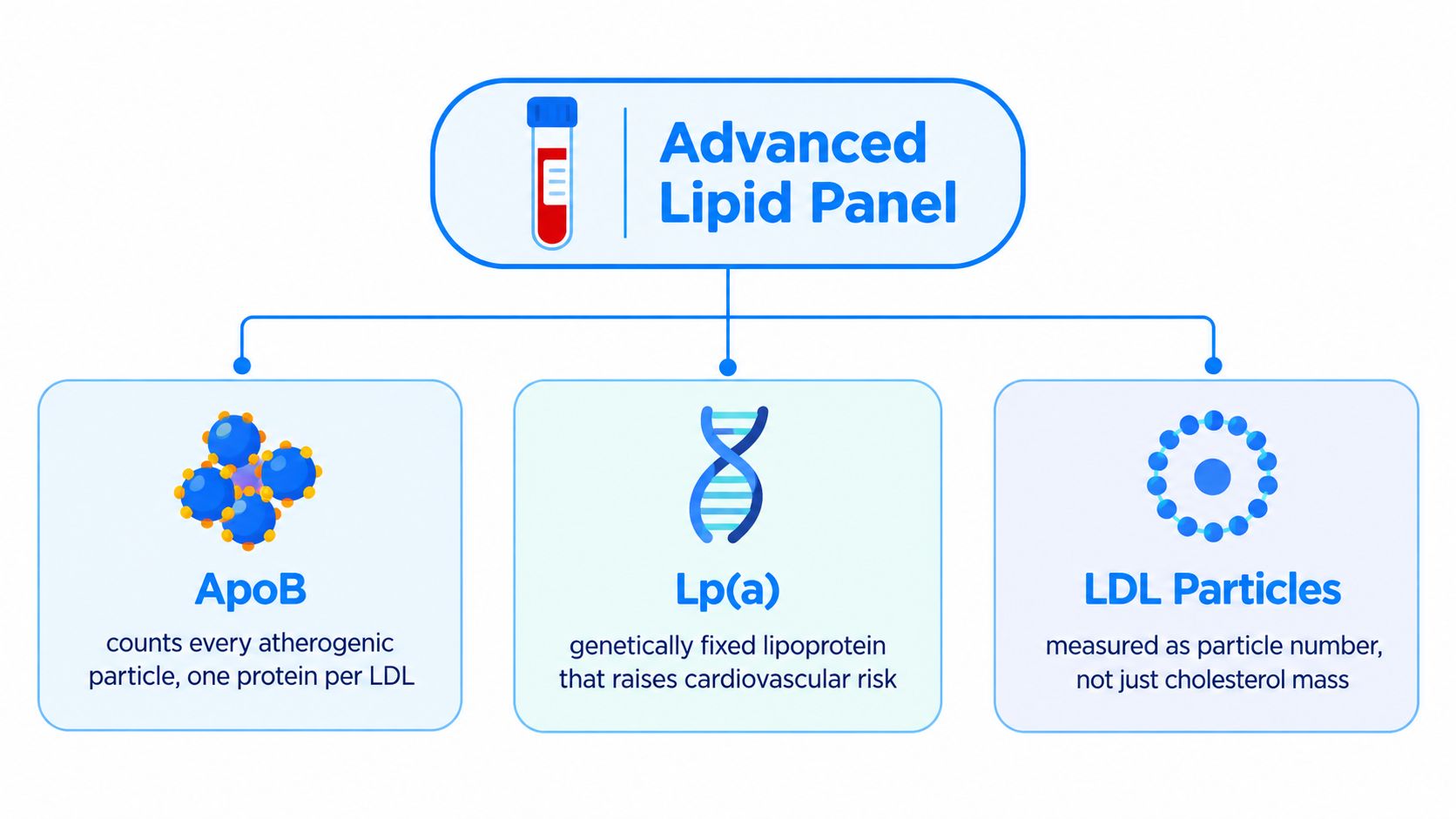
An advanced lipid panel is only useful if each marker has a defined role. The three most important are apoB, Lp(a), and LDL particle number. They overlap, but they aren't interchangeable.
ApoB as a particle count
Each LDL, VLDL, IDL, and Lp(a) particle carries one apoB molecule. Measuring apoB therefore provides a direct estimate of the total number of atherogenic particles in circulation, rather than measuring only the cholesterol mass inside them. When cholesterol content varies from particle to particle, apoB can represent particle burden more faithfully than LDL-C.
This is why apoB can be useful when triglycerides are high, diabetes is present, or LDL-C and non-HDL-C targets have already been reached but residual risk remains. Guidance summarized in the clinical literature on apoB and lipoprotein testing supports its use for refining risk and treatment decisions in selected high-risk cardiometabolic patients.
Lp(a) and inherited risk
Lp(a) is an atherogenic lipoprotein with a strong genetic component. Lifestyle changes remain important for overall risk, but they don't reliably normalize a genetically determined Lp(a) concentration. That makes the result useful for risk classification even when the standard lipid profile looks unremarkable.
The 2026 ACC/AHA guidance recommends that all adults have Lp(a) measured at least once in a lifetime. A single measurement can identify inherited risk that may influence how aggressively a clinician manages other modifiable factors, especially when there is a family history of premature cardiovascular disease.
LDL-P and particle characteristics
LDL-P measures the concentration of LDL particles, commonly expressed in nanomoles per liter. Unlike LDL-C, it doesn't describe the amount of cholesterol carried inside those particles. LDL particle size may also be reported, although particle number generally has greater practical relevance than treating size as an isolated target.
Small, dense LDL can accompany high triglycerides and metabolic dysfunction, but the useful clinical question isn't whether small particles exist. It is whether the overall particle burden, metabolic context, and global cardiovascular risk justify a change in care. For a broader explanation of testing beyond standard cholesterol testing, the emphasis should remain on interpretation rather than collecting every available subfraction.
The most useful advanced panel is therefore not necessarily the one with the most markers. It is the one that clarifies whether particle burden or inherited risk changes the prevention strategy.
When to Order and How to Prepare
An advanced lipid panel is most defensible when the result could change a clinical decision. Useful situations include:
- Discordant results: LDL-C appears acceptable, but triglycerides, diabetes, obesity, or other metabolic features suggest that particle burden may be higher.
- Existing atherosclerotic cardiovascular disease: ApoB can help monitor atherogenic particle reduction alongside standard treatment targets.
- Diabetes or significant metabolic risk: The standard fractions may not fully capture the pattern of atherogenic lipoproteins.
- Family history: Lp(a) can reveal inherited risk that isn't visible on a standard lipid report.
- Treatment uncertainty: ApoB may help determine whether the biological response to lipid-lowering therapy matches the intended reduction in atherogenic particles.
The historical hesitation around routine advanced testing still matters. Ordering a test without a plan for interpretation can create anxiety, contradictory targets, or unnecessary treatment changes. A clinician should state in advance what result would alter medication, lifestyle priorities, or monitoring.
Preparation depends on the laboratory and the exact panel. Many lipid assessments can be performed without fasting, but triglycerides may be more difficult to interpret after a recent meal. Follow the ordering clinician's instructions rather than assuming that fasting or non-fasting is universally correct.
Keep medication timing consistent unless your clinician tells you otherwise. Don't stop a statin, supplement, or other prescribed treatment to produce a “cleaner” result. The objective is to measure your real-world profile, not an artificial state.
After starting or changing lipid-lowering treatment, the 2026 ACC/AHA guideline recommends repeating lipid profiles after 4–12 weeks, then every 6–12 months for ongoing monitoring. Practical high cholesterol management tips can help with the broader treatment conversation, but advanced markers should be interpreted by a qualified healthcare professional.
Interpreting Results and Cardiovascular Risk
The report doesn't make the decision. The pattern does.
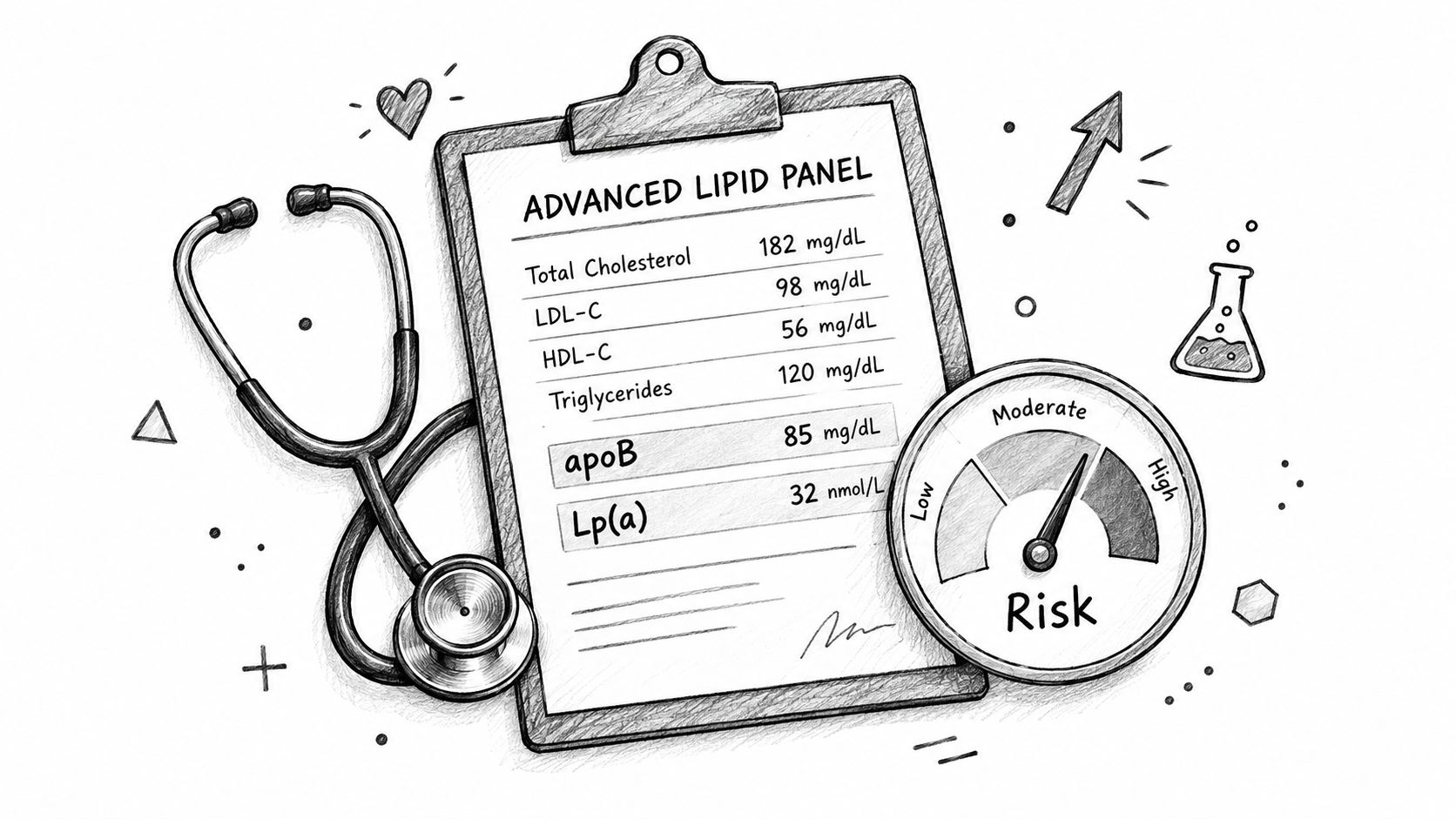
ApoB is most informative when interpreted beside LDL-C, non-HDL-C, triglycerides, blood pressure, glucose regulation, family history, age, and any established cardiovascular disease. A high apoB with a relatively modest LDL-C suggests discordance and may justify a more focused conversation about diet, weight management, medication, or treatment intensity.
Lp(a) works differently. Because it is largely genetically determined, the result is less about changing the number through lifestyle and more about recognizing inherited risk. If Lp(a) is high, the practical response is usually to take modifiable risks seriously, including LDL-related particle exposure, blood pressure, smoking, glucose regulation, and physical activity.
What should change treatment
A result should change treatment when it changes the estimated risk or resolves uncertainty. Examples include:
- High apoB with acceptable LDL-C: Discuss whether particle burden remains above the intended level and whether the current strategy is sufficient.
- High Lp(a): Intensify attention to modifiable risk factors and consider whether the overall prevention plan needs to be more proactive.
- Improved LDL-C but persistent apoB elevation: Evaluate whether the treatment is reducing cholesterol mass without adequately lowering the number of atherogenic particles.
- Low-risk profile with concordant markers: Avoid adding tests or interventions that won't alter management.
The distinction between medical intervention and structure/function support matters. Nutrition, exercise, sleep, and ketone products may support energy metabolism or training consistency, but they aren't substitutes for prescribed lipid-lowering therapy when a clinician believes medication is indicated.
A useful discussion of blood test nutrition should lead to specific questions, not a search for one “perfect” food. Ask what the result means for your risk category, what target is being used, and when the panel should be repeated.
Metabolic Health and Ketone-Based Interventions
Atherogenic particle burden and metabolic flexibility describe different aspects of metabolic health. An advanced lipid panel measures lipoprotein transport and particle-related cardiovascular risk. Metabolic flexibility describes how effectively the body shifts between glucose and fat-derived fuels as energy availability and demand change. These measures can be considered together, but one cannot substitute for the other. Metabolic flexibility and insulin sensitivity are closely linked, as covered in our guide to insulin sensitivity.
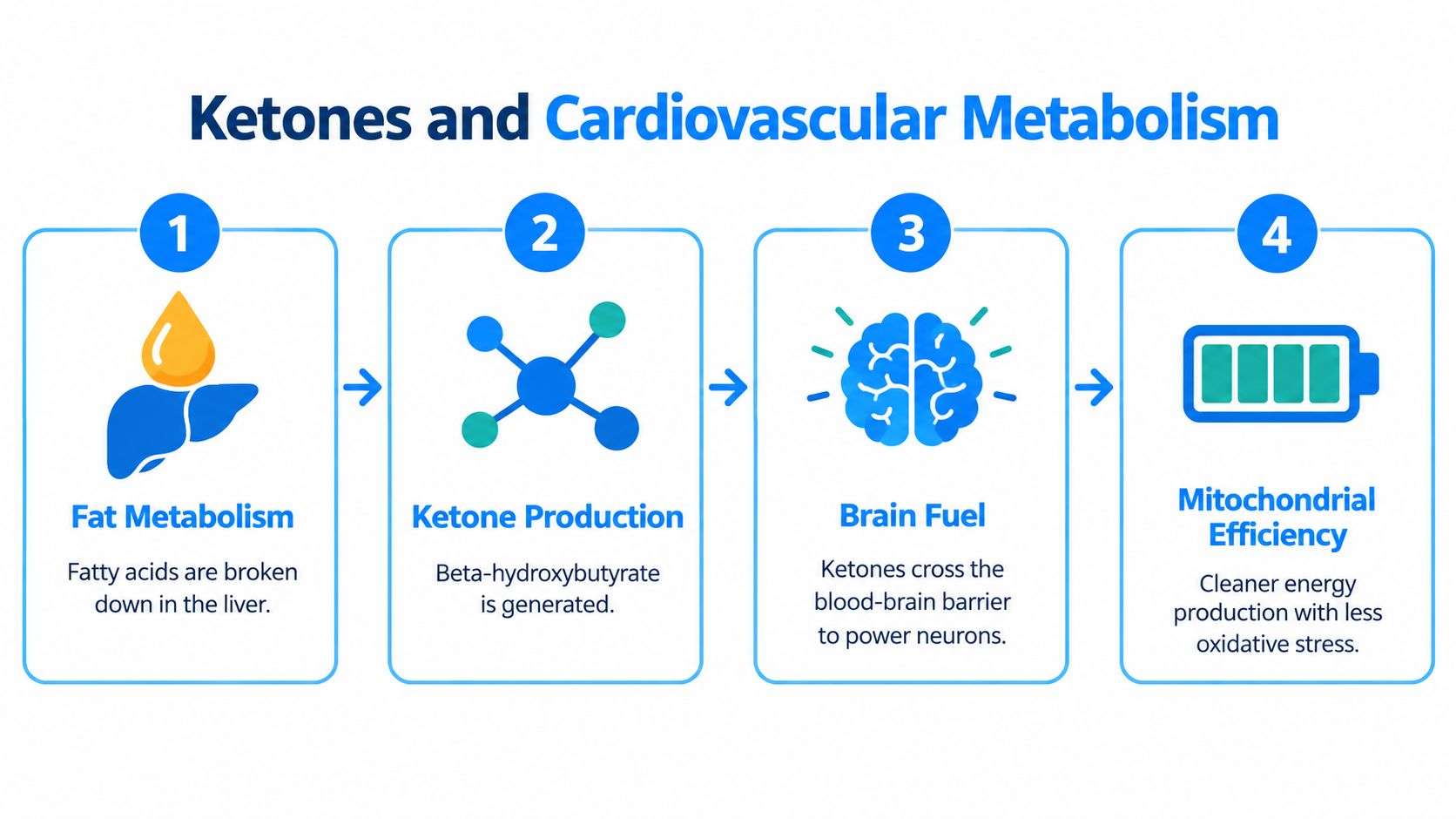
During nutritional ketosis, carbohydrate restriction or fasting increases ketone production in the liver. Fatty acids are converted into ketone bodies, including beta-hydroxybutyrate, or BHB. BHB travels through the blood to tissues such as skeletal muscle and the brain, where it can become acetyl-CoA and enter the mitochondrial tricarboxylic acid cycle for ATP production.
Three routes to ketones
- Nutritional ketosis: Restricting dietary carbohydrate encourages endogenous ketone production. The response depends on diet, energy balance, liver metabolism, and individual physiology.
- Endogenous ketone production: Fasting, prolonged exercise, and carbohydrate restriction can increase hepatic ketogenesis without supplementation.
- Exogenous ketone supplementation: Ketone esters, salts, and other formulations supply ketones from outside the body, raising circulating BHB without requiring the same dietary conditions.
Formulation affects both the size and tolerability of the BHB response. A peer-reviewed review comparing products reported a peak blood BHB concentration of 2.8 mM after a ketone monoester, compared with 1.0 mM after an equivalent ketone salt dose, with fewer gastrointestinal or systemic side effects. The formulation review supports evaluating esters and salts as distinct technologies rather than interchangeable products.
A randomized human brain-imaging study found that one oral ketone ester dose increased blood BHB, lowered blood glucose, and reduced brain glucose metabolism by 17% in regions including the frontal, occipital, and cingulate cortices, hippocampus, amygdala, and insula. This indicates a rapid shift in brain energy use toward ketones. It does not establish that ketones treat disease. The human imaging study provides the relevant evidence.
A separate double-blind randomized trial enrolled adults aged 55+ with metabolic syndrome and administered 25 g of oral ketone ester three times daily for four weeks. Brain BHB measured by magnetic resonance spectroscopy increased with p<0.001, while brain glutamate levels also declined. These findings show central nervous system target engagement rather than only a change in blood ketones. The clinical trial supports the physiological plausibility of brain ketone delivery, but does not establish a cardiovascular treatment effect.
Why This Matters
For performance, the likely benefits are practical rather than dramatic:
- Steadier energy: Ketones provide an alternative oxidative fuel while glucose availability or use changes.
- Cognitive endurance: Greater brain BHB availability during exogenous ketone use may support sustained mental work in some settings.
- Workout performance: Athletes may use exogenous ketones during endurance training or demanding sessions, although individual responses vary.
- Metabolic efficiency: Exposure to different fuels can complement exercise, adequate nutrition, and glucose regulation. It does not replace those foundations.
Liposomal delivery systems are intended to affect ingredient dispersion and absorption. Bioidentical structures aim to provide the D-BHB form used by human metabolism. Assess these features through measured BHB response, tolerability, formulation transparency, and appropriate labeling rather than branding alone.
As noted earlier, the 2026 ACC/AHA guideline sets the repeat-testing interval after therapy changes. The metabolic question here is different: how fuel use, insulin sensitivity, and ketone delivery fit the person's goals and clinical context.
For mentally demanding work, Locked Cognition™ Shot combines liposomal R3HBG™, Alpha GPC, and Lion's Mane in a format designed for workdays and sustained focus without relying on coffee or stimulants. Treat it as a performance nutrition option, not therapy for cognitive or cardiovascular disease.
Practical Application Framework
Start with the cardiovascular question, not the product or the test.
Ask your clinician:
- Does my LDL-C agree with my overall risk profile? If triglycerides, diabetes, obesity, or family history complicate the picture, ask whether apoB would clarify particle burden.
- Should I measure Lp(a)? Current ACC/AHA guidance supports at least one lifetime measurement for all adults.
- What result would change my treatment? Establish whether a high apoB, high Lp(a), or persistent discordance would alter medication or monitoring.
- Which targets are we using? Clarify whether the plan follows LDL-C, non-HDL-C, apoB, or a combination of markers.
- When should I repeat testing? After a treatment change, use the clinician's recommended interval rather than testing repeatedly without a decision point.
Then build the metabolic side of the plan around fundamentals:
- Train consistently. Exercise improves the body's ability to use both carbohydrate and fat-derived fuels.
- Prioritize dietary quality. Replace vague restriction with a sustainable pattern that supports glucose regulation, triglyceride control, fiber intake, and adequate protein.
- Protect sleep and recovery. Poor recovery can make appetite, training quality, and metabolic regulation harder to manage.
- Use exogenous ketones selectively. They may fit before or during endurance work, a demanding work block, or a period when steady energy is useful without caffeine. They don't erase excess energy intake or correct an adverse apoB or Lp(a) result.
- Track response. Notice energy, gastrointestinal tolerance, training output, and concentration, while allowing laboratory decisions to remain under clinical supervision.
The most useful framework is therefore layered. Use standard lipids for the foundation, apoB and Lp(a) to resolve important blind spots, and metabolic strategies to support daily function. Don't treat a ketone reading as a cardiovascular risk score, and don't treat a normal LDL-C result as proof that particle burden is low.
Tecton Ketones™ offers bioidentical exogenous ketone nutrition designed to provide direct BHB fuel for training, cognitive endurance, and metabolic flexibility without requiring a strict ketogenic diet. Visit Tecton Ketones™ to explore a clinically informed approach to ketone supplementation that can complement, but never replace, evidence-based cardiovascular care.


