


You're standing in the kitchen with a full bottle, shaker, or tumbler and wondering whether 24 oz of water is enough for the day, a fasting window, or the workout ahead. The answer starts with measurement, but it doesn't end there. Twenty-four U.S. fluid ounces is a precise serving size, yet its value depends on your body, environment, sweat losses, food intake, and whether you're using water alongside a performance strategy such as exogenous ketones.
Why 24 Ounces Is the Serving People Keep Measuring
A 24-ounce bottle feels substantial. It's large enough to carry through a commute or training session, but small enough to finish without treating hydration like a separate task. That practicality explains why people keep asking whether one bottle covers their needs.
It doesn't, by itself, define an appropriate daily target. Twenty-four U.S. fluid ounces is a working unit, not a universal prescription. It gives you a reliable amount to measure, compare, and time around activity.
The useful questions are more specific:
- Is the bottle marked in U.S. fluid ounces or Imperial ounces?
- How much does the serving contribute to daily fluid intake?
- Are you drinking it during ordinary activity, heat exposure, or prolonged exercise?
- Are you pairing it with food, electrolytes, caffeine, or an exogenous ketone product?
- Are you replacing sweat losses, or just drinking because the bottle is available?
This guide turns the measurement into a practical decision. You'll see exactly how 24 ounces converts into cups, milliliters, liters, and weight; how it compares with U.S. and international hydration references; and why timing matters more than treating the serving as a fixed rule.
The same distinction applies to energy. Water supports fluid balance, but it doesn't supply a metabolic fuel. Exogenous ketones provide a separate source of beta-hydroxybutyrate, or BHB, that the body can use when circulating ketones rise. Hydration and ketone use can fit together, but neither should be confused with a guarantee of improved performance.
How Much 24 oz of Water Actually Is in Every Unit
Start with the U.S. measurement. Twenty-four U.S. fluid ounces equals 3 U.S. cups, 1.5 U.S. pints, 0.75 U.S. quart, and approximately 709.76 milliliters, according to the standardized relationships summarized by U.S. customary measurement references.
| Unit | Equivalent |
|---|---|
| U.S. fluid ounces | 24 fl oz |
| U.S. cups | 3 cups |
| U.S. pints | 1.5 pints |
| U.S. quart | 0.75 quart |
| Milliliters | 709.76 mL |
| Liters | Approximately 0.71 L |
| U.S. gallon | 18.75% of a gallon |
The gallon comparison is straightforward. A U.S. liquid gallon contains 128 fluid ounces, so 24 ounces is 24 divided by 128, or 18.75% of a gallon.
This is fluid volume, not weight. Water's density is close to 1 gram per milliliter under ordinary conditions, so 24 fluid ounces has a mass of approximately 710 grams, or 1.56 pounds, although temperature changes the exact mass. A beverage label showing “24 oz” normally describes how much liquid the container holds, not how heavy the water is.
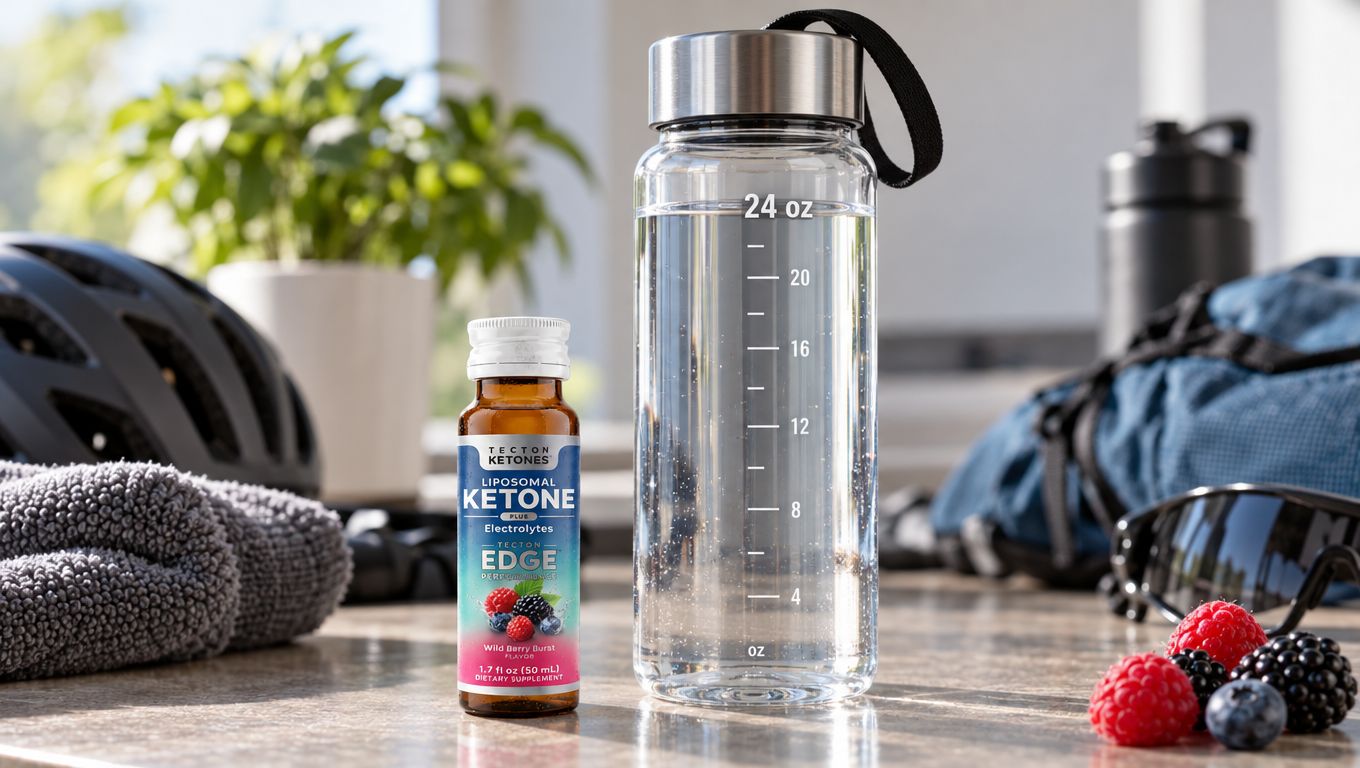
Imported packaging can create another problem. One U.S. fluid ounce is approximately 1.041 British Imperial fluid ounces, so a U.S. 24-fluid-ounce container is about 23.05 Imperial fluid ounces. For international products, milliliters provide the clearest common reference.
For a performance routine, Tecton EDGE™ Performance Shot + Electrolytes is a ketone shot designed for active individuals, with liposomal R3HBG ketone and sodium, potassium, and magnesium. Its role is distinct from the water serving, which remains a measurable hydration volume.
24 Ounces Compared to Daily Hydration References
A 24-ounce bottle is easy to count, but counting bottles alone can misrepresent daily hydration. The FDA uses 8 fluid ounces, or 240 milliliters, as a beverage reference amount customarily consumed. For labeling purposes, 24 ounces equals three FDA reference servings, according to the FDA beverage serving-size guidance.
The serving comparison helps explain a label. It does not set a personal hydration prescription. Public-health references usually count water from beverages and food, so “daily water” includes more than the liquid poured into a bottle.
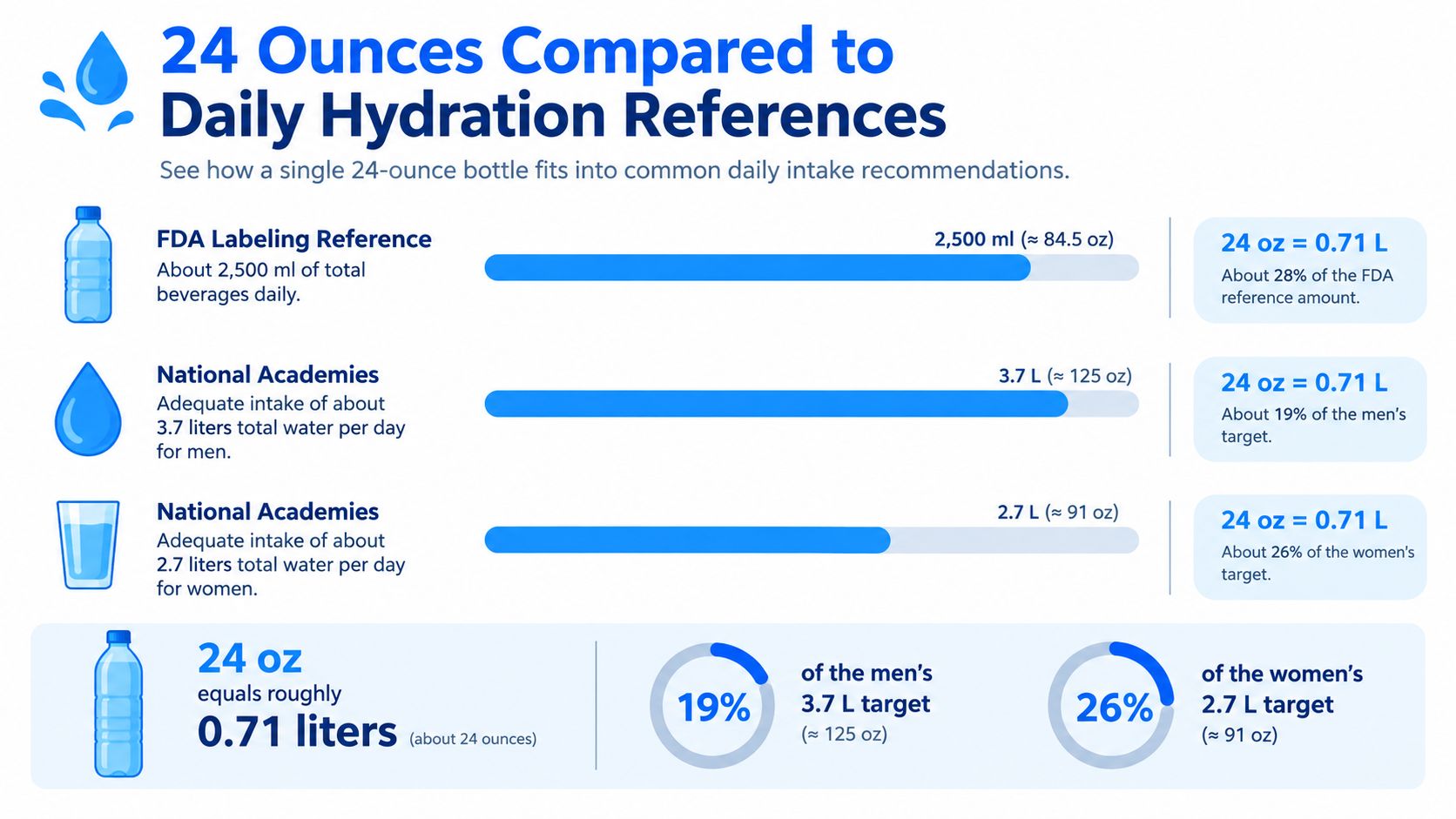
The National Academies' cited average total-water intakes are 2.7 liters, or 91 ounces, for women, and 3.7 liters, or 125 ounces, for men. Because 24 ounces is approximately 0.71 liters, one serving represents about 19% of the women's reference and 14% of the men's reference, based on the National Academies' water intake discussion.
Those figures include moisture in soups, fruits, vegetables, yogurt, and other water-rich foods. A bottle count therefore gives only part of the picture. A person drinking 24 ounces with a meal is adding to total water intake, while the meal itself may also provide fluid.
Different countries use different reference points
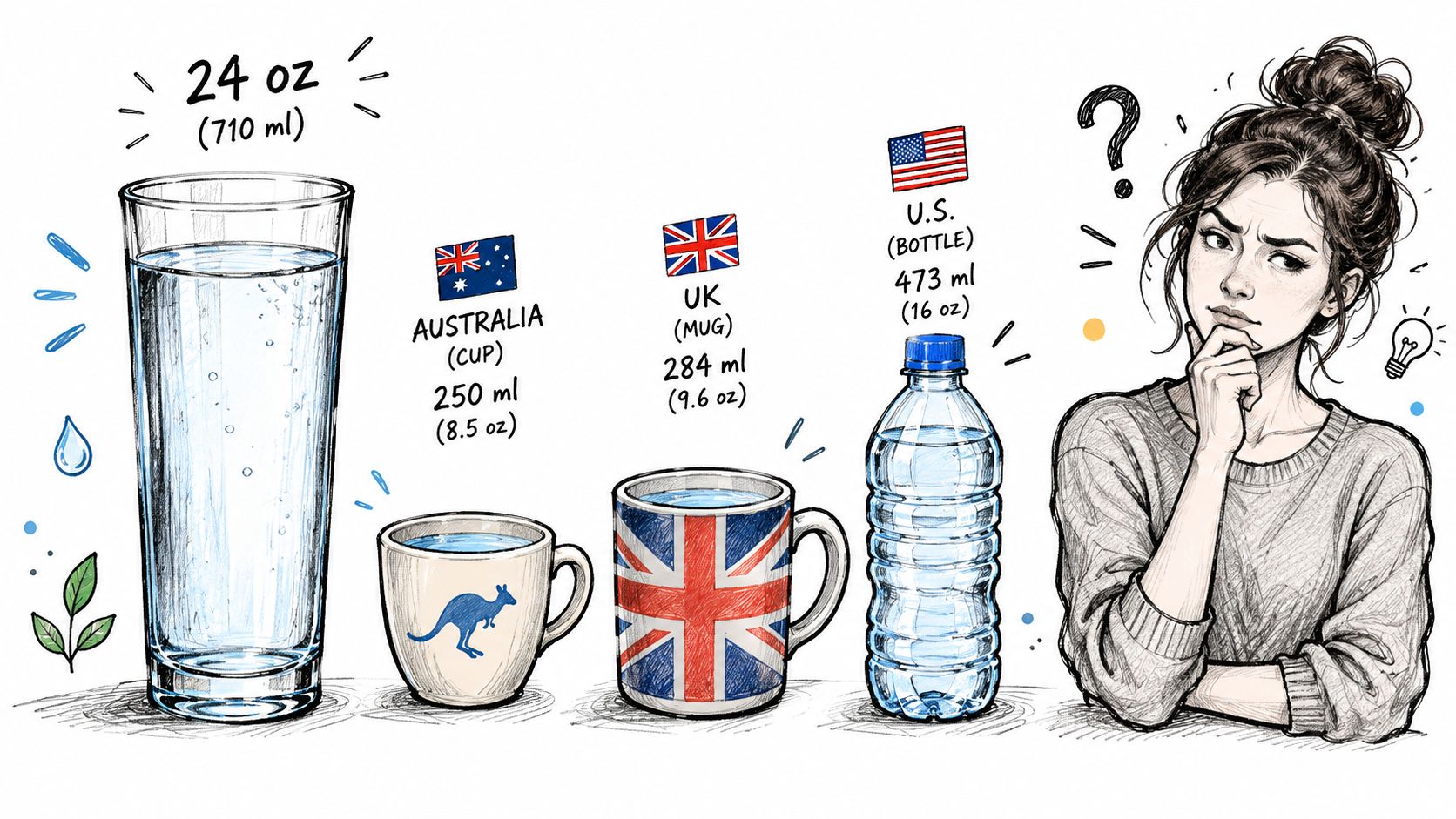
Australian guidance lists approximately 2.1 liters of fluids daily for adult women and 2.6 liters for adult men. UK guidance emphasizes individual variation and suggests drinking enough to maintain pale-yellow urine. These references describe different measurement methods, so they should not be converted into one universal bottle target.
The FDA has also historically used 1.2 liters as an estimate of average daily drinking-fluid intake per U.S. person, based on 2005–2006 NHANES data. Against that older comparison, 24 ounces contributes approximately 59%, but the figure is not a general hydration recommendation.
Practical rule: Treat 24 ounces as one measurable portion of a larger daily pattern, not the entire plan.
When 24 oz of Water Fits a Workout and When It Does Not
A bottle size can't estimate sweat loss. Two people can complete the same session in the same environment and lose different amounts of fluid because sweat rate, body size, clothing, pace, and acclimatization differ.
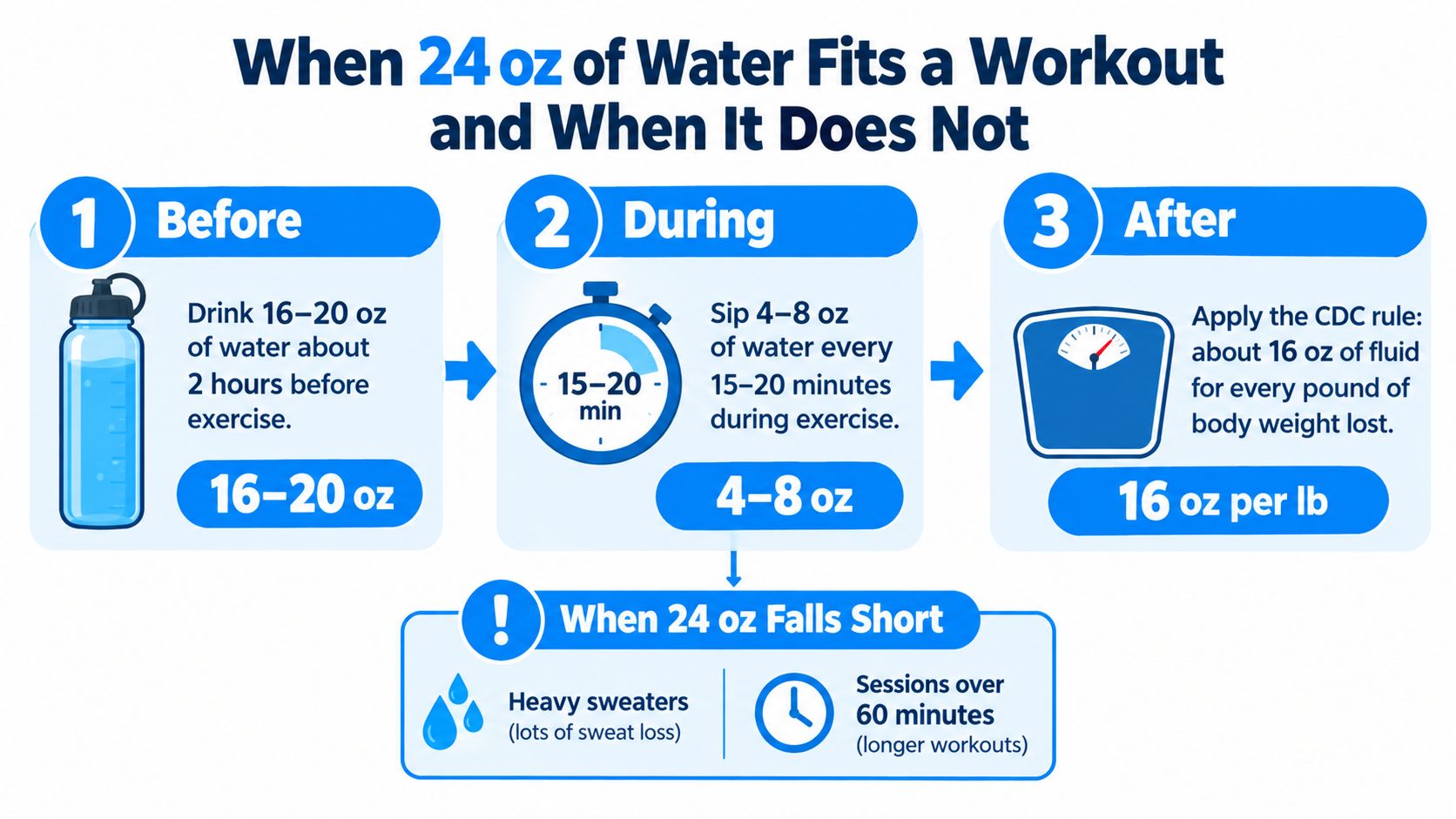
The CDC provides a more useful post-exercise relationship: approximately 16 ounces of fluid for every pound of body weight lost through sweating, as outlined in its exercise and heat guidance. By that calculation, 24 ounces corresponds to the fluid associated with approximately 1.5 pounds of body-weight loss, assuming the change is primarily water.
Use the session, not the bottle, as the starting point
Before training, drink according to thirst and your usual routine rather than forcing a full container. During a short, cool session, 24 ounces may be more than you need. During prolonged exercise, heat exposure, or heavy sweating, the same amount may not replace what you lose.
A simple field method is to weigh before and after training under similar conditions. Record fluid consumed and account for urine produced, then compare the body-weight change across similar sessions. Over time, this gives you a personal estimate instead of relying on a generic bottle size.
Know when water alone may be insufficient
For prolonged exercise or heavy sweating, sodium-containing fluids and food may be more appropriate than water alone. Excessive drinking can dilute blood sodium and contribute to exercise-associated hyponatremia, so drinking to thirst is safer than forcing a fixed volume.
The goal during exercise is to limit excessive dehydration without replacing every ounce mechanically. Guidance commonly targets preventing body-weight losses greater than 2%, but the correct strategy still depends on the session and your sweat pattern.
For readers interested in the broader relationship between fluid balance, endurance, and amino-acid support, browse taurine endurance benefits for additional context. Taurine is not a substitute for a sweat-rate assessment, but it belongs in the wider discussion of performance nutrition.
Pairing a Ketone Shot With About 24 oz of Water
Water and ketones solve different physiological problems. Water contributes to fluid balance, while an exogenous ketone delivers a circulating fuel that can be used without waiting for fasting or carbohydrate restriction to produce nutritional ketosis.
The key molecule is beta-hydroxybutyrate, or BHB. After BHB crosses the blood–brain barrier, it is converted to acetoacetate and then to acetyl-CoA. Acetyl-CoA enters the mitochondrial tricarboxylic-acid cycle, supporting ATP production through oxidative phosphorylation. Unlike glucose metabolism, ketone conversion to acetyl-CoA doesn't require an initial ATP investment, and ketones aren't converted to lactate before energy production, as described in this peer-reviewed review of ketone metabolism.
What changes in the brain
Under ordinary dietary conditions, glucose remains the brain's primary fuel. When circulating ketones rise through fasting, carbohydrate restriction, or supplementation, BHB and acetoacetate can partially substitute for glucose.
In a controlled human study summarized in the peer-reviewed literature, intravenous BHB infusion reduced cerebral glucose consumption by approximately 14% while oxygen consumption remained unchanged. That pattern indicates substrate switching, not merely lower overall brain energy use. Human PET studies also found that cerebral ketone uptake increases in proportion to blood ketone concentration, as summarized in this human ketone metabolism review.
Nutritional ketosis and exogenous ketone use are therefore different:
- Endogenous ketone production occurs when the liver generates ketones from fatty acids during fasting or carbohydrate restriction.
- Nutritional ketosis usually describes the metabolic state produced by diet-induced carbohydrate restriction.
- Exogenous ketone supplementation raises circulating BHB directly through an ingested ketone source, without requiring diet-induced ketosis.
A human study also found that nutritional ketosis increased the NAD+/NADH ratio in the resting brain. This reflects a more oxidized cellular redox state and supports a narrower conclusion: human brain tissue can use ketones, alter substrate selection, and modify redox balance. It doesn't prove that every person experiences better cognition or performance, as discussed in this human study on ketones and brain redox balance.
A practical pairing approach
If you tolerate a ketone shot well, pair it with roughly 24 ounces of water spread across the surrounding activity rather than swallowing the entire volume rapidly. The water supports ordinary hydration and may make the routine easier on the gastrointestinal system, but it doesn't force ketones into the brain or guarantee a particular blood BHB response.
Consider the following sequence:
- Drink part of the water before or near the start of activity.
- Take the ketone shot according to its label and your established tolerance.
- Sip the remainder during the session or fasting window.
- Adjust the total volume based on thirst, heat, sweat loss, and urine color.
For a deeper explanation of how ketone products fit into performance routines, explore this ketone energy shot guide. Tecton's R3HBG positioning centers on bioidentical D-BHB, while its liposomal delivery system is intended to support absorption and consistency. Ketone salts, ketone esters, and precursors differ in chemistry and tolerability, so the product format matters when you evaluate a routine.
The useful goal is not to drink a bottle because a ketone shot requires it. The goal is to coordinate a measured fluid serving with a fuel strategy that matches the session.
Why 24 Ounces Is Not a Universal Hydration Target
A fixed bottle target ignores the variables that control fluid needs. Body size, climate, activity, illness, pregnancy, breastfeeding, diet, and sweat rate can all change how much fluid a person needs.
Food moisture also matters. Harvard's Nutrition Source notes that food can provide 20–30% of water intake, so a person eating water-rich meals may need a different beverage pattern from someone eating mostly dry foods. The Harvard water guidance is useful precisely because it treats hydration as an individual pattern rather than a single mandatory number.
Australian guidance, UK guidance, and U.S. references also differ in how they define daily needs. Some emphasize total water, some drinking fluids, and some practical signals such as pale-yellow urine. Comparing those references without checking what they include can make one bottle appear either too large or too small.
Endurance athletes also need to avoid turning hydration into a forced task. A 2025 cross-sectional study of Chinese recreational marathon runners reported that 72.5% failed to meet recommended daily fluid-intake standards, while 47.9% reported drinking habitually regardless of thirst, according to the Frontiers in Nutrition study. Those findings don't establish a universal rule for every runner, but they show why thirst, sweat loss, and timing deserve attention.
A better question is not, “Is 24 ounces enough?” It's “Is 24 ounces appropriate for me today?” On a sedentary day, it may be one convenient serving. In heat or prolonged exercise, it may be only part of replacement needs. During fasting, it may support fluid intake, but it doesn't replace electrolytes when substantial sweat losses occur. For a separate discussion of water quality and performance claims, see what alkaline water pH means.
Tracking Intake, Electrolytes, and Safety Limits
Use several signals rather than treating a bottle count as a health target. Pale-yellow urine offers a rough daily cue. Comparing body weight before and after training gives a more specific view of fluid lost during that session.
A 24-ounce container is a practical serving unit, not a safety limit. Its value depends on what the fluid replaces, how long you exercise, and how much you sweat. On a quiet day, it may merely organize intake. During prolonged activity, the same serving may need a different electrolyte composition.
Sodium matters more during long, hot, or high-sweat sessions. Potassium and magnesium may also appear in performance formulas, but every 24-ounce serving does not require added electrolytes. Match the drink to sweat losses and session duration. This guide to drinking with electrolytes explains the distinction.
Avoid forcing large amounts of plain water during prolonged exercise. Excess intake can dilute blood sodium and contribute to exercise-associated hyponatremia. Medical conditions that affect fluid or electrolyte balance call for individualized clinical guidance, not a generic bottle calculator.
A Practical Hydration Framework You Can Use Today
Use three decisions:
- Daily base: Drink according to thirst, meals, and urine color. Treat 24 ounces as one convenient serving.
- Training adjustment: Compare pre- and post-session body weight, account for fluids consumed, and adjust for heat and sweat.
- Ketone timing: If you use an exogenous ketone shot, sip roughly 24 ounces around the routine instead of treating the bottle as a required dose.
Why This Matters
- Steadier energy: BHB gives cells an alternative oxidative fuel when circulating ketones rise.
- Cognitive endurance: The brain can partially switch from glucose toward BHB and acetoacetate.
- Workout performance: Matching fluid and electrolyte intake to sweat loss supports the conditions needed for sustained effort.
- Metabolic efficiency: Using glucose and ketones according to availability reflects metabolic flexibility, not dependence on one fuel.
Water is the measured foundation. Ketones are a separate fuel option. The most useful routine respects both.
Tecton Ketones™ offers bioidentical exogenous BHB through liposomal R3HBG formulations, including performance options designed to pair with hydration and demanding activity. Visit Tecton Ketones™ to explore how a measured 24-ounce water serving can fit into a more deliberate energy and performance routine.


