


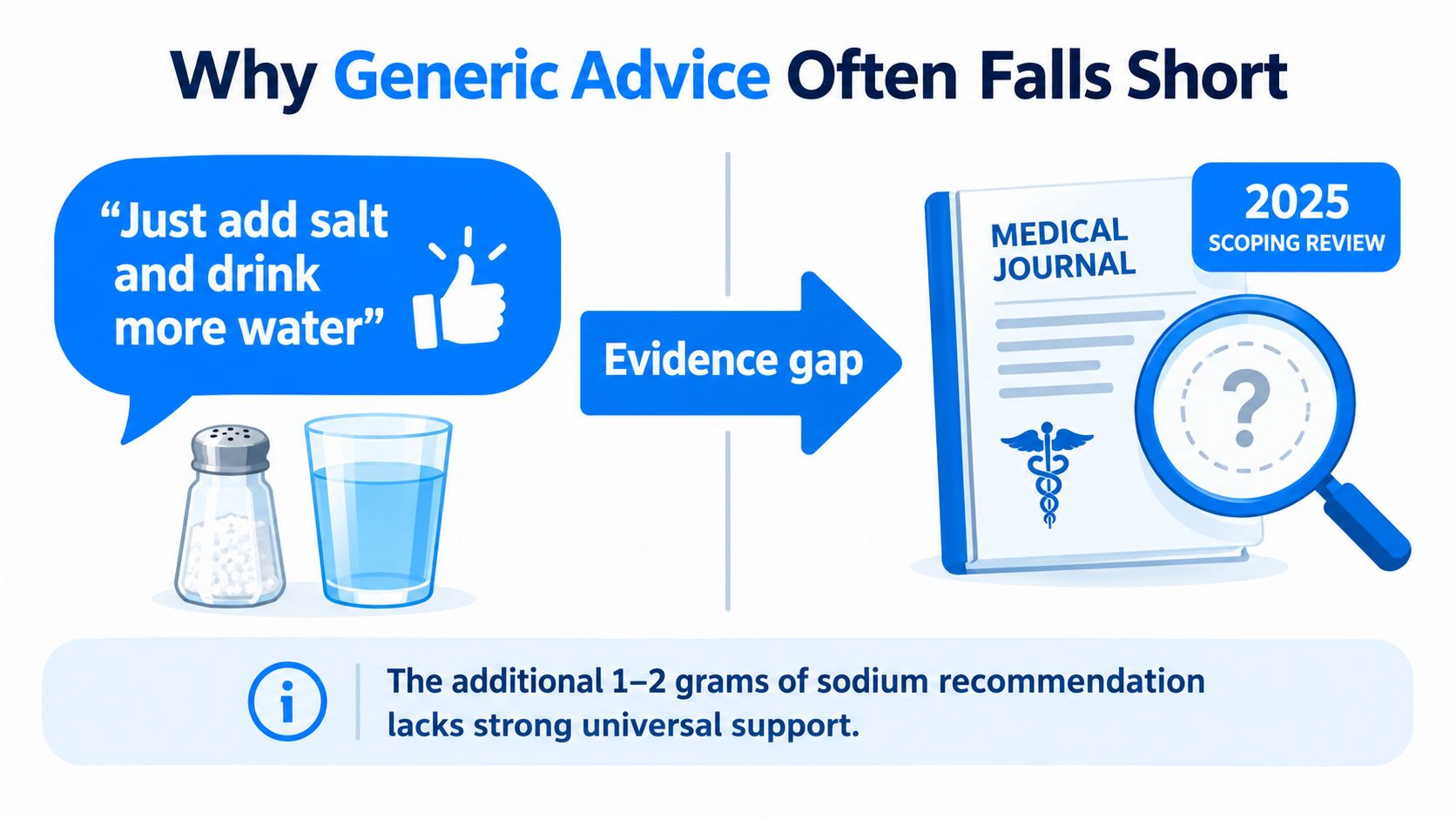
“Just add salt and drink more water” isn't a complete answer to keto and electrolyte imbalance. It assumes that everyone loses the same minerals, that every headache signals a deficiency, and that everyone can safely increase sodium or potassium. None of those assumptions is a sound starting point for individualized care.
A more useful approach separates the physiology of carbohydrate restriction from the diagnosis of an electrolyte problem. You can understand why symptoms develop without assuming they're harmless, and you can plan hydration without treating a supplement as a substitute for medical assessment.
Why Electrolyte Shifts Happen on Keto
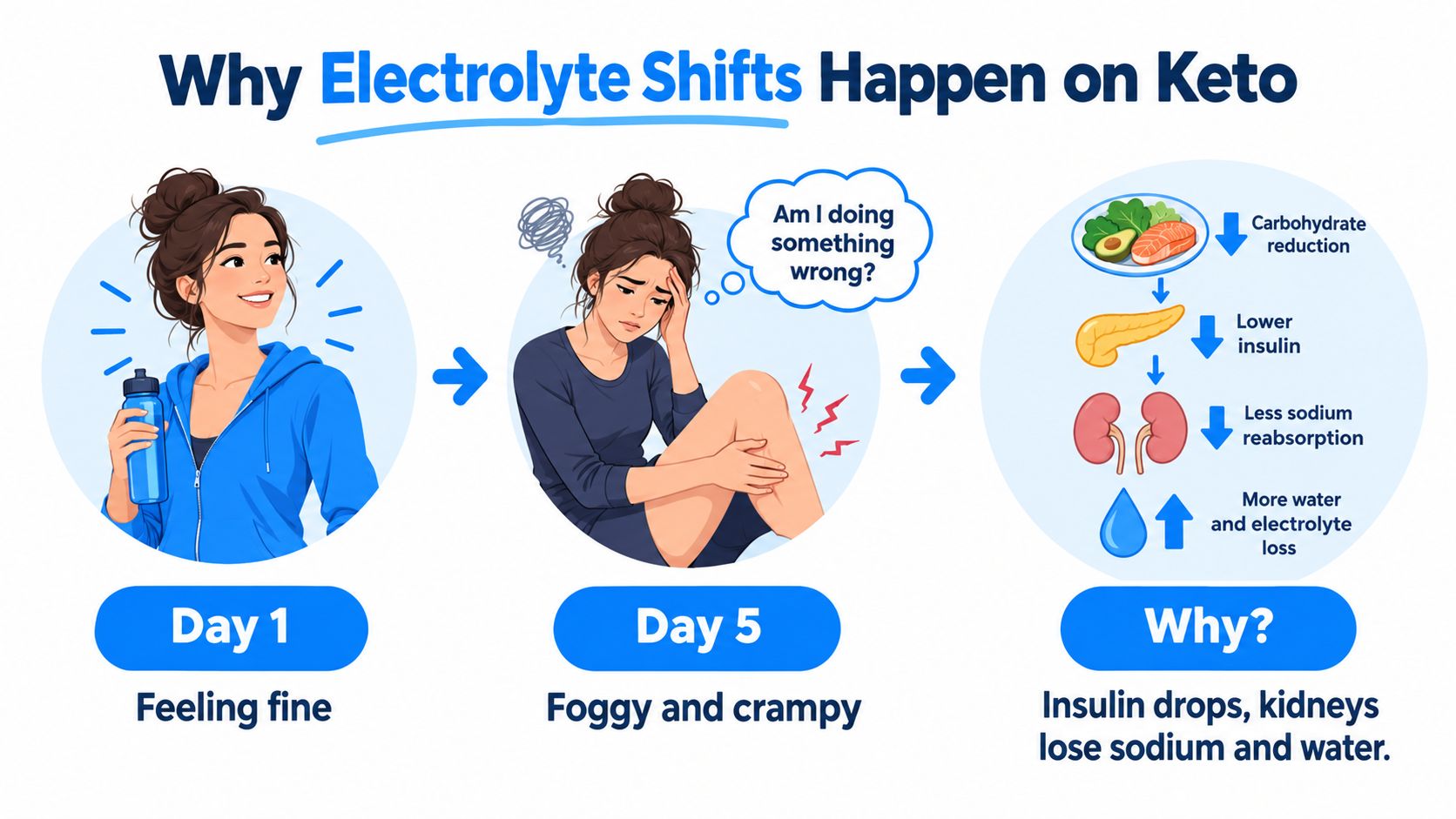
Consider an illustrative early-keto experience: you begin changing your meals and initially feel comfortable, then notice fogginess, a headache, or a cramping calf. You wonder whether you've eaten the wrong foods or whether your body can't tolerate carbohydrate restriction.
That experience doesn't establish a diagnosis. However, headache, fatigue, dizziness when standing, cramps, and lethargy are recognized complaints during keto initiation, when changes in insulin signaling and kidney handling can increase fluid and mineral losses, as described in the clinical overview of ketogenic diets.
The following illustration shows a possible sequence, not a timetable everyone should expect.
A symptom label isn't a diagnosis
Keto flu is a convenient description of symptoms, not a single, uniform condition. It doesn't tell you which electrolyte is low, whether circulating fluid volume has fallen, or whether something unrelated to the diet is happening.
Think of a headache as a warning light rather than a laboratory result. The light deserves attention, but it doesn't identify the underlying problem on its own.
- Timing matters: Symptoms that begin after a dietary change provide useful context, but timing alone doesn't prove causation.
- Severity matters: Mild discomfort and difficulty remaining upright shouldn't be treated as equivalent experiences.
- Baseline health matters: The same dietary change can require different decisions in someone with normal kidney function and someone whose clinician already manages fluid or mineral intake.
Adaptation doesn't mean “push through”
There's an important difference between recognizing a plausible adjustment and declaring every symptom normal. A diet can cause predictable physiological changes without making all consequences safe to manage at home.
Practical rule: Treat “keto flu” as a reason to assess your situation, not as permission to ignore worsening symptoms.
The useful questions are whether your symptoms fit a manageable dietary transition and whether they suggest a clinically meaningful imbalance requiring a different response. Answering those questions starts with understanding what the kidneys are doing.
The Physiology Behind Sodium and Water Loss
Your kidneys continually filter fluid and return needed substances to circulation. Reabsorption means reclaiming something from the filtered fluid rather than allowing it to leave in urine.
A faucet-and-drain analogy makes this easier to visualize. Fluid enters the system, while the kidneys regulate what escapes through the drain. Drinking changes the incoming supply, but kidney handling determines how much sodium and water the body retains.
How carbohydrate restriction changes the drain
When carbohydrate intake falls, insulin signaling decreases. The kidneys then reclaim less sodium, increasing urinary sodium loss, a process called natriuresis. Water loss accompanies this shift.
A review of ketogenic diets and kidney physiology describes this sequence and the compensatory rise in sympathetic activity and aldosterone that helps preserve plasma volume while increasing potassium and magnesium excretion.
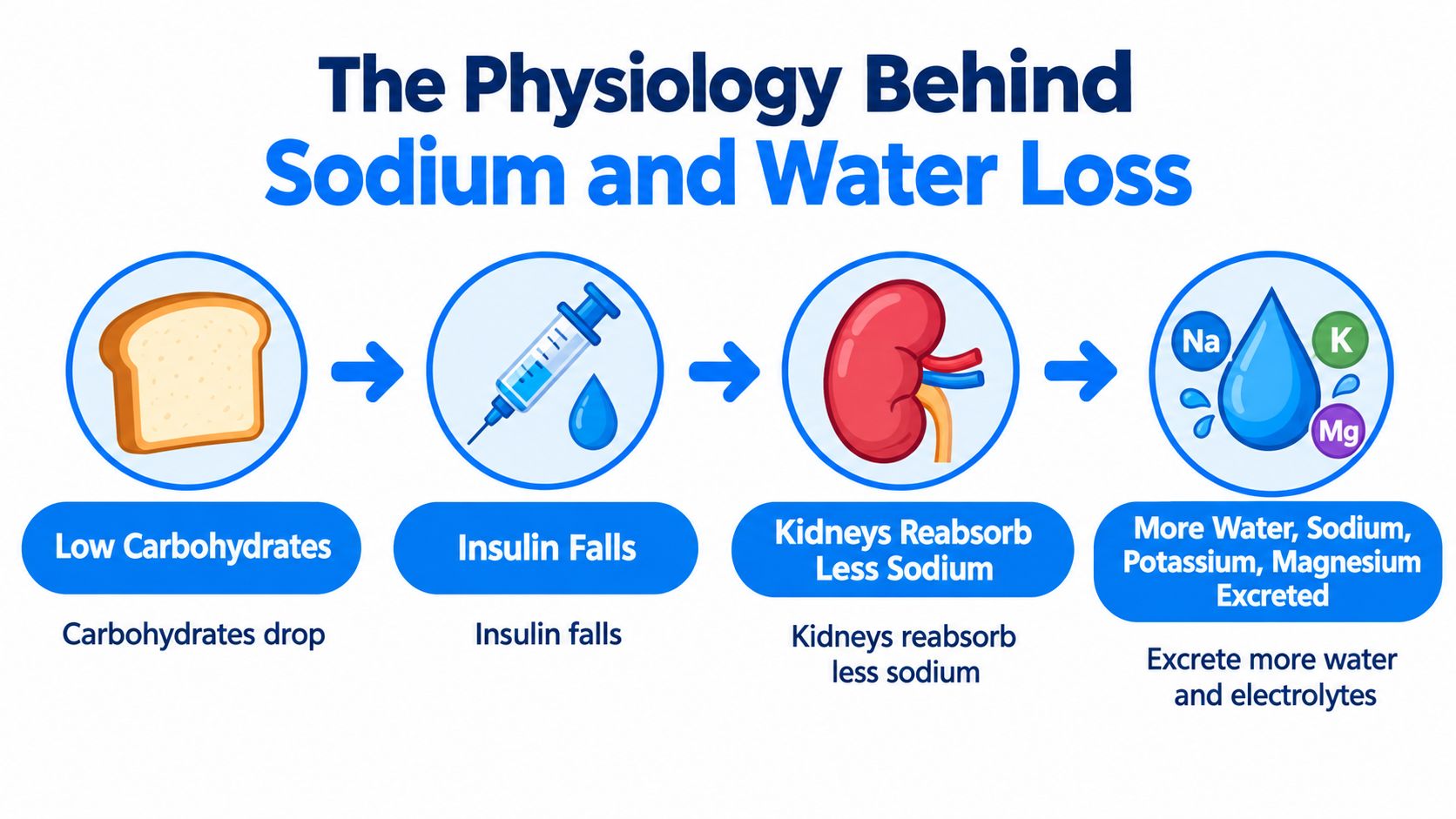
The sequence is easier to follow when separated into its parts:
- Less sodium reclaimed: More sodium remains in the fluid destined to become urine.
- More fluid lost: The resulting change can reduce circulating volume, rather than merely making someone feel thirsty.
- Compensation begins: Hormonal and nervous-system responses attempt to maintain circulation, but their effects on different minerals aren't identical.
This explains why drinking more water isn't necessarily the same as correcting the underlying problem. Increasing the faucet doesn't automatically change what's escaping through the drain.
Fluid volume and blood concentration aren't interchangeable
Hypovolemia means reduced circulating fluid volume. It isn't synonymous with a low sodium concentration on a blood test, and symptoms alone can't establish either condition.
Someone who feels dizzy when standing may have a volume-related problem, but that observation doesn't reveal their potassium or magnesium status. Clinicians interpret symptoms alongside dietary intake, medications, examination findings, and laboratory results when indicated.
The early transition also shouldn't be assumed to represent permanent mineral requirements. Kidney responses during initiation can differ from those after adaptation, so an adjustment that seems appropriate at the beginning still needs reassessment.
That distinction prevents a common mistake: turning a temporary hydration strategy into an indefinite, escalating supplement routine.
Sodium, Potassium, and Magnesium Explained
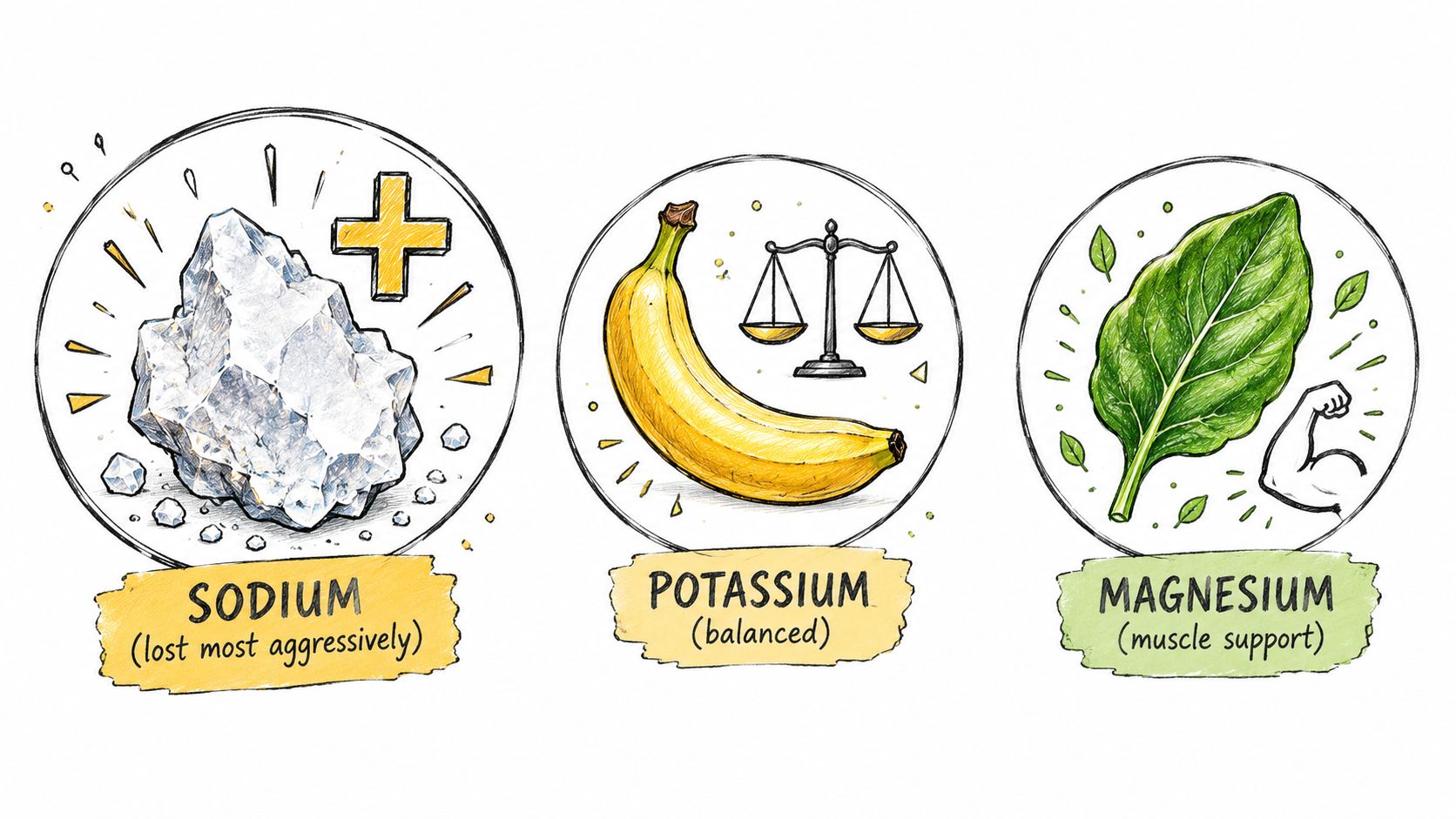
An electrolyte blend isn't a single ingredient. Its sodium, potassium, and magnesium components need separate consideration because their roles, losses, and safety constraints differ.
This illustration provides a useful way to keep the minerals distinct.
Sodium and circulating fluid
Sodium is the principal extracellular cation, meaning it's the main positively charged mineral in fluid outside cells. During early carbohydrate restriction, it's central to the sodium-and-water loss described above.
Volume-related dizziness and lethargy may therefore make sodium intake relevant to the assessment. But it's too simplistic to equate every headache with sodium deficiency or to decide that a salty drink confirms the diagnosis because you feel better afterward.
Sodium intake, fluid volume, and blood sodium concentration are different measurements. Confusing them can lead to unnecessary or unsafe supplementation.
Potassium and magnesium need their own safety checks
Potassium and magnesium losses may contribute to weakness, cramps, and susceptibility to abnormal heart rhythms. These symptoms overlap, so you can't reliably identify the missing mineral by matching a symptom to a supplement.
The clinical guidance on electrolyte management during ketogenic diets emphasizes that high-dose potassium can be hazardous when kidney excretion is impaired or potassium-sparing medications are used. It also recommends electrolyte and renal-function assessment during medically supervised ketogenic diets, particularly when comorbidities or diuretics are involved.
| Mineral | Useful interpretation | What symptoms can't tell you |
|---|---|---|
| Sodium | Consider intake alongside circulating volume and clinical context | Whether blood sodium is low |
| Potassium | Review food intake, kidney function, and medications | Whether additional potassium is safe |
| Magnesium | Assess dietary intake and the need for supplementation | Whether a cramp proves magnesium deficiency |
For broader mineral context, Tecton's educational discussion of magnesium and calcium offers a companion topic, rather than a diagnostic tool.
A symptom discussion is most useful when paired with the safety distinctions above.
Acid–base handling adds another layer
Keto-adaptation also changes bicarbonate and acid–base handling. That makes adding bicarbonate-style products to “balance” the body an unjustified shortcut without an identified clinical need.
Don't turn a symptom checklist into a shopping list. Similar symptoms can arise from different problems, and correcting the wrong presumed deficiency can create another risk.
Why Generic Advice Often Falls Short
The strongest challenge to universal electrolyte advice isn't that the physiology is implausible. It's that a plausible mechanism doesn't establish the right dose for every person.
A 2025 scoping review of keto-induction symptoms found little rigorous research quantifying individualized supplementation needs. It concluded that the familiar recommendation to add 1–2 grams of sodium daily rests largely on clinical experience and mechanistic reasoning rather than direct intervention trials, and found no experimental evidence that liberal fluid intake prevents induction symptoms or constipation.
What the evidence gap actually means
The same review reported that sodium and potassium losses tend to subside after approximately 14 days, while noting that no single study had directly connected symptoms with simultaneous measured electrolyte and body-water changes.
That uncertainty doesn't prove supplementation is useless. It means we shouldn't describe every episode of fogginess or fatigue as a confirmed deficiency, or present a fixed dose as a proven prevention strategy.
A reasonable recommendation should therefore state both its rationale and its limits. “This may help replace increased losses in an appropriate person” is more defensible than “everyone on keto needs this amount.”
Replace blanket advice with context
The decision changes when someone has hypertension, kidney disease, heart failure, or medications that influence mineral handling. Diuretics and potassium-sparing drugs deserve explicit review rather than an assumption that all electrolyte products are interchangeable.
Useful questions include:
- Exercise load: Are you beginning keto during routine daily activity or prolonged training?
- Environment: Are heat and substantial sweating adding another source of fluid and mineral loss?
- Illness: Are vomiting or other acute symptoms making ordinary dietary guidance inadequate?
- Existing care: Has a clinician already given you sodium, potassium, or fluid restrictions?
For example, an athlete training in heat and an office worker following a prescribed sodium restriction shouldn't copy the same online hydration routine. Their dietary label may match, but their risks and losses don't.
Evidence boundary: A recommendation can be physiologically reasonable without being a universally tested prescription.
Individualization isn't needless complexity. It's how you avoid solving a presumed sodium problem while overlooking medication effects, kidney limitations, or a condition that needs assessment.
Exogenous Ketones, Formats, and Fluid Dynamics
Ketone fuel and electrolyte replacement are different inputs. A product can supply both, but the presence of ketones doesn't establish that it replaces the minerals you've lost.
Nutritional ketosis describes diet-induced ketosis. Endogenous ketone production is the liver's production of ketones, including during fasting. Exogenous ketone supplementation supplies an external ketone source or a substance that is converted into ketones.
BHB changes fuel availability, not just a meter reading
Beta-hydroxybutyrate, or BHB, can provide substrate for mitochondrial ATP production. Glucose and ketones enter energy metabolism through different pathways, but ketone availability doesn't mean glucose use stops.
Human evidence illustrates this flexibility. A review of cerebral ketone metabolism describes increasing brain ketone utilization with greater circulating availability and reports that acute BHB infusion reduced cerebral glucose consumption by about 14% without reducing oxygen use. That supports alternative fuel utilization, not a promise that a supplement improves cognition.
BHB also participates in cellular fuel signaling. In a controlled human study of hydroxybutyrate administration, glucose appearance fell 14% and lipolytic rate fell 37%, while insulin and glucagon remained unchanged. These acute findings don't establish long-term metabolic benefits or improved endothelial function, which requires its own direct evidence.
Formats aren't interchangeable
| Format | Formulation distinction | Electrolyte implication |
|---|---|---|
| Ketone salts | BHB paired with mineral cations | Count the accompanying minerals in total intake |
| Ketone esters | An ester supplies ketone-related substrate | Don't assume it provides electrolyte replacement |
| Precursors | Require conversion rather than supplying BHB in the same form | Evaluate separately from direct BHB sources |
In a randomized crossover study of 15 healthy adults, ester drinks raised circulating D-BHB more than 50% higher than salt drinks at equivalent BHB doses. Racemic salts also supplied more slowly metabolized L-BHB, increased urinary pH as accompanying cations were excreted, and both formats mildly altered acid–base balance.
R3HBG is positioned as a D-BHB-delivering ester technology, not as a separate, clinically proven hydration category. Liposomal delivery describes a formulation approach; it shouldn't be treated as proof of superior absorption or performance without product-specific human comparisons.
For example, the GLP-1 Shot contains liposomal R3HBG™, 5-HTP, and prebiotic fiber and is designed for routines involving spaced meals, fasting windows, or energy dips. That description doesn't establish electrolyte repletion.
Tecton's discussion of whether exogenous ketones work provides further context. The practical distinction remains: raising BHB externally isn't the same as reproducing dietary adaptation, correcting mineral depletion, or proving improved performance.
Practical Repletion and Prevention Strategies
Start with an intake review, not a supplement stack. Write down what you eat and drink, the electrolyte amounts on product labels, your exercise conditions, and any medications or existing restrictions.
This helps separate food intake from supplemental intake. It also makes a clinician consultation more useful because you can describe what you're consuming rather than saying you "take electrolytes."
Use targets as context, not automatic prescriptions
The dietary ranges below come from the kidney-physiology review discussed earlier. They apply as general guidance for adults with normal kidney function, not as instructions for people with conditions or medications that change safe intake.
Daily Electrorolyte Targets During Early Keto Adaptation
| Electrolyte | Daily Target | Best Food Sources | Supplement Cautions |
|---|---|---|---|
| Sodium | Approximately 4–5 grams total daily, as described in the earlier clinical review | Measured salted foods or broth, with label checking | Total intake isn't the same as added salt or a supplemental dose |
| Potassium | Approximately 3–4 grams total daily, from the same review | Food-first meal planning, including avocado, leafy greens, and salmon | Avoid unsupervised high-dose supplementation |
| Magnesium | Individualize rather than assign a universal keto dose | Review meals containing greens, nuts, and seeds | Check elemental amount, kidney considerations, and tolerability |
The food examples are meal-planning options, not guarantees of a particular mineral dose. Broth composition varies, and a casual pinch of salt isn't a reproducible measurement.
For magnesium, don't assume a particular form or bedtime dose will reliably prevent cramps or improve sleep. Vitamin Planet's guide on how to take magnesium supplements safely can help frame practical questions, but individual dosing still requires appropriate assessment.
Evaluate the serving, not the hydration slogan
A transparent product should disclose elemental sodium, potassium, and magnesium per serving, serving limits, and contraindications. Tecton's guide to choosing a drink with electrolytes offers related reading for label evaluation.
Tecton EDGE™ Performance Shot + Electrolytes is a liposomal R3HBG™ formulation containing sodium, potassium, and magnesium, designed for active routines. Assess its disclosed mineral amounts as you would an electrolyte mix or measured dietary source, rather than assuming the ketone component corrects dehydration.
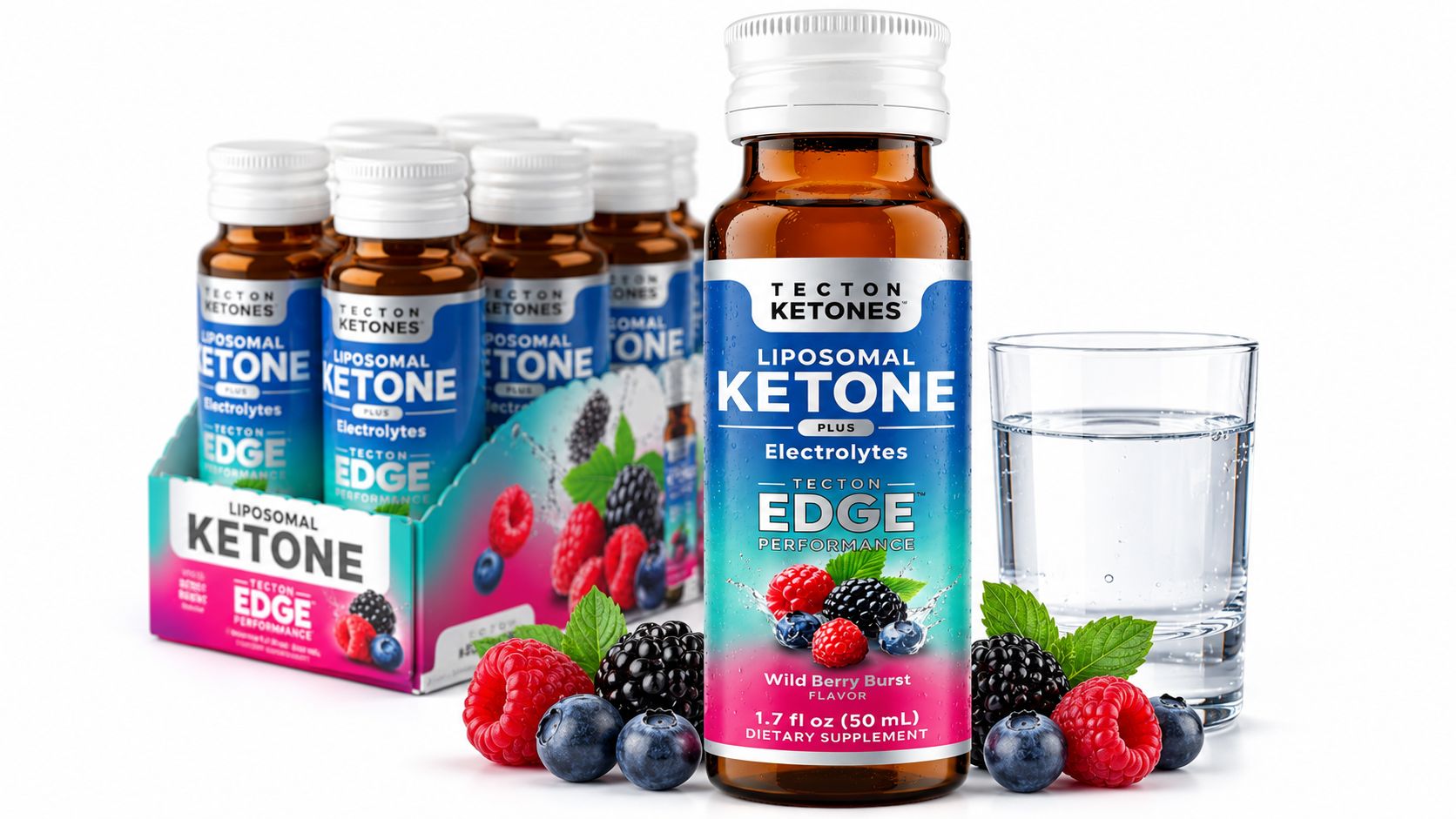
Hydration planning should consider thirst, exercise duration, heat, and individual sweat losses rather than a fixed drinking schedule. Urine appearance can be an observation to discuss, but it isn't a stand-alone test of electrolyte status.
Know when to stop self-treatment
The clinical guidance discussed earlier identifies symptoms that warrant medical assessment:
- Persistent vomiting
- Marked weakness
- Confusion
- Fainting
- Sustained tachycardia, meaning an ongoing unusually rapid heartbeat
- Abnormal breathing
Don't respond to these symptoms by repeatedly increasing salt, potassium, or ketone intake. Seek prompt medical evaluation, with emergency care for severe symptoms, rather than waiting for the diet to “settle.”
Why This Matters and an Application Framework
Steadier energy, cognitive endurance, workout performance, and metabolic efficiency are goals, not guaranteed supplement outcomes. Adequate fuel availability and an appropriate hydration strategy should be considered separately.
- Begin deliberately: Review food, fluids, labels, medications, and baseline health before increasing electrolytes.
- Trial cautiously: If appropriate, use exogenous ketones during an ordinary routine rather than first experimenting during demanding training or prolonged fasting.
- Reassess: Revisit temporary adjustments at the adaptation checkpoint described earlier instead of continuing them automatically.
Arrange clinician-guided management if you have red-flag symptoms, kidney, blood-pressure, or heart concerns, or medications affecting sodium or potassium.
Tecton Ketones™ offers exogenous ketone formulations, including an option that combines ketone nutrition with electrolytes for active routines. Visit Tecton Ketones™ to review the formulations and compare serving-level information with your dietary intake and, when needed, your clinician's guidance.


