


Most advice about exogenous ketones starts with the wrong question: “Which ketone supplement is best?” The more useful question is, “What exactly is in the serving, and how does that ingredient become usable fuel?” Products that look similar on a shelf can deliver different BHB isomers, mineral loads, precursors, carriers, doses, and absorption profiles.
That distinction matters because a measurable rise in blood ketones is not the same as proven improvement in cognition, exercise output, body composition, or long-term health. A clinician separates those questions before recommending a formula. The ingredient pipeline, from molecular identity to delivery system and tolerability, deserves more attention than the front-of-pack promise.
Why the Ingredient List Matters More Than the Label
“Exogenous ketones” is an umbrella term, not a single ingredient. A ketone salt, a ketone ester, a ketone diol, a direct D-BHB source, and a liposomal formulation can all belong to the same category while behaving differently after ingestion.
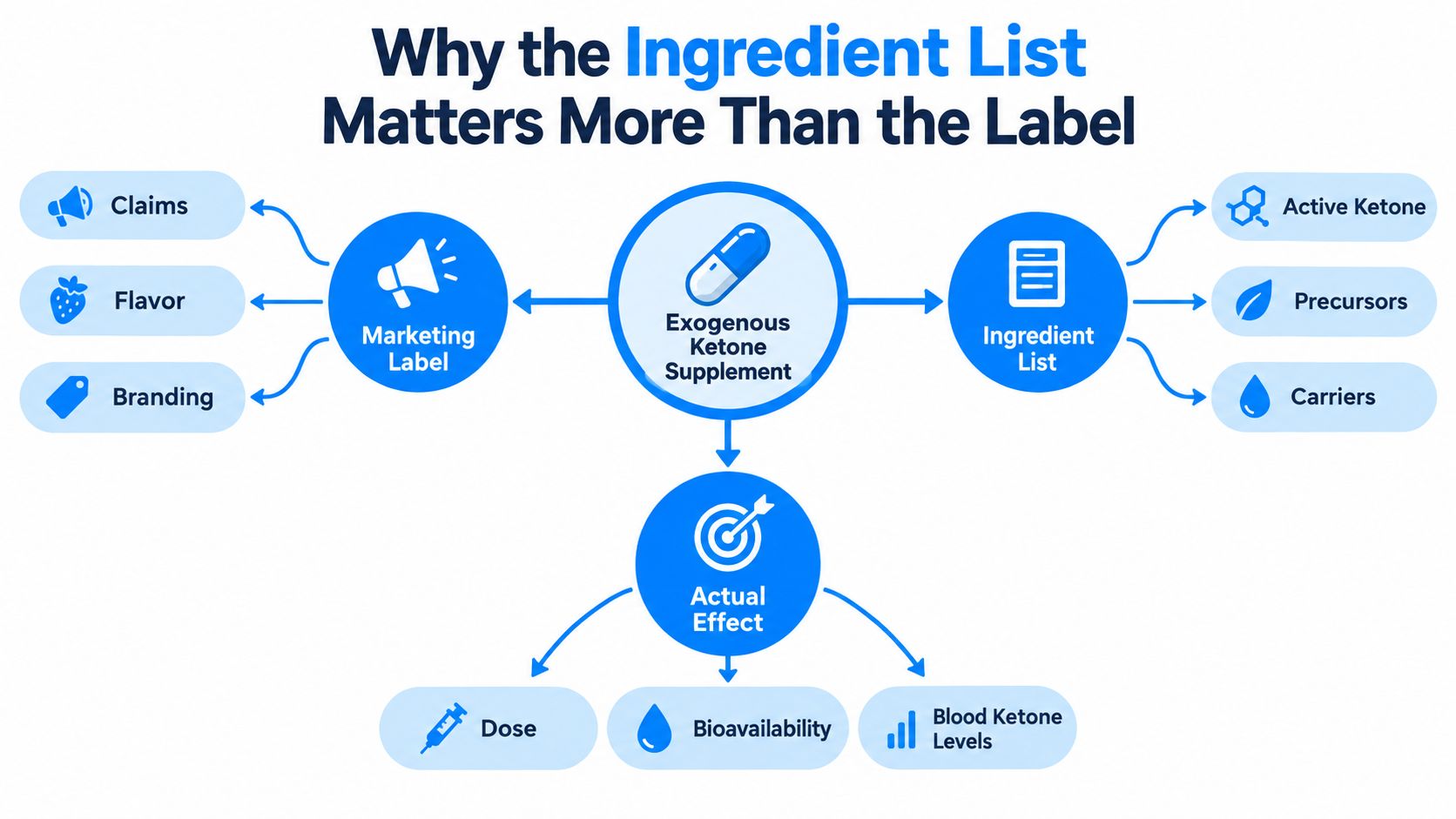
The first practical distinction is pharmacokinetics, meaning what happens to the ingredient in the body. Does it raise circulating D-BHB quickly? Does it also deliver sodium, potassium, calcium, or magnesium? Does it contain L-BHB, which may clear more slowly? Is the product providing BHB directly, or does the liver need to convert a precursor first?
A systematic review covering 43 trials and 586 participants found that exogenous ketones increased blood BHB by an average of 1.73 mM and reduced blood glucose by 0.54 mM. The review also found significantly larger effects for ketone monoesters than for ketone salts, showing that ingredient chemistry changes the response, not merely the presence of the word “ketones” on the label (systematic review of exogenous ketone trials).
What the label can and cannot tell you
A blood-ketone increase is a physiological measurement. It doesn't automatically demonstrate better athletic performance, sharper thinking, fat loss, or disease treatment. Those outcomes require appropriately designed human trials that test the relevant population, dose, duration, and endpoint.
When comparing a supplement with a broader training routine, keep the same discipline. A resource such as smart workout plans for muscle growth can help organize training variables, but it can't substitute for reading the ketone formula itself.
Clinical rule: Treat “ketones” as a category name. Treat the Supplement Facts panel as the actual intervention.
The BHB Molecule and Why Stereochemistry Changes Everything
Beta-hydroxybutyrate, or BHB, is one of the main ketone bodies. The body produces it in the liver when carbohydrate availability falls, such as during fasting, prolonged exercise, or a ketogenic diet. That is endogenous ketone production. Nutritional ketosis is the diet-induced state that increases this natural production, while exogenous supplementation introduces ketone-related fuel from outside the body.
BHB is closely related to acetoacetate, another ketone body. Cells can convert BHB to acetoacetate, then to acetyl-CoA, which enters the mitochondrial tricarboxylic acid cycle. The resulting reducing equivalents support oxidative phosphorylation and ATP production. This gives ketones a legitimate role in energy metabolism, but it doesn't prove that raising blood BHB automatically increases ATP output in every tissue or situation.
A useful analogy is a key and a lock. D-BHB is the naturally predominant form that human tissues can use readily. L-BHB is its mirror image. It isn't bad, but it follows different metabolic pathways and can remain higher longer, with slower metabolism and urinary elimination. A label reporting only "total BHB" can therefore combine two molecules with different immediate usefulness.
Why total BHB can mislead
In a controlled human study, pure D-BHB raised circulating ketones to 1.2 ± 0.1 mmol/L, while an equivalent amount of racemic D+L-BHB reached approximately 0.62 ± 0.05 mmol/L. L-BHB cleared more slowly and was partly eliminated through urine (human study of D-BHB and racemic BHB).
That result doesn't mean every D-BHB product will produce the same peak. Dose, delivery matrix, gastric tolerance, meal timing, and metabolic state all matter. It does establish why D-BHB content should be specified separately from total BHB.
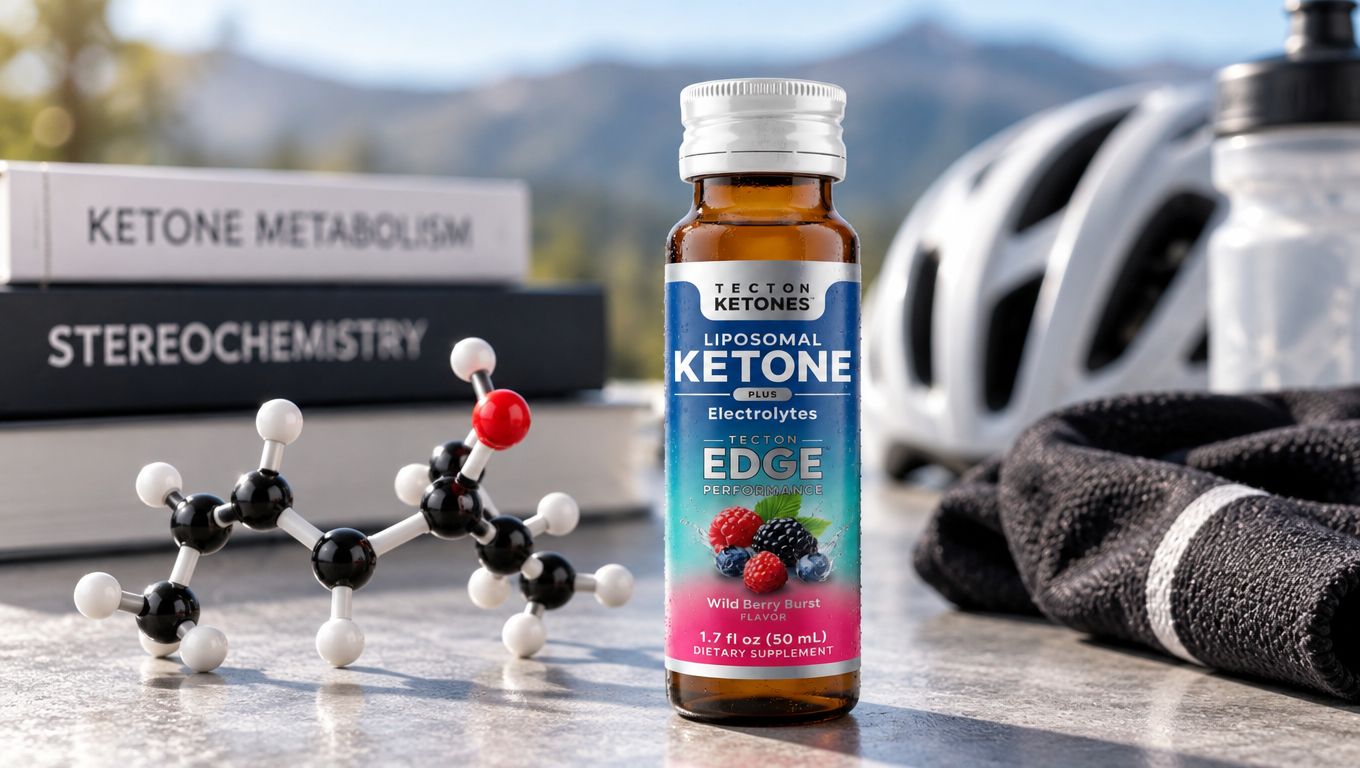
A product such as Tecton EDGE™ Performance Shot + Electrolytes illustrates how a formula can combine a liposomal R3HBG ketone with sodium, potassium, and magnesium for active users seeking a non-caffeinated option during training or physically demanding days. The product description identifies the delivery and electrolyte components, which is more informative than a generic claim about “advanced ketones.”
Ketone Esters Versus Ketone Salts in Head-to-Head Pharmacokinetics
Ketone esters and ketone salts are often compared as if a gram of one equals a gram of the other. It doesn't. Their chemical structures create different constraints around D-BHB delivery, mineral exposure, stereochemistry, taste, and tolerance.
A ketone ester chemically links BHB, or a BHB precursor, to an alcohol backbone. A ketone salt pairs BHB with a mineral such as sodium, potassium, calcium, or magnesium. The salt's mineral content isn't a minor detail. It contributes to the total amount consumed and can affect formulation, labeling, and individual tolerability.
In a human comparison involving approximately 12 or 24 g of BHB, a ketone ester produced a peak blood D-BHB concentration of about 2.8 mmol/L, compared with approximately 1.0 mmol/L for a sodium-plus-potassium BHB salt. Both generally moved back toward baseline within roughly 3 to 4 hours, while L-BHB from the racemic salt remained increased for more than 8 hours (human comparison of ketone ester and salt pharmacokinetics).
Ester versus salt at a glance
| Attribute | Ketone Ester | Ketone Salt |
|---|---|---|
| Main structure | BHB or a precursor bonded to an alcohol backbone | BHB paired with minerals |
| D-BHB response | Often produces a larger acute rise in controlled comparisons | Typically produces a lower D-BHB peak at comparable BHB delivery |
| Stereochemistry | Can be D-BHB predominant | May contain both D- and L-BHB |
| Mineral load | Doesn't require an equivalent mineral counterion load | Adds sodium, potassium, calcium, or magnesium |
| Duration | Blood response commonly returns toward baseline within several hours in acute comparisons | L-BHB may remain elevated longer |
| Tolerability | Taste and nausea can limit use | Mineral burden, saltiness, and gastrointestinal effects can limit use |
| Best comparison unit | D-BHB dose, peak, exposure, and tolerance | D-BHB dose, total minerals, isomer profile, exposure, and tolerance |
The comparison doesn't support a simplistic “ester good, salt bad” conclusion. A higher blood-ketone peak is a pharmacokinetic finding, not proof of superior long-term performance or cognition. Compound, dose, flavoring, sweeteners, exercise state, and the user's gastrointestinal response still matter.
For a deeper explanation of the chemistry, the ketone ester guide from Tecton is a useful reference. The important habit is to compare like with like. “Grams of BHB” has limited meaning unless the label also identifies the molecular form and the D-BHB contribution.
Precursors, Carriers, and Delivery Systems Worth Naming
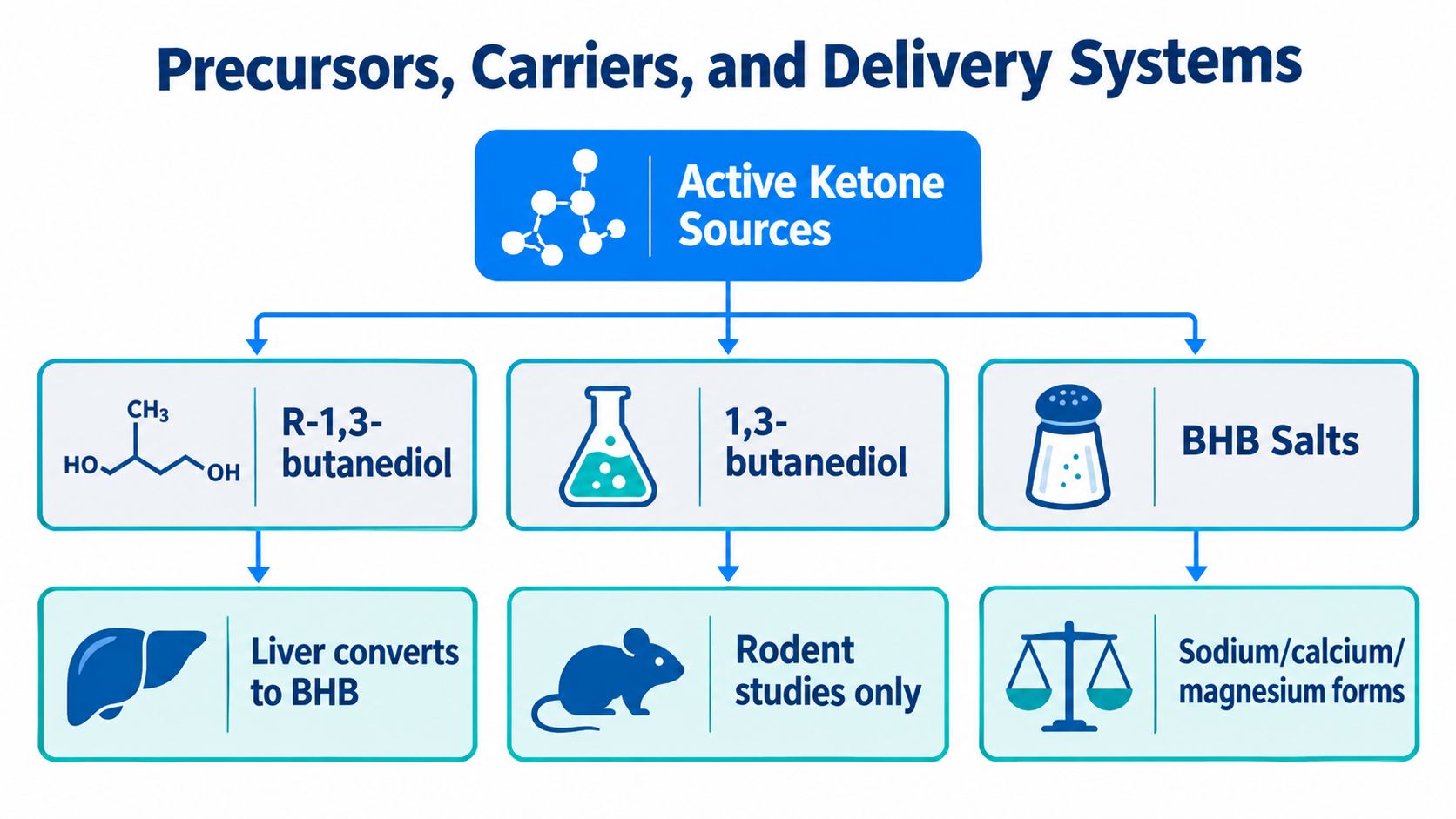
The active ketone isn't the only ingredient that determines the experience. Some products provide BHB directly. Others supply a precursor, which the body absorbs and the liver converts into BHB. R-1,3-butanediol is one example. A precursor-only product isn't equivalent to a direct D-BHB source because the conversion step adds another stage between ingestion and circulating ketones.
R-1,3-butanediol and 1,3-butanediol also shouldn't be treated as interchangeable labels. The stereochemical form and human evidence matter. A product developer should identify the exact compound, the expected conversion pathway, and the evidence for the finished formula rather than borrowing findings from a different ingredient.
Delivery is not the same as efficacy
Liposomal delivery places an active compound within lipid-based carriers. The intended purpose may be to influence dispersion, absorption, taste, or tolerability. But “liposomal” describes a delivery approach, not a guarantee of a particular blood BHB profile or functional outcome. The formula still needs appropriate human testing.
Ester backbones can also act as delivery structures. A tri-ester such as R3HBG is described by Tecton as linking three D-BHB molecules to a glycerol backbone. Once the ester is processed, the design is intended to provide D-BHB without the same mineral counterion load as a salt. That molecular description should be kept separate from claims about performance or cognition unless those outcomes have been directly tested.
Medium-chain triglycerides, or MCTs, represent another carrier or precursor strategy. They can support endogenous ketone production, but they aren't the same as delivering BHB directly. Consumers comparing formulas can review the practical differences in pure C8 MCT oil, especially when deciding whether they want a precursor pathway or an immediately available ketone source.
The label vocabulary becomes clearer when organized by function:
- Direct ketone: Supplies BHB or a related ketone structure.
- Precursor: Requires metabolic conversion before producing BHB.
- Carrier: Helps transport or disperse the active compound.
- Electrolyte: Adds minerals that may support hydration needs but also increase total mineral intake.
- Flavor system: Improves palatability and may affect gastrointestinal response.
Additives, Sweeteners, and the Rest of the Ingredient List
The ketone source is only one part of a usable formula. Allulose, stevia, monk fruit, and sucralose can change taste, while flavor systems may soften the bitterness of esters or the saltiness of mineral BHB. Fillers and preservatives can affect texture and shelf stability.
These ingredients are formulation choices, not automatic warning signs. Their value depends on your tolerance, dietary preferences, and intended use. Tecton takes a no-artificial-sweeteners approach to daily-use formulation, described in its no-artificial-sweeteners explainer.
Read the inactive ingredients as a tolerability signal
After locating the BHB amount, scan the rest of the panel. Electrolytes, caffeine, nootropics, fiber, MCTs, artificial dyes, and several sweeteners may all affect how the product feels. If bloating or nausea occurs, the active ketone may not be the only variable involved.
A 28-day ketone monoester study used 25 mL of a ketone monoester three times daily. Average maximum BHB was 4.1 ± 1.1 mM. The study reported no changes in body weight, fasting glucose, cholesterol, triglycerides, electrolytes, or kidney-function measures, although participants reported typical mild gastrointestinal effects from repeated dosing.
The lesson is narrow but useful: monitored laboratory measures can remain stable while a formula still causes digestive discomfort. Taste, serving size, meal timing, sweeteners, minerals, and dose speed may shape that experience.
Label-reading habit: Count caffeine separately from the ketone. Assess the mineral contribution of electrolytes separately from the BHB.
For a broader framework on additive choices, see this clean label supplement guide. Your final choice should match the exact Supplement Facts panel and your own response.
Reading Labels and Understanding Regulatory Language
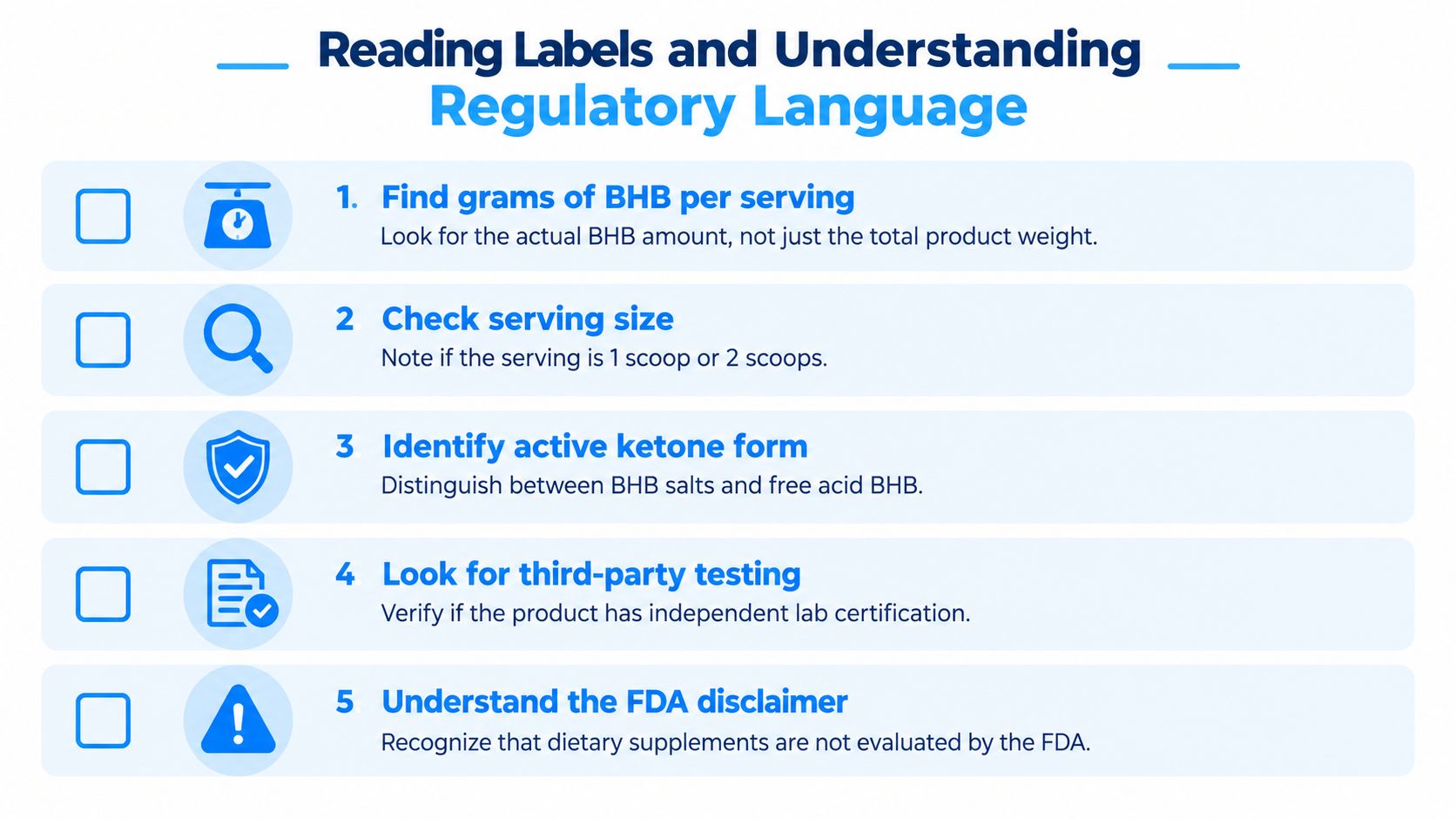
A Supplement Facts panel should reveal the ingredient pipeline, not merely answer whether ketones are present. Check the BHB per serving, serving size, chemical form, D-BHB contribution, and accompanying minerals or active compounds. Powder weight is only the container measurement. It does not automatically equal the amount of active D-BHB delivered.
Regulatory wording requires the same precision. Terms such as “FDA-recognized,” “bioidentical,” and “NDI” do not mean that the FDA approved a supplement for safety or effectiveness before sale. Manufacturers are responsible for evaluating safety and maintaining compliant labeling, while dietary supplements are not approved by the FDA before reaching consumers. The FDA's consumer guidance explains this distinction (FDA questions and answers on dietary supplements).
Use an evidence ladder
Review each product through four questions:
- Identity: Does the label clearly name the chemical form and isomer?
- Absorption: Does human research show that this ingredient raises blood D-BHB, and at what dose?
- Tolerability: Has the same ingredient, or the finished formula, been monitored for unwanted effects?
- Clinical benefit: Has research tested the promoted outcome, such as cognition, exercise output, appetite, or metabolic markers?
A 2025 systematic review found potential applications for exogenous ketosis across neurological, metabolic, cardiovascular, inflammatory, and psychiatric areas. It also described insufficient evidence for clear clinical efficacy because studies were often small, short, heterogeneous, and dependent on surrogate biomarkers (2025 systematic review of exogenous ketosis).
The ladder separates measurable absorption from broader promises. A clearly identified D-BHB ingredient may raise blood ketones without proving improved cognition, exercise performance, appetite control, or metabolic health. A clean label supplement guide can help you scrutinize the panel, but independent testing and transparent dosing matter more than a “clean” phrase alone.
A Practical Framework for Choosing and Using Exogenous Ketones
Start with the job you want the ingredient to perform. A long endurance session may prioritize a tolerable ketone source paired with electrolytes. A demanding work block may favor a non-caffeinated formula if you already use coffee. A high-intensity session may require carbohydrates regardless of whether ketones are included.
The physiology is straightforward but limited. In one controlled intervention, a ketone ester raised mean blood D-BHB to 4.0 mmol/L after 30 minutes, compared with 0.7 mmol/L at baseline. Blood glucose fell by 28.8%, lactate by 28.2%, and non-esterified fatty acids by 49.1%, demonstrating a rapid shift in fuel availability rather than proving automatic improvement in tissue ATP production or performance (controlled ketone ester intervention).
Why This Matters
- Steadier energy: A temporary rise in available BHB may feel useful during a long, steady effort, but personal tolerance and total fueling still determine the outcome.
- Cognitive endurance: The brain can take up ketones and reduce part of its glucose use, yet ketones don't replace all cerebral glucose needs or guarantee better cognition.
- Workout performance: Ketones can supplement a fuel strategy, but higher-intensity work still requires an appropriate carbohydrate and hydration plan.
- Metabolic efficiency: Exogenous BHB changes circulating fuel availability. That is different from proving improved long-term metabolic health.
Application Framework
- Choose the target. Identify whether you want support for endurance, focus, a fasting window, or general metabolic flexibility.
- Inspect the molecule. Confirm D-BHB content, ester or salt structure, precursor status, mineral load, caffeine, sweeteners, and serving size.
- Test during routine conditions. Start with the labeled serving in training or an ordinary workday, not during a competition or a high-stakes event.
- Track useful signals. Note perceived energy, focus, workout pacing, gastrointestinal comfort, hydration, and sleep.
- Use medical caution. Speak with a qualified healthcare professional before use if you're taking diabetes medication, have kidney disease, are pregnant, or have another condition affecting glucose or ketone metabolism.
A complete routine may also include separately evaluated nutrients, such as UK vitamin D3 K2 magnesium, but one supplement shouldn't be assumed to solve every nutritional need.
Tecton Ketones™ focuses on clearly defined exogenous ketone formulations, including liposomal R3HBG-based products and targeted options such as electrolytes or caffeine-free performance support. Review the formula, compare it with the ingredient principles above, and visit Tecton Ketones™ to explore the available options.


