


You've cut out bread and sugar, check your ketones, and keep showing up for workouts. But the scale has barely changed, or it has stopped moving after an encouraging start. That can feel as if you're doing everything right and still getting nowhere.
The confusion often comes from treating three different outcomes as if they were the same: being in ketosis, losing scale weight, and losing body fat. Ketosis tells you that ketones are available as fuel. A scale records total body weight, which shifts with water and other factors. Fat loss depends on a sustained energy deficit. Understanding the difference turns a frustrating plateau into a question you can investigate without blaming yourself.
The Frustrating Truth About Keto Plateaus
In the early days of keto, the scale may drop quickly. When carbohydrate intake falls, the body uses stored glycogen, and water associated with glycogen can shift too. That early change can feel like proof that fat is melting away. It isn't a reliable measure of continuing fat loss, though. Once those fluid changes settle, the pace on the scale may slow even if you're still following the diet.
This is one reason people search “why am I not losing weight on keto?” A person can eat very few carbohydrates, see ketones on a test, and still not create the conditions for ongoing fat loss. Ketosis is a fuel state, not a receipt for calories burned. Harvard's review of diet evidence notes that keto can produce faster short-term weight loss, but its advantage over conventional calorie-reduction diets tends to fade over time (Harvard's overview of healthy eating).
A useful distinction: Ketone readings tell you about ketone availability. They don't tell you whether your body is losing fat.
A stalled scale doesn't automatically mean keto has failed or that you lack discipline. Portions can grow, daily movement can decline, and normal changes in water, sodium, bowel contents, or menstrual-cycle patterns can obscure a change in body fat. Those are different possibilities, and each calls for a different response.
Treat the plateau as a diagnostic puzzle. First look at food intake and adherence, then consider changing energy needs and measurement noise, and finally ask whether medical context could matter. That approach is more useful than reacting to one weigh-in or chasing a higher ketone reading.
How Ketosis Actually Works in Your Body
Ketosis begins when carbohydrate availability falls enough that the liver increases ketone production. Here's the basic pathway:
- The liver processes fatty-acid-derived acetyl-CoA into ketone bodies, including acetoacetate and beta-hydroxybutyrate (BHB).
- BHB circulates in the blood and enters tissues. Inside mitochondria, it's converted back into acetyl-CoA, which enters the Krebs cycle and helps cells produce ATP, their usable energy.
- The brain can use ketones as an alternative fuel. Under healthy conditions, greater circulating ketone availability corresponds with greater brain ketone use and proportionally lower glucose use (NCBI Bookshelf overview of ketosis).
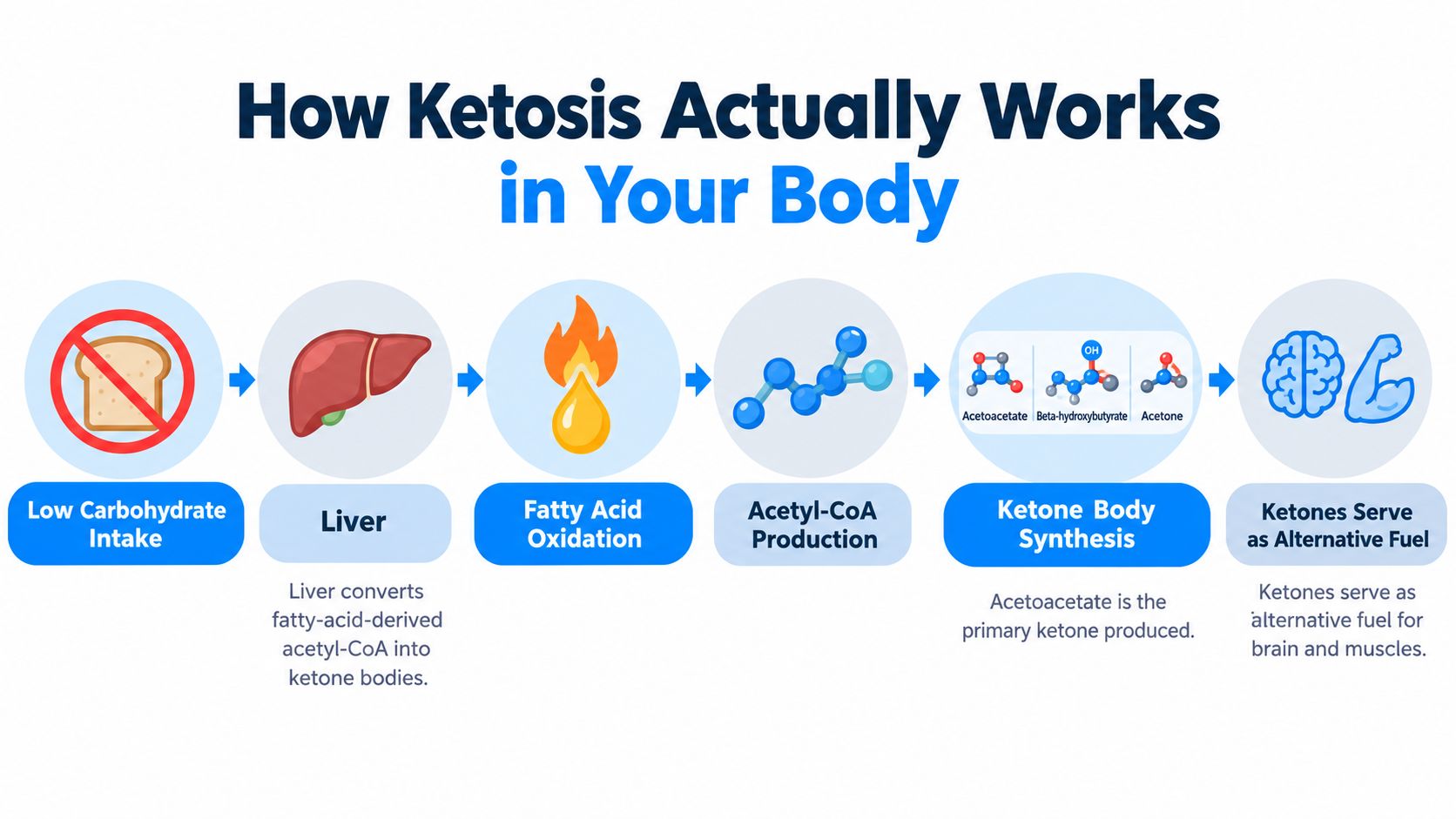
The distinction between ketone sources matters. Endogenous ketones are made by your own liver from fatty acids. Nutritional ketosis is a dietary state associated with increased ketone availability, but it still doesn't confirm that body fat is being lost. Exogenous ketones, by contrast, are consumed as BHB or as compounds that can raise circulating ketones. A higher ketone reading after a supplement reflects ketone availability, not necessarily equivalent release of stored fat.
Cells can use glucose or ketones to support energy production, and the ability to draw on different fuels is part of metabolic flexibility. But having another fuel available doesn't establish how much energy you're taking in or where that fuel came from. Ketones also participate in cellular signaling, and research explores their relationship to processes such as endothelial function. Those mechanisms shouldn't be mistaken for proof of weight loss or a substitute for established medical care.
If you're comparing weight-management options alongside diet changes, GLP-1 results from Athena Plastic Surgery offer a separate point of reference. Medication and dietary decisions are individual, so discuss them with a qualified clinician rather than judging them by ketone readings.
Hidden Calories and Sneaky Carbohydrates on Keto
Keto foods can be low in carbohydrate and still make it easy to eat more energy than you use. A typical ketogenic pattern gets about 70%–75% of calories from fat, around 20% from protein, and no more than 10% from carbohydrates. Fat provides 9 calories per gram, compared with 4 calories per gram from protein or carbohydrate, so small additions can matter (Harvard's review of the ketogenic diet).
A drizzle of oil, extra butter, a handful of nuts, cream in coffee, cheese between meals, or a generous serving of fatty meat can add up. “Keto” treats may also be calorie-dense, even when their carbohydrate count looks low. Low-carb doesn't mean unlimited.
Carbohydrates can creep in from another direction: sauces, sweetened drinks, protein bars, restaurant meals, and serving sizes estimated from memory. A meal can remain relatively low in carbs while the total energy intake rises, or a hidden ingredient can make carbohydrate intake less consistent than expected.
A controlled metabolic-ward study helps clarify why ketones aren't the deciding signal. In an isocaloric comparison, an approximately 300-kcal-per-day negative energy balance occurred during the ketogenic phase, with continued losses of body weight and fat. The practical lesson is not that keto automatically creates a deficit. It's that fat loss followed the energy imbalance in that setting, rather than the mere presence of ketones (the controlled metabolic-ward study indexed by PubMed).
Before changing your diet, audit it. For one week, weigh and log meals, cooking fats, snacks, drinks, and restaurant food. Record protein as well as added fats, and make serving sizes visible rather than guessed. A short, accurate record can show whether the issue is calorie creep, hidden carbohydrate exposure, or neither.
Why the Scale Stalls Even When You Stay in Ketosis
Your ketone reading stays positive, but the scale stops moving. That leaves three separate questions: are you in ketosis, is your weight changing, and are you losing body fat? Each needs its own evidence. A stall is a diagnostic puzzle involving energy needs, measurement, and physiology.
As your body becomes lighter, it generally needs less energy at rest and during activity. Everyday movement may also decrease without a conscious decision to sit more. Your previous intake can therefore become closer to maintenance, like a household budget whose expenses have shrunk. The NIH Body Weight Planner explains these compensatory adjustments and why weight change doesn't follow a fixed-calorie rule.
The scale weighs more than fat.
Early keto losses may include glycogen-associated water. Later, sodium shifts, hydration, constipation, and menstrual-cycle changes can obscure fat loss. Resistance training can also affect body composition: fat loss alongside lean-mass gains may leave total weight relatively stable, while maintaining lean mass helps preserve it during weight loss.
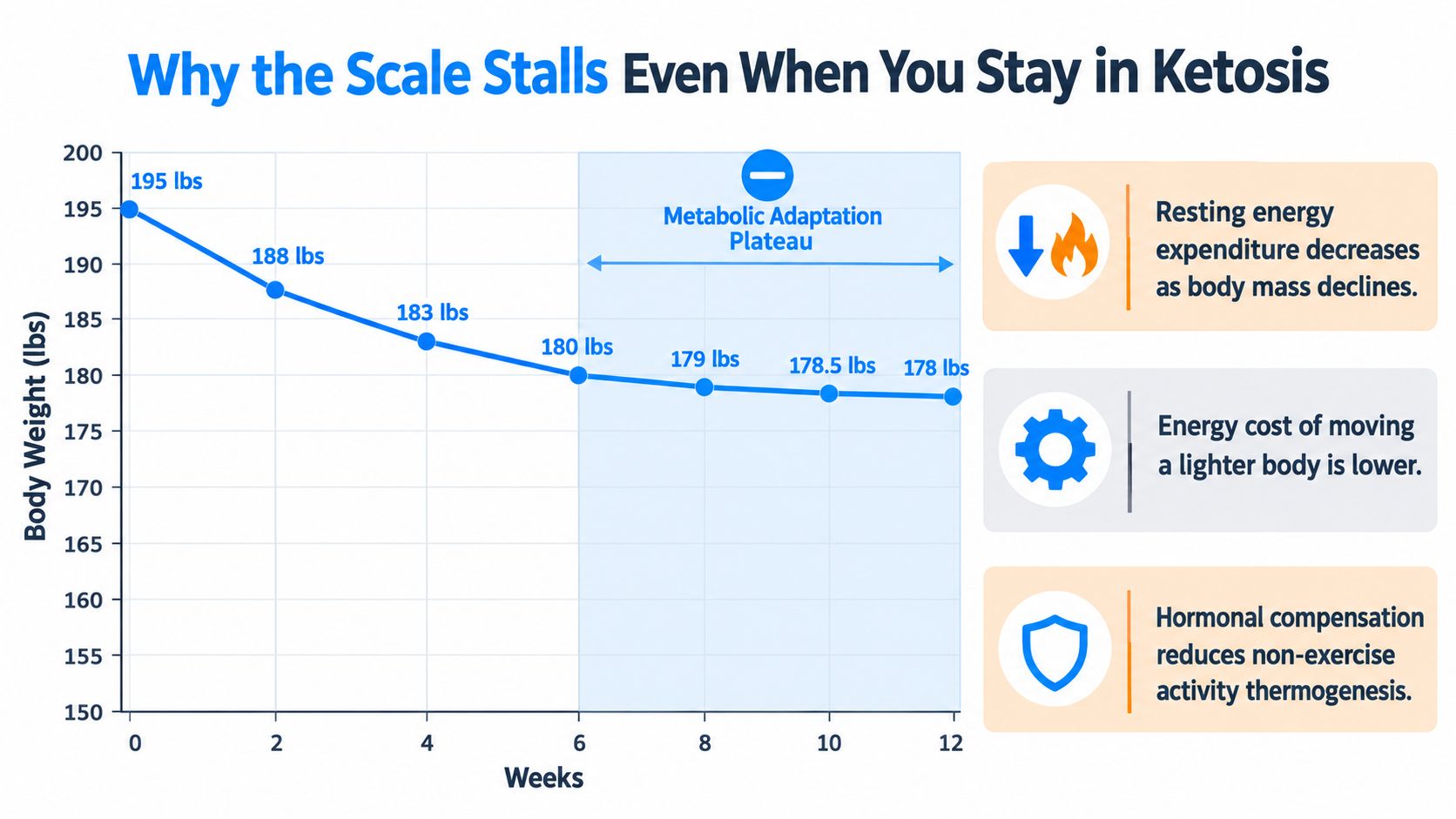
A practical plateau means roughly 4–8 weeks of stagnation despite good adherence, as described in the sports-nutrition position stand on ketogenic diets. Sustained stagnation can reflect a new energy equilibrium or reduced adherence; a few flat days don't establish either.
For more on body-composition changes, see why scale stalls while fat drops. A multi-week weight trend, waist measurements, consistent photos, and strength records provide context that an isolated weigh-in lacks.
Ketone testing answers a different question. A urine result reflects ketones excreted in urine and cannot establish whether stored body fat is decreasing. The guide to urine ketone test kits explains what this measurement captures. Treat it as evidence about ketosis, alongside separate evidence about weight and body composition.
A Step-by-Step Self-Audit to Diagnose Your Plateau
Collect a clear picture before you cut portions or add more exercise. A short audit can distinguish an intake issue from a measurement issue and give you something specific to discuss with a clinician.
For one week, weigh and log all food with a digital kitchen scale. Include protein, added fats, beverages, alcohol, snacks, and the bites that are easy to forget. Compare average intake with an estimate of your current energy needs, not a target chosen because it worked for someone else. A keto macro calculator may help organize macronutrient estimates, but it can't determine by itself whether your plan is appropriate for your health or goals.
Collect measurements alongside the food record:
- Morning weight: Measure under similar conditions and look at the trend, not individual fluctuations.
- Waist and photo: Measure at the navel and take a consistent progress photo.
- Strength and activity: Record a repeatable exercise benchmark, daily steps, and resistance-training sessions.
- Recovery: Note sleep duration and quality, since poor sleep can make routines harder to sustain.
A useful audit includes accurately recorded meals, including weekends. A red flag is a log with missing cooking oils, restaurant portions, alcohol, or frequent untracked bites. This doesn't mean you've done something wrong; it shows where the picture is incomplete.
Review the findings before making one manageable adjustment. If the log is complete and the trend still doesn't make sense, or tracking creates significant stress, ask a registered dietitian or clinician for help rather than tightening the diet further on your own.
Medications, Hormones, and When to Call a Clinician
A plateau isn't always a food-tracking problem. Certain antidepressants, antidiabetic medications, steroids, hormonal contraceptives, and some blood-pressure medicines can affect weight or make weight management more complicated. Don't stop or change a prescription to test that possibility. Ask the prescriber whether your medication plan could be relevant.
Hormonal and medical context can matter too. Thyroid conditions, cortisol-related issues, perimenopause, and polycystic ovary syndrome may affect weight or the way symptoms appear. A clinician can decide whether testing is appropriate, based on your history and symptoms, rather than applying the same laboratory checklist to everyone.
A 2025 multidisciplinary advisory reported placebo-adjusted GLP-1-related weight reductions of roughly 5%–18% in relevant trials (the 2025 multidisciplinary advisory). That information belongs in a medical conversation, not as a promise or reason to self-prescribe. If you take a GLP-1 medication, have appetite or metabolic concerns, or are working with a medical weight-management service, evaluate keto within that care plan. An overview of how supervised weight loss programs work can help you understand the kinds of clinician-guided support such programs may involve.
Contact a healthcare professional if you experience rapid weight changes, persistent fatigue, hair loss, menstrual irregularities, or other concerning symptoms. You might say: “I've tracked my food and weight trends, but progress has stalled. Could my symptoms or medications be affecting this, and what evaluation makes sense?” Keto and exogenous ketones can complement a plan, but they don't replace clinician-supervised care.
Where Exogenous Ketones Fit In
Exogenous ketones can raise circulating BHB without requiring your liver to produce it from body fat. That can make ketones available as an alternative fuel, but it doesn't prove that you're burning stored fat or creating a calorie deficit. Controlled human research has examined how ketone intake changes energy metabolism, including measures in muscle and the heart. Those findings inform physiology; they don't establish that a ketone supplement causes weight loss.
Products also differ. Ketone salts pair BHB with minerals, while ketone esters deliver ketones through an ester structure. Precursors are compounds the body can use to produce ketones. The D-BHB form is the bioidentical form used by the body; not every product has the same composition, and formulation can affect the experience of taking it. Liposomal delivery is used in some products to support absorption and tolerability, but that feature shouldn't be treated as proof of a particular weight-loss outcome.
Tecton's R3HBG is described by the company as a tri-ester that delivers bioidentical D-BHB. The brand states that it has FDA-recognized New Dietary Ingredient status and describes a formulation excluding R-1,3-butanediol, artificial dyes, and sweeteners. Those product details don't change the central point: exogenous ketones provide fuel, not evidence that body fat is falling. For a discussion of evidence and limitations, read whether exogenous ketones work.

For active people who want ketone fuel during training or demanding days, the Tecton EDGE™ Performance Shot + Electrolytes combines liposomal R3HBG ketone with sodium, potassium, and magnesium. Its intended role is energy support during movement, not a shortcut around food intake or medical advice.
Why This Matters
The realistic value of ketone fuel is about how you feel and function, not what a ketone meter implies about fat loss. Some people use exogenous ketones in routines where they want steadier energy, cognitive endurance, or support during exercise. Those are practical outcomes to assess personally; they shouldn't be promised or confused with weight change.
Metabolic flexibility means using available fuels in response to the body's needs. Ketones can be part of that fuel mix, while sustainable fat loss still depends on your overall eating pattern, activity, and clinical context.
Your Application Framework for Breaking Through
Treat stalled progress as a diagnostic puzzle. Ketosis, scale weight, and body-fat change are separate outcomes, like different gauges on a dashboard.
In week one, record food, protein, activity, sleep, morning weight, waist measurement, and a strength baseline without deliberately changing intake. Look for portions, added fats, or untracked foods that could explain why energy intake remains higher than intended. Keep measuring conditions consistent so comparisons are useful.
In week three, make one targeted adjustment based on that record. Measure or reduce added fats if they are driving intake. If carbohydrates vary, review sauces, drinks, packaged snacks, and restaurant portions. Changing one variable makes its effect easier to judge.
Maintain resistance training and adequate protein to support lean mass, considerations discussed in the position stand on ketogenic diets and sports nutrition.
Assess several weeks of weight trends alongside waist measurements, photos, and strength. A flat scale alone cannot settle whether body composition is changing. Bring your records to a clinician if symptoms, medications, or health conditions could be involved.
Practical takeaway: Use energy-balance awareness, consistent measurements, and your health context to decide what to adjust. A ketone reading measures a different outcome from fat loss.
Evaluate steadier energy, cognitive endurance, workout performance, and metabolic efficiency separately from body-composition progress. Subjective energy or focus may matter to your routine, but cannot establish improved efficiency or fat loss.
Tecton Ketones™ offers exogenous ketone products designed to provide bioidentical BHB fuel without requiring a strict ketogenic diet. Review Tecton Ketones™ product information against your goals, keeping fuel support separate from weight-management expectations.


