


A blood ketone reading can rise sharply after a supplement even when the body hasn't switched to the same fuel-producing state created by a low carb diet. That's the central distinction behind low carb diet and ketones: ketone concentration tells you that ketones are circulating, but not by itself why they're there or what else is happening metabolically.
A low carb diet can prompt the liver to make ketones from fatty acids. Fasting can raise ketones through a related shift in fuel availability. An exogenous ketone product supplies ketones directly. Those routes can produce a similar reading while supporting different physiological conditions, so the right approach depends on the outcome you want.
Why Not Every Ketone Rise Means the Same Thing
Two people can measure the same blood beta-hydroxybutyrate level and arrive there by different routes. One may have restricted carbohydrates long enough to increase the liver's own ketone production. The other may have taken an exogenous ketone, which raises circulating BHB without necessarily increasing the breakdown of stored body fat or reproducing the longer-term adaptations of a ketogenic diet.
That's why ketone concentration isn't a complete metabolic report. It shows that ketones are present in the blood, but doesn't reveal whether they came from the liver or a supplement, whether insulin signaling has shifted, or whether the person has adapted to using more fat and ketones as fuel.
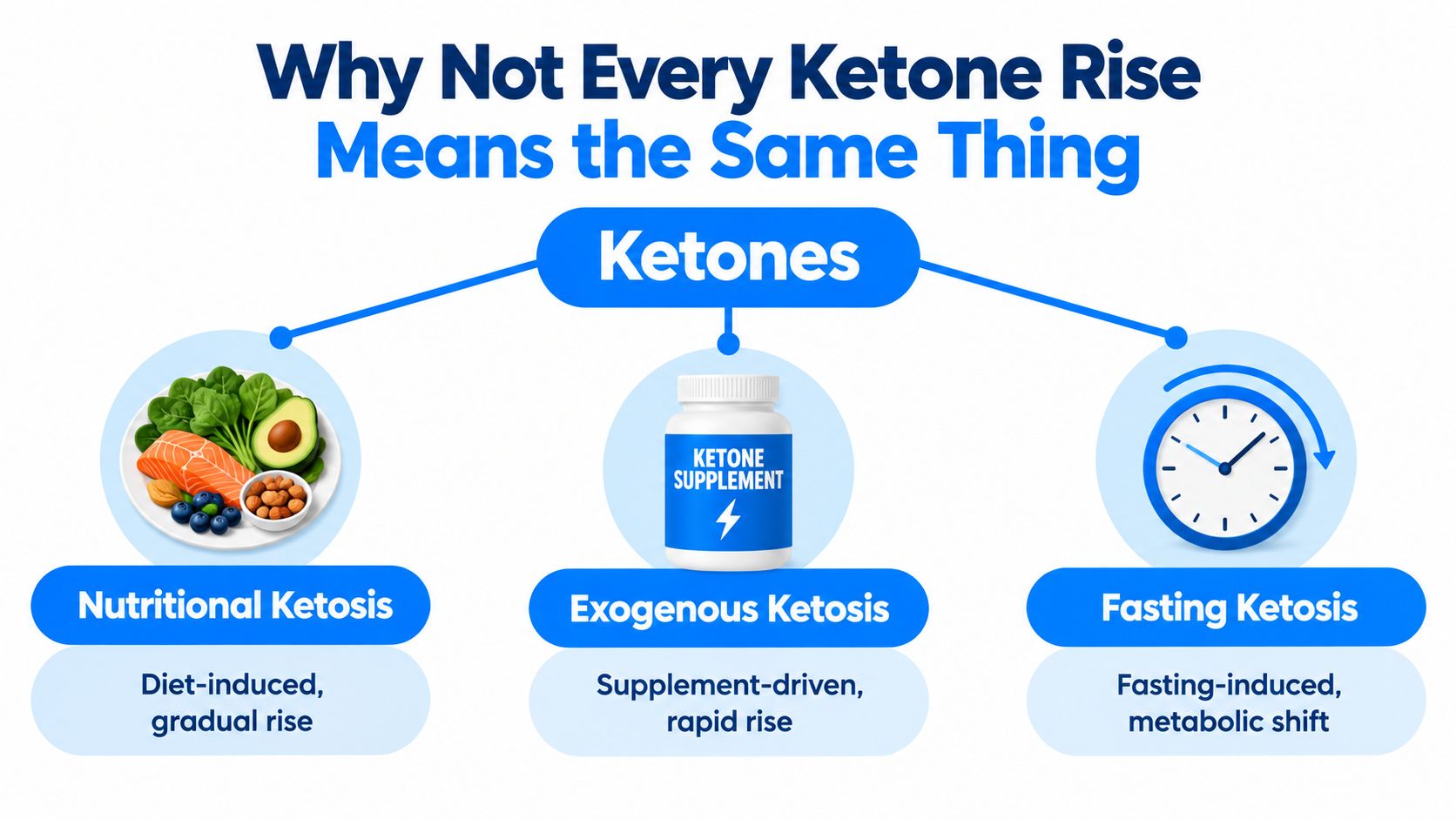
Three routes to circulating ketones
Nutritional ketosis develops when carbohydrate restriction changes the balance of fuel available to the body. Lower carbohydrate availability reduces insulin signaling and can increase the release of fatty acids from adipose tissue. The liver then uses fatty acids to make ketones, including BHB and acetoacetate.
Fasting ketosis is another form of endogenous ketone production. As time passes without food, the body relies more heavily on stored fuel, and the liver produces more ketones. Exercise and sustained low-carbohydrate eating can also affect circulating ketone levels.
Exogenous ketosis starts with a ketone product rather than a dietary change that prompts the liver to make more ketones. A 2025 scoping review explains that exogenous ketones can raise circulating BHB but are “not in themselves ketogenic.” They provide ketone fuel without necessarily increasing endogenous fat oxidation, lowering insulin, or triggering the broader adaptations associated with a ketogenic diet (review of exogenous ketones).
Let the goal guide the method
Before choosing a diet or supplement, clarify what you want to achieve. Are you looking for fuel availability, support around performance, help maintaining an appetite routine, or a therapeutic diet under clinical supervision? Those goals call for different approaches and different ways to assess results.
Practical rule: A blood BHB result answers how much BHB is circulating at that moment. It doesn't prove that a supplement has recreated the metabolic changes of a low carb diet.
How a Low Carb Diet Triggers Ketogenesis
A low carb diet changes the flow of fuel through the body in stages. With less carbohydrate available, insulin signaling falls. That shift encourages adipose tissue to release fatty acids, which travel to the liver and can be oxidized there. The liver then produces acetoacetate and BHB, which enter circulation and can be used by other tissues.
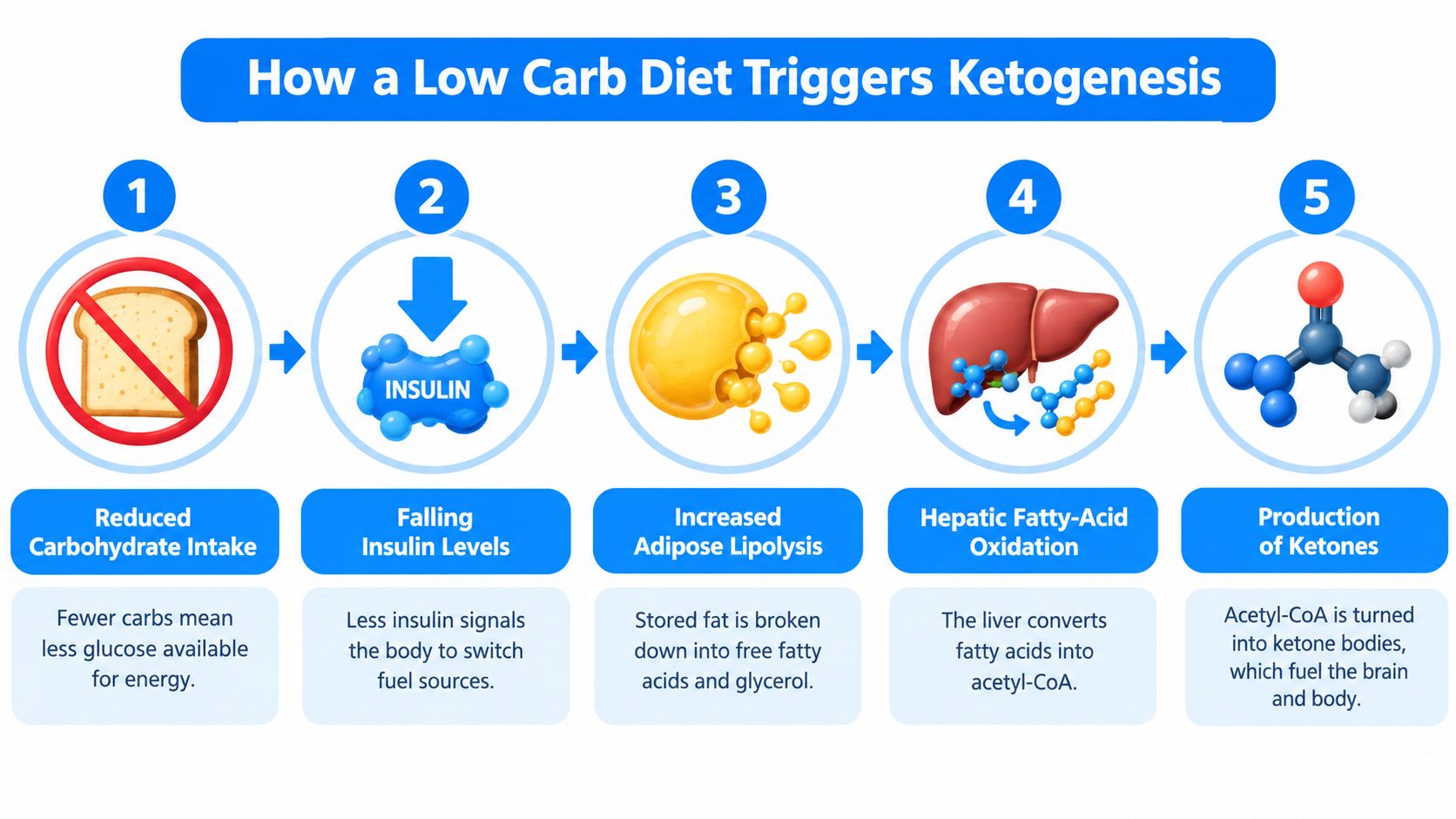
From dietary change to alternative fuel
The liver is the production site, not a storage tank for a large reserve of ketones. It releases ketone bodies into the blood, where tissues can take them up and use them. BHB can cross the blood–brain barrier through monocarboxylate transport systems, making it available to the brain as well as to the heart and skeletal muscle.
A simple analogy is a hybrid vehicle. Glucose is one fuel source; ketones are another. A low carb diet doesn't mean the body stops using glucose, but it can increase the contribution of ketones as carbohydrate availability falls. That ability to move between fuel sources is metabolic flexibility.
The shift takes time, and individual responses vary. Protein intake, total energy intake, exercise, insulin sensitivity, and medication use can all affect ketone production. A fixed timeline or carbohydrate threshold shouldn't be treated as a guarantee that every person will reach the same BHB level.
Put fasting values in context
In healthy adults, circulating ketones are approximately 50 micromolar in the fed state, can rise to about 1 millimolar after 16–20 hours of fasting, and can reach as high as 7 millimolar during prolonged starvation, post-exercise states, or sustained low-carbohydrate eating (peer-reviewed review of ketone metabolism). These values describe different physiological contexts, not a scorecard where higher is always better.
A BHB range around 0.5–3.0 mmol/L is commonly associated with nutritional ketosis, though responses vary between people. That state is distinct from diabetic ketoacidosis, a dangerous condition involving markedly high ketones and metabolic acidosis. People with diabetes or medication-related risks shouldn't attempt to manage ketone levels on their own.
For readers looking at broader metabolic habits, this resource on practical insulin resistance strategies offers related context. Diet composition also matters, and this guide to keto macro ratios can help readers understand how fat, protein, and carbohydrate fit together.
A physiological overview can help connect those steps visually:
Measuring Ketones Accurately and What the Numbers Mean
Ketone tests don't all measure the same molecule. Blood meters measure BHB, the main circulating ketone body and a direct way to track a momentary rise. Breath analyzers measure acetone, a byproduct related to ketone metabolism. Urine strips detect acetoacetate excreted in urine, which may be less useful as the body adapts and changes how much it disposes of.
A test should match the question you're asking. If you want to check whether BHB rose after a product, a blood measurement is more direct than urine. If you're following a dietary pattern over time, consistency in testing conditions matters more than treating a single reading as a verdict.
| Method | Ketone measured | Response time | Best use case |
|---|---|---|---|
| Blood meter | BHB | Direct reading at the time of testing | Checking circulating BHB, including after a supplement |
| Breath analyzer | Acetone | Indirect signal that can lag changes in blood ketones | Following broad trends without a blood sample |
| Urine strip | Acetoacetate | Reflects ketone excretion in urine | A simple early check, with limitations as adaptation changes |
Read the value with its context
In a human study of obese women on a ketogenic diet, circulating ketones increased significantly, with serum BHB reaching approximately 1.235 mmol/L at an early measurement and remaining high through 8 weeks (human ketogenic-diet study). That's a diet-related measurement over time, not the same kind of response as a short-lived post-supplement rise.
The source of the ketones matters. A blood reading after taking an exogenous product can indicate that the product raised circulating BHB. It can't, by itself, show that the liver increased ketone production or that the person is oxidizing more stored fat. Record whether the test followed food, fasting, exercise, or supplementation so the number has meaning.
For a closer look at the strengths and limits of urine testing, see this guide to a urine ketones test kit. Whatever the method, use it consistently and interpret it alongside the behavior or outcome you're tracking.
Endogenous Versus Exogenous Ketosis Compared
A blood BHB reading can look identical whether it came from days of carbohydrate restriction or a single serving of a supplement. The mechanism behind it is different. Endogenous ketones are produced by the liver from fatty-acid-derived fuel, while exogenous ketones arrive already formed in a product. That difference shapes how quickly levels rise, and what the number says about your own fuel production.
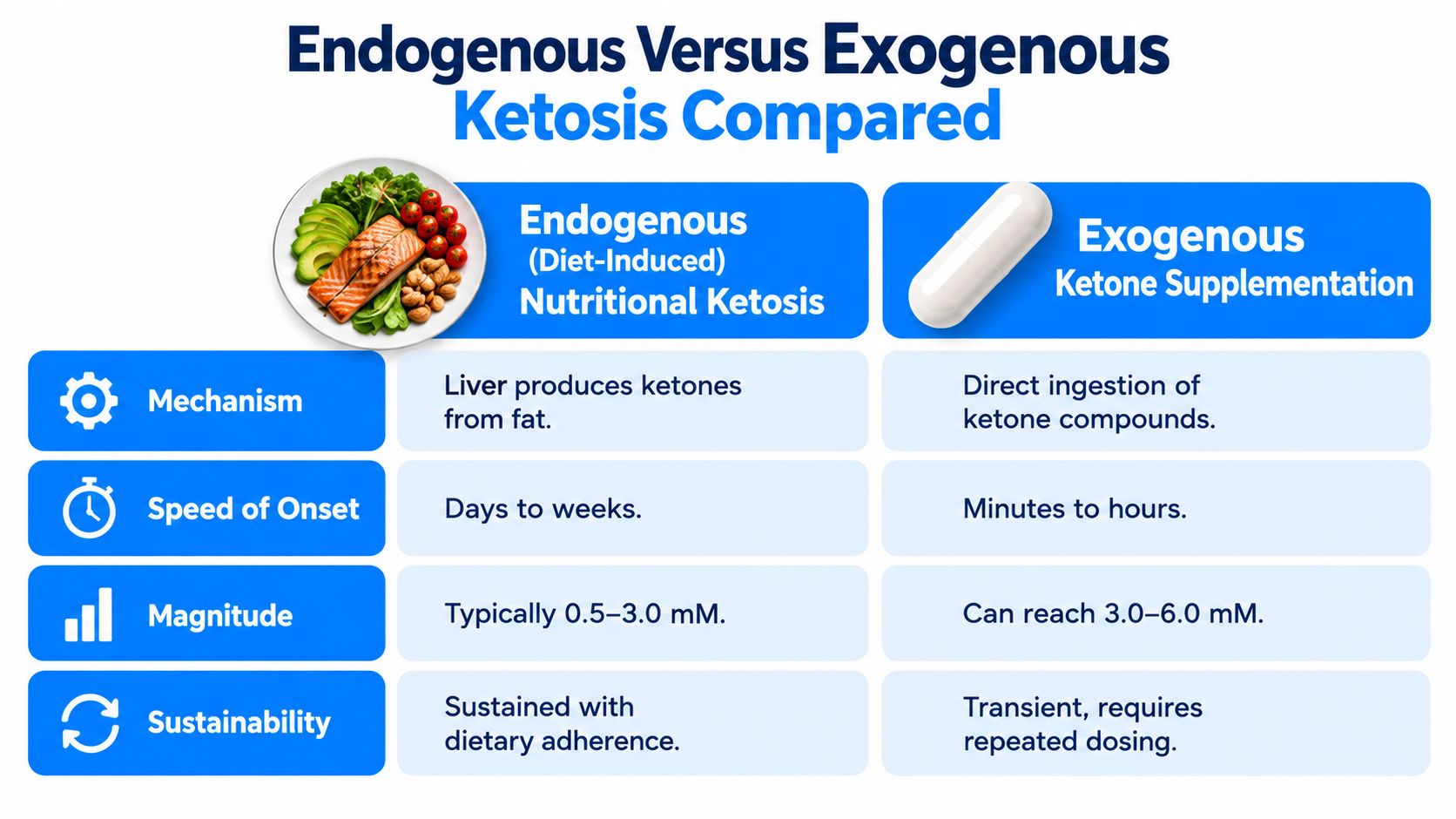
Compare the pathways, not just the number
A meter reading works like a fuel gauge: it shows how much is circulating, not which pipeline filled it.
| Comparison point | Endogenous nutritional ketosis | Exogenous ketone supplementation |
|---|---|---|
| Source | The liver makes ketones from fatty-acid-derived fuel during carbohydrate restriction or fasting. | A supplement supplies ketone compounds or a precursor that the body converts. |
| Onset | Develops as dietary and metabolic conditions change. | Can produce a rapid rise in circulating BHB after ingestion. |
| What it signals | Greater endogenous ketone production in the context of reduced carbohydrate availability. | Greater circulating ketone availability, not necessarily increased endogenous fat oxidation. |
| Adaptation | Diet adherence can support ongoing use of fat and ketones as fuel. | A rise in BHB doesn't by itself reproduce the full adaptation to a ketogenic diet. |
| Practical trade-off | Requires a sustained dietary pattern that may not suit every routine. | Can add ketone fuel without requiring carbohydrate restriction, but its effects depend on product and timing. |
In a human study, 24 healthy adults who consumed a ketone monoester at 25 mL three times daily for 28 days saw blood BHB climb from approximately 0.1 to 4.1 ± 1.1 mmol/L after dosing (human ketone monoester study). Measures of body composition, fasting glucose, cholesterol, triglycerides, electrolytes, blood gases, and kidney function remained unchanged within normal ranges in that protocol. Those findings describe that study's participants and dosing schedule; treat them as evidence of what supplementation can do to a reading, not a guarantee of an identical response.
Choose based on the job
Match the pathway to the goal you're pursuing.
- Shift baseline fuel use over time. Diet-induced ketosis is the relevant approach, because the liver adapts its ketone production in response to sustained carbohydrate restriction.
- Make ketones available around a specific activity. An exogenous product can raise circulating BHB without requiring dietary change first.
- Interpret a blood reading correctly. Knowing which pathway produced the number decides what it can prove about fat metabolism.
- Sustain the approach long term. The better option is the one you can maintain, since adherence shapes outcomes more than any single measurement.
Neither pathway turns one BHB reading into proof of a specific health outcome. People also vary in their ability to maintain a ketogenic eating pattern, and a dietary strategy should be selected with personal circumstances and clinical needs in mind.
Ketone Salts, Esters, Precursors, and Bioidentical D-BHB
A higher ketone number is not one result. Product chemistry decides which isomer reaches the blood, how quickly it appears, what else arrives with it, and whether the rise resembles liver-made D-BHB or only proves that a dose was absorbed.
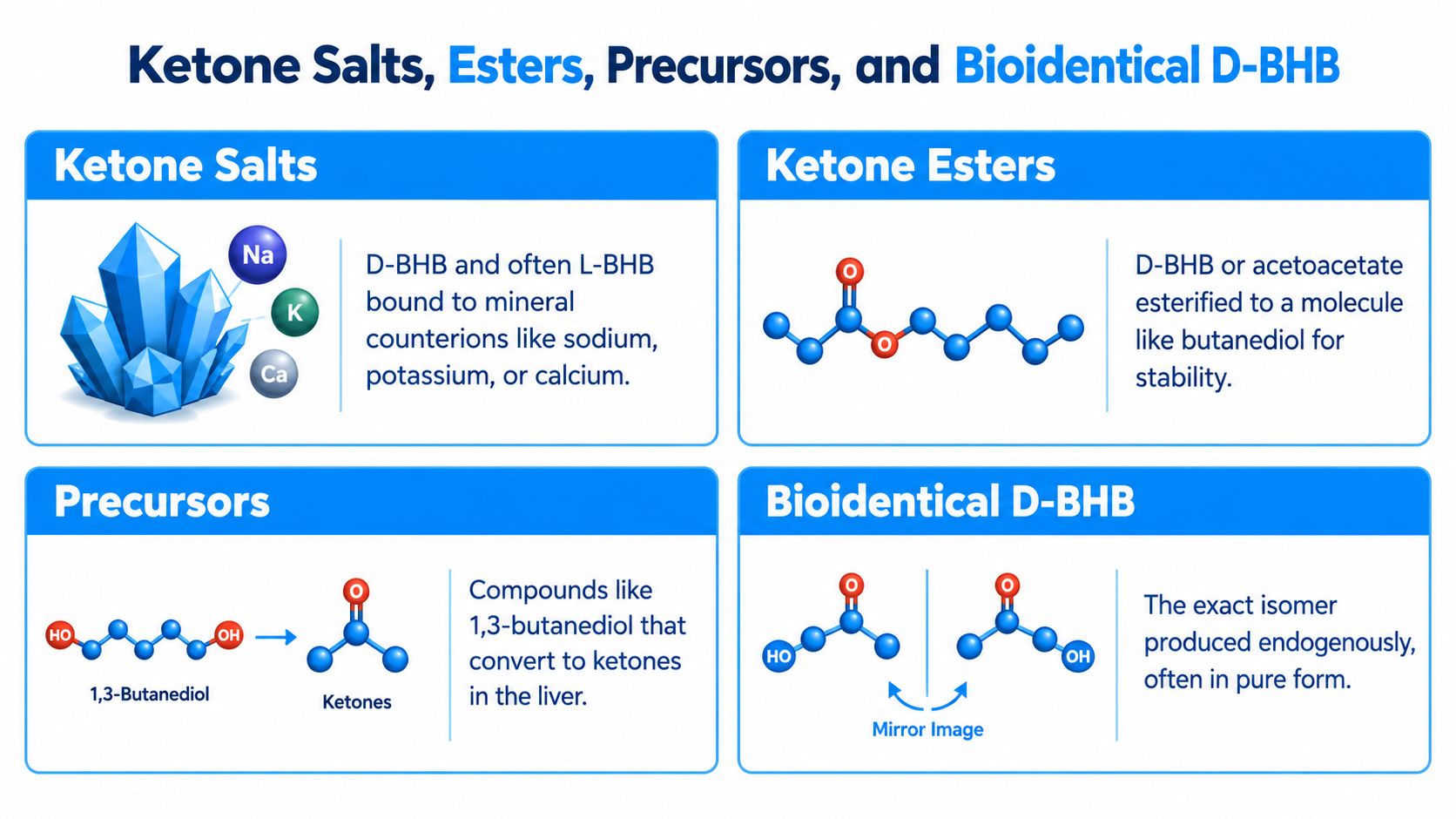
Read the molecule before the marketing
Ketone salts attach BHB to mineral counterions such as sodium, potassium, or calcium. A salt works like a delivery truck with extra passengers: it can bring BHB quickly, while the mineral load still counts for anyone managing electrolyte intake or following clinical limits. In a controlled human comparison, ketone-ester drinks produced blood D-BHB concentrations more than 50% higher than ketone-salt drinks, while racemic salts also raised L-BHB, which was cleared more slowly than the naturally utilized D-isomer (human comparison of ketone forms). Two labels can both say “BHB” and still produce different curves.
Ketone esters use bonds that are broken down to release ketone substrate, often pushing D-BHB up faster than salts. Speed has a cost profile: taste, gastrointestinal tolerance, dose size, and price can decide whether a theoretically stronger rise is usable outside a lab.
Precursors sit one step upstream and must be converted before BHB appears. Their effect depends on digestion and hepatic handling, so treat them as indirect inputs rather than instant D-BHB.
Bioidentical D-BHB is the isomer the body produces and uses in nutritional ketosis. The name still does not settle the formulation question. Source, carrier system, dose, and any liposomal delivery claim are product-specific details, not automatic proof of absorption or benefit.
The distinction protects an inference. Diet-induced ketosis means the liver has adapted to sustained carbohydrate restriction. An exogenous rise can place D-BHB in circulation for a defined window without that adaptation.
Turn the label into a decision
Ask four questions before comparing products: which isomer is supplied, whether L-BHB is present, how much mineral load comes with each serving, and what evidence exists for that exact formulation. Match the answers to the job: baseline fuel adaptation points toward dietary change, a short performance window points toward D-BHB delivery and tolerability, strict sodium or potassium limits argue against high-salt formats, and racemic blends make one meter reading harder to interpret.
For example, the Tecton EDGE™ Performance Shot + Electrolytes is described as a liposomal R3HBG ketone shot with sodium, potassium, and magnesium for active individuals seeking energy support during training or physically demanding days. That description identifies its intended use and listed electrolytes; it doesn't establish that every user will experience the same response.
A clear label tells you what enters the body. The goal decides whether that entry matters.
Why This Matters for Energy, Focus, and Performance
A higher ketone reading means fuel is available. It says nothing, on its own, about whether output improved. Inside a cell, BHB converts back to acetoacetate and then to acetyl-CoA, which feeds the mitochondrial tricarboxylic-acid cycle. That cycle generates the reducing equivalents that drive oxidative phosphorylation, the process mitochondria use to produce ATP, the cell's spendable energy.
Glucose reaches the same destination by a different road. Its carbons pass through glycolysis before entering mitochondrial metabolism, so the two fuels converge on acetyl-CoA rather than running on separate machinery. Metabolic flexibility is the capacity to shift how much each pathway contributes as conditions change, and a low carb diet trains that capacity over weeks of adaptation. An exogenous dose raises circulating BHB within minutes. Raising the fuel supply and adapting the engine are different events, which is why a meter spike after a supplement is not the same physiological state as nutritional ketosis.
What the evidence can and can't tell you
For cognitive outcomes, a systematic review and meta-analysis pooled 38 studies, 41 protocols, and 1,602 participants. It found a modest, statistically significant effect for exogenous ketones, with a standardized mean difference of 0.29, alongside very high heterogeneity (I² = 91%) (systematic review and meta-analysis). Heterogeneity that large means the average hides wide variation between studies. An average effect cannot tell you whether you, on a given task, will feel sharper than you would after adequate sleep, hydration, food, or caffeine.
On the fuel side, the ketone-ester trial described earlier raised mean D-BHB from 0.7 ± 0.3 mmol/L to 4.0 ± 1.1 mmol/L within 30 minutes, while blood glucose fell 28.8%, lactate fell 28.2%, and non-esterified fatty acids fell 49.1% after ingestion. Those are measured shifts in circulating fuels over a defined window. Whether they translate into training gains or a felt energy boost is a separate question the data does not answer.
Match the expectation to the mechanism
- Steadier energy: Ketones add a fuel source, but the subjective experience depends on context and cannot be read off a blood value alone.
- Cognitive endurance: The pooled evidence is promising yet variable, so treat ketones as a possible adjunct rather than a substitute for sleep, hydration, or a suitable meal.
- Workout performance: A rapid rise in BHB increases fuel availability for a limited window. Whether a specific session improves depends on the activity, product, timing, and your own response.
- Metabolic efficiency: The useful capacity is switching between fuel sources when conditions change, which dietary adaptation builds over time rather than a single dose.
Anyone comparing approaches to sustained energy and focus benefits from asking which metabolic route each ingredient takes, rather than treating all fuel-support products as interchangeable.
An Application Framework for Real-World Use
A blood ketone reading answers a "what" question. Your goal supplies the "why," and the "why" decides which route makes sense. Work through the decision in order: define the outcome, choose the mechanism, then match the product form to the job.
- Adapting over weeks: If the goal is a body that produces and uses its own ketones, a low carb diet is the mechanism. A cyclical ketogenic diet is one structured way to run that pattern, pairing restriction periods with planned carbohydrate days.
- Raising BHB for a defined window: If the goal is circulating ketone fuel on demand, an exogenous product is the mechanism. Supplemental ketones work like borrowing fuel for a single trip, where dietary adaptation is your body learning to produce it. That distinction matters, because the same product that suits a hard training session adds little to long-term metabolic flexibility.
- Matching the form to the job: Esters push BHB highest and fastest, salts rise more gradually alongside an electrolyte load, and a precursor asks your liver to finish the work. A higher peak is not the same thing as a better outcome, so let the goal pick the chemistry rather than the other way around.
- Knowing when to ask first: If you have diabetes, kidney disease, liver disease, or take medications that affect ketone metabolism, bring a clinician into the decision before supplementing. A supplement should never stand in for management of a medical condition.
Keep a simple record of blood BHB when relevant, subjective energy, training output, and sleep quality. Compare similar conditions and look for a consistent pattern rather than relying on a single reading.
Tecton Ketones™ offers exogenous ketone products that deliver BHB without requiring a strict ketogenic diet, including a performance shot with electrolytes for training and physically demanding days. To weigh diet-induced ketosis against supplemental ketone fuel for your own routine, review the options at Tecton Ketones™.


