


You know the moment.
You're on your second coffee. The first one made the screen look manageable. The second one made your mind feel busy, but not necessarily precise. You're awake, yet your attention keeps slipping. You reread the same sentence, open another tab, and wonder whether caffeine stopped working or whether you're using it wrong.
That's the question behind caffeine and focus.
Many think in a yes-or-no frame. Does caffeine help concentration or not? But that's too simple. In practice, focus depends on a dose-timing-fuel system. Caffeine can sharpen attention. It can also overshoot, disturb sleep, and leave the next day worse than the first. And because caffeine is not fuel, the background energy state of the brain matters more than many realize.
If you want a broader behavioral lens on concentration habits, the Orange Neurosciences focus guide is a useful companion resource. For people already looking beyond another cup of coffee, it also helps to review healthy alternatives to coffee for energy.
Sustainable focus is not just “feeling alert.” It's being able to hold attention, respond accurately, and keep mental output stable without borrowing too much from sleep or doubling your dose every week.
Introduction Why Caffeine Feels Like Focus Until It Does Not
A common pattern looks like this. Morning coffee works well. Midday caffeine feels weaker. Late afternoon caffeine seems necessary, but that same dose pushes sleep later, lightens sleep quality, or leaves you tired but wired.
The confusion starts because subjective alertness and measured attention are not the same thing. You can feel stimulated and still perform poorly on tasks that need precision, patience, or error control. You can also feel only mildly different and still show better reaction time or steadier vigilance.
The trap of chasing the feeling
Caffeine often gets judged by sensation alone.
If you feel a clear lift, you assume it's helping. If that lift fades, you assume you need more. That's where many people drift from focused into jittery. The nervous system gets louder, but the work quality doesn't improve.
Practical rule: Treat caffeine like a tool for task performance, not a tool for producing a stronger internal sensation.
The more useful question is not “How much caffeine wakes me up?” It's “What amount improves the type of attention I need today, at a time that won't sabotage recovery tonight?”
What changes the outcome
Three variables usually determine whether caffeine helps or backfires:
- Dose: Small amounts may be enough for one person and too little for another.
- Timing: A well-timed dose can help a deep work block. A late dose can shift the cost into sleep.
- Fuel context: Caffeine masks fatigue signals. It doesn't deliver calories or direct cellular fuel.
That last point matters. If your brain is under-fueled, underslept, or running through a long gap between meals, caffeine may create a sharper surface feeling than the underlying physiology can support.
How Caffeine Sharpens Attention in the Brain
You drink coffee at 1 p.m., and twenty minutes later the screen looks less foggy. That change feels like added energy, but the main early effect is different. Caffeine changes the brain's signaling about fatigue.
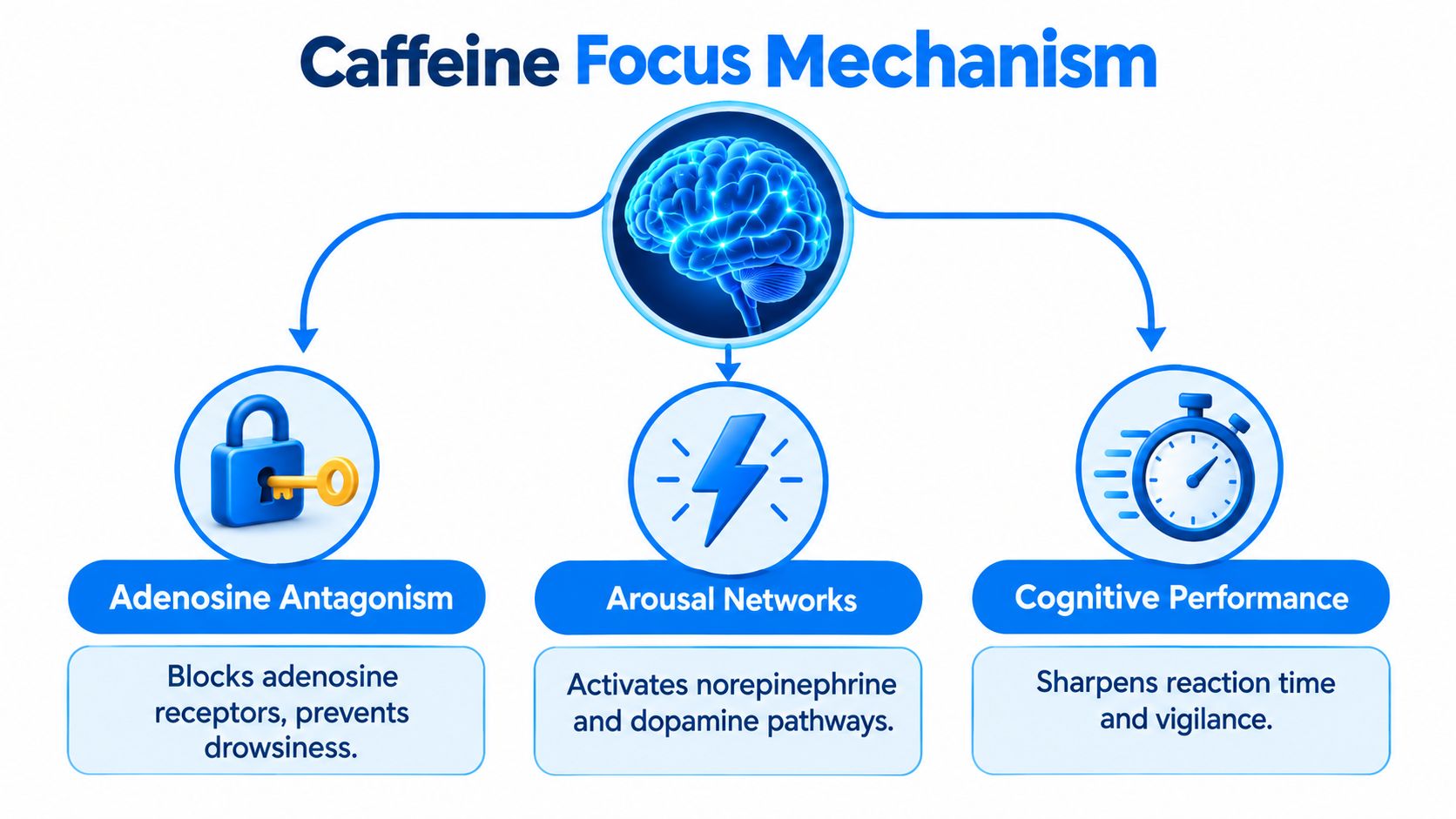
Adenosine is the brake signal
As waking hours accumulate, the brain builds sleep pressure. One part of that process involves adenosine, a signal that makes effort feel heavier and attention harder to hold. Caffeine binds to adenosine receptors and blocks part of that message, so the brain gets less of the usual “slow down” input.
A useful analogy is a dimmer switch, not a fuel tank. Caffeine can turn down the signal for fatigue. It does not supply calories, and it does not replace sleep.
That distinction matters because focus depends on more than alertness. If caffeine lowers the brake signal while the brain is still short on recovery or usable fuel, you may feel more switched on than your performance can support.
Attention has several parts
“Focus” is a bundle of functions, not one single setting.
A demanding work block might require you to stay engaged with a boring task, respond quickly to new information, and avoid small mistakes at the same time. Those are related skills, but they are not identical. One person can get faster yet sloppier. Another can feel only mildly stimulated and still become more steady.
In a randomized, placebo-controlled, double-blind crossover study, a single 60 mg oral caffeine dose improved sustained attention, reaction time, peak saccadic velocity, and error rate versus placebo in healthy adults, which helps explain why even a modest amount can sharpen task performance for some people (PubMed study).
Why the effect can feel clean or chaotic
Once adenosine signaling is blocked, other alerting systems become easier to recruit. For the right task and dose, that can feel like cleaner mental traction. You hold your place better. You respond sooner. Distracting signals carry less weight.
But the same mechanism can overshoot.
If arousal rises past what the task needs, attention stops feeling stable and starts feeling noisy. That is why caffeine works better as part of a dose, timing, and fuel system than as a stimulant you add on top. The same cup can help one day and backfire the next, depending on sleep pressure, what you have eaten, and whether the brain also has access to steadier fuel such as ketones.
Caffeine sharpens attention best when it reduces fatigue signaling without pushing the nervous system past the level the task can use.
Repeated use also changes the picture. The receptor effect still exists, but the subjective lift often becomes less dramatic with time. Part of what feels like “focus” in a habitual user may be reversal of baseline withdrawal, not a fresh performance gain.
Caffeine works like wiping condensation off a windshield. Vision improves quickly. If the trip is long, the engine still needs real fuel, and the driver still needs sleep.
Finding Your Effective Dose Without Overdoing It
You drink one coffee before a focused work block and feel clear. You drink a second to get more of the same, and the result changes. Typing gets faster, but judgment gets looser. That shift is the dosing problem.
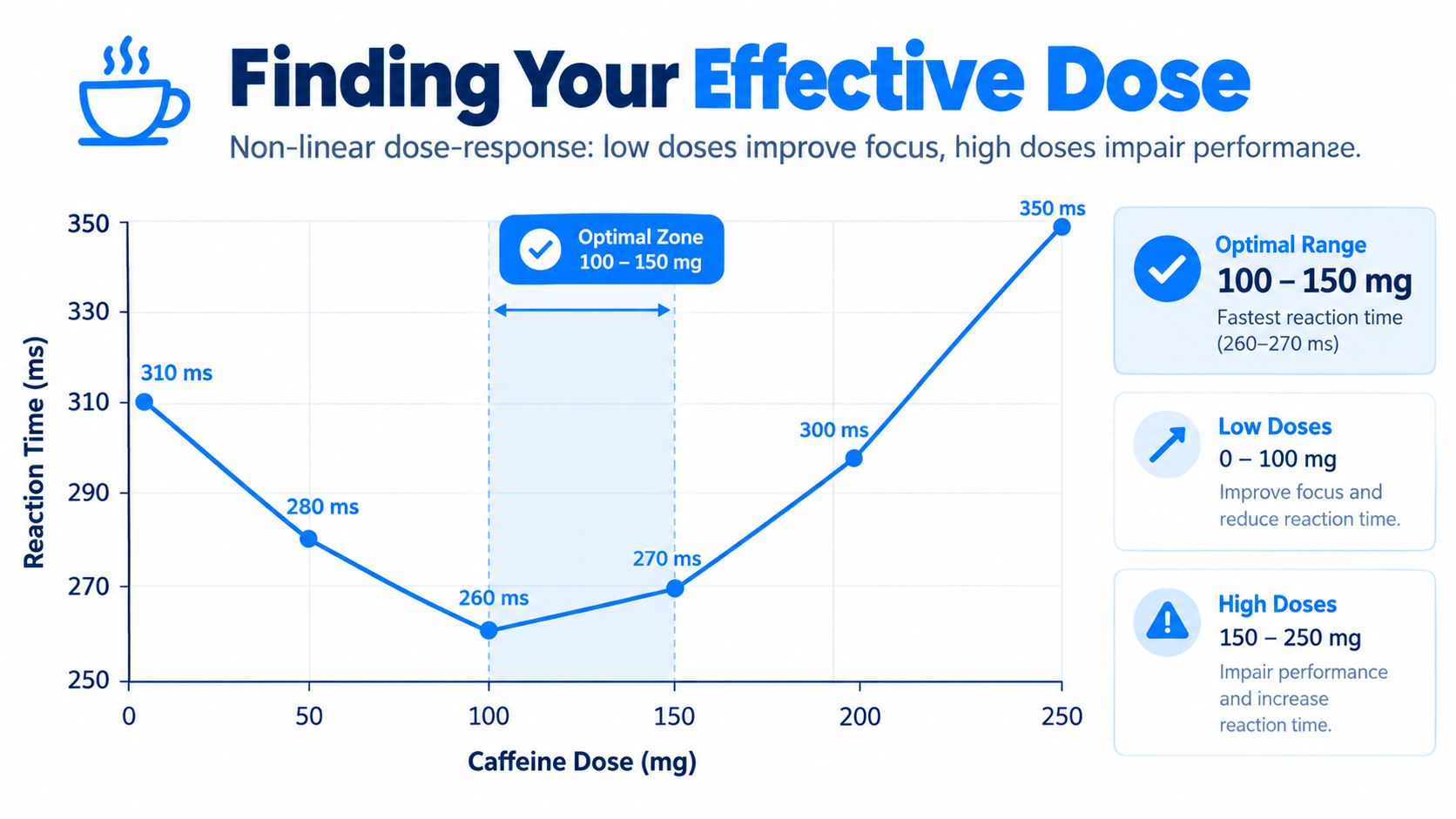
Caffeine has a useful range, not a simple more-is-better effect. The goal is to reach the level that lowers fatigue enough for the task, while keeping control, accuracy, and later sleep intact.
What the human data suggests
A recent systematic review and meta-analysis found that acute caffeine can improve attention measures such as accuracy and reaction time in healthy adults (PMC review).
The pattern inside that review matters more than the headline. Reaction speed may continue to improve at higher doses, while accuracy does not always follow in parallel. For real work, that is a meaningful split. A dose that helps you answer sooner can still make you less precise.
That is why an effective focus dose is task-specific. Fast responses help in some settings. In editing, analysis, and decision-heavy work, a small rise in error rate can erase the benefit of feeling more alert. The U.S. Food and Drug Administration also notes that caffeine sensitivity varies widely, so the same amount can feel steady in one person and excessive in another (FDA overview).
A useful companion if you want context on upper-intake decision making is this daily caffeine max guide.
Why one person does well at 60 mg and another does not
Dose works like a volume knob, but the setting depends on the room. The same intake lands differently based on sleep debt, baseline stress, usual caffeine exposure, and the kind of mental work in front of you.
A simple alertness task can tolerate more stimulation than a task that requires inhibition, careful reading, or error checking.
Fuel also changes the picture. If you are underfed, between meals, or in a fasting window, the brain may be asking for energy as much as stimulation. In that situation, adding more caffeine can feel like pressing harder on the gas when the tank is low. If ketones are available, including BHB, some people experience steadier mental energy with less need to keep raising caffeine just to feel functional.
A metabolic support tool can also matter on days when appetite, meal timing, or fasting windows are irregular. For example, GLP-1 Shot is a metabolic support ketone shot designed for people handling appetite changes, fasting windows, or midday energy dips, and it is designed to support structured habits without relying on aggressive stimulants or appetite suppressants.
A low-start calibration method
Use a short personal trial and keep the setup boring. Boring is good here because it lets you see the dose effect instead of guessing.
- Pick one repeatable task. Use the same type of work each time, such as writing, reviewing spreadsheets, or studying.
- Start with a low dose. Enough to notice, not enough to force intensity.
- Track three outputs. Record perceived focus, actual accuracy or error rate, and sleep that night.
- Increase only if all three stay acceptable. If speed rises but precision drops, you passed your useful range.
- Keep fuel in mind. Note whether you were fasted, underfed, or using ketones, because the same caffeine dose can feel different when brain energy is different.
That last step matters. Caffeine is only one part of the system. The best dose is the one that matches the task, fits the timing, and works with your available fuel instead of trying to overpower low energy with more stimulation.
After you understand your own curve, this short explainer can add context:
If a higher dose makes you faster but less accurate, it is a stronger stimulant dose, not a better focus dose.
Timing Tolerance and Side Effects That Undermine Focus
Even a reasonable caffeine dose can fail if timing is poor. Many blame the amount first, but the schedule often causes the problem.
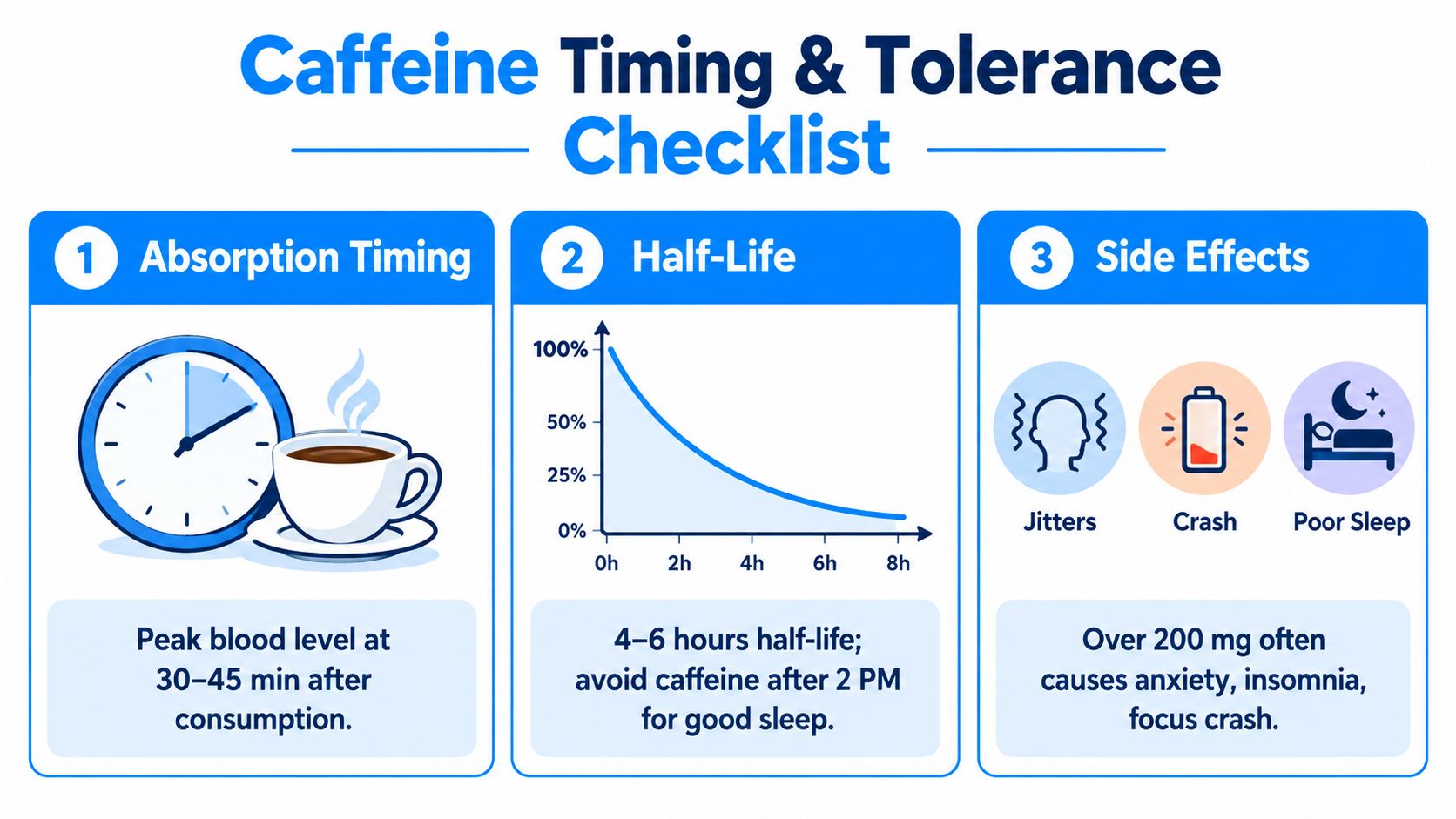
Timing changes the result
Caffeine works best when you attach it to a defined demand. A deep work block, an exam period, or a training session makes more sense than steady sipping from morning through late afternoon.
What often undermines caffeine and focus is not a dramatic crash. It's the quieter pattern of scattered attention, rising tension, and delayed sleep onset.
People who want a steadier, less stimulant-dependent approach often do better when they separate “I need brain energy” from “I need more stimulation.” That distinction is part of the logic behind energy without crash strategies.
Tolerance and side effects to watch
Common signs that caffeine is no longer helping the way you think it is:
- Rising dose creep: You keep increasing intake to recreate the first-week effect.
- Task avoidance disguised as activation: You feel switched on but keep bouncing between tabs.
- Sleep erosion: You fall asleep later, wake less refreshed, or need earlier caffeine the next day.
- Body noise: Jitters, increased heart awareness, digestive discomfort, or anxious urgency start crowding out concentration.
A simple daily protocol
Try this instead of all-day caffeine exposure:
- Use it intentionally: Reserve it for blocks that need vigilance or rapid output.
- Protect late-day sleep: If sleep gets lighter, move the dose earlier rather than increasing it.
- Pair with basics: Food, fluids, and a stable work window often improve tolerability.
- Take periodic lower-use days: That can help you notice whether you still respond to modest intake.
Protecting sleep is part of protecting focus. The brain keeps the bill even when the coffee feels productive.
Why This Matters When Your Brain Runs on Ketones Too
Caffeine changes signaling. Ketones change fuel availability. That difference is central if you care about stable attention rather than a brief alertness spike.
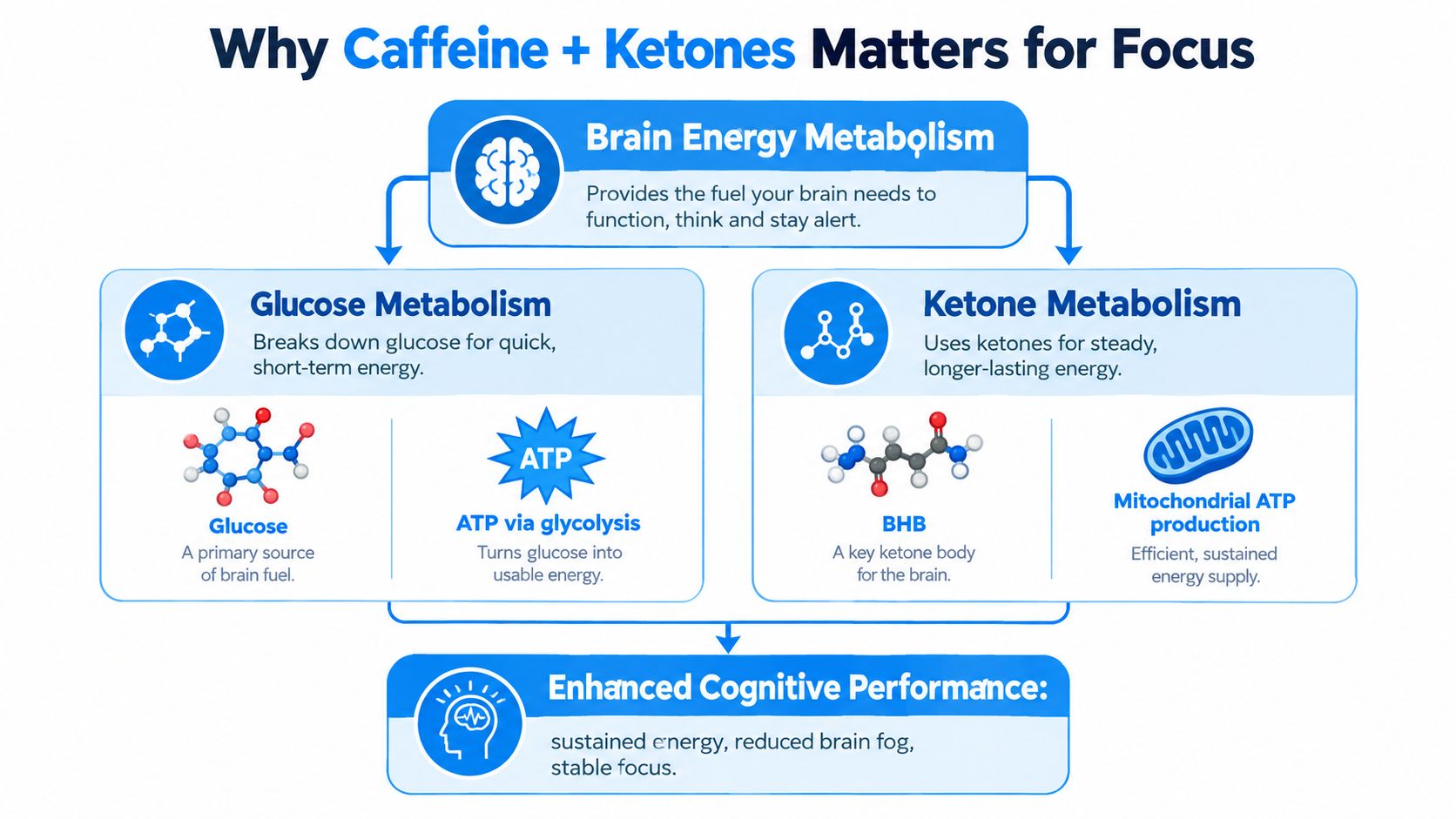
BHB is a fuel, not just a buzzword
The main circulating ketone relevant here is beta-hydroxybutyrate, or BHB. When BHB is available, cells can use it as an energy substrate. In plain language, it gives mitochondria another input for ATP production, the usable energy currency cells rely on.
That matters in the brain because focus is expensive. Holding attention, filtering distractions, and maintaining output all require constant energy turnover.
A human trial of ketone monoester supplementation in young adults reported that acute ketone ingestion raised blood BHB, lowered glucose, and reduced cognitive interference. The abstract states that raised BHB improved cognitive function through neurometabolic pathways involving BHB, glucose, and prefrontal connectome measures (PubMed trial).
Glucose and ketones are different pathways
The brain commonly uses glucose, but it can also use ketones. That's where metabolic flexibility comes in. Metabolic flexibility means the body can shift between available fuels rather than depending heavily on one pathway.
When that flexibility is better supported, many people describe the result as steadier output. Less sharp rise, less hard drop.
This is also where it helps to distinguish three related ideas:
- Nutritional ketosis: A diet-induced state, usually achieved through carbohydrate restriction.
- Endogenous ketone production: Ketones your body makes on its own during fasting or carbohydrate restriction.
- Exogenous ketone supplementation: Ketones delivered directly through a supplement, without waiting for diet or fasting to generate them.
For a practical background on how these systems intersect, see ketosis and caffeine.
What human ketone studies add
Exogenous ketones are not all the same. Form matters.
A ketone ester drink study reported that blood BHB rose from 0.2 mM to 3.3 mM within 60 minutes, and another human study found that all tested exogenous ketone formats raised BHB, with the ketone monoester producing the highest total and incremental BHB exposure and peak values (PubMed kinetics study).
That's one reason the differences among ketone salts, ketone esters, and precursors matter. They don't create identical blood ketone profiles, and they don't all fit the same use case.
A separate human study in adults over 55 with metabolic syndrome used 25 g of oral ketone ester three times daily for four weeks and found increased brain BHB by magnetic resonance spectroscopy, confirming brain penetrance and target engagement. The same study reported accompanying improvements in memory and executive-function measures, with trends favoring ketone ester over placebo despite practice effects (PubMed brain uptake study).
Why delivery and structure matter clinically
If a ketone product is meant to support real-world performance, the chemistry and delivery system matter. That includes whether the structure is bioidentical, how efficiently it raises BHB, and whether the format is tolerable enough for repeated use.
Tecton Ketones builds much of its platform around liposomal delivery systems and bioidentical ketone structures, specifically R3HBG, with the goal of delivering direct BHB fuel in a format designed for daily usability. That's relevant in the exogenous ketone category because many common alternatives differ in isomer profile, mineral burden, precursor strategy, or overall tolerability.
Why This Matters
This biochemistry becomes practical very quickly:
- Steadier energy: Ketone availability may support a more even mental output profile.
- Cognitive endurance: Fuel support can matter when attention has to last, not just start.
- Workout performance: A person may want support for both physical and cognitive demand in the same session.
- Metabolic efficiency: Flexible fuel use can help when meals are delayed, light, or intentionally spaced.
Caffeine can help the brain stay on task. Ketones can help support what the brain runs on while doing that task.
Caffeine Sleep and Ketone Nutrition in Real Life
Many people don't live in a laboratory. They live in calendars, deadlines, commutes, workouts, and broken meal timing. That's where caffeine decisions get messy.
The under-discussed issue is sleep. A 2025 review highlights that caffeine clearly affects subsequent sleep, while a separate 2026 study found that objective wearable sleep data may sometimes look stable even when people feel their sleep quality worsens. Review literature also suggests long-term links between caffeine and subjective sleep quality remain unclear because of small study counts, variability, and inconsistent methods (PubMed sleep review).
So a student may say, “My tracker says I slept fine,” while still feeling mentally dull the next day. Both observations can coexist.
Choosing Your Focus Fuel Strategy
| Scenario | Best Approach | Why It Helps Focus |
|---|---|---|
| Morning deep work after normal sleep | Caffeine alone may be enough | If you're already reasonably fueled and rested, stimulation may be all you need for a short block |
| Midday work during a long gap between meals | Caffeine plus exogenous ketone support | This can address both alertness and fuel availability when attention fades during inconsistent eating |
| Late-day output when sleep matters | Lower stimulation or caffeine-free ketone option | This can reduce the chance that same-day focus borrows from next-day cognition |
| Physically demanding day with cognitive demands | Caffeine-free ketone support with hydration focus | Useful when you want steady output without adding extra stimulant load |
| Exam, presentation, or intense training block | A targeted caffeine-containing performance option | Best used when the need is acute, time-limited, and worth the stimulant tradeoff |
A good example of the caffeine-free side is Tecton EDGE™ Performance Shot + Electrolytes, a ketone shot designed for active individuals who want steady energy during training, movement, or physically demanding days, powered by liposomal R3HBG™ ketone and electrolytes including Na, K, and Mg.
Four real-life patterns
- Students: They often mistake panic energy for learning energy. Late caffeine may help them stay up while reducing next-day sharpness.
- Shift workers: Their challenge is less about ideal timing and more about minimizing collateral sleep disruption whenever sleep is available.
- Athletes: They may need mental drive and physical pacing at the same time, which changes the value of fuel support.
- Professionals: Meetings, creative work, and analytical review don't all require the same stimulation level.
The best caffeine strategy is the one that still works tomorrow.
Application Framework for Sustainable Focus
A practical caffeine and focus plan is usually simpler than people expect.
Use caffeine for a job
Match the dose to a specific demand. Use it for a writing block, a training session, or a period of sustained vigilance. Don't use it just because energy dipped for unclear reasons.
Support fuel when the day is long
If meals are delayed, appetite is low, or you're working through a fasting window, exogenous ketones may fit better than increasing stimulant load. In human ketone research, measurable BHB elevation has occurred within about an hour, which matches the kind of timing people often need before a work block or training session.
Expect physiology, not magic
What you may notice from a better-matched approach:
- Clearer onset: Attention feels easier to hold
- Less overshoot: Fewer jitters or “busy brain” effects
- More stable output: Better continuity through the middle of a demanding block
- Less temptation to redose: Because the problem may have been fuel context, not just stimulation
Practical takeaway
Use this checklist:
- Start with the minimum effective caffeine dose
- Place it early enough to protect sleep
- Judge it by work quality, not sensation
- Use exogenous ketones when energy availability is the limiting factor
- Choose tolerable, clean-label formats you can repeat consistently
Sustainable focus usually doesn't come from pushing harder. It comes from matching stimulation, timing, and fuel to the task in front of you.
Tecton Ketones™ develops bioidentical exogenous ketone nutrition for people who want steadier energy, cleaner cognitive support, and more metabolic flexibility without relying only on stimulants or a strict keto diet. If you want to explore how ketone fuel can fit alongside a more intentional caffeine strategy, visit Tecton Ketones™.


