


The most common advice on keto friendly shots is also the least useful: check that the bottle says zero sugar and you're done. That shortcut tells you almost nothing about suitability. A sugar-free shot can still carry undisclosed caffeine, a mineral load your gut won't tolerate, a sweetener you didn't choose, calories that break your fast, or so little actual ketone that the dose can't be compared with anything published.
Read the label the other way around. Start with the molecule, the grams, and the milligrams. Then decide whether the shot fits one specific job in your day.
What Keto Friendly Shots Change in Fuel Use
Say you eat an ordinary mixed breakfast, then drink a shot labeled keto friendly an hour before a long ride. You haven't recreated a ketogenic diet. You've added one product with low carbohydrate per serving to a normal day. That distinction matters, because the front-of-pack claim describes the serving, not your whole metabolic state.
Three related ideas are often blurred together, and separating them clears up most of the confusion.
- Nutritional ketosis: A diet-induced state. The classic therapeutic version supplied about 70% to 90% of calories from fat while sharply limiting carbohydrates and protein, as summarized in the Johns Hopkins Medicine ketogenic diet timeline.
- Endogenous ketone production: Your liver makes ketone bodies itself during fasting or prolonged carbohydrate restriction.
- Exogenous ketone supplementation: Ketones arrive from outside the body in a drink, so blood ketones can rise without the dietary pattern.
A Brief History Without the Hype
Fasting was described as an epilepsy treatment as early as 1911, and in 1921 Mayo Clinic physician Russell Wilder designed the ketogenic protocol to mimic fasting biochemistry through food. That history shows ketone metabolism is a well-established area of physiology. It doesn't show that any modern shot treats epilepsy or any other disease. A shot also doesn't automatically reproduce the wider dietary effects of nutritional ketosis, including changes in insulin signaling, micronutrient intake, and fatty-acid metabolism.
Where Both Fuels Meet
Glucose breaks down to pyruvate and then to acetyl-CoA. The ketone body D-beta-hydroxybutyrate (D-BHB) also converts to acetyl-CoA. From there, both enter the same mitochondrial cycle that produces ATP, the energy currency your cells spend.
The three ketone bodies are acetoacetate, D-BHB, and acetone. When glucose availability falls, the brain can oxidize ketones for fuel, and muscle can do the same. Using carbohydrate on some days and ketones on others, as conditions change, is what's meant by metabolic flexibility.
The buying question isn't whether ketones are real fuel. They're. The question is whether a shot discloses the molecule, the grams, and everything else in the bottle.
If you want an objective baseline before changing how you fuel, services such as Telomyx DEXA, VO2 max and RMR testing can give you body composition and metabolic measurements to track against, rather than relying on how a single session felt.
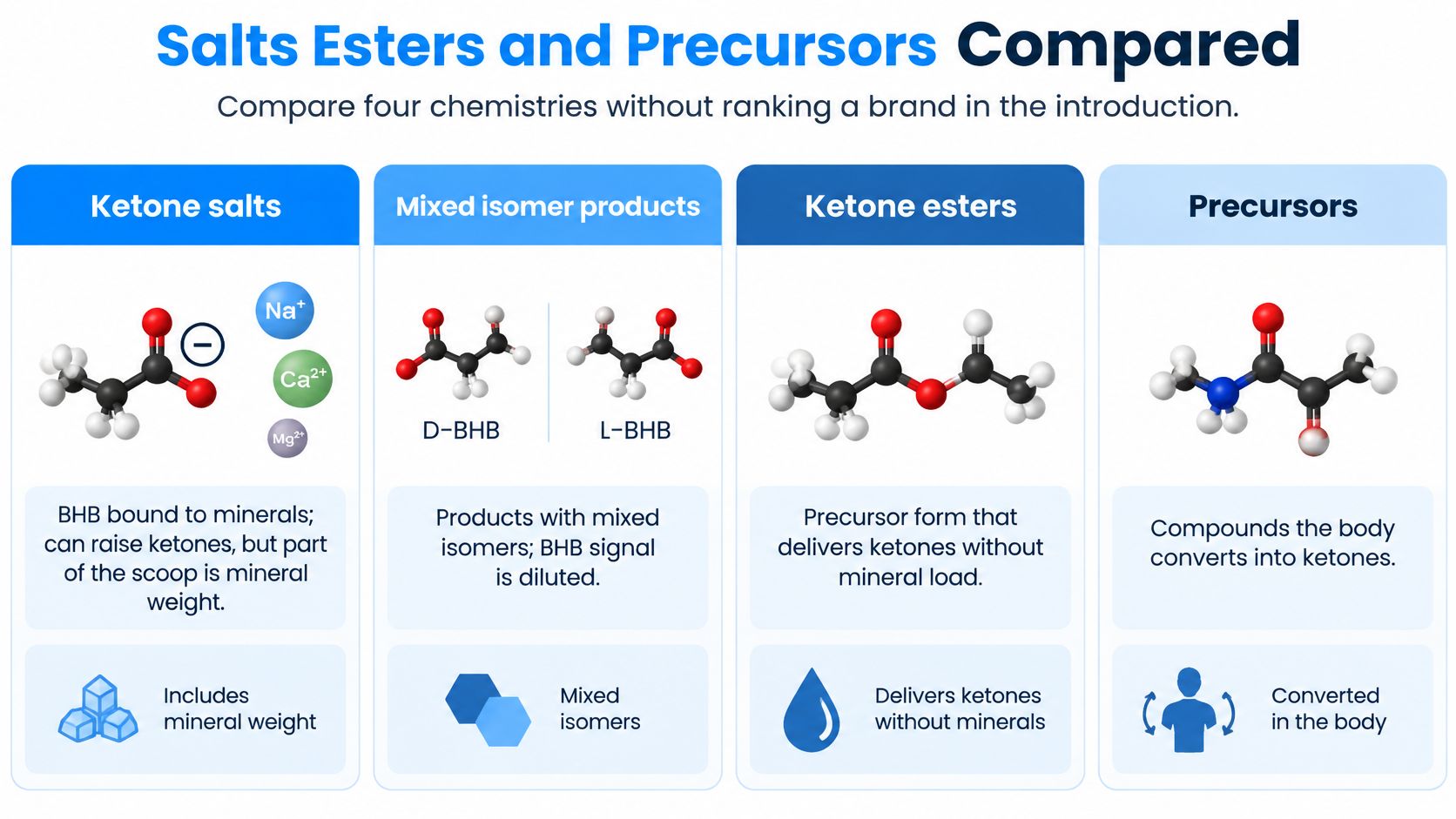
Salts Esters and Precursors Compared
Chemistry determines what a dose delivers, and flavor should be the last thing you compare. Four formats dominate the market, and they aren't interchangeable.
Ketone shot chemistries and what the dose delivers
| Format | What is ingested | Main limitation | Best fit |
|---|---|---|---|
| Ketone salts | BHB bound to sodium, calcium, magnesium, or a mix | Mineral load and possible L-isomer content | Occasional use if the gut tolerates the salt |
| Ketone esters | D-BHB released from an ester backbone | Taste, price, and variable labeled grams | A measured ketone rise for training or focus |
| Precursors | Compounds such as 1,3-butanediol that require conversion | Not already the circulating ketone | Not a substitute when direct D-BHB is the goal |
| D-BHB tri-ester | Three D-BHB units on glycerol, sometimes liposomal | Still needs a disclosed gram dose and tolerability check | Daily ketone fuel without a heavy mineral carrier |
Salts Carry Their Carrier With Them
In a salt, BHB is bound to minerals. That means part of every scoop or shot is mineral weight rather than ketone, and products built from mixed isomers dilute the D-BHB fraction with the L form, which the body doesn't oxidize the same way. Large salt doses are also a common reason for gastrointestinal upset. None of that makes salts useless, but it does mean the gram number on the front overstates the usable ketone.
Esters and the Tri-Ester Pattern
A ketone monoester bonds BHB to a backbone that's cleaved after ingestion, so more of the dose can arrive as D-BHB. Human exercise research uses this class when reporting blood ketone levels during activity. The tradeoffs are taste, cost, and wide variation in labeled grams between products.
A tri-ester takes the same logic further. Three D-BHB molecules sit on a single glycerol backbone, and digestion releases them as bioidentical D-BHB, the same form your liver produces, without a heavy mineral carrier. Our R3HBG follows this pattern, and it raises blood ketones directly, independent of what has been eaten, and works alongside a normal diet.
Liposomal delivery wraps the ingredient to support absorption consistency. Treat that as a formulation choice, not as proof of a bigger performance effect. The same restraint applies to regulatory language. An FDA New Dietary Ingredient notification is a safety-notification pathway for the labeled use. It isn't approval of a disease treatment or a performance claim, and any brand implying otherwise is overselling.
Precursors Are a Different Promise
Compounds such as R-1,3-butanediol aren't circulating BHB. Your liver must convert them first, so the response is indirect and slower to predict. Calling a precursor bioidentical ketone delivery is inaccurate.
As one concrete example of the tri-ester format, the Tecton EDGE™ Performance Shot + Electrolytes pairs liposomal R3HBG with sodium, potassium, and magnesium for active individuals who want ketone fuel during training or physically demanding days, without caffeine.
Label Criteria That Separate Useful Shots
Ignore the front of the bottle. Work through seven rows on the Supplement Facts panel and ingredient list, in this order.
Seven label checks for keto friendly shots
| Criterion | Prefer | Why it matters | Red flag |
|---|---|---|---|
| BHB source | Identified D-BHB ester or clearly stated isomer | Matches the ketone form used for fuel | Unspecified BHB or mostly L-isomer |
| Sweeteners | None, or a named sweetener with amount | Taste without assuming metabolic neutrality | Hidden sugar, maltodextrin, or unnamed flavor carriers |
| Caffeine | Milligrams per shot, or explicitly none | Fits a daily budget near 400 mg for most adults | Undisclosed stimulant or encouragement to stack drinks |
| Electrolytes | Listed sodium, potassium, and magnesium | Hydration support without using minerals as the ketone carrier | Salt load presented as the ketone itself |
| Fillers | Short excipient list and no artificial dyes | Better chance of daily tolerability | Dye, alcohol base, or long additive list |
| Packaging | Pre-measured single-serve; BPA-free if stated | Accurate dose and less measurement error | Bulk concentrate or unmarked bottle |
| Dosing | Grams of ketone per shot and suggested timing | Lets dose be compared with published blood-ketone responses | Proprietary blend with no gram amount |
How to Apply Each Row
BHB source comes first because isomer identity determines what's usable. Look for D-BHB named explicitly. An unspecified blend may include a substantial share of the less useful L form, and you'll never know the ratio.
Sweeteners are where zero sugar misleads people. A shot can contain no sugar and still include sweeteners, flavor systems, or carbohydrate carriers such as maltodextrin. Ask whether each one is named and quantified. Zero sugar isn't the same as metabolically quiet.
Caffeine needs a number in milligrams per shot. Without it, you can't place the product inside your day alongside coffee or pre-workout. "Natural energy blend" isn't a dose.
Electrolytes should be listed as sodium, potassium, and magnesium with amounts. That's different from a mineral load that exists only because BHB had to be bound to sodium, calcium, or magnesium to make a salt. One is hydration support. The other is a carrier you're paying for by weight.
The Three Rows People Skip
Fillers matter for a product you might use daily. A short ingredient list without artificial dyes is easier to tolerate and easier to audit.
Packaging is a dosing issue, not a cosmetic one. A pre-measured single-serve shot removes the measurement error that comes with bulk concentrates and powders. For a product used often, a stated BPA-free container is worth checking.
Dosing is the comparison that separates a product from a claim. Published ester research often discusses blood BHB around roughly 1 mmol/L. A label that hides behind a proprietary blend gives you no grams, so you can't judge whether the serving is anywhere near that kind of exposure. Our breakdown of what exogenous ketone ingredients actually mean on a label walks through each term in more detail.
Practical rule: If two of the seven rows are missing, the product isn't ready to be compared on performance. Set it aside until the label answers those questions.
Why This Matters
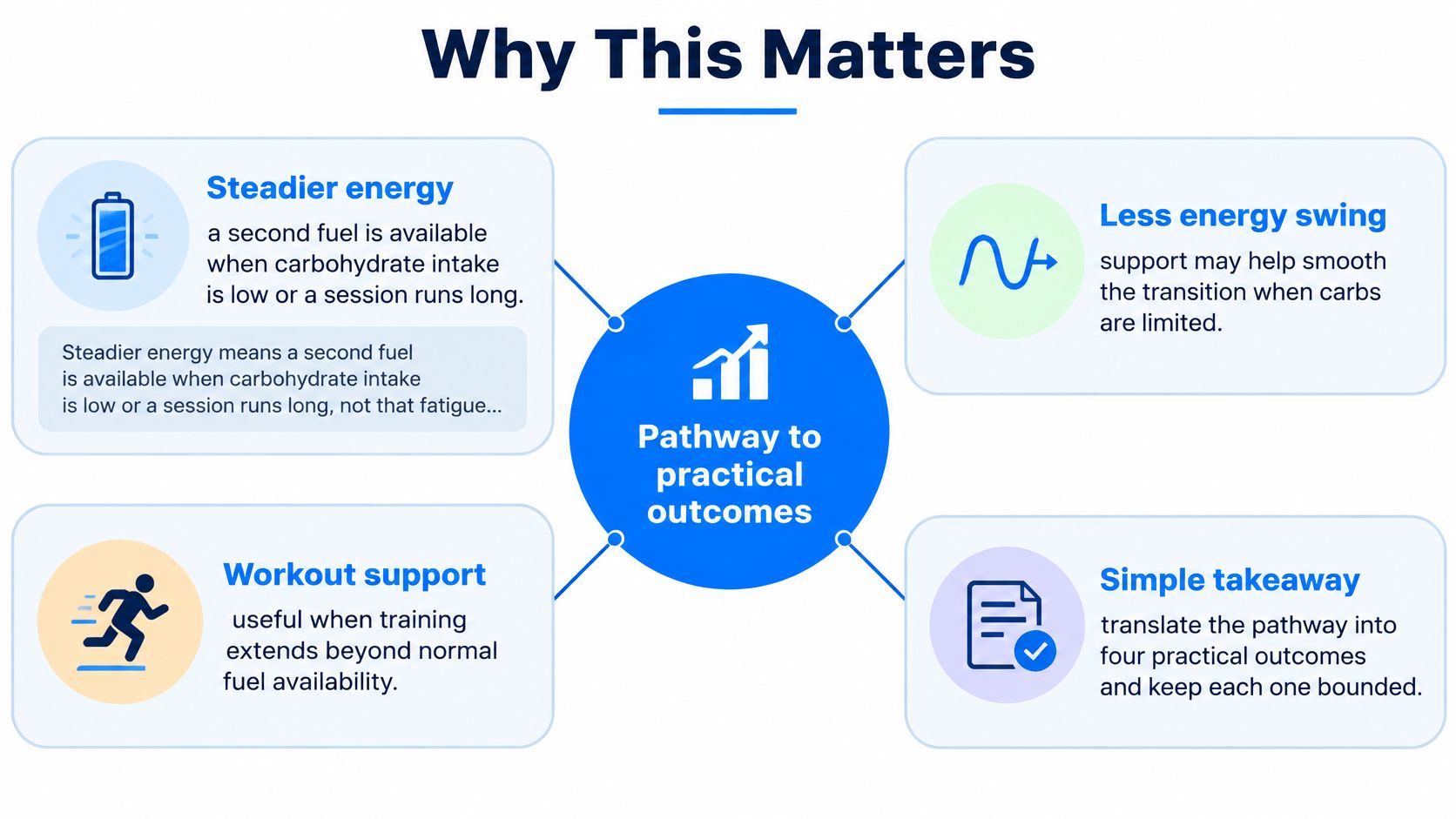
Biochemistry only earns its place in a routine if it changes something you can feel or measure. Four outcomes are worth considering, and each one comes with a limit.
Steadier Energy and Metabolic Efficiency
Steadier energy means a second fuel is available when carbohydrate intake is low or a session runs long. It doesn't mean fatigue disappears. You'll still slow down eventually, and you'll still need food, fluid, and sleep.
Metabolic efficiency is the flexibility point in practice. You can use carbohydrate when it's available and ketones when meals are spaced out or training runs past your usual fueling window. That flexibility doesn't require you to live in dietary ketosis, and it isn't the same as being in ketosis all day.
Cognitive Endurance
The evidence is most encouraging here, and still modest. A 2025 systematic review and meta-analysis of exogenous ketones and cognition covering 29 studies and 1,347 participants found a statistically significant positive effect on cognitive performance, with a standardized mean difference of 0.26, 95% confidence interval 0.11 to 0.40, and P = 0.0007.
A fair reading is potential support for cognitive endurance, meaning attention, working memory, and task accuracy holding up a little better under fatigue. It isn't a promise of a large subjective surge in focus. That review also combined different ketone chemistries, doses, and populations, so its average can't be assumed to apply equally to every formulation you can buy.
Two mechanisms sit behind that interest. Ketones can serve as brain fuel when energy demand is high, and BHB also participates in cellular signaling. Endothelial function belongs in the same physiology discussion, but it's an area of study, not a vascular treatment claim.
Workout Performance, Kept Honest
Supplying an additional fuel can support output during long or demanding work. A rise in blood BHB is not, by itself, a faster race. Keep those two claims separate and you'll set expectations that a product can meet.
What should you expect physiologically in your first few uses? A gradual shift toward ketone availability in the post-dose window, sometimes a mild sense of warmth or alertness, and no guaranteed change on a stopwatch. The people most likely to notice value are those in long training sessions, long focus blocks, or long gaps between meals, provided the formula sits well in the stomach.
Caffeine Budget and Tolerability Limits
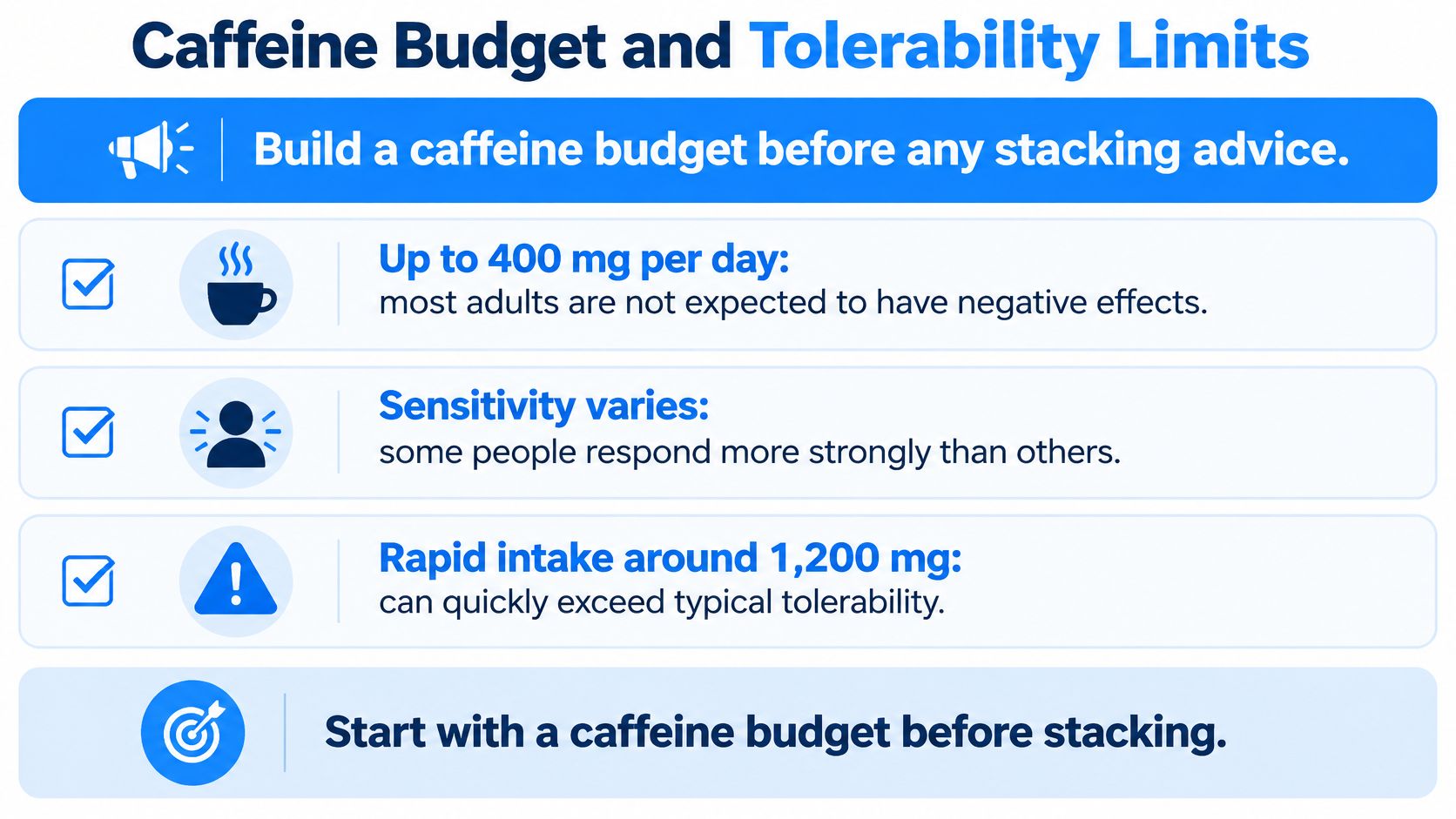
Build a caffeine budget before you think about stacking anything. According to FDA caffeine guidance materials, up to 400 mg of caffeine per day is generally not associated with negative effects for most adults, individual sensitivity varies, and rapid intake of roughly 1,200 mg can produce toxic effects such as seizures.
That 400 mg figure is a total from all sources, not a per-product allowance. It disappears faster than expected.
One Stacked Morning
Say your day starts with a 100 mg caffeinated shot, a 200 mg coffee in the car, and a 200 mg pre-workout before training. You're already at about 500 mg before any afternoon tea, soda, or second coffee. Each choice looked reasonable alone. Together they've overshot the reference level.
A pre-measured shot does reduce one real risk. FDA guidance distinguishes pre-measured products from bulk concentrated caffeine, because a fixed unit removes the scooping and measuring errors behind the most serious incidents. But a fixed unit only helps if the milligrams are printed where you can see them. Hidden caffeine in a pre-measured bottle is still hidden caffeine.
Keep caffeinated shots earlier in the day, and choose a non-caffeinated shot when sleep, anxiety, or stimulant sensitivity is the priority. Our notes on combining exogenous ketones with caffeine cover timing in more detail.
Tolerability Beyond Stimulants
Caffeine isn't the only limit. Salt-heavy ketone products can cause nausea or loose stools, especially on an empty stomach. The practical first test is boring and effective: take one labeled serving with ordinary hydration, don't add a second serving the same day, and see how you feel.
Dietary supplements aren't pre-approved by the FDA for safety and effectiveness, and they may interact with medicines or affect laboratory tests. Extra caution applies during pregnancy, for adolescents, for people with cardiovascular conditions, and for anyone on glucose-lowering therapy.
A trustworthy label publishes Supplement Facts, calories, caffeine milligrams, the sweetener type, and a clear stop signal. A blanket keto friendly claim is not a substitute for any of those.
Matching Shots to Training Focus and Fasting
Start with the endurance case, because it sets expectations for every other scenario. For a long session, choose a stimulant-free shot with a disclosed BHB gram dose plus sodium, potassium, and magnesium, taken before the session or ahead of a physically demanding day.
Matching shot profiles to each job
| Scenario | Shot profile | Caffeine | Watch for |
|---|---|---|---|
| Endurance session | Disclosed D-BHB gram dose plus sodium, potassium, magnesium | None | 10 km trial 2,402 s vs 2,422 s placebo, P = 0.483 |
| Early high-intensity block | Disclosed D-BHB gram dose plus labeled caffeine | Counted in daily total | Coffee and pre-workout add to the same total |
| Stimulant-free focus block | Non-caffeinated shot with gram dose | None | Cognitive gains modest and context-dependent |
| Fasting window | Calorie-free or calorie-containing per label | Per label | Calories break a strict water fast; glucose-lowering drugs need clinician review |
What the Runner Study Actually Showed
In a randomized, double-blind crossover study of eight endurance-trained runners, carbohydrate plus ketone monoester raised plasma beta-hydroxybutyrate to approximately 1.0 to 1.3 mmol/L during exercise, but the subsequent 10-km time trial showed no significant improvement at 2,402 seconds with ketone monoester versus 2,422 seconds with placebo, P = 0.483. Reaction time and multitasking performance also did not differ.
Read that result correctly. The ketones reached the blood, and they were available as fuel alongside hydration support. They didn't produce a personal record. A clear blood-ketone response is a pharmacodynamic finding, not automatic proof of faster racing.
High Intensity and Focus Blocks
For an early high-intensity session or a hard deadline, a shot with disclosed caffeine can fit, as long as coffee and pre-workout count toward the same daily total. If they push you past your budget, drop one, don't just add the shot on top.
For a stimulant-free focus block, pick the non-caffeinated option and judge it on work completed accurately over a few hours, not on whether you felt a rush in the first ten minutes.
Fasting Needs a Definition First
Decide what your fast is before you decide what fits inside it. A shot that contains calories breaks a strict water fast, even though many people still take it during a fasting window for hunger management or steadier energy. Both statements can be true, and pretending otherwise muddles the choice. Our guide to using exogenous ketones around fasting separates those goals.
A shot also doesn't reproduce the insulin, micronutrient, and fatty-acid pattern of a full ketogenic diet. If you use insulin, other glucose-lowering drugs, or a prescribed GLP-1 medicine, changes in appetite and glucose readings are a clinician question, not a self-experiment.
Set stop rules as hard boundaries. Nausea, dizziness, palpitations, or an unexpected glucose reading means you stop and don't repeat the experiment that day.
Application Framework for a Daily Shot
Use five steps this week, in order, before you buy a second box of anything.
- Name the job: Pick one. A long training session, a caffeinated work block, an appetite routine, or a stimulant-free focus block. A shot chosen for everything is usually chosen for nothing.
- Run the seven label checks: Confirm a direct D-BHB source and disclosed grams. Don't accept a precursor when the goal is a measurable ketone dose.
- Put caffeine on paper: Add up coffee, tea, pre-workout, and the shot, and keep the daily total near the 400 mg adult reference unless a clinician has set you a lower limit.
- Take one labeled serving: Use it before the session or block, neat or over ice. Don't stack servings or stimulants to force a bigger effect.
- Judge two weeks, not one day: Score steadier energy, whether you finished the session, stomach comfort, and sleep quality. Don't score a single race time or a health outcome.
Mapping Our Own Options Onto Those Steps
We hold our labels to the same seven checks. Our Performance Shot + Electrolytes is the stimulant-free training option, with 10g of R3HBG and a full electrolyte load of sodium, potassium, and magnesium. Our Performance Shot + Caffeine is formulated with liposomal R3HBG and naturally sourced caffeine for an early, high-intensity block, which means its milligrams belong in step 3 of your budget. Check current label values before purchase, since serving data change.
A sensible starting point is the electrolyte shot on training days, with caffeine added only when it fits the budget. If you're pregnant, under 18, or taking glucose-lowering medication including GLP-1 medicines, review the label with a clinician first.
Tecton Ketones™ builds liposomal R3HBG shots that disclose the molecule and the gram dose, so you can apply the seven label checks instead of trusting a keto friendly claim. If you want ketone fuel for training, focus, or a fasting window without maintaining a strict ketogenic diet, compare the stimulant-free and caffeinated options and pick the one that fits your budget at Tecton Ketones™.


