


Blood BHB rose from 0.2 to 4.1 mmol/L after participants consumed 395 mg/kg of a ketone ester in a randomized crossover human study indexed on PubMed. That's a substantial change in available fuel, but it isn't a universal dose recommendation or proof of better performance.
The useful question about exogenous ketones dosage isn't just how much raises your ketones. It's which formulation, amount, and timing produce a tolerable response that serves your goal. A blood reading measures exposure, not sharper thinking, faster running, or improved metabolic health.
Exogenous Ketone Doses by Form and Body Weight
Start with product form, body weight, and measured blood response. Compound mass, BHB-equivalent mass, and liquid volume measure different things, so a bottle's size alone tells you little about the dose inside. A gram of ketone salt works like a packaged drink mix: part of the weight is carrier, part is the active ingredient.
The studied doses in the table below come from a physiology review of exogenous ketones indexed on PubMed, which reports the salt range, the monoester benchmark, and the exercise-ester protocols.
Exogenous ketone doses and expected blood BHB by form
| Product form | Studied dose | Dose for a 70 kg adult | Typical blood BHB peak |
|---|---|---|---|
| Ketone salt, such as sodium or calcium BHB | 0.25–0.5 g/kg | 17.5–35 g | 0.5–0.6 mmol/L |
| Ketone monoester | 482 mg/kg | About 34 g | 2–3 mmol/L |
| Ketone ester, endurance athlete trial | 573 mg/kg | About 40 g | About 3 mmol/L within 30–60 minutes |
| Ketone ester, review of exercise protocols | 573–600 mg/kg | About 40–42 g | 2–4 mmol/L during exercise |
These figures describe research benchmarks, and treating them as consumer recommendations would overstate what the studies tested. The 70 kg column is a straight arithmetic conversion: an adult at 482 mg/kg calculates to 33.7 g, which is why that row reads about 34 g.
Read the rows as different formulations
Ketone salts combine BHB with minerals, so a portion of every serving is mineral mass. That is why a large serving can still produce a lower blood peak than a smaller mass of ester. Raising a salt serving to imitate an ester study adds minerals faster than it adds circulating BHB.
Ketone monoesters reach higher circulating levels, and the word monoester carries the meaning. A dose tested with one molecule says nothing automatic about a different ester.
The endurance-athlete row describes a controlled setting. Training status, recent meals, exercise intensity, and sampling time all shape how closely a person's response matches a trial result.
The last row summarizes exercise protocols. Use it as context for interpreting the evidence, since the protocols were designed to measure a response under test conditions.
Keep the units straight
Use this calculation only when the product and the study express dose in the same units:
Dose calculation: Body weight in kilograms × studied amount per kilogram = total studied amount.
For help with the arithmetic, the PepFlow guide to weight-based dosing explains the calculation framework. It stops at the math: it cannot establish a safe ketone dose or reconcile different ketone molecules.
Before comparing products, write down:
- Your body weight in kilograms, from a scale that displays kilograms when possible.
- The specific named ketone ingredient on the label.
- BHB content per serving, separated from total ingredient mass.
- Minerals and other ingredients, including sodium, potassium, calcium, magnesium, and caffeine.
If a label leaves compound mass and BHB delivered undifferentiated, assume nothing. That uncertainty matters more than calculating another decimal place.
Why Ketone Salts and Esters Deliver Different Doses
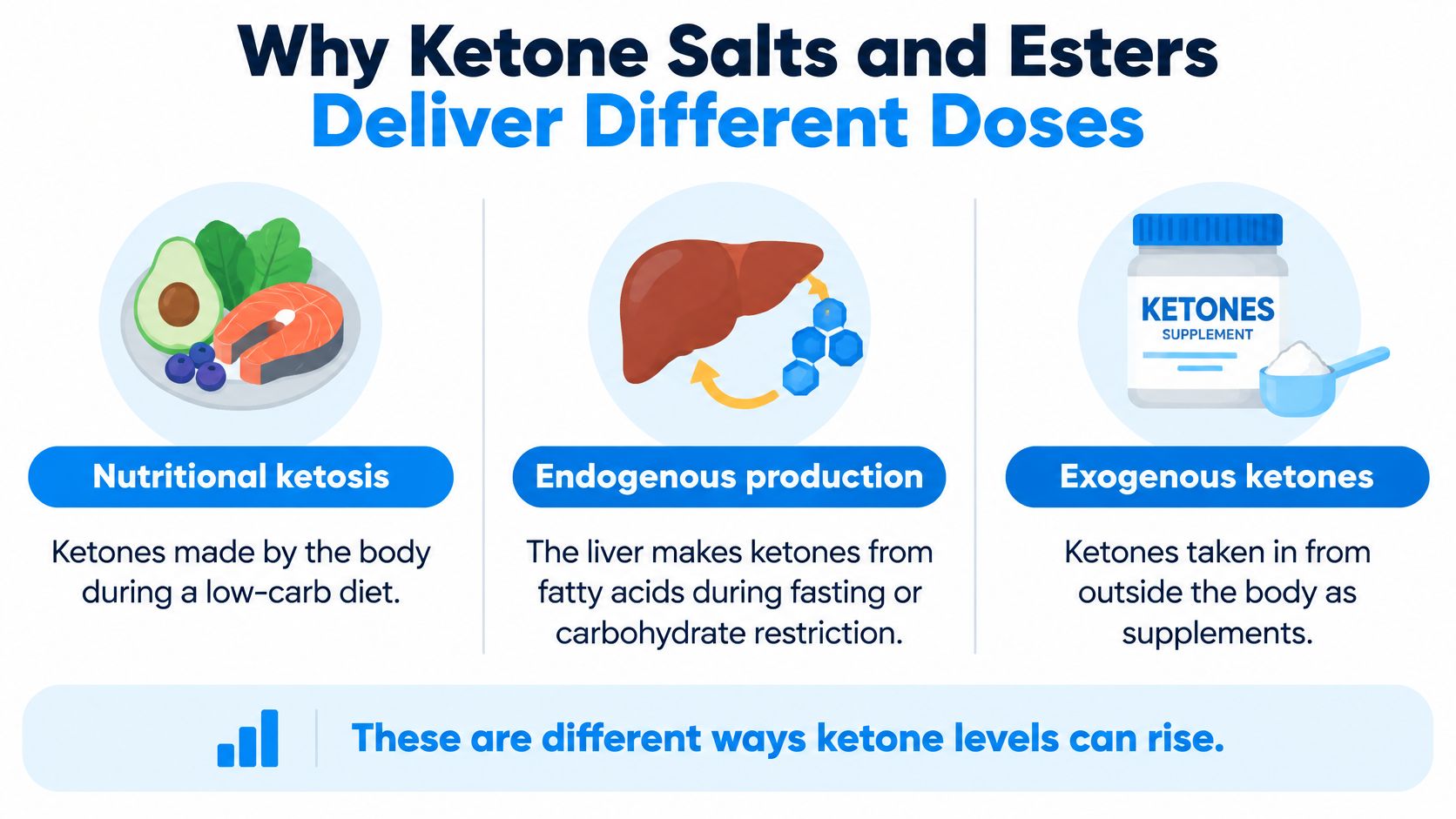
Ketone concentrations can rise through different processes. Nutritional ketosis describes a diet-induced state in which carbohydrate restriction encourages greater ketone availability. Endogenous production is the underlying process: the liver makes ketones from fatty acids, including during fasting or carbohydrate restriction.
Exogenous supplementation supplies ketones or ketone-generating compounds from outside the body. It can raise circulating BHB without reproducing all the adaptations of a ketogenic diet.
The distinction is easier to understand visually.
Same blood marker, different delivery chemistry
In a controlled human metabolism study, a ketone monoester produced a maximum blood D-BHB concentration of approximately 2.8 mmol/L, compared with about 1.0 mmol/L for a salt; concentrations returned to baseline within roughly 3–4 hours. That comparison demonstrates why equal-looking servings don't guarantee equal exposure.
Salts carry a mineral load along with BHB. Sodium or calcium intake therefore increases when you increase the ketone serving, which can constrain how much is practical to consume.
Esters bind ketone-related molecules through ester bonds that are broken during metabolism. They can provide substantial ketone exposure without requiring BHB to be paired with a large mineral load, although individual ester structures still differ.
D-BHB, also called R-BHB, is the stereochemical form the body naturally produces and readily uses as fuel. Some salt formulations contain both D- and L-BHB, so total BHB on the label doesn't necessarily describe the same immediate D-BHB exposure.
For a formulation-focused explanation, our comparison of ketones and esters helps distinguish ingredient categories.
From BHB to cellular energy
Cells convert BHB to acetoacetate and then to acetyl-CoA, which enters mitochondrial energy pathways that support ATP production. Glucose reaches those pathways through glycolysis and subsequent metabolism, so ketones offer another fuel route rather than eliminating the need for glucose.
The brain can take up circulating ketones and use them for energy. Metabolic flexibility means adjusting fuel use to availability and demand, not permanently replacing carbohydrate with ketones.
BHB also participates in cellular signaling. Endothelial function, meaning how blood-vessel lining cells regulate vascular activity, is another area of investigation, but these mechanisms don't establish a supplement dose or guarantee a vascular benefit.
Precursors and liposomal formulations
Precursors such as 1,3-butanediol depend on liver conversion before they contribute to circulating BHB. That additional metabolic step means their response shouldn't be assumed equivalent to direct BHB delivery.
Liposomal delivery encapsulates ingredients in lipid-based structures intended to support delivery and absorption. Comparative human evidence is still developing, so encapsulation alone doesn't prove superior performance or establish dose equivalence.
Our R3HBG is a tri-ester of D-BHB that raises blood ketones directly, independent of what has been eaten, and works alongside a normal diet. The practical comparison remains BHB delivered per dose, followed by measured response and tolerability.
Matching Your Dose Target to Your Goal
Choose the outcome before choosing a blood-ketone number. A target for a long ride, a demanding work block, and a glucose-related goal are three different questions, and the evidence behind each differs in strength.
Dose targets and evidence strength by goal
| Goal | Blood BHB target | Timing window | Evidence strength |
|---|---|---|---|
| Endurance or exercise | Roughly 3–5 mmol/L within 60 minutes on a ketone ester | 30–60 minutes before effort | Mixed and context-dependent across the reviewed protocols |
| Cognitive endurance | No universally validated target | Align the measured response with the work block | Small overall benefit across 29 protocols |
| Metabolic and glucose goals | No universally validated consumer target | Clinician-defined relative to meals and monitoring | No meaningful extra glucose reduction at higher doses |
These categories describe evidence boundaries rather than validated treatment instructions.
Endurance and cognitive endurance
For endurance, the practical comparison is pace or power at a similar perceived effort, with gastrointestinal symptoms logged alongside the session.
The trial protocol that reports the exercise range also gives a compound half-life of 0.8–3.1 hours, and it summarizes a cognitive evidence base spanning 29 meta-analyzable protocols with doses from 573 mg/kg up to 162.5 g total. One exercise protocol used 0.5 g/kg during exercise plus 0.25 g/kg afterward and didn't improve most cognitive domains versus placebo.
A spread that wide argues for caution when a research total becomes a personal dose. An amount without the matching body weight, formulation, population, and exposure pattern isn't a usable prescription, which is why the table gives ranges tied to protocol conditions. For a fuller look at how those trials measured actual outcomes, our guide covers whether exogenous ketones work.
For a work block, assess a repeatable task rather than a general feeling of productivity. Keep task difficulty and sleep conditions reasonably consistent.
Metabolic goals and co-use
A human evidence synthesis found no meaningful difference in glucose reduction between lower doses below an average of 431 mg/kg and higher doses, so a larger amount shouldn't be assumed to produce a larger metabolic effect.
Don't use supplementation to self-manage abnormal glucose. Record meals and carbohydrate intake, and involve a clinician when glucose monitoring has a medical purpose.
Caffeine also changes how a trial reads. If you adjust caffeine, carbohydrate, and ketones at the same time, you can't tell which change drove alertness or exercise output. Gym Snack's guide to macros provides useful context for recording dietary intake alongside supplementation.
Concrete checks by goal
- Endurance: pick one repeatable session, such as a fixed-pace time trial; dose within the 30–60 minute window, hold caffeine and carbohydrate constant, and compare pace or power at matched effort while logging stomach comfort.
- Cognitive endurance: run a timed task-accuracy check on a task you can repeat; score errors or completion time rather than rating how alert you felt, and hold difficulty and sleep steady.
- Metabolic goals: log meals and carbohydrate intake around each dose, and review the pattern with a clinician if monitoring serves a medical purpose.
Safety Limits, Side Effects and Who Needs Supervision
A controlled study in healthy adults tested 25 mL, approximately 26.8 g, of ketone monoester three times daily for 28 days, about 80.4 g/day, and measured post-dose BHB rising from approximately 0.1 to 4.1 ± 1.1 mmol/L with no meaningful changes in body weight, fasting glucose, lipids, electrolytes, blood gases, or kidney-function measures. That outcome supports tolerability at that dose, duration, and formulation in healthy adults, and it neither defines a safe upper limit for consumers nor predicts how a different ester, a salt, or a liposomal preparation would be tolerated at the same intake.
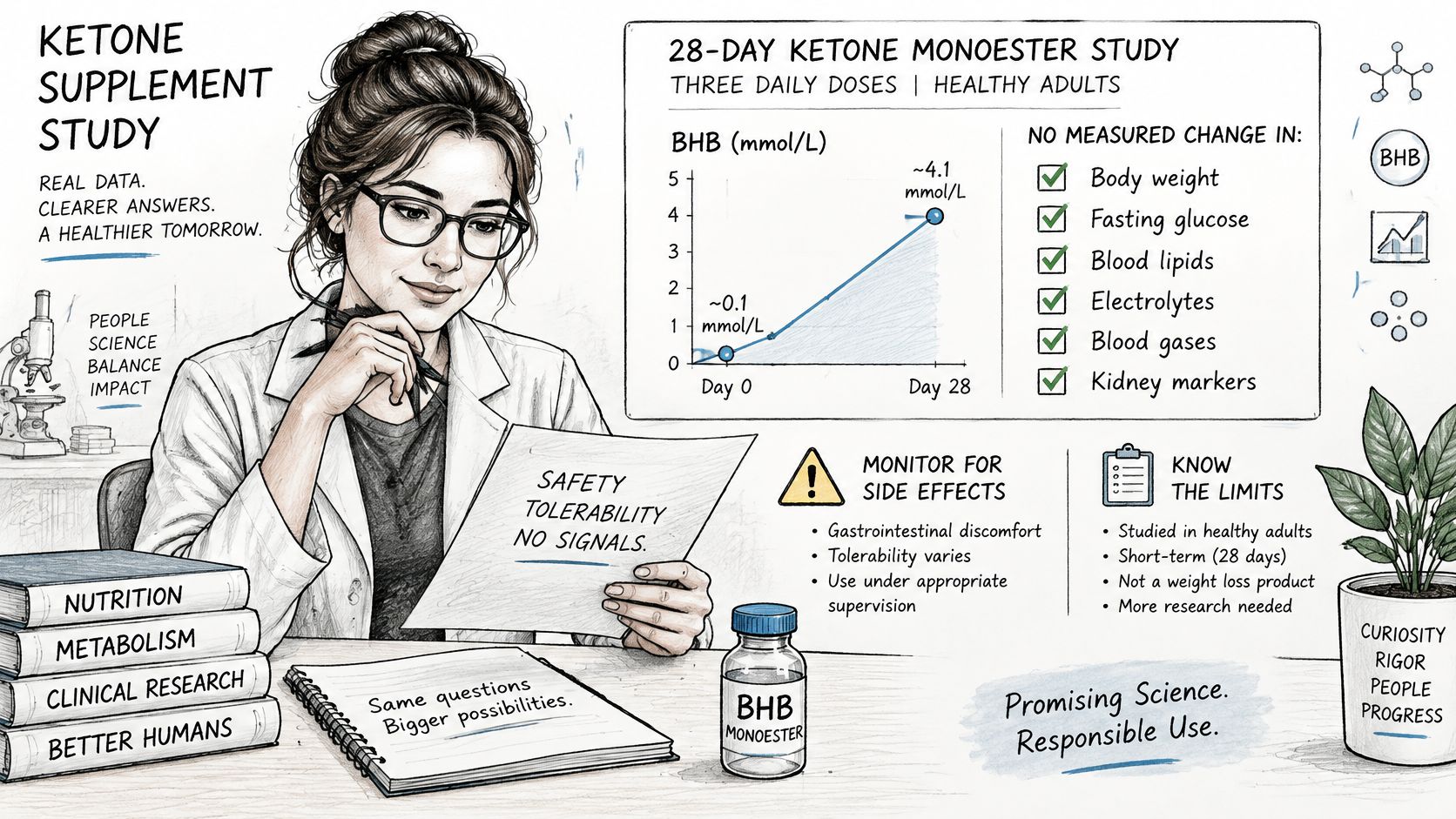
Interpret the side-effect counts correctly
Reported side effects in a 28-day ketone monoester study
| Effect | Occurrences in 2,016 drinks | Share of administrations | Action if it appears |
|---|---|---|---|
| Mild nausea | 6 | 0.30% | Don't escalate; log timing and pause if symptoms continue |
| Headache | 3 | 0.15% | Don't escalate; assess hydration within your usual fluid guidance |
| Mild diarrhea | 2 | 0.10% | Reduce to the previously tolerated amount or pause |
| Abdominal pain | 2 | 0.10% | Reduce or pause; see a clinician if it persists |
Read the denominator before the count. These are events per administration, not the percentage of participants who experienced symptoms. Six nausea reports across 2,016 drinks could trace to one person or several, so the table describes how often a symptom followed a serving rather than how likely you are to feel it. Your own formulation and dose can shift that risk in either direction.
Don't try to push through symptoms by adding more supplement. With salt products, sodium and calcium exposure rise alongside the ketone ingredient, and larger servings may bring cramping, bloating, or diarrhea before blood BHB climbs much at all.
Who needs clinical supervision
Get clinical advice before any use if you have diabetes, take glucose-lowering medication, have kidney disease or a cardiovascular condition, are pregnant, or take regular medication. Fluid balance, electrolyte handling, and glucose responses each deserve individualized review, because a dose tolerated by a healthy volunteer may interact with your treatment plan.
Bring the actual label, including every added ingredient. A clinician needs more than the word ketones to judge how a product fits your circumstances.
- Gastrointestinal monitoring: Record nausea, reflux, cramping, stool changes, and abdominal pain.
- Systemic symptoms: Note dizziness, unusual weakness, and headaches rather than dismissing them as adaptation.
- Hydration: Follow your normal clinical fluid guidance; indiscriminately increasing fluids isn't appropriate for everyone.
- Measured response: Record glucose when clinically appropriate and blood BHB when assessing exposure.
Our guide to exogenous ketone side effects provides additional context for discussing tolerability.
The video below covers ketone use in an educational format.
Supplements aren't disease treatments
Medical treatments follow a different evidence standard than supplement use. XO's explanation of effective prescription treatments for bacterial vaginosis describes condition-specific prescription care, a category a ketone supplement does not belong to and a boundary worth keeping clear whenever a symptom points toward a diagnosis.
Tecton Ketones products may be dietary supplements, and statements on our site have not been evaluated by the FDA. Our products are not intended to diagnose, treat, cure, or prevent any disease.
Stop rule: Stop supplementation and seek medical assessment for persistent vomiting. Fainting, confusion, or chest pain warrant urgent medical attention, not another dose.
How to Titrate Your First Exogenous Ketone Doses
Titration means adjusting an amount according to response and tolerability. It doesn't mean automatically increasing until you reach the largest studied dose.
A review of human dosing protocols describes ester administration approximately 30–60 minutes before the target activity, with controlled protocols commonly using 0.48–0.60 g/kg and measuring blood D-BHB. Those quantities are research benchmarks, not interchangeable starting instructions for every product.
Use a conservative process that separates arithmetic from a personal dosing decision.
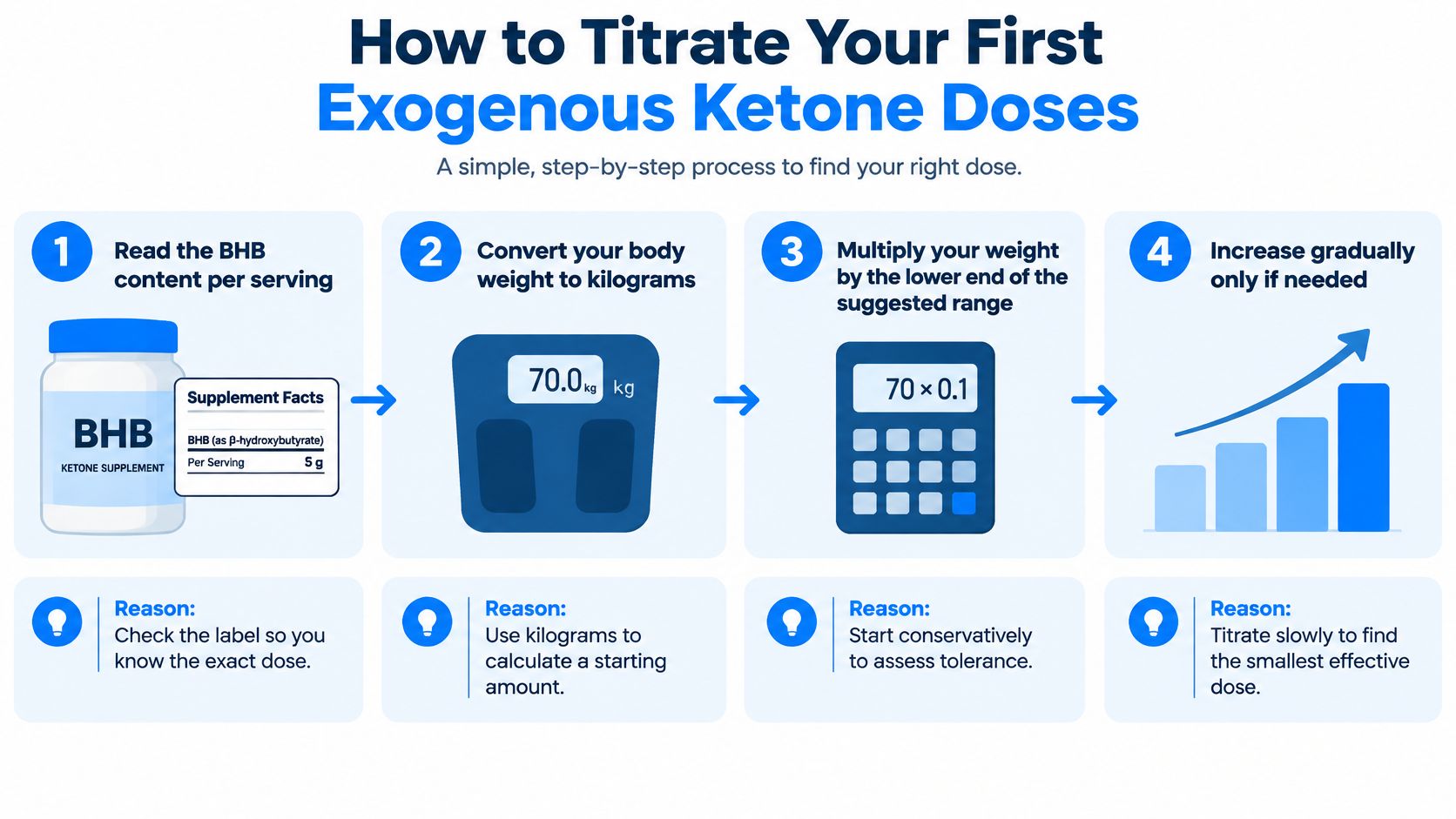
Establish a baseline before increasing
- Identify exactly what you're taking. Read BHB content per serving, ketone compound mass, serving volume, and added minerals or caffeine. Convert your body weight to kilograms and use the same unit consistently. Every Tecton bottle contains 10 g of R3HBG, a bioidentical ketone; ingredient mass should still be distinguished from BHB-equivalent mass when comparing it with a trial.
- Calculate a benchmark, not a prescription. Multiply body weight by the lower end of a matching formulation's studied range to understand the scale of that protocol. Then select a conservative starting amount below the research dose, within product directions and any clinician guidance. Don't assume that a monoester calculation establishes an equivalent R3HBG, salt, or precursor amount.
- Choose an ordinary test setting. Time the initial trial before a familiar training session or work block, using the goal-specific timing window. Don't make the first exposure part of a race, maximal workout, important examination, or critical presentation. The aim is to learn your response without adding avoidable consequences.
- Control what you can. Record meal timing, carbohydrate intake, caffeine, hydration, and other supplements. Keep these reasonably similar during comparison sessions. A different breakfast or an extra coffee can make the result difficult to interpret.
Measure exposure without chasing a peak
Use a blood ketone meter that measures D-BHB, compatible strips, and the manufacturer's sampling instructions. Check strip storage and expiry, wash and dry your hands, and record the measurement time alongside the result.
As a practical observation schedule, take a baseline reading and check again approximately an hour and two hours after ingestion. These checkpoints help describe the response; they aren't a validated universal titration schedule, and they may miss the true peak.
- Log the activity outcome beside the meter result. For exercise, record power or pace, perceived effort, and stomach comfort. For cognitive work, choose a repeatable task and note accuracy or completed work. A rising BHB value without a useful outcome isn't a reason to keep increasing.
- Repeat before changing anything. Use the same conservative amount across several comparable, well-tolerated sessions. Only consider a small increase if there's a clear reason, the formulation's directions permit it, and symptoms aren't appearing. There's no universally validated three-day escalation rule or standard increment for all ketone products.
- Reduce or stop when tolerability worsens. Return to the last tolerated amount only when symptoms have resolved and no warning signs require assessment. Don't use a target blood value to justify continuing through nausea, dizziness, diarrhea, or pain. Apply the safety-table actions and urgent stop rules rather than improvising.
Choose acute use or supervised repeated use
For an acute goal, test a single pre-session exposure before considering a more complicated routine. Repeated daily dosing raises a different question: total intake and tolerability across the day, not whether an isolated serving felt acceptable.
Don't copy a high-dose chronic study as a consumer schedule. If repeated use is appropriate, agree on the purpose, monitoring, and review point with a clinician, especially when medications or medical conditions are involved.
There's no loading phase, and you don't need to be in ketosis for our product to work. Fasting isn't required, and changing your diet solely to amplify a meter reading makes the initial trial harder to interpret.
Practical Takeaway
Write down your body weight, exact product, intended outcome, and planned first-dose time before opening the bottle. If you have a condition requiring supervision, bring that plan and the label to your clinician before starting; otherwise, choose an ordinary training or work day and keep a simple response log.
The useful endpoint is the smallest tolerable amount that serves a clearly defined purpose. It isn't the highest ketone concentration you can produce.
Tecton Ketones™ offers R3HBG-based exogenous ketone nutrition designed to provide ketone fuel alongside a normal diet. Visit Tecton Ketones™ to review the formulations and serving information, then use your goal, tolerance, and clinical circumstances to guide a measured first trial.


