


A ketone drink can increase the fuel available in your blood without making you faster, improving recovery, or increasing measurable energy reserves in muscle. Human trials have demonstrated that distinction: raising blood ketones is a reliable physiological effect, but improving performance is a separate test.
So, do ketone esters work? The useful answer starts with what you want them to do, not how high a ketone meter reads.
The Short Answer Depends on the Outcome
Do ketone esters work? The answer depends on what you want to change. The evidence supports a clear verdict for each outcome: blood ketones rise after consumption, while effects on performance, cognition, and recovery remain uncertain.
D-beta-hydroxybutyrate, or D-BHB, is a ketone form tissues can use for energy. A higher blood level confirms that ketones are available in circulation. It does not show how much a particular tissue used or whether that fuel improved performance.
Evidence and verdict by outcome
| Outcome | Evidence label | Verdict |
|---|---|---|
| Blood ketone levels | Consistent increase after consumption | Reliable effect |
| Mitochondrial energy markers | Acute change not demonstrated in healthy adults | Not shown |
| Endurance performance | Results vary across trials | No consistent gain |
| Cognition | Findings differ by task and conditions | Mixed |
| Recovery | Direct evidence remains limited | Not established |
| Short-term safety | Limited to the groups and periods studied | Tolerated in studied groups |
A benefit in one category does not establish a benefit in another. A cognitive task result, for example, cannot stand in for a measure of running performance. Likewise, higher blood ketones show exposure, not improved recovery.
Short-term tolerability also does not establish safety for every person or for indefinite use. The evidence applies to the populations, formulations, and observation periods studied.
Match the verdict to your goal. Temporary ketone availability has a clearer basis than expectations of faster racing, sharper thinking throughout the day, or better recovery after every workout.
Ketone Esters Compared With Salts and Nutritional Ketosis
The same blood-ketone reading can reflect different processes. Nutritional ketosis usually follows carbohydrate restriction, when the liver makes ketones. Fasting can also increase the body's own ketone production. Exogenous supplements introduce ketones, or compounds used to make them, from outside the body.
The route matters because a blood reading describes ketone availability, not the full metabolic state.
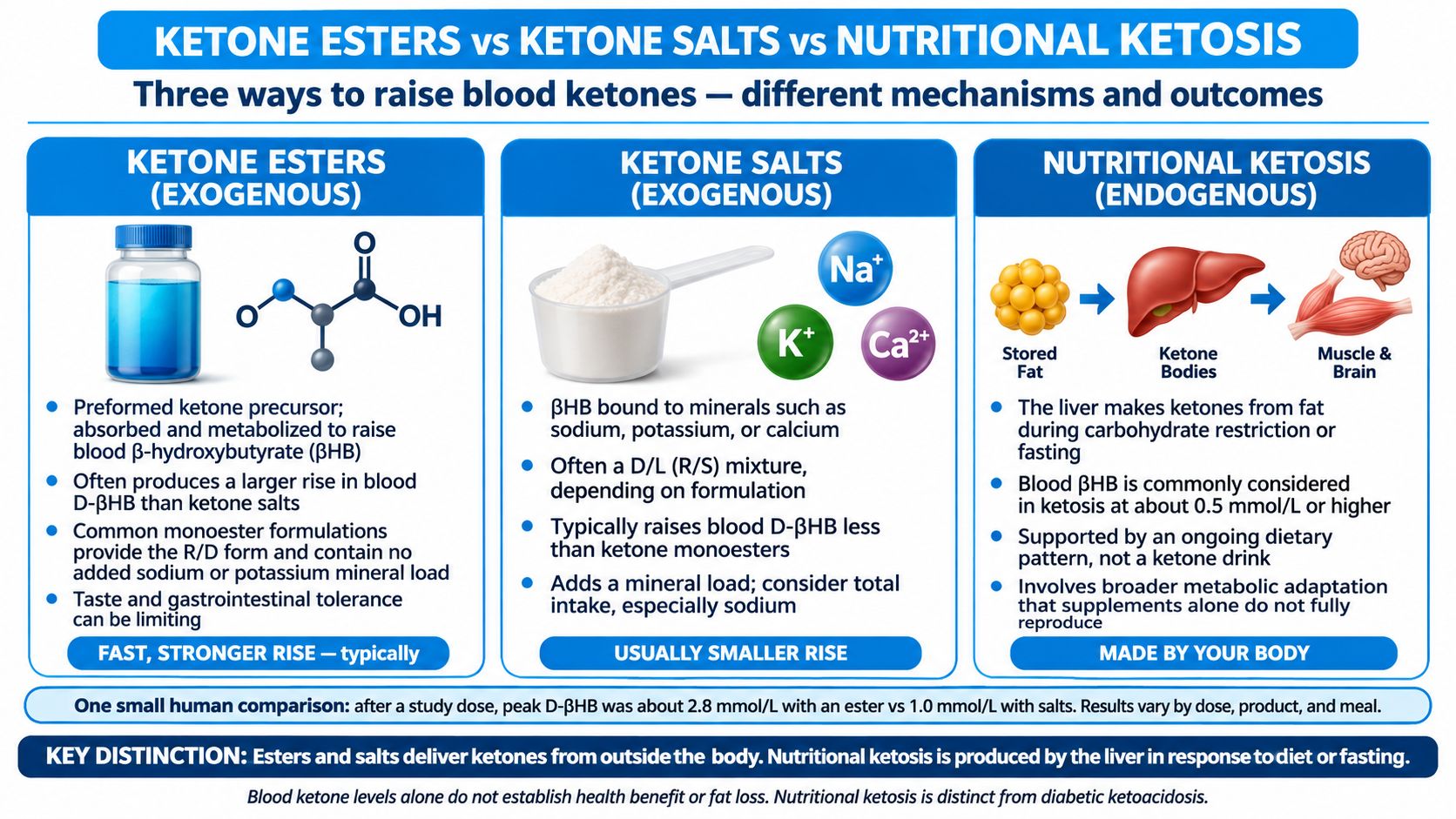
Routes to higher ketones compared
Peak values below come from specific evidence, not a prediction for every person or serving.
| Route | How It Raises Blood Ketones | Typical Peak | Main Limitation |
|---|---|---|---|
| Nutritional ketosis | Liver makes BHB during carbohydrate restriction or fasting | No single peak established here | Requires dietary change or fasting |
| Endogenous production | Body's own hepatic ketone output | Set by nutritional and physiological conditions | Not an on-demand serving |
| Ketone salts | Mineral-bound BHB is absorbed | About 1.0 mmol/L in the Springer human ketone-metabolism review | Lower peak in that comparison; mineral load |
| Ketone esters | Ester is broken down, making ketone fuel available | About 2.8 mmol/L in healthy adults in the Springer human ketone-metabolism review | Temporary and dose-dependent |
| Precursors | Compounds are converted to BHB in the body | No class-wide peak established here | Requires metabolic conversion |
In the cited comparison, peak D-BHB was approximately 2.8 mmol/L after the monoester and 1.0 mmol/L after salts, with P < 0.001. Levels returned toward baseline within roughly 3–4 hours. The result supports a larger temporary blood-ketone response under the tested conditions; it does not establish greater athletic output.
Chemical structure matters more than category labels
The studied monoester, (R)-3-hydroxybutyl (R)-3-hydroxybutyrate, is one specific molecule. Different esters and finished formulations need separate testing to establish their effects.
Tecton EDGE™ Performance Shot + Electrolytes is a ketone shot formulated without added sugar or artificial stimulants. The monoester comparison does not establish the blood-ketone response or performance effect of this finished product. The cited trials also did not compare liposomal delivery with non-liposomal versions, so they do not establish an advantage for encapsulation.
How Ketones Fuel Cells, Muscle and the Brain
A ketone can enter cellular energy pathways, but that alone does not show that a supplement improves energy production or performance. The distinction is visible in human measurements of the heart and skeletal muscle.
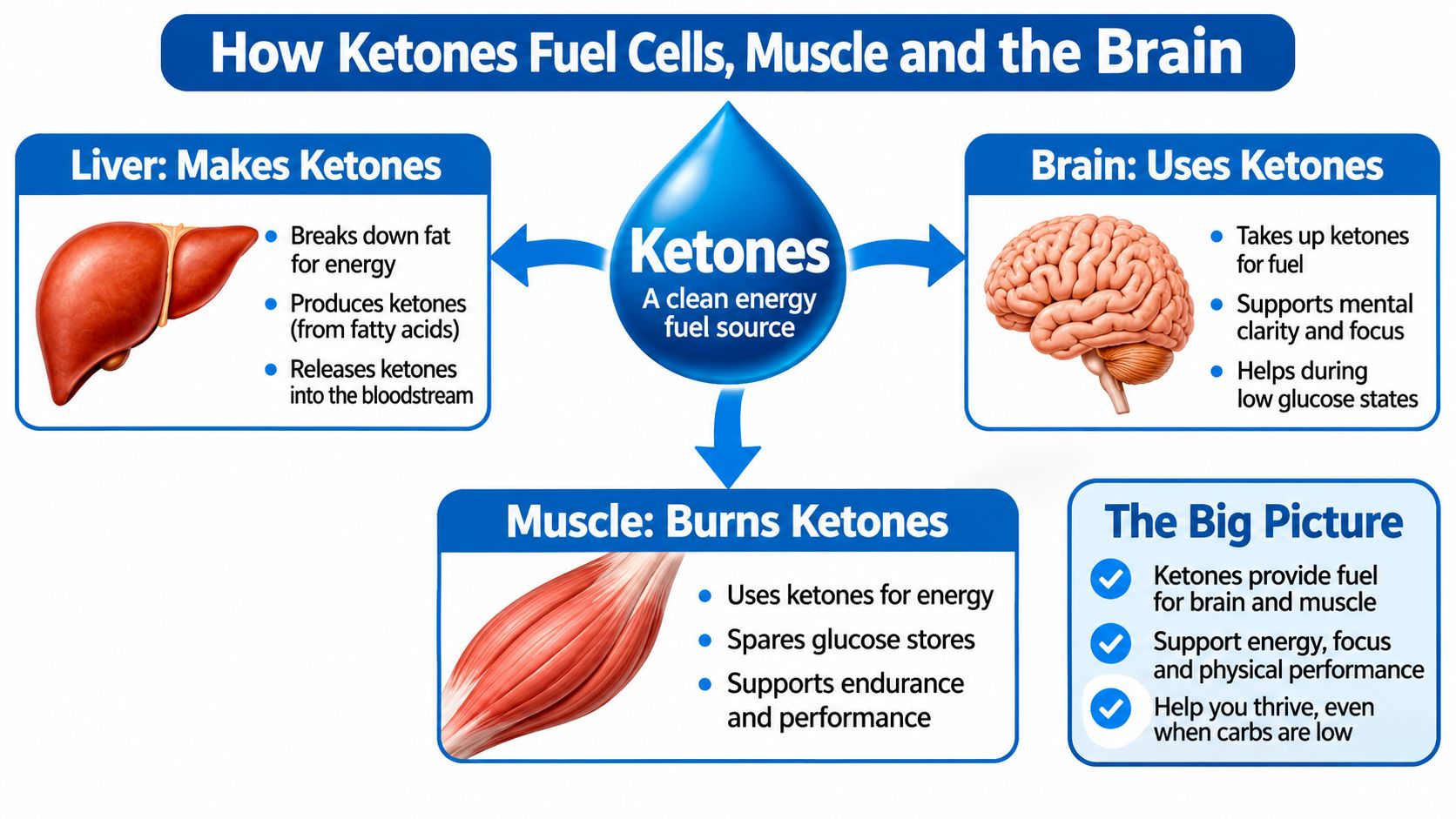
From BHB to ATP
Cells convert BHB to acetoacetate, then process it into acetyl-CoA for mitochondrial oxidation. Acetyl-CoA enters the tricarboxylic-acid cycle, which supplies reducing equivalents to the electron-transport chain.
The electron-transport chain supports oxidative phosphorylation, the process that produces ATP, the immediately usable energy currency of cells. This pathway explains how ketones can be used as fuel; whether supplementation changes energy production is a separate question.
Glucose reaches the same mitochondrial machinery by a different route. Glycolysis converts glucose into pyruvate, which can then contribute acetyl-CoA. The pathways differ, but both feed into the cell's existing energy machinery.
In a controlled human magnetic-resonance spectroscopy study, investigators measured cardiac and skeletal-muscle energetics before and 30 minutes after a ketone-monoester dose. Cardiac phosphocreatine-to-ATP ratio and skeletal-muscle metabolic parameters showed no significant acute change.
Fuel flexibility isn't the same as greater capacity
Metabolic flexibility means adjusting fuel use as fuel availability and energy demand change. A lower respiratory exchange ratio during exercise can indicate altered substrate use, but it does not directly measure improved fitness or greater mechanical efficiency.
Several factors shape how cells use available fuel:
- Workload: Cells regulate energy production according to demand.
- Oxygen delivery: Oxidizing ketones still requires oxygen.
- Substrate competition: More circulating ketones do not mean glucose oxidation stops.
- Tissue regulation: The heart, skeletal muscle, and brain can respond differently.
The brain can take up and oxidize BHB when it's available, partly substituting for glucose. This does not show that a supplement replaces glucose as brain fuel or improves every cognitive function. The overview of how the brain uses energy explains the relevant metabolic pathways.
Cellular signaling and endothelial function require separate evidence. A ketone reading or muscle-energy measurement cannot establish an effect on blood-vessel lining cells. The human findings described here do not demonstrate a practical endothelial benefit. Mechanistic and preclinical hypotheses remain distinct from measured consumer outcomes.
Performance Studies Where Results Are Mixed
The exercise evidence is mixed: some trials found no measurable performance gain, one reported lower maximal power, and a running study found faster responses on selected cognitive tasks without improving race time. Results depend on the task and the conditions under which it was tested.
In a crossover trial described in a review of controlled human performance studies, 39 trained endurance athletes received 573 mg/kg of ketone ester. Blood D-BHB reached approximately 3 mmol/L within 30–60 minutes. The result shows that the dose raised circulating ketones quickly; it does not show that performance improved.
Human performance and cognition trials
| Study Context | Design and Dose | Reported Result |
|---|---|---|
| Trained cyclists, 12 participants | Incremental cycling; monoester 330 mg/kg | No performance improvement; earlier ventilatory-threshold response; lower blood pH and bicarbonate |
| Trained runners, 13 participants, 2025 | Paired running trials; ketone ester versus placebo | First-bout distance was similar between conditions; time to exhaustion was also similar |
| Healthy men, simulated altitude, 2025 | Maximal exercise crossover, 13 participants | Lower maximal power; no protection against hypoxia-related cognitive decline |
| Simulated cycling race, 8 days, 2026 | 25 g after stages and before sleep | No gain in endurance, recovery, sleep, cognition, or skeletal-muscle markers |
| Recreational runners, 31 days, 2026 | Randomized, single-blind; 30 g three times daily | Faster Stroop and task-switching responses; no 5-km time-trial gain |
| Meta-analysis, 8 trials, 80 participants | Ketone monoesters or precursors | No significant overall endurance gain |
In the incremental-cycling trial, lower blood pH and bicarbonate occurred alongside an earlier ventilatory-threshold response, but the cyclists did not perform better. These physiological changes describe what happened during the test, not a performance advantage.
The simulated-altitude crossover trial found lower maximal power in 13 healthy men and no protection against cognitive decline under hypoxia. This result matters for athletes considering ketones for endurance exercise: the trial did not show that ketone availability compensated for the simulated altitude conditions.
The recreational-runner trial found faster responses on selected executive-function tests after 31 days, but no improvement in 5-km performance. These tests assess skills such as response control and switching between tasks. They do not measure all-day concentration or general mental endurance.
Across eight trials involving 80 participants, the systematic review and meta-analysis found no significant overall endurance improvement. Its pooled estimate was compatible with both a small benefit and no effect, so it does not establish a dependable endurance advantage.
Read each outcome independently
The practical reading is outcome-specific: an exercise-physiology change is not the same as better race performance, and a faster response on a cognitive test is not evidence of improved running. The trials support narrow conclusions about the tasks they measured, rather than a general claim that ketones improve performance.
Why This Matters
The practical value of ketone esters depends on the outcome you want to change. Blood ketones, perceived energy, task performance, and exercise output are separate measures.
The visual below compares potential outcomes with the limits of what the evidence supports.

- Steadier energy: Track perceived energy and completed work across comparable days. A change in blood ketones alone cannot show whether an afternoon dip has eased.
- Cognitive endurance: Record a repeatable task, such as proofreading a fixed-length document. Log errors and completion time alongside perceived effort; a single impression of focus is harder to interpret.
- Workout performance: Compare pace, power, or time to exhaustion across similar sessions. Feeling different during exercise does not establish improved output.
- Metabolic efficiency: Lower glucose or altered fuel use describes a physiological change. To assess efficiency, compare useful work with energy input under comparable conditions.
Measure the experience you want
Choose one outcome before starting, then use the same measure each time. For work, that might be errors and completion time on a recurring task. For training, it might be power at a set effort.
The video offers a visual overview of these distinctions.
Measurable ketosis confirms a physiological effect; it does not by itself show a performance benefit. Define the result you want, then judge it by a measure suited to that outcome.
Who May Benefit and When to Hold Off
The best candidate isn't a demographic label. It's someone with a specific use case, realistic expectations, and a way to evaluate the result.
Use the checklist to distinguish the session you're planning from the benefit you hope to obtain.
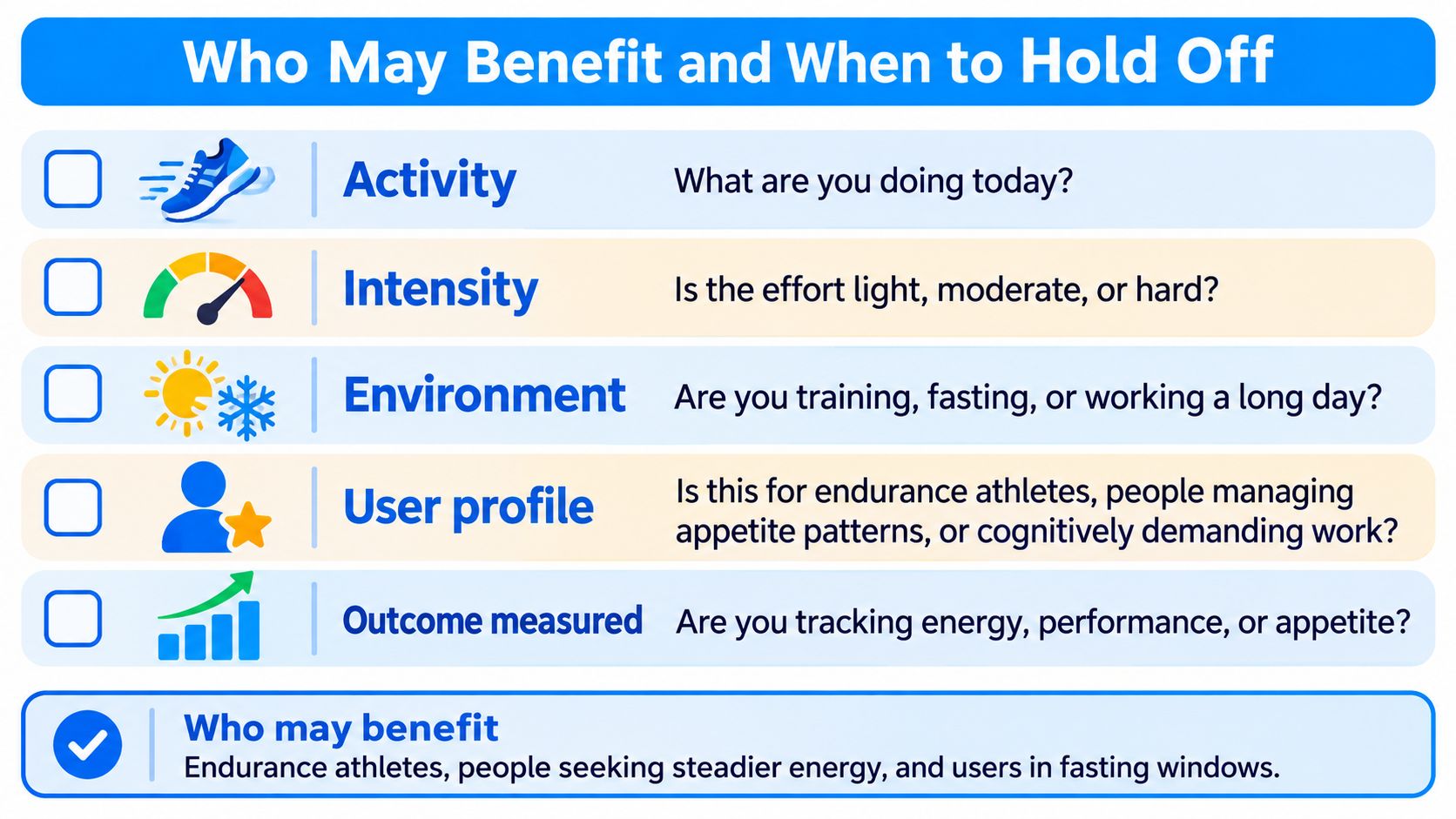
Situations where a cautious trial may be reasonable
- A long, steady training session: An endurance athlete interested in alternative fuel availability can evaluate tolerance and session experience without assuming a faster finish.
- Ketone availability without fasting: Someone who wants circulating ketones without changing their entire eating pattern has a clear physiological objective.
- A repeatable cognitive task: A person doing comparable work sessions can track accuracy, completion, and perceived effort rather than relying on an undefined sense of mental sharpness.
- A willingness to record results: A baseline log makes experimentation more informative than taking a supplement whenever fatigue happens.
There's no loading phase and no need to already be in ketosis for supplementation to raise ketone availability. That makes this a session-level decision, not a requirement to begin a ketogenic diet.
Situations that warrant caution
High-altitude or maximal-effort testing isn't a sensible first experiment given the adverse performance signal under simulated hypoxia. Neither is an important race, examination, or work presentation where an unfamiliar response could matter.
Anyone taking glucose-lowering medication should review use with a clinician because supplementation can lower glucose. That physiological effect shouldn't be interpreted as a reason to adjust medication independently.
People seeking appetite control, better sleep, or general cognitive resilience also need evidence for those particular endpoints. A product category's ability to raise BHB doesn't establish those benefits.
Before buying: Name the activity, intensity, environment, user profile, and outcome. If you can't name the outcome, you can't meaningfully decide whether the trial worked.
For example, choose a repeatable steady ride rather than an all-out event. Decide whether you're evaluating perceived energy, external output, or ketone exposure; those are different questions, and ordinary training equipment can't directly measure tissue ketone oxidation.
Confirm Safety and Dosing Before You Start
Safety findings apply to the formulation, dose, and population studied. In a 2024 randomized, double-blind, placebo-controlled pilot study, healthy adults aged 65 and older consumed up to 25 g of ketone ester daily for 12 weeks. Researchers found no statistically significant or clinically relevant changes in vital signs or measured clinical laboratory tests.
That result supports tolerability under the study conditions. It does not establish long-term safety or safety during pregnancy, or for people with every medical condition or medication.
Dosing reference from human studies
The protocols below are study doses, not recommended servings. Body-weight dosing, liquid volume, ester mass, and BHB-equivalent dose describe different quantities and cannot be directly substituted for one another.
| Study Population | Dose | Duration |
|---|---|---|
| Trained endurance athletes, 39 participants, ketone ester trial | 573 mg/kg body weight of ketone ester | Single session |
| Healthy adults, cardiac and muscle energetics study | Single dose of (R)-3-hydroxybutyl (R)-3-hydroxybutyrate | Single dose; measured at 30 minutes |
| Healthy adults aged 18–70, 24 participants, repeated-use ketone monoester study | 25 mL ketone monoester three times daily | 28 days |
| Recreational runners, ketone monoester study | 30 g ketone monoester three times daily | 31 days |
| Healthy adults aged 65 and older, pilot study | Up to 25 g ketone ester daily | 12 weeks |
| Participants in a simulated cycling race, ketone ester study | 25 g after stages and before sleep | 8 days |
The repeated-use study in healthy adults also reported no adverse changes in measured metabolic and laboratory outcomes. Such results cannot automatically be applied to other ester structures. A randomized crossover trial of a lactate-ketone ester in adults with obesity reported overall tolerability during 28 days of twice-daily consumption, alongside mild-to-moderate gastrointestinal side effects. Formulation and digestive tolerance both matter when interpreting safety.
Put formulation checks before dose escalation
Use the directions for the specific formulation. A dose from another ester trial is not a basis for increasing a personal serving, particularly when the study used body-weight dosing.
Product identity testing and clinical efficacy address different questions. The resource on independent peptide testing explained describes testing in another product category; it does not establish ketone efficacy or independent testing of a ketone formulation. For ketone-specific considerations, see this guide to ketone supplement safety.
Before use, confirm with a clinician if you take medication, are pregnant, or have a kidney or metabolic condition. Follow the product label, and stop and seek professional advice if side effects occur. A four-week log of sessions, blood-ketone readings if available, and digestive discomfort can help track your response; it is a practical tracking period, not a proven treatment duration.
Application Framework
A useful trial starts with one outcome and a way to measure it. Pick the goal before deciding whether ketones belong in your routine.
- Name the outcome. Choose one target, such as fuel availability, endurance output, performance on a specific cognitive task, or recovery. A focused target makes the result easier to interpret.
- Set expectations from the evidence. If the outcome is marked mixed or not shown, treat supplementation as a personal trial, not an expected improvement.
- Match the route to the need. Use exogenous ketones for a temporary fuel window, and diet-induced ketosis for a sustained metabolic strategy.
- Choose a repeatable session. Compare similar training or work conditions rather than a race or altitude challenge. Keep food, caffeine, sleep, and workload reasonably consistent.
- Record the result. Track the outcome you selected and any tolerance issues. For training, log finish time and a 1–10 perceived-effort rating for each comparable session.
- Continue only if the result is useful and tolerable. If the target outcome does not improve, or side effects are difficult to manage, stop. A favorable personal result does not establish that others will experience the same effect.
Practical takeaway: Ketone esters can raise circulating D-BHB. Whether that change helps depends on the specific task, so judge a trial by the outcome you recorded.
Tecton Ketones™ offers bioidentical exogenous ketone nutrition for people exploring alternative fuel availability without a strict ketogenic diet. Review the Tecton Ketones™ formulations to decide whether a measured trial fits your training or work routine.


