


If a blood ketone meter reads high, does that tell you anything about whether you're building muscle? For most lifters, the honest answer is no. A ketone reading describes fuel availability, not whether you've eaten enough energy, eaten enough protein, or overloaded a muscle enough to grow. That distinction sits at the center of ketosis and bodybuilding, because diet-induced ketosis, your body's own ketone production, and an exogenous ketone drink are three different states with different effects on training. Separating them lets you judge each claim by a measured outcome, such as squat load, repetitions at a fixed weight, or lean mass trend, rather than by a single beta-hydroxybutyrate (BHB) number.
What the Research Says About Ketosis and Muscle Gain
Ketosis doesn't appear to block strength or muscle gain when protein and training are controlled. It also hasn't been shown to build muscle better than a carbohydrate-containing diet. That's the verdict across maximal strength, fat-free mass, and hypertrophy outcomes, and it's why a lifter should treat ketosis as a fuel environment, not an anabolic switch.
A 2024 systematic review and meta-analysis found no statistically significant difference between ketogenic and control diets for one-repetition maximum squat in 106 trained participants or bench press in 119 participants. A single maximal lift, though, doesn't capture the repeated volume that drives hypertrophy, so neutral 1-RM results don't prove equal training quality across a full block. Understanding how muscle protein synthesis responds to protein and training stimulus helps explain why that volume matters more than fuel type alone.
Ketosis and Bodybuilding Outcomes at a Glance
| Outcome | What the studies found | Evidence consistency | Practical reading |
|---|---|---|---|
| Maximal strength (squat and bench press) | No significant difference from control diets in 106 squat and 119 bench participants | Consistent across 2024 review and position stand | Ketosis does not appear to impair heavy lifting |
| Fat-free mass | No significant difference in 5 studies with 111 resistance-trained participants | Limited number of studies | Ketosis does not add lean mass on its own |
| Body composition during a cut | Ketosis may support adherence and energy control | Context-dependent | Useful only if it makes the deficit easier to hold |
| Hypertrophy from a ketogenic bulk | No independent advantage shown over carbohydrate-containing diets | Limited | Requires a sustained energy surplus, which is hard to maintain |
| Acute exogenous ketones and training performance | Alters fuel use during exercise; net performance effect unresolved | Mixed | Test in your own sessions rather than assume benefit |
| Recovery signaling after training | No change in transcriptomic response or glycogen resynthesis in one controlled study of nine men | Single study | Do not assume better recovery from raised ketones |
Read the strength and fat-free mass rows together. They say ketosis is broadly neutral, which is useful if you prefer low-carbohydrate eating, but neutral isn't superior. If your goal is to build muscle that performs, a program built around progressive compound work gives you a clearer lever than chasing a higher ketone reading.
The recovery row deserves equal weight. In a randomized, double-blind crossover study described in a Liverpool John Moores University research paper, ketone monoester ingestion during cycling and recovery in nine recreationally active men didn't produce expected changes in skeletal-muscle transcriptomic response or glycogen resynthesis. Raising circulating ketones changed fuel availability without proving a better molecular recovery response.
Ketones in the blood aren't the same as amino acids in the muscle. One is fuel, the other is building material.
Three levers drive hypertrophy regardless of diet. You need sufficient total energy for the phase you're in, adequate protein to supply essential amino acids, and progressive overload to signal adaptation. Ketosis can sit alongside those levers. It can't replace any of them, and high BHB alone shouldn't be read as proof that you're in an anabolic state.
Keeping Strength on a Ketogenic Diet
Say you're a trained lifter who wants to try nutritional ketosis without losing top-end strength. The most directly relevant worked example comes from competitive natural bodybuilders, not beginners, which makes the numbers worth reading in the order you'd check your own logbook.
In an eight-week study reported in a Nutrients paper on ketogenic dieting in bodybuilders, 9 men followed a ketogenic diet and 10 men followed a conventional Western diet. The ketogenic group ate approximately 5% of calories from carbohydrates, equivalent to fewer than 50 grams per day, while both groups consumed 2.5 grams of protein per kilogram of body weight daily.
What Happened to the Lifts
Both groups got stronger. Bench-press performance increased by 4.13% in the ketogenic group versus 3.75% in the Western-diet group. Squat performance increased by 3.62% with the ketogenic diet versus 6.40% with the Western diet. Neither between-group difference was statistically significant, so you can't claim keto won the bench press or lost the squat based on this sample.
What you can conclude is narrower and still useful. Trained bodybuilders maintained or improved maximal strength during short-term nutritional ketosis when protein intake and resistance training were controlled. Protein wasn't an afterthought here. At that intake, both groups had ample amino acids available, which removes one common reason low-carbohydrate trials fail lifters in practice.
The Limits You Should Not Skip
The study was small and lasted only two months. It doesn't establish that ketosis is superior for muscle gain or long-term hypertrophy, and maximal strength over eight weeks isn't the same outcome as lean mass added over a year. A lifter who extrapolates from this trial to a full bulking season is going beyond what the design can support.
Practical rule: Judge ketosis by your logged loads over at least four weeks, not by how one session felt during the first low-carbohydrate week.
If you test this approach, copy the controls that made the result interpretable:
- Set protein first: Match the study level of 2.5 grams per kilogram before you adjust fat or carbohydrate.
- Track fixed-load performance: Record top-set loads and repetitions at the same weight each week for squat and bench press.
- Read a squat dip correctly: If squat volume falls, review total energy intake and sleep before blaming ketosis itself.
- Give it a fair window: Assess the trend over four or more weeks, because early sessions reflect fuel transition as much as strength.
The takeaway is compatibility, not advantage. Ketogenic dieting can fit strength development when you hold protein high and keep progressive resistance exercise in place. It doesn't prove that removing carbohydrate builds more muscle, and it shouldn't be sold to you that way.
Fat Loss, Lean Mass and the Energy Surplus
Strength can stay flat while body composition moves in either direction, and that split is where ketosis and bodybuilding goals most often diverge. A lifter can hold a bench press, lose fat, and still add no lean mass if energy never rises above maintenance.
The infographic below summarises the body-composition comparison that matters for phase selection.
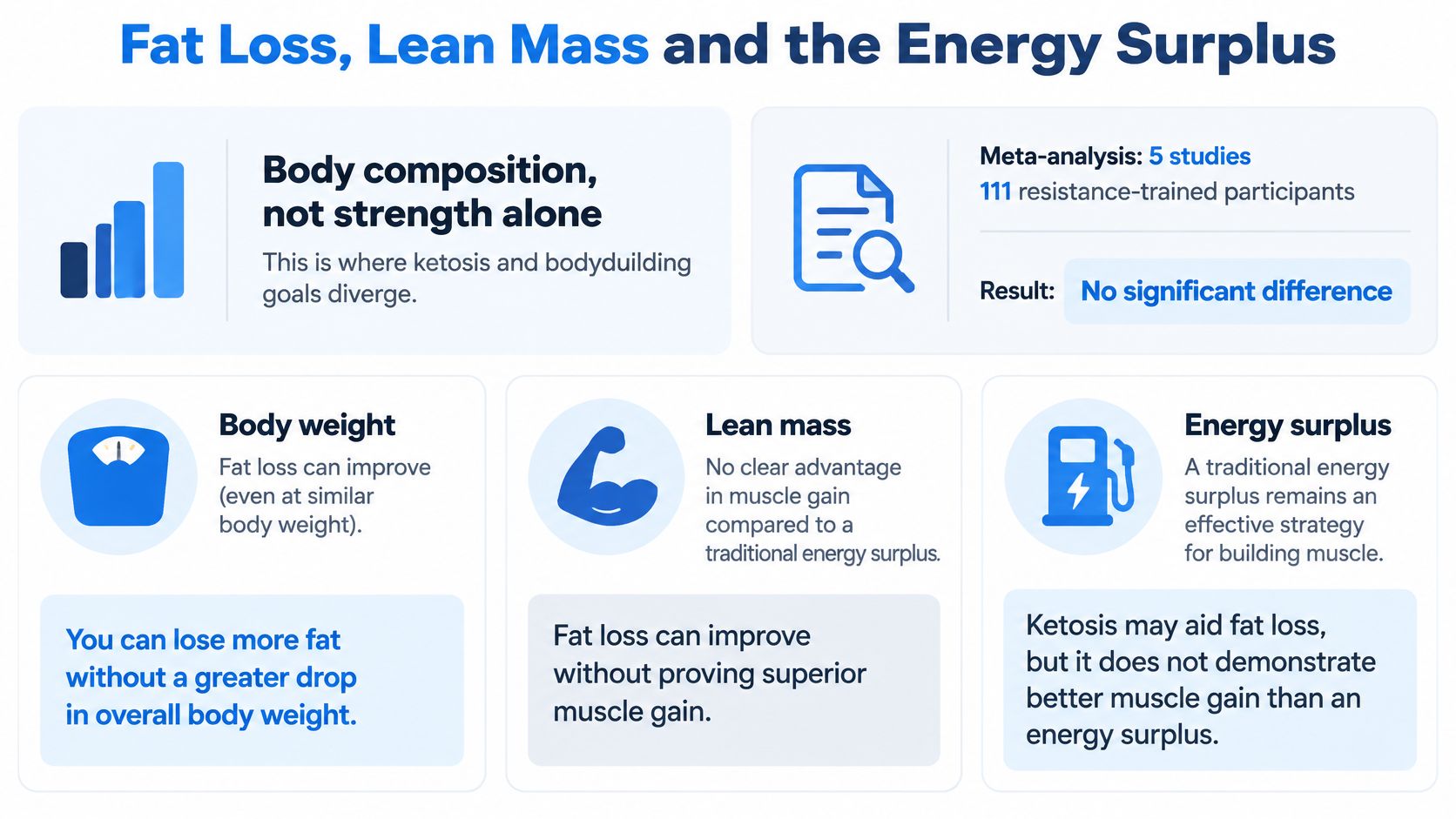
A systematic review and meta-analysis held by the University of Málaga repository covering five studies and 111 resistance-trained participants found no significant difference in fat-free mass between ketogenic and control diets. That result reframes ketosis as a body-composition strategy rather than a proven hypertrophy advantage.
Cutting and Bulking Are Different Problems
For a cut, ketosis may help if it improves dietary adherence and energy control. If low-carbohydrate eating makes a deficit easier for you to hold without constant hunger, that behavioral fit has value even though ketones themselves aren't building tissue. Judge it by whether body mass trends down while training loads hold.
For a bulk, the constraint reverses. A ketogenic bulk may support hypertrophy only when it creates a sustained energy surplus, and high satiety plus reduced dietary variety can make that surplus difficult to maintain. For maximal mass gain, carbohydrate restriction isn't supported as an independent muscle-building advantage.
The video below walks through how energy balance interacts with training phase decisions in practice.
Monitor the variables that tell you whether the phase is working:
- Weekly body mass: Use a rolling average, not single-day readings.
- Training volume and load: Log sets, reps, and progression on main lifts.
- Lean-mass trend: Use one consistent method, such as skinfolds or DXA, at spaced intervals.
- Hunger and adherence: Score both weekly so you can see whether the diet is sustainable.
Don't make the most common error in this space. A high blood ketone reading isn't proof of an anabolic state, and it tells you nothing about whether energy and protein were sufficient that week.
Nutritional, Endogenous and Exogenous Ketosis Compared
Most confusion in ketosis and bodybuilding comes from using one word for three states. A diet changes your whole fuel system over days. A fast changes liver output while you abstain from food. A drink raises blood BHB for a short window. Those aren't interchangeable, and a claim about one shouldn't be used to sell another.
Three Types of Ketosis and How They Differ
| Type of ketosis | How BHB rises | Typical duration | Blood BHB reference |
|---|---|---|---|
| Nutritional ketosis (diet-induced) | Carbohydrate restriction raises liver ketone output | Sustained while intake stays low | Above 0.5 mmol/L (ISSN definition) |
| Endogenous ketosis (fasting) | Prolonged fasting lowers glucose and raises liver ketone output | Lasts while fasting continues | Above 0.5 mmol/L marks nutritional ketosis in sports nutrition research |
| Exogenous ketone supplementation | Ingested BHB or ester raises blood BHB directly | Transient, about one to two hours | Measured as a post-ingestion rise from your pre-dose baseline |
The International Society of Sports Nutrition position stand indexed on PubMed defines nutritional ketosis generally as a serum ketone concentration above 0.5 mmol/L. It also found ketogenic diets substantially increase fat oxidation during exercise to approximately 1.5 g/min, while athletic performance is usually neutral or detrimental compared with higher-carbohydrate, lower-fat diets.
That pairing matters. Burning more fat per minute describes substrate use, not winning performance or added hypertrophy. Maximal strength and strength gains are generally similar between approaches, although some non-ketogenic comparisons have favored carbohydrate-containing diets.
Endogenous ketone production is your liver making ketones during fasting or prolonged carbohydrate restriction. It continues as long as the conditions driving it continue, and it comes packaged with lower insulin, altered fat mobilization, and depleted or reduced glycogen availability. You can't separate the ketones from that wider metabolic state.
Exogenous ketone supplementation works differently. You ingest BHB or a precursor form, blood BHB rises directly, and the rise is transient. Exogenous ketones can raise circulating BHB without reproducing the full metabolic state created by carbohydrate restriction. Glycogen availability, total energy intake, protein intake, and training intensity remain separate determinants of your result.
Any ketone claim should name its type, dose, and measurement time. If it doesn't, you can't judge whether it applies to your training.
Use the table as a filter. When you read that ketosis did something in a study, ask whether participants ate a ketogenic diet for weeks, fasted, or drank a ketone product once. The answer changes what the finding means for a bodybuilder.
Why This Matters for Training Output
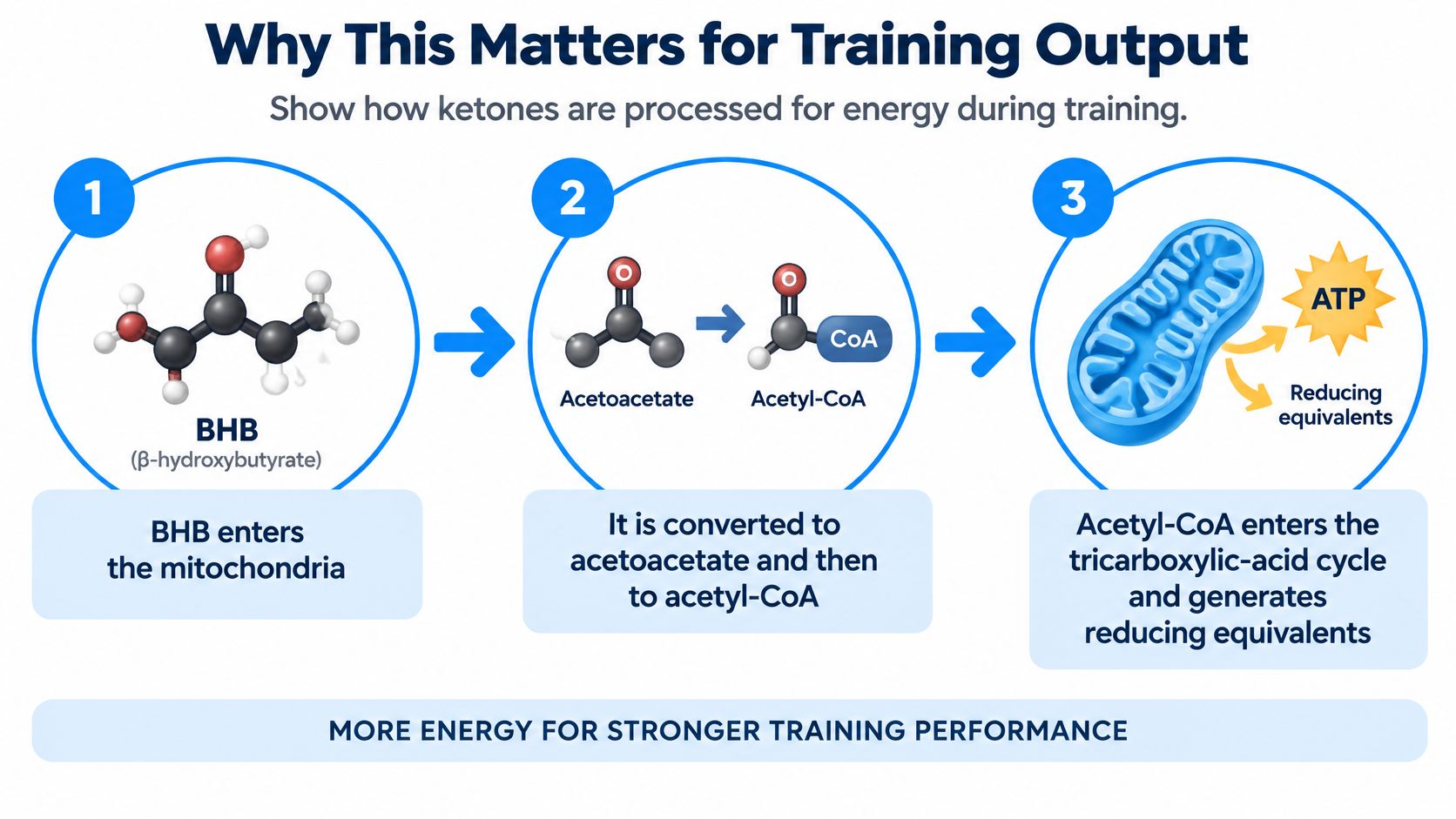
BHB is a usable oxidative fuel, and its pathway explains both its promise and its limits for lifting. Follow the sequence and you'll see why ketones suit sustained oxidative work better than they suit rapid, repeated glycolytic efforts.
- BHB enters the mitochondria in muscle and other tissues.
- It's converted to acetoacetate and then to acetyl-CoA inside the mitochondria.
- Acetyl-CoA enters the tricarboxylic-acid cycle and generates reducing equivalents.
- Those equivalents drive the electron-transport chain and ATP synthesis through oxidative phosphorylation.
Glucose follows a different route. Glycolysis in the cytosol produces pyruvate and fast ATP before mitochondrial oxidation, which is why carbohydrate supports heavy, short, repeated efforts so well. Ketones bypass glycolysis. That bypass is a feature for oxidative fuel supply and a limitation when glycolytic speed is the point.
The diagram below shows that conversion sequence in training terms.
In five studies involving 39 high-performance athletes reported in a PubMed indexed ketone ester study, ketone-ester nutrition produced ketosis while normal muscle glycogen, carbohydrate intake, and high insulin levels were maintained. It reduced muscle glycolysis and plasma lactate concentrations and increased intramuscular triacylglycerol oxidation during exercise. That's metabolic flexibility, the ability to shift fuel use according to substrate availability. It isn't proof of better strength, hypertrophy, or competition performance.
Four Training Outcomes, With Their Limits
Steadier energy is the most defensible framing. BHB adds an oxidative substrate when glycogen is partly depleted or when you've trained fasted. That describes fuel availability during a session, not a guarantee that output rises. If your logged reps at a fixed load don't change, the extra fuel didn't translate into work.
Cognitive endurance has a physiological rationale. In healthy middle-aged adults described in a PMC review of ketone brain metabolism, intravenous BHB infusion reduced cerebral glucose consumption by approximately 14% while cerebral oxygen use remained unchanged, indicating ketones were used immediately by the brain. It also reports that after approximately three days of fasting, ketone bodies supplied about one-quarter of cerebral energy requirements. BHB also acts as a signaling molecule that can influence oxidative stress, inflammatory processes, and gene expression, including pathways relevant to endothelial function. Those findings support studying focus during long sessions. They don't prove better gym performance.
Workout performance is most plausible where oxidative demand dominates. Lower-volume strength work, fasted sessions, or endurance work before lifting fit that profile better than high-volume hypertrophy blocks. Evidence for a direct anabolic benefit remains limited, so don't credit a ketone drink for growth that protein and overload explain.
Metabolic efficiency needs careful wording. Higher fat oxidation and lower lactate describe a different fuel mix, not automatic efficiency. A muscle can burn more fat and still produce the same or fewer repetitions.
Ketones change which fuel the muscle burns. They don't replace the training stimulus, the protein needed for repair, or the energy needed to grow.
Choosing Between Ketone Salts, Esters and Precursors
Form isn't a branding detail. Chemical structure determines what else you ingest with the BHB, whether conversion is required, how tolerable the dose is, and how long blood ketones stay high. Treating salts, esters, and precursors as interchangeable is how a lifter ends up judging a product by data from a different molecule.
A controlled human study in PMC of a single ketone-ester drink found a mild rise in blood ketones with reductions in glucose, lactate, and free fatty acids, but no detectable change in cardiac phosphocreatine-to-ATP ratio or skeletal-muscle metabolic measures 30 minutes after ingestion. Increased circulating BHB didn't automatically translate into measurable muscle energetics. The same evidence base notes exogenous supplementation generally produces a transient one- to two-hour increase in BHB and acetoacetate, with many studies failing to find benefits on exercise-capacity tests.
Ketone Salts, Esters and Precursors Compared
| Form | Chemical basis | Main limitation | What to check |
|---|---|---|---|
| Ketone salts | BHB bound to sodium, potassium or magnesium | Larger mineral load per dose | Total mineral content per serving |
| Ketone esters | BHB bound to an alcohol that must be hydrolysed | Tolerability and taste vary between products | Whether the human data used the same ester |
| Tri-ester with liposomal delivery (R3HBG) | Three D-BHB units on a glycerol backbone | Human data for this specific form are limited to the cited studies | Absorption data and D-BHB stereochemistry |
Salts deliver BHB with minerals attached, so dose size carries a sodium, potassium, or magnesium load you should count alongside the rest of your diet. Esters must be hydrolysed to release BHB, and tolerability varies enough between products that gastrointestinal response should be part of any trial. Precursors such as 1,3-butanediol depend on liver conversion, adding another step between ingestion and circulating BHB.
Bioidentical refers to stereochemistry. Your body produces and uses the D-BHB isomer, so a label should state which isomer the product delivers rather than listing total BHB alone. A tri-ester such as R3HBG carries three D-BHB units on a glycerol backbone and is formulated with liposomal delivery, a lipid-based system designed to support absorption. Judge that specific form by human data for that form, not by salt or monoester trials.
One example of that format is the Tecton EDGE™ Performance Shot + Electrolytes, described as powered by liposomal R3HBG ketone with sodium, potassium, and magnesium for active individuals who want steady energy during training without caffeine.
Read any label in this order:
- Specific form: Salt, ester, precursor, or tri-ester.
- BHB per serving: Grams stated, not just a proprietary blend total.
- Mineral content: Sodium, potassium, and magnesium per dose.
- Study timing: When blood BHB and performance were measured after ingestion.
- Absorption evidence: Whether data exist for any liposomal claim on that product.
Carbohydrates for High Volume Sessions
High-volume hypertrophy work is where exogenous ketones are least able to stand in for carbohydrate. Repeated hard sets depend on rapid glycolytic ATP production and adequate muscle glycogen, even though BHB can provide oxidative fuel and may influence protein-turnover signaling. A peer-reviewed review in a PMC article on ketone supplementation and muscle metabolism concludes ketone supplementation changes muscle metabolism during exercise while the net performance effect remains unresolved.
That unresolved status should shape your session planning. Don't remove the fuel system that repeated sets rely on and assume an oxidative substrate covers the gap. A structured approach such as a cyclical ketogenic diet is one way lifters periodize carbohydrate around harder training instead of treating every day the same.
A Session Rule You Can Apply This Week
- Assign carbohydrate to high-volume days: Put it with leg days and long hypertrophy sessions so repeated sets keep glycogen support.
- Confine ketone tests: Use lower-volume strength work, fasted training, or a calorie-restricted phase for any exogenous ketone trial.
- Ignore the meter as a carb decision: Crossing a ketone threshold isn't proof carbohydrate can be dropped without cost.
- Troubleshoot volume loss in order: If top-set squat or bench volume slips, check total energy and carbohydrate before blaming ketosis.
Session rule: Carbohydrate carries glycolytic volume. Ketones stay an optional oxidative add-on, tested where they can't compromise your hardest training.
Track repetitions at a fixed load, perceived exertion, gastrointestinal tolerance, and next-day recovery across multiple sessions before you decide a ketone product helps. One good workout proves little, and blood BHB alone proves less. Established variables still carry the block: protein intake, energy availability, progressive overload, sleep, and hydration. If a ketone test costs you reps on the sessions that drive growth, it has failed the only test that matters for bodybuilding, regardless of what your meter displayed that morning.
Decide Whether a Ketone Test Fits Your Training Block
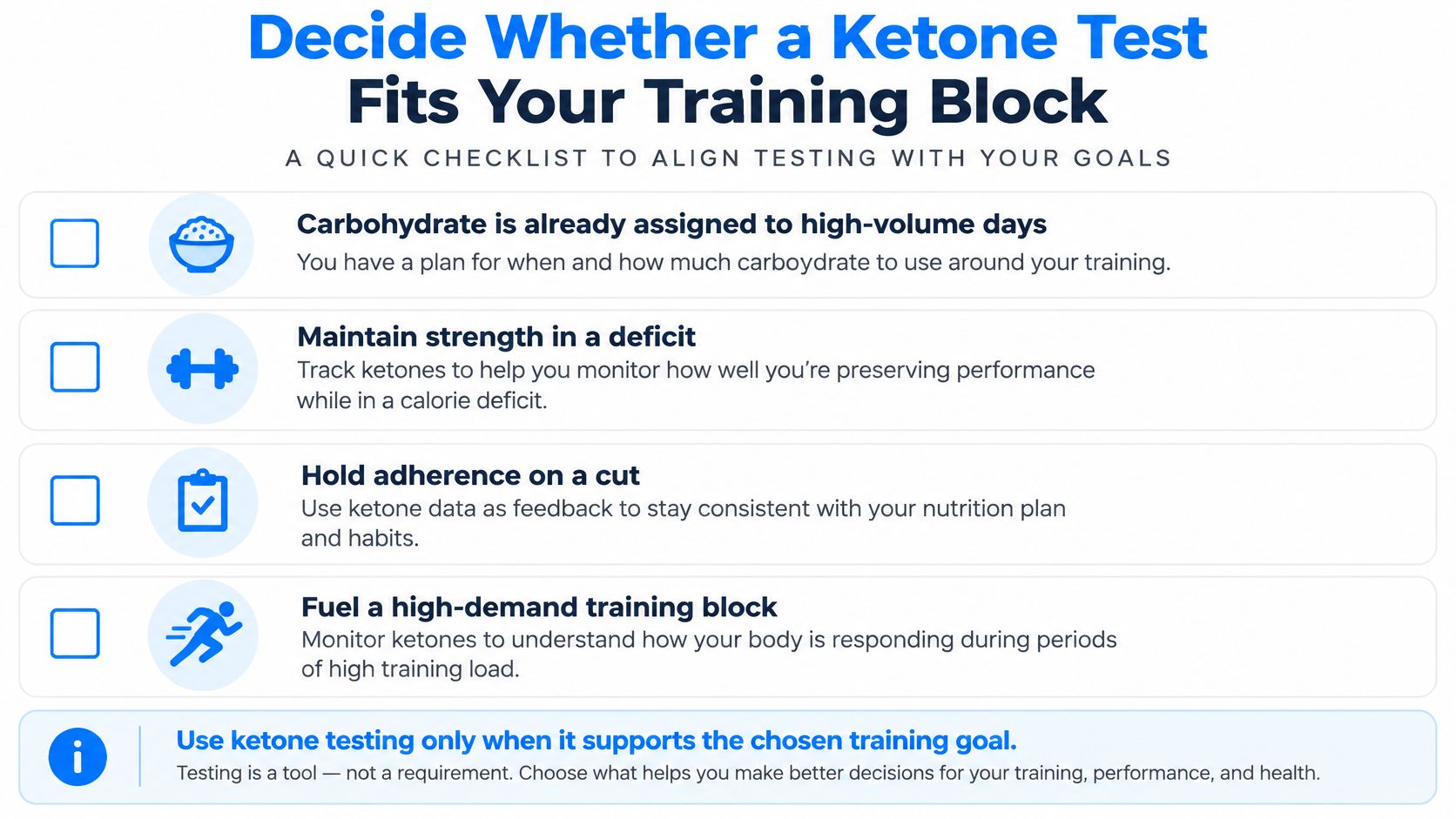
Run a ketone test only after carbohydrate is already assigned to your high-volume days. That order protects the training that drives hypertrophy and leaves you testing ketones where a neutral result costs nothing.
The checklist below puts that decision sequence in the right order.
Application Framework
Start by naming one goal: maintaining strength in a deficit, holding adherence on a cut, or fueling a fasted or low-volume session. Lifters with a defined training phase and stable training history are best placed to judge a test, because their baseline performance is predictable. If you're managing a medical condition or taking medication, consult a clinician before using exogenous ketones. Guidance on measuring ketones with a urine test kit can help you understand what different testing methods do and don't tell you.
Expect a transient rise in blood BHB, possible gastrointestinal discomfort, and a mineral load if your chosen form is a salt. Our R3HBG raises blood ketones directly, independent of what has been eaten, and works alongside a normal diet. There's no loading phase and no need to be in ketosis for the product to work, which matches how exogenous ketones raise blood ketones without fasting or a ketogenic diet.
Run the test like an experiment, not a vibe check:
- Repeat three to four sessions: Keep the same program so sessions are comparable.
- Fix the loads: Log repetitions and perceived exertion at identical weights.
- Track tolerance and recovery: Note gastrointestinal response and next-day readiness.
- Weigh weekly: Use a trend and ignore single-day spikes.
Judge the test by logged lifts, not by the ketone number. Tecton Ketones products may be dietary supplements, and statements on the site have not been evaluated by the FDA. They're not intended to diagnose, treat, cure, or prevent any disease, and nothing in a ketone test changes your need for calories, essential amino acids, progressive training, electrolytes, or carbohydrate when glycolytic demand is high.
If you want to test exogenous ketones without restructuring your whole diet, Tecton Ketones™ offers bioidentical R3HBG ketone shots with liposomal delivery, designed to raise blood BHB directly alongside normal eating and training. Choose a low-volume or fasted session, log your fixed-load repetitions and tolerance across several workouts, and let your training data decide whether ketones earn a place in your block.


