


An international survey found that approximately two-thirds of 3,887 adult and adolescent elite athletes competing at world-championship events used at least one dietary supplement, according to the U.S. National Institutes of Health Office of Dietary Supplements fact sheet. That figure explains the size of the runners recovery supplements market. It doesn't tell you which product helps, when it helps, or whether food would do the same job.
The useful question isn't, "What's the best recovery supplement?" It's, "What's limiting my next session?" Empty glycogen stores, muscle damage, fluid loss and poor readiness are different problems. They need different answers, in a specific order.
Recovery Supplements Ranked by Evidence
In the China Marathon Nutrition Survey, 23.3% of runners used dietary supplements frequently or regularly, 31.7% used them occasionally, mainly before important races, and 21.4% used protein powders, according to a review of runner supplement use. These figures describe the surveyed runners, not all runners worldwide. They show that supplement use often clusters around important races and specific demands, rather than routine use after every easy run.
Use the image and table to compare evidence and function, not as a shopping list.
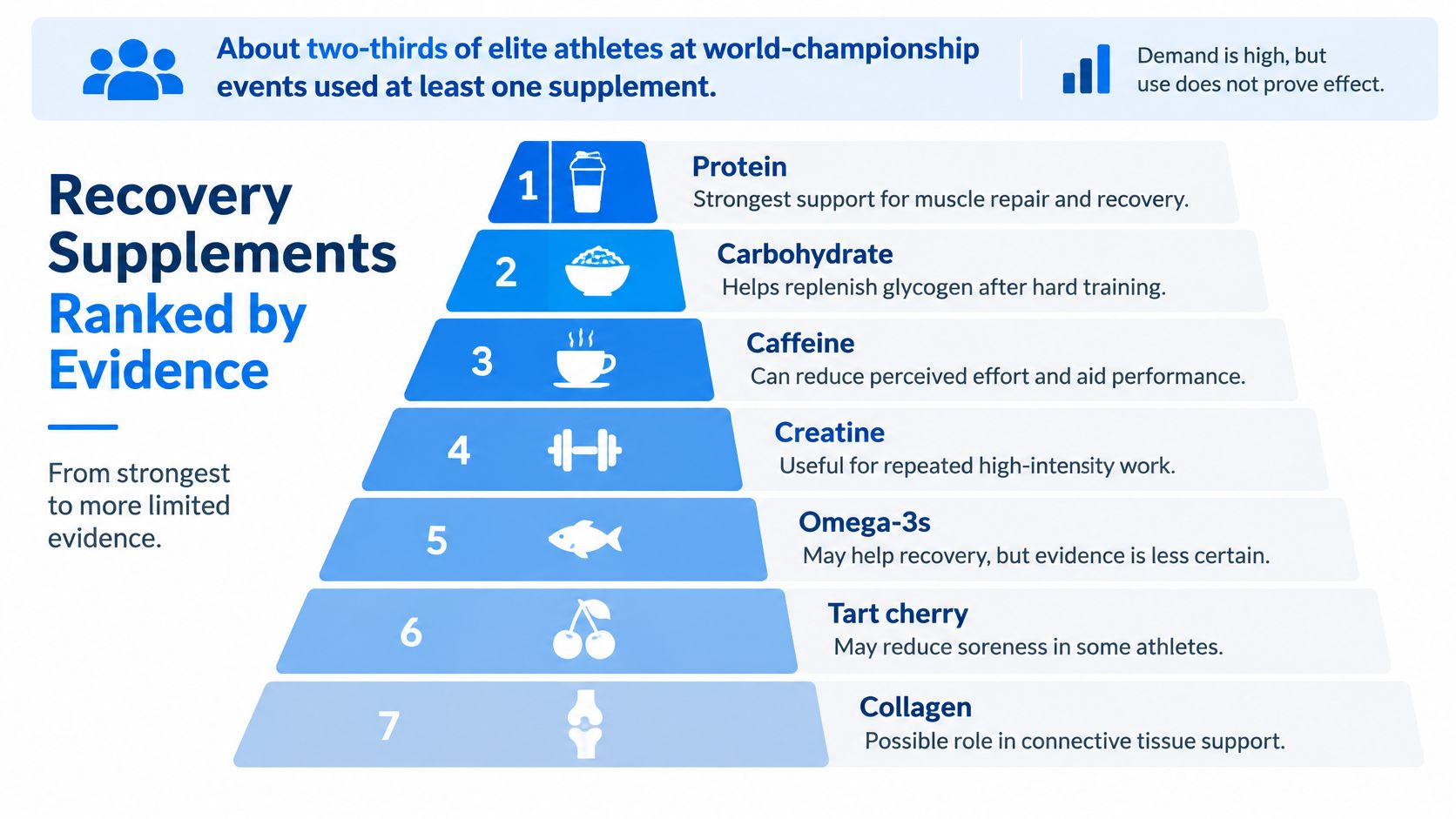
Recovery Supplements by Evidence Strength and Role
| Supplement | Evidence strength | Main recovery role | Practical note |
|---|---|---|---|
| Protein | Strong | Muscle-protein repair after hard sessions | Pair with carbohydrate after long efforts |
| Creatine | Strong | Strength and high-intensity work support | Take daily at a consistent time, not only post-run |
| Caffeine | Strong | Perceived readiness and output | Performance aid rather than recovery in the strict sense |
| Beta-alanine | Strong | High-intensity performance support | Supports hard efforts, not glycogen or tissue repair |
| Nitrate | Strong | Performance support | Time it before key sessions, not as post-run repair |
| Tart cherry | Conditional | Possible soreness moderation after damaging load; results inconsistent | Use around the damaging training load |
| Electrolytes | Context-dependent | Sodium and fluid replacement after heavy sweat loss | Most relevant after long, hot or salty sessions |
| Exogenous ketones | Mixed | Raises circulating BHB and shifts fuel use | Results vary by format and intensity |
| Omega-3s and antioxidant blends | Mixed or unproven | General nutritional support | Runner-specific recovery data remain limited |
Protein ranks highly because it supplies amino acids for muscle-protein remodeling after long runs, hills and strength work. For practical serving ideas and timing around training, Swift Running's guide to post-run protein complements the table.
Match the product to the limiting factor. A readiness aid will not replace glycogen, and a glycogen strategy will not by itself repair muscle.
The ketones row needs separate treatment because its evidence differs from protein. Exogenous ketones raise circulating BHB and can shift fuel use, but outcomes vary by product format and exercise intensity. That makes them a timed option to consider within a food-first recovery plan, not a substitute for protein or other strategies matched to the runner's actual needs.
Carbohydrate Timing Comes Before Any Supplement
When your next demanding session starts in less than 8 hours, carbohydrate timing outranks specialty runners recovery supplements. Glycogen resynthesis is time constrained. If you underfuel that window, no soreness product or ketone shot restores the missing muscle and liver glycogen.
A review of carbohydrate-protein strategies identifies approximately 1.2-1.5 g of carbohydrate per kilogram of body mass per hour as the intake range that approaches maximal post-exercise glycogen-synthesis rates during short recovery windows. For a 70 kg runner, that's 84-105 g per hour in the early recovery period. Treat that as an example for short turnarounds, not a prescription for every run.
Carbohydrate and Protein Targets by Recovery Window
| Recovery window | Carbohydrate target for a 70 kg runner | Protein role |
|---|---|---|
| Under 8 hours before the next session | 84-105 g per hour in early recovery | Paired with carbohydrate, never replacing it |
| 8-24 hours | Total daily carbohydrate matched to training load | Complete protein spread across meals and snacks |
| Over 24 hours | Total daily carbohydrate and energy availability | Daily protein target met from overall diet |
A Four-Step Short-Window Protocol
- Start soon after finishing. Begin with a drink, meal or snack you can tolerate when appetite is low.
- Repeat servings. Spread carbohydrate across the first several hours instead of relying on one large feeding.
- Add complete protein. Include dairy, eggs, soy, meat, fish or a complete protein supplement to support remodeling.
- Scale to the load. A 90-minute interval morning followed by an evening strength session needs more aggressive refueling than an easy 40-minute run.
Protein shouldn't displace carbohydrate in this window. A shake with modest carbohydrate may help you hit a protein target while leaving glycogen restoration unfinished. That trade-off shows up as heavy legs and poor quality in the next session.
When recovery time is longer than roughly 24 hours, the priority shifts. Total daily carbohydrate, adequate energy availability, sleep and hydration matter more than precise hourly timing. Broader habits around post-exercise recovery for active individuals fit here, alongside a food-first plan such as the one in our marathon training nutrition guide. Supplements can fill logistical gaps. They don't replace that foundation.
Electrolytes and Fluid Replacement After Heavy Sweat Loss
Fluid replacement is a separate decision from glycogen restoration. You can refill glycogen and still start the next run underhydrated. Start by measuring your own losses rather than copying another runner's bottle plan.
Weigh yourself before and after a hot or hilly session, in similar clothing. Note the weight change, how much you drank, and whether dried sweat leaves white salt marks on your skin or kit. That simple record tells you whether electrolytes are a priority or a minor detail.
Four Steps After a Heavy Sweat Session
- Replace fluid gradually. Drink across the hours after the run rather than forcing the full loss down at once.
- Add sodium when losses are large. Use salted food or an electrolyte drink after long, hot sessions or when you're a visibly salty sweater.
- Match intake to the day. A short temperate run and a two-hour summer long run don't create the same sodium need.
- Don't drink far beyond your loss. Overdrinking can dilute blood sodium, which is a recognized risk in long events.
Evidence for one fixed sodium dose for every runner is limited, so adjust from weight change, thirst, urine pattern and symptoms. In that context, some runners consider a combined option such as Tecton EDGE™ Performance Shot + Electrolytes, powered by liposomal R3HBG™ ketone and electrolytes Na, K and Mg. Whatever you choose, electrolytes support fluid balance. They don't replace carbohydrate for glycogen or protein for repair.
How Ketones Fuel Muscle and Brain
Think of two fuel lines feeding one engine. Glucose is the familiar line. Beta-hydroxybutyrate, or BHB, is another. They reach the mitochondria through different early steps, then converge on the same energy-producing machinery.
The diagram below maps that route from circulating BHB to ATP.
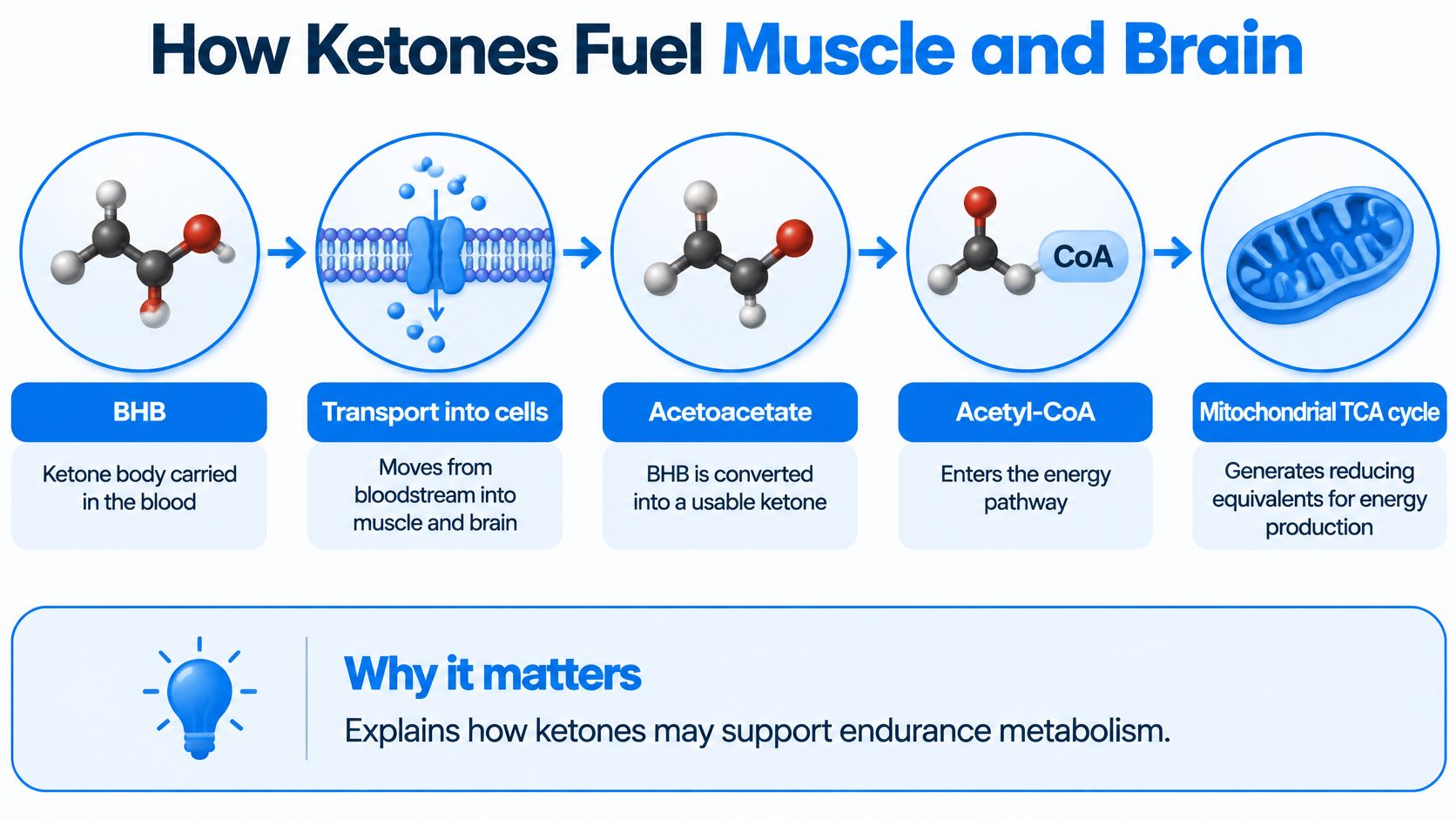
Glucose is first broken down through glycolysis to pyruvate. Pyruvate can then be converted to acetyl-CoA, which enters the mitochondrial tricarboxylic acid cycle, also called the TCA cycle. BHB takes a shorter entry route. It's transported into cells, converted to acetoacetate, then metabolized through acetyl-CoA into that same TCA cycle.
Inside the cycle, both fuels help generate reducing equivalents. Those reducing equivalents drive oxidative phosphorylation, the process mitochondria use to produce ATP, the cell's usable energy currency. Ketones therefore add an alternative supply of acetyl-CoA. They don't create a separate engine, and they don't make glucose irrelevant.
What Human Physiology Shows
In a controlled human study of healthy post-absorptive men, experimentally raising circulating D-BHB produced measurable ketone uptake by the brain and skeletal muscle, and cerebral BHB uptake and oxidation increased linearly with arterial BHB concentration. That's an important distinction. A higher blood BHB reading isn't just a marker on a meter. In that setting, brain tissue used more of the available ketone as supply rose.
That's metabolic flexibility in practical terms: tissues adjust fuel selection according to what's circulating. When carbohydrate is plentiful, glucose dominates in many tissues. When BHB availability rises, brain and muscle can oxidize more BHB. The proportion depends on concentration, tissue type and metabolic state.
The short video below gives a visual walkthrough of that fuel-switching idea before you compare product formats.
Researchers also study BHB in relation to endothelial function and cellular signaling, meaning blood vessel lining behavior and chemical messages inside cells. Those remain research areas for this discussion. They shouldn't be turned into promises about soreness, injury repair or race performance.
Physiology boundary: Demonstrating that muscle and brain can use BHB doesn't prove that a given product improves recovery in runners.
For a runner, the takeaway is narrower and more useful. Fuel selection can shift when BHB availability changes. Whether that shift helps a particular session depends on dose, format, carbohydrate availability and intensity.
Nutritional, Endogenous and Exogenous Ketones Compared
Runners often merge three different states into one word, "ketosis." Separating them prevents bad planning decisions.
Nutritional ketosis is diet induced. Sustained carbohydrate restriction or prolonged fasting prompts the liver to make more ketones over days. Endogenous production means your own liver output, whether it rises during fasting, hard exercise or a ketogenic diet. No supplement directly controls that baseline system. Exogenous supplementation means you ingest ketones or related compounds orally, raising circulating BHB without waiting days for a dietary state to develop.
Three Sources of Circulating Ketones Compared
| Ketone source | How it raises BHB | Time to effect | Runner relevance |
|---|---|---|---|
| Nutritional ketosis | Carbohydrate restriction or prolonged fasting | About three days in the starvation benchmark | Diet-dependent and slow to adjust |
| Endogenous production | Liver output during fasting or hard exercise | Hours to days as liver output changes | Part of normal fuel shifts, not controlled by a product |
| Exogenous supplementation | Oral ketone product raises circulating BHB directly | Within the session window after ingestion | Can be timed around a session; results vary by format |
Human starvation research gives a useful benchmark for brain fuel use. After approximately three days of starvation, ketone bodies supplied about one-quarter of total cerebral energy requirements, according to human starvation research on cerebral ketone use. Ketones didn't replace glucose completely. They supplied an alternative acetyl-CoA source for mitochondrial ATP production in brain cells.
Don't overextend that finding. Starvation-induced endogenous ketosis isn't the same as taking a commercial supplement before a run. The benchmark proves the brain can use ketones at meaningful scale under specific conditions. It doesn't prove every product or dose produces the same effect.
The planning implication is timing. Diet-induced ketosis is a sustained metabolic state that takes days to establish and affects your whole fueling strategy, including carbohydrate availability for hard training. An exogenous product is a timed option around a session. It can change circulating BHB for a window. It doesn't reset your baseline fuel system.
Ketone Salts, Esters and Precursors Compared
Format determines how much a “ketone” label tells you about a session. Salts, esters and precursors differ in chemical structure, mineral load and the steps needed to raise BHB. Evidence from one format does not establish an effect for the others.
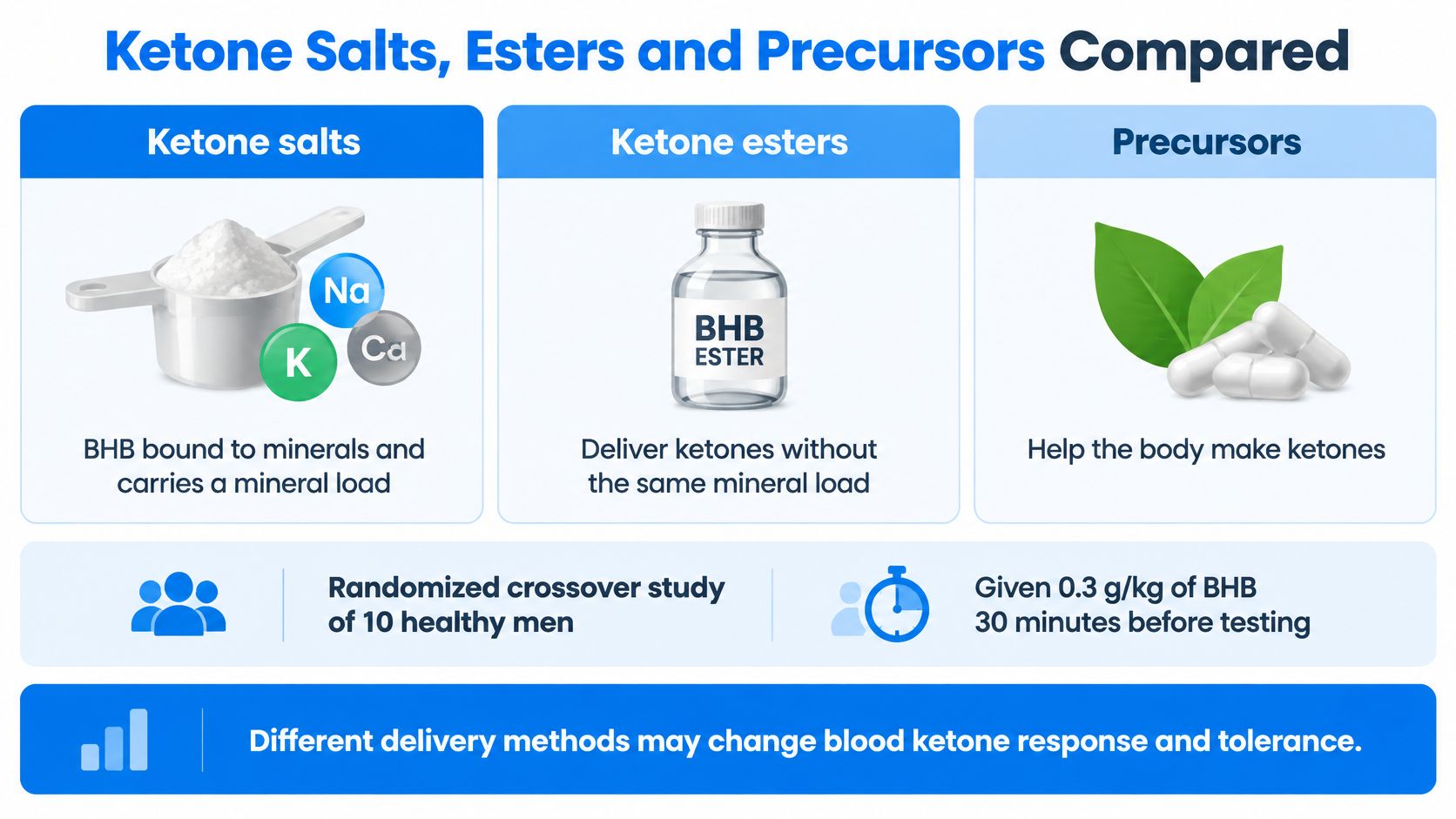
Ketone salts bind BHB to minerals such as sodium, potassium, calcium or magnesium. That mineral load is part of the formulation. In a randomized crossover study in 10 healthy men, participants took 0.3 g/kg of BHB 30 minutes before cycling. The salts increased plasma BHB and shifted fuel use toward fat oxidation, while average time-trial power was approximately 7% lower, equivalent to 16 watts, than in the control condition.
For runners, the distinction is practical: a change in BHB or fat oxidation does not guarantee better high-intensity output. During hill repeats or a finishing kick, power matters more than a blood ketone reading alone.
Ketone Delivery Formats Compared
| Format | Chemical form | Human evidence | Main limitation |
|---|---|---|---|
| Ketone salts | BHB bound to minerals | Average time-trial power about 7% lower (16 W) than control in a 10-man cycling crossover | Mineral load and high-intensity trade-off |
| Ketone esters | BHB bonded to a carrier molecule | Study results vary across outcomes | Wide outcome variation and product-specific tolerance |
| Precursors | Compounds converted to BHB in the body | Study results vary across outcomes | Conversion adds individual variability |
Heterogeneity, measured as I-squared, describes how much variation across studies reflects differences between studies rather than chance. High heterogeneity means results are less consistent, so an average finding may not predict what happens in an individual workout. It does not show that a format cannot work.
Ketone esters bond BHB to a carrier molecule and avoid the same mineral load as salts. One commercial example is a tri-ester that bonds three D-BHB molecules to a glycerol backbone. Precursors must be converted in the body before BHB rises, adding another source of variation. Liposomal delivery packages compounds in a lipid-based system designed to support absorption and consistency. Bioidentical D-BHB refers to the D form used and produced by the body; ingredient labels still need to be assessed by their specific chemistry rather than treated as interchangeable.
For a runner comparing products, check the delivery format, dose per serving and any available third-party testing. These details help distinguish a potential option for a particular limiting factor from a general claim about ketones.
What Ketone Trials Show for Endurance Performance
Ketone trials are too inconsistent to support a universal performance promise.
A rise in blood BHB is a physiological event. A faster finish is a performance event. Those results line up only when the dose changes the limiter that caps the session. Glycogen supply, muscle damage, fluid loss and readiness are not the same problem.
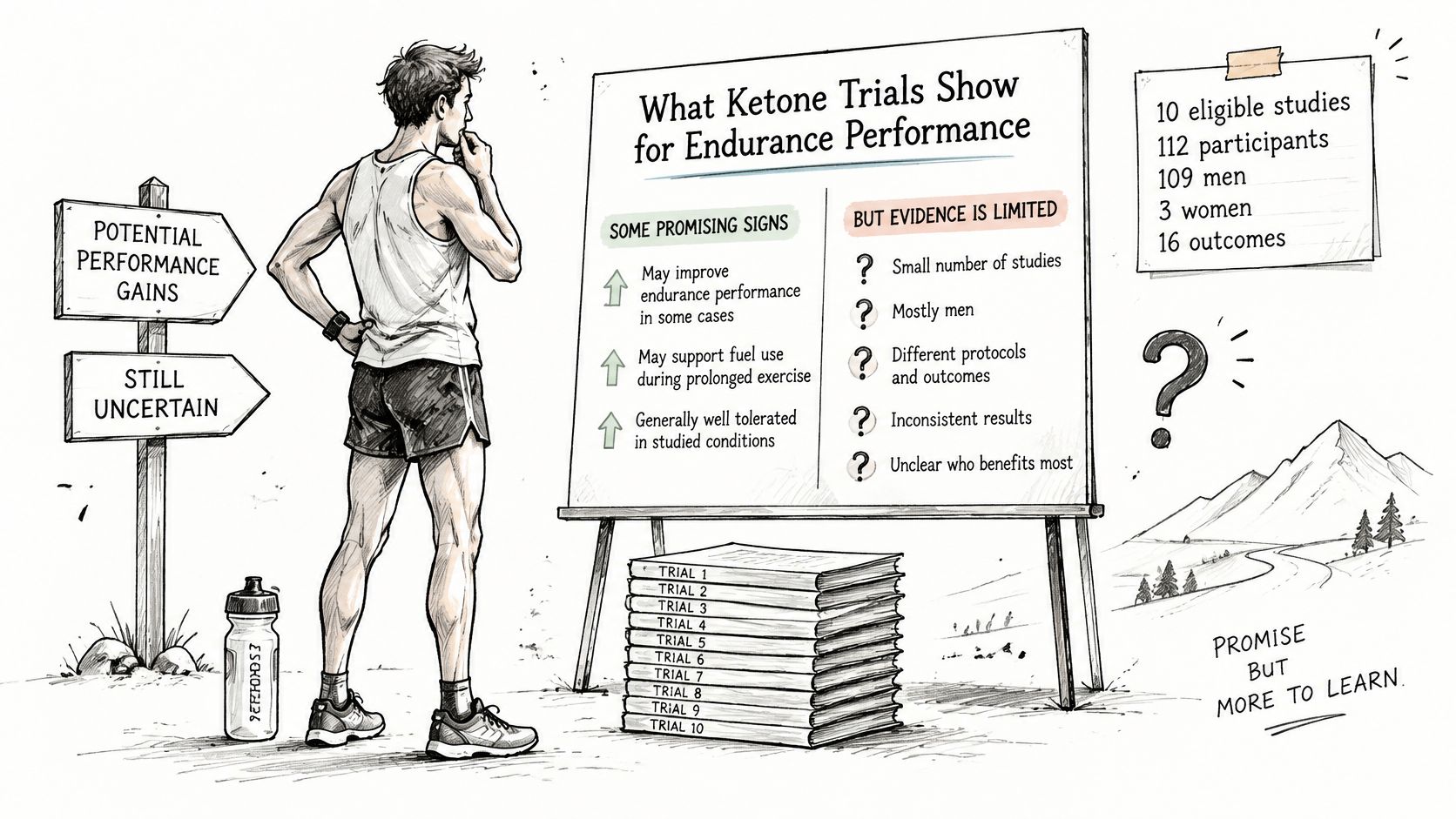
A systematic review of ketone-supplement studies included 10 eligible studies involving 112 participants, of whom 109 were men and three were women, across 16 performance outcomes. Eight outcomes measured lower-body power and eight measured endurance. That evidence base is small, mostly male, and spread across different formats and tests.
What looks like a product effect is often a mismatch between the dose and the limiter. Molecular format changes how BHB arrives. Dose and timing decide whether the rise overlaps the work: a low serving taken far from exercise is not the same exposure as a larger pre-session dose. Steady aerobic work and a high-intensity time trial stress different fuel pathways, so a shift in oxidation can show up in one test and disappear in the other. A protocol run with low carbohydrate intake does not describe a well-fueled marathon, where glycogen is the limiter a ketone serving is not meant to replace. Recreational and trained athletes may diverge, and fat oxidation is not finishing time.
Exogenous ketones can raise BHB and shift substrate oxidation. That physiology is real. Dependable gains in pace or power are a higher bar, and this set of trials does not clear it. Claims about recovery or next-day readiness need direct trials in runners, not extrapolation from unrelated metabolic studies.
A Practical Test Protocol
If you still want a personal check, treat ketones as one timed option after carbohydrate, fluid, protein and sleep are already covered.
- Use a low-stakes session first: Choose a planned steady run, not a race or key workout.
- Keep other variables stable: Match carbohydrate, caffeine, sleep and route as closely as you can.
- Name the limiter: Glycogen, heavy sweat loss, muscle damage and readiness call for different fixes. A ketone dose speaks, at most, to fuel availability during that session.
- Track four outputs: Record pace or power, heart rate if you use it, perceived exertion and gastrointestinal response.
- Repeat before judging: One good or bad run can reflect weather, fatigue or fueling rather than the product.
- Never debut on race day: Test tolerance and logistics in training.
The guide to ketones for endurance athletes expands on that testing mindset. Ketones do not stand in for carbohydrate when glycogen is low, or for fluid replacement after heavy sweat loss.
Why This Matters for Runners
Biochemistry only matters if it changes a decision on your run. These four outcomes are best treated as hypotheses to track, not guaranteed results.
- Steadier energy: Fuel partitioning can change when circulating BHB rises, which may smooth fuel supply during long steady efforts. That expectation comes from fuel-use data, not proof that you'll feel better at mile 18.
- Cognitive endurance: Brain BHB uptake is measurable in human physiology. Whether that translates into better focus, pacing or decision making late in a run is still under study.
- Workout performance: Pace and power findings are mixed across formats and intensities. Judge a product against your own logs from comparable sessions.
- Metabolic efficiency: A shift toward fat oxidation at moderate intensity may occur, but high-intensity output can carry a cost. Efficiency at one pace isn't automatically efficiency at every pace.
Say you test the same product twice. On Saturday, you run 90 minutes at a steady aerobic effort on flat roads. On Tuesday, you do short hill repeats that demand rapid carbohydrate use. The same BHB rise won't have identical meaning in both sessions, because the limiting fuel pathway and intensity differ.
Direction is not a result. Track whether the change improves the session you actually planned.
That's the difference between buying runners recovery supplements by category and using them by limiting factor. A product can be reasonable to test for a long steady run and a poor fit for high-intensity work. Your training log should make that call.
Application Framework for Your Recovery Plan
Use this framework after the test protocol, not instead of it.
- When to use exogenous ketones. Treat them as an optional fuel experiment around a planned session, only after carbohydrate, protein and fluid targets are met. Our product guidance is to take them 30-45 minutes before endurance efforts, 20 minutes before high-intensity sessions, and any time for recovery. That's product guidance, not a universal rule for every format.
- Who may benefit. Runners with consistent daily food intake who want a tested addition for specific sessions are the clearest fit. Consult a qualified healthcare professional before using any dietary supplement, especially if you're pregnant, nursing, have a medical condition or take medications.
- What to expect physiologically. Expect a rise in circulating BHB and possible shift toward fat oxidation within the session window. Also watch for gastrointestinal discomfort or lower high-intensity output, and stop the experiment if either undermines training.
Recovery decisions also extend beyond nutrition. If soreness reflects an injury rather than normal training load, Arizona Valley Acupuncture injury rehabilitation insights can help you think through rehabilitation context, while our post-workout recovery tips cover routine habits that support the nutrition plan.
Before your next purchase, ask three questions. What's my limiting factor today? Have I met my carbohydrate and protein needs? Have I completed a controlled test rather than relying on a label claim? If you can't answer all three, fix the basics first.
If you're ready to test exogenous ketones within a food-first recovery plan, Tecton Ketones™ offers bioidentical D-BHB through liposomal R3HBG formulations designed for specific uses, including training, hydration and focus. Start with the format and timing guidance that matches your session, track pace, exertion and tolerance in training, and keep carbohydrate, protein, fluids and sleep as your foundation.


