


Most advice on ketones for endurance athletes is too blunt to be useful. The usual framing is simple: ketones work, or ketones don't. The actual physiology is less convenient and far more practical.
The research doesn't support a blanket ergogenic claim for acute ketone use in endurance sport. It also doesn't justify dismissing ketones as useless. The more accurate conclusion is that outcomes depend heavily on ketone type, timing, and purpose. Athletes who use the wrong form, at the wrong point in a session, for the wrong reason often get exactly the result the literature warns about: no benefit, or worse, reduced output.
That matters because endurance sport is rarely limited by one fuel problem. Athletes manage power, pacing, gut tolerance, hydration, glycogen availability, and decision-making under fatigue. A substrate that changes fuel selection can help in one context and hurt in another.
Exogenous ketones are best understood as a metabolic tool, not a race-day shortcut. They may fit long steady work, selective pre-load strategies, and post-exercise recovery far better than high-intensity efforts where rapid carbohydrate flux still dominates. Used precisely, they can support metabolic flexibility and alternative fuel availability. Used casually, they can blunt the very glycolytic output an athlete needs.
Rethinking Ketones for Athletic Performance
Ketones became popular in endurance sport for the wrong reason. The early pitch was simple: add another fuel, go faster. In practice, performance changes only when the product raises blood ketones high enough, at the right time, without creating GI distress or suppressing the carbohydrate use required for the session.
That is why the first high-profile ketone ester result attracted so much attention. In 2016, Cox et al. reported a small time-trial improvement in trained cyclists after a ketone ester was taken with carbohydrate, with blood D-β-hydroxybutyrate rising into a range that could plausibly affect substrate use, as summarized in Precision Hydration's review of the ketone performance literature. The study was real. The mistake was treating it as a general rule instead of a specific result under a specific protocol.
Subsequent work has been much less convincing. Across the broader endurance literature, acute ketone use has usually produced either no clear performance gain or a context-dependent downside, especially when intensity is high, carbohydrate turnover needs to stay high, or the athlete cannot tolerate the formulation. That pattern is more useful than a simple yes or no verdict because it points to the variables that decide the outcome.
Three variables matter more than the headline claim.
What serious athletes should ask
- Which form are you using? Ketone esters and ketone salts differ sharply in pharmacokinetics, achievable BHB levels, sodium load, taste, and GI risk. They should not be treated as interchangeable.
- When are you taking it? A pre-exercise ketone load is a different intervention from sipping ketones during prolonged work. Blood levels, gut tolerance, and interaction with carbohydrate feeding all change with timing.
- What is the purpose? Trying to support long steady output is not the same as trying to improve repeated surges, sharpen decision-making late in an event, or support post-exercise recovery.
This is the part many athletes miss. A ketone product can be metabolically interesting and still be poorly matched to the session.
For coaches, the practical question is not whether ketones "work." It is whether a given formulation fits the demands of the day. If the goal is high-end race power or repeated attacks, ketones may be neutral at best and counterproductive at worst. If the goal is controlled submaximal work, a glycogen-management experiment, or selective recovery support, the discussion becomes more reasonable.
Tecton Ketones has taken a more useful position than much of the category. Ketone products should be judged on formulation quality, dose delivery, and use case, not slogans. That is the standard serious athletes should apply.
Understanding Ketone Metabolism The Fourth Macronutrient
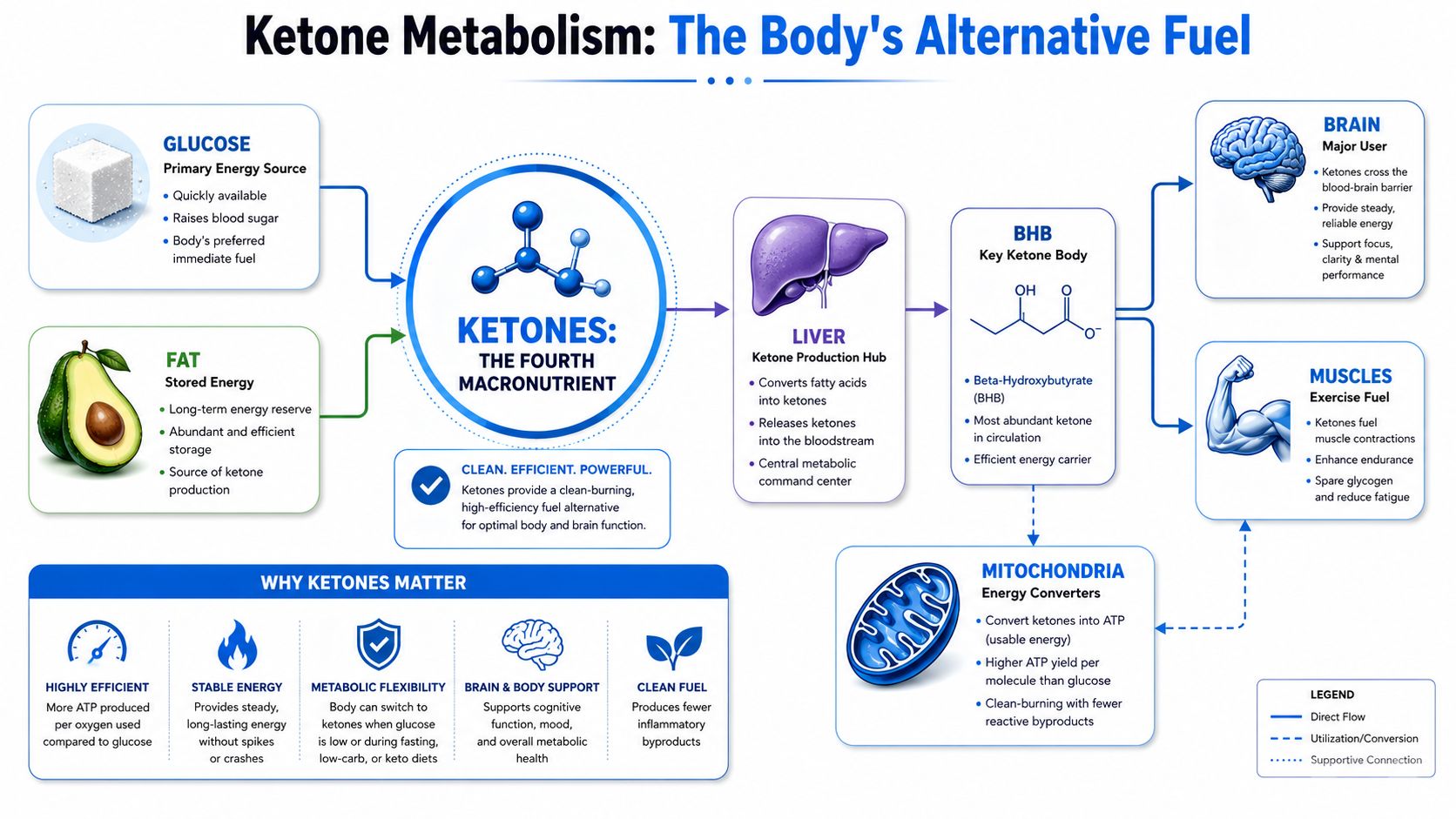
Ketones sit in an unusual position in human metabolism. They aren't a classical macronutrient in the dietary sense, yet once present in circulation they function as a direct energy substrate for tissues with high oxidative capacity. For athletes, the key molecule is beta-hydroxybutyrate (BHB).
How BHB fits into exercise metabolism
Under ordinary mixed-diet conditions, glucose is the dominant fast-access fuel for harder efforts, while fat supports lower-intensity oxidative work. Ketones add a third usable lane. When BHB is available, tissues can oxidize it in mitochondria and generate ATP without requiring the full digestive and hormonal sequence needed to mobilize stored fat.
That matters most during endurance work because the body isn't choosing one fuel in isolation. It's constantly adjusting between carbohydrate, fat, and, when available, ketones. This is the basis of metabolic flexibility. An athlete with good metabolic flexibility can meet changes in intensity without becoming overly dependent on a single substrate.
Exogenous ketone ester administration can raise plasma BHB to 3–6 mmol/L within 30 minutes in humans, as shown in a peer-reviewed randomized trial on BHB kinetics published through PubMed Central. That gives athletes a way to access circulating ketones without fasting or strict carbohydrate restriction.
Mitochondria, ATP, and fuel efficiency
Inside the mitochondria, ketones are converted into acetyl-CoA and fed into oxidative metabolism. That doesn't mean ketones replace glucose in all athletic settings. It means they can contribute to ATP production in a way that may alter the burden placed on glycogen during steady work.
Human clinical data listed on ClinicalTrials.gov reports that ingesting bioidentical D-BHB via ketone esters shifts skeletal and cardiac muscle energy metabolism and is associated with a 20–30% rise in ATP turnover rates during submaximal exercise compared with glucose-only conditions. Mechanistically, that supports the idea that ketones can serve as an efficient oxidative substrate when the exercise demand is predominantly aerobic.
A practical way to think about this is a hybrid engine. Glucose still handles rapid acceleration. Ketones may help support efficient cruise.
Practical rule: Ketones are most plausible when the event includes a long aerobic segment where fuel selection matters more than maximal glycolytic output.
Brain energy and cellular signaling
Endurance performance isn't just muscular. Late in long sessions, pacing judgment, concentration, and tolerance of discomfort often decay before mechanics do. Ketones cross the blood-brain barrier and provide another substrate for brain energy use, which is part of why athletes often care about them beyond raw speed.
Ketones also act as signaling molecules. The current literature links them to cellular signaling relevant to adaptation, including effects on histone deacetylation and sirtuin pathways. That doesn't make them magic. It makes them biologically active.
In practical product terms, Tecton EDGE™ Performance Shot + Electrolytes is designed for active individuals who want steady energy during training or physically demanding days, with liposomal R3HBG ketone plus sodium, potassium, and magnesium. That format fits the practical overlap between endurance fueling and hydration, especially for athletes who want ketone support without caffeine.
Nutritional Ketosis vs Exogenous Ketone Supplementation
Athletes often blur three different states into one word: ketosis. That creates confusion fast.
Three ways ketones appear in circulation
Nutritional ketosis comes from sustained dietary carbohydrate restriction. The liver increases ketone production because substrate availability and hormone levels favor that shift. This is a whole-body adaptation, not a quick switch. Training quality during adaptation can be uneven, and many endurance athletes still prefer higher carbohydrate availability for demanding sessions.
Endogenous ketone production also occurs naturally during fasting, overnight energy restriction, or prolonged exercise. In that case, the body is generating ketones internally in response to energy state and substrate flow.
Exogenous ketone supplementation is different. It supplies ketones directly from outside the body. That allows a temporary rise in blood ketones without requiring a ketogenic diet or fasting window.
Why that distinction matters for endurance athletes
An athlete can remain carbohydrate-supported and still use exogenous ketones strategically. That's a very different application from trying to become fully keto-adapted.
Capillary blood BHB testing is considered the gold standard for assessing nutritional ketosis, and clinical studies reviewed in Frontiers in Nutrition report that exogenous ketone supplementation can reliably achieve 1.5–3.0 mmol/L BHB, a range associated in that review with brain energy utilization and cognitive endurance, without dietary adherence or fasting.
That's the useful distinction. Diet-induced ketosis changes the athlete's overall metabolic environment. Exogenous ketones create a targeted, time-limited substrate shift.
A practical comparison
| Approach | How it works | Main trade-off |
|---|---|---|
| Nutritional ketosis | Diet-driven, sustained elevation of endogenous ketone production | Requires strict dietary adherence and adaptation |
| Endogenous production during fasting or long exercise | Internal response to low carbohydrate availability or prolonged demand | Hard to control precisely during training cycles |
| Exogenous supplementation | Direct rise in circulating ketones from a supplement | Outcome depends on formulation, timing, and context |
For athletes who want a cleaner conceptual foundation, Tecton's explainer on what exogenous ketones are is a useful reference point. The main point is simple: supplemental ketones are not a substitute for a sound diet. They're a controllable input layered onto a broader fueling strategy.
The Evidence on Ketones and Endurance Performance
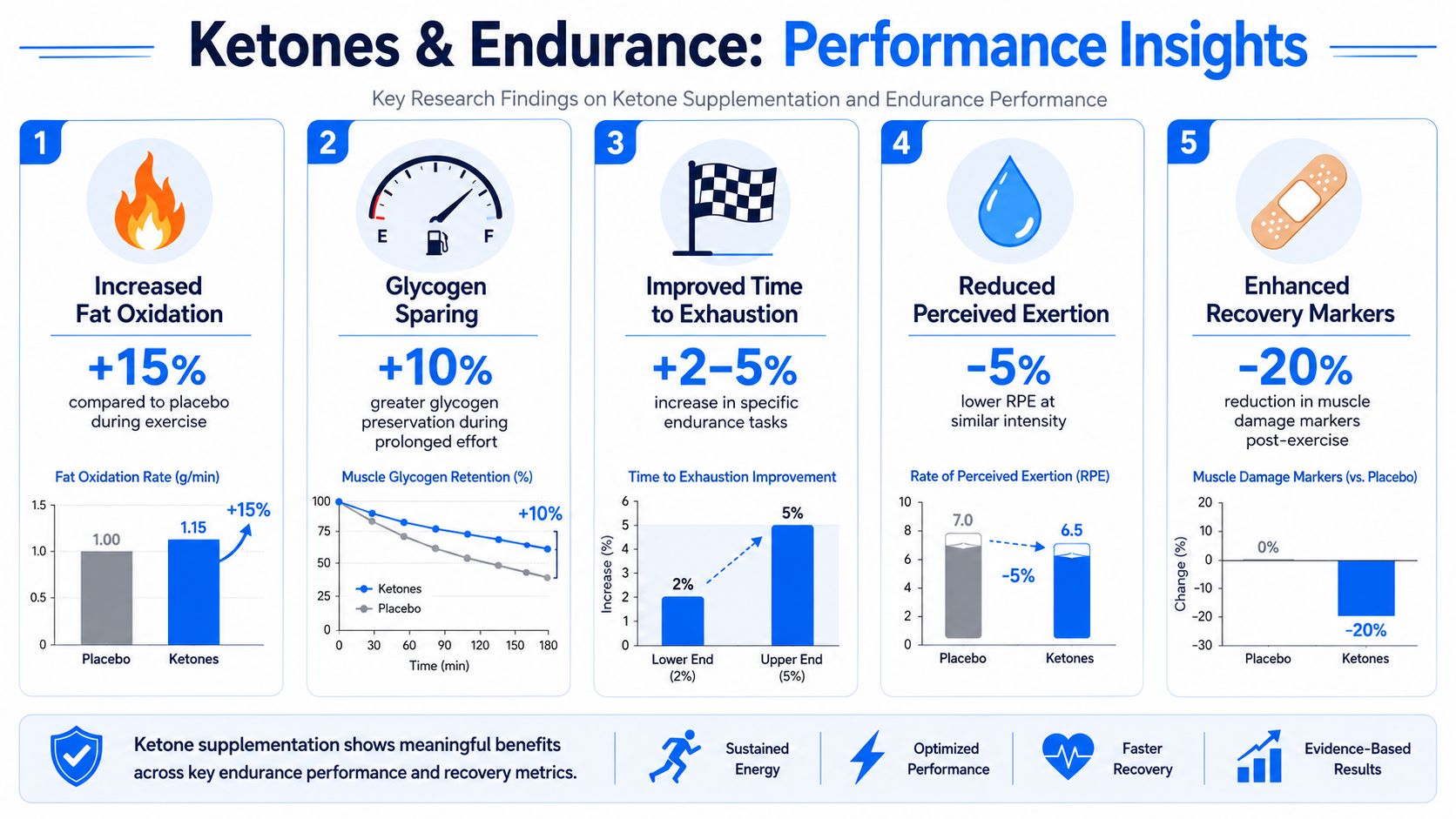
The endurance literature is mixed because the interventions are mixed. Different studies use different ketone forms, different co-ingested nutrients, different exercise structures, and different timing windows. Putting all of that under one headline obscures the essential lesson.
What the better-known studies actually show
The optimistic starting point came from the Cox et al. work already noted earlier. But broader evidence has not reproduced a reliable performance benefit across standard endurance settings.
A summary highlighted by ScienceDaily's report on McMaster-led findings states that acute oral ketone supplements do not improve aerobic endurance performance in trained athletes and may worsen it. That report includes a McMaster University finding in which cyclists sustained a 10–15% lower speed during endurance tests after ketone supplementation compared with placebo, with investigators attributing the result to increased cardiorespiratory stress and reduced glycogen oxidation efficiency. The same report notes a review of 12 studies showing no advantage for aerobic running performance and aligns that with established guidance that high carbohydrate availability remains core advice for distance athletes.
That conclusion should make coaches cautious, but not simplistic. “No consistent acute benefit” is not the same thing as “all ketone use is irrational.”
Why results diverge
Three variables explain much of the disagreement.
Ketone type
Ketone esters and ketone salts are not interchangeable. Esters generally raise BHB more effectively. Salts often come with a large mineral payload and a greater risk of poor tolerance.
Timing
Taking ketones before a prolonged submaximal block is not metabolically equivalent to taking them during a hard time trial. If ketones suppress carbohydrate use at the wrong moment, they may impair the ability to produce power when it's needed most.
Purpose
Studies designed around acute race performance may miss benefits that show up more clearly in recovery, adaptation, or cognitive steadiness during very long efforts.
If an athlete expects ketones to behave like caffeine or a carbohydrate gel, the intervention is already mismatched to the mechanism.
This is also why generic supplement roundups often mislead marathoners and cyclists. The better question is not “should I take ketones,” but “in which session, in which form, and for which outcome?” Athletes sorting through broader race-fueling support may also find Tecton's guide to the best supplements for marathon runners helpful as part of a bigger performance nutrition plan.
Where the evidence is stronger
The most compelling validated use case isn't acute performance enhancement. It's post-exercise recovery and adaptation.
Research summarized in the American Journal of Physiology Cell Physiology abstract indicates that post-exercise ketone supplementation can suppress AMPK phosphorylation in skeletal muscle, blunt overtraining symptoms, improve sleep quality, and enhance anabolic signaling and angiogenesis. The same line of work describes ketones as alternative ATP substrates that may help restore cellular energy status faster than glucose alone, while also affecting signaling pathways such as SIRT1 and SIRT3 that are relevant to mitochondrial biogenesis and metabolic flexibility.
That doesn't mean every athlete needs ketones after every session. It does mean the recovery window may be a more rational place to evaluate them than the middle of a high-intensity race.
A Practical Protocol for Using Ketones in Training and Competition
Protocol matters more than enthusiasm. If ketones are going to help, they need to be integrated into the session with the same discipline athletes apply to carbohydrate intake, sodium, and pacing.
A useful starting principle is this: match ketone use to the dominant demand of the session. Long aerobic rides, steady long runs, and heavy training blocks are different from threshold intervals and final-race surges.
For a quick visual reference, this protocol captures the main decision points.
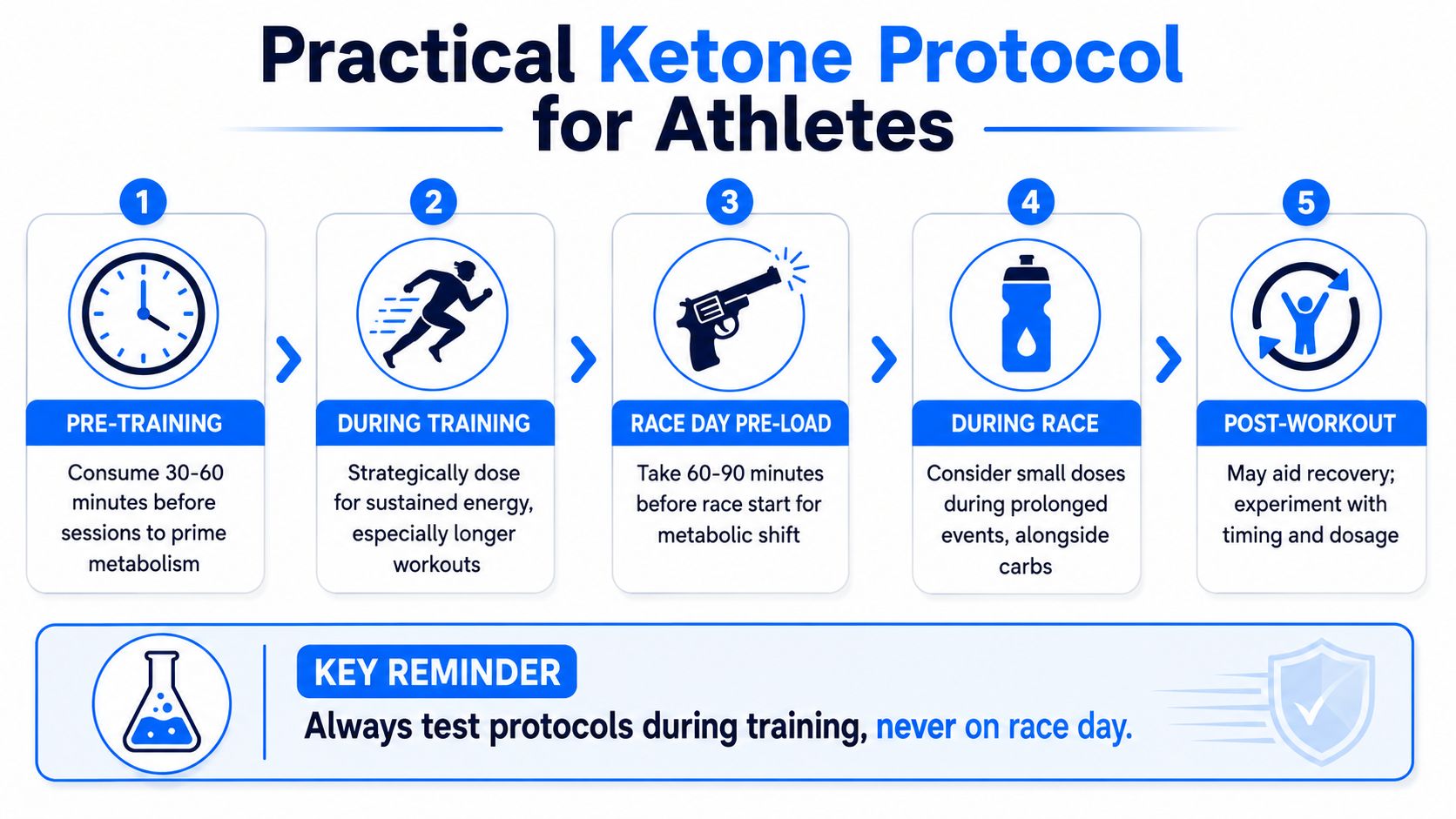
Pre-load use for long submaximal work
The most overlooked variable is timing. A study summarized by TrainerRoad's review of bicarbonate and ketones found that ketone esters without bicarbonate had no effect on time-trial performance, while ketone ester combined with gradual bicarbonate intake produced a 5% performance increase. The same review notes that ingesting ketones during a time trial reduced performance by about 2%, whereas pre-loading before the submaximal effort helped spare glycogen for the final sprint.
That is the clearest practical lesson in the category. If ketones are taken at the wrong phase, the athlete may blunt carbohydrate use when immediate power is required.
A sensible trial framework looks like this:
- Use them in training first. Test ketones before long steady rides or runs, not before high-intensity interval work.
- Keep carbohydrate intake stable. Don't remove carbs and then blame or praise ketones for the outcome.
- Watch the session end, not just the start. Glycogen-sparing strategies matter most if the athlete still has better legs late.
During-session use needs restraint
During-race ketone use is where many athletes get into trouble. Mid-session intake can make sense only in very prolonged events where intensity is modest and the goal includes steadier cognition or an alternate substrate. It's a poor fit for race phases where glycolytic demand is high.
This is also where coach judgment matters. If an athlete already struggles to hit carbohydrate targets or has a sensitive gut, adding a new variable during competition is rarely wise.
Test the full stack exactly as you'll use it. Carbs, fluids, sodium, caffeine if relevant, and ketones all interact at the level of tolerance and output.
For runners building the broader base first, these tips for better running stamina are a useful complement. Supplement strategy only matters when the basics of aerobic development, pacing, and fueling are already in place.
The video below adds practical context on using ketones around training and racing.
Recovery may be the cleaner application
Post-exercise use is often easier to evaluate because the target is different. You're not asking for a faster split in the next ten minutes. You're supporting energy restoration and adaptation after a hard block.
In practice, athletes may consider ketones after sessions that create high cumulative stress, especially when the goal is to support recovery while maintaining a carbohydrate-inclusive program. What to expect physiologically is not a stimulant effect. It's a rise in circulating ketones, a change in substrate availability, and potentially a smoother recovery profile.
Who may benefit most:
- Ultra-endurance athletes who spend long periods at submaximal intensity
- Athletes in dense training blocks where recovery quality matters as much as any single session
- Competitors with cognitive fade late in long events who want another substrate available
- Athletes who tolerate esters well and want to test them alongside a structured fueling plan
Choosing a High-Quality Ketone Supplement
Product choice determines whether ketones are even worth testing. Athletes and coaches often judge the category too quickly, when the bigger issue is that salts, esters, and precursors behave differently in the blood, in the gut, and in training.
What separates salts, esters, and precursors
Ketone salts bind beta-hydroxybutyrate (BHB) to minerals such as sodium, calcium, or magnesium. They are easy to formulate and heavily marketed, but the mineral load creates a real constraint. In endurance settings, that often means modest ketone exposure paired with greater GI risk and a large electrolyte hit that may not fit the rest of the fueling plan.
Ketone esters raise blood BHB more reliably and are the form used in much of the performance and recovery literature. The trade-offs are practical, not trivial. They taste harsh, can be expensive, and still need tolerance testing before race use.
Precursors such as R-1,3-butanediol sit in between. They depend on hepatic conversion rather than delivering BHB directly, so onset, peak levels, and user experience can differ from a true ester.
For endurance athletes, the main screening question is simple. Does the product produce the ketone exposure needed for the job you want it to do? If the goal is acute race performance, weak elevation with a heavy mineral burden is usually a poor bargain. If the goal is recovery support, the threshold for a useful product may be different.
That distinction matters because the literature is not saying “ketones work” or “ketones fail” in a uniform way. It is saying formulation matters, dose matters, and context matters. Earlier in this article, the negative findings on ketone salts were covered already. There is no need to force a second percentage into this section and create confusion. The practical point is clearer than the headline number. Salts have generally looked less convincing than esters for serious endurance use.
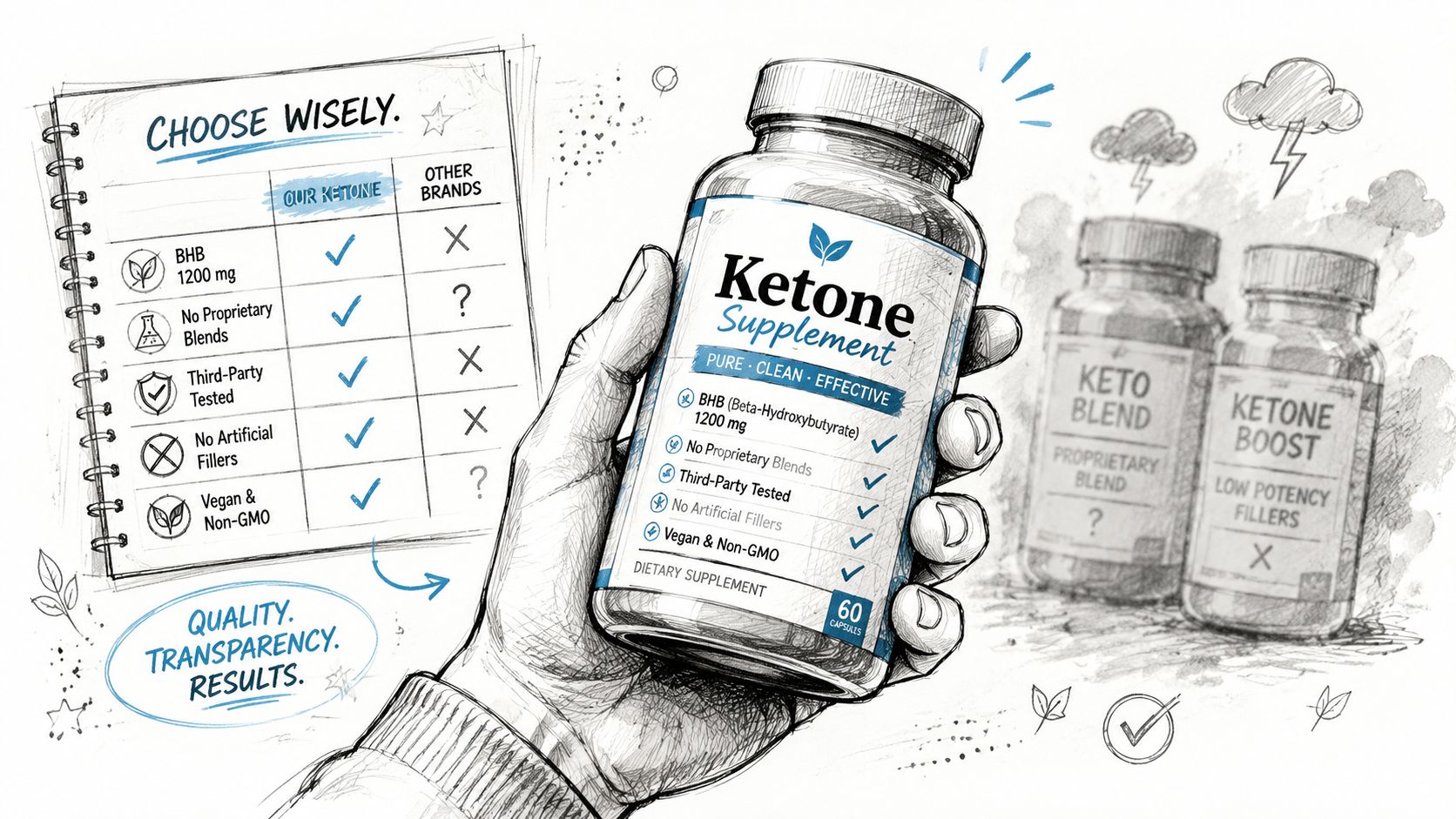
What to look for on a label
A useful label review starts with chemistry, not branding:
- Molecule identity. Check whether the product provides bioidentical D-BHB or a racemic mix containing L-BHB, which is metabolized differently and may be less relevant for acute performance use.
- Form. Distinguish a true ketone ester from a ketone salt or a precursor. These are not interchangeable.
- Dose transparency. The label should state how much active ketone substrate is provided, not hide behind a proprietary blend.
- Mineral load. With salts, calculate the sodium, calcium, and magnesium burden against the rest of the athlete's hydration plan.
- Intended use. A product positioned for fasting support or general wellness may be poorly suited to long-session fueling or post-exercise recovery.
Tecton's formulation is notable for a reason grounded in physiology. The product uses bioidentical D-BHB in an R3HBG tri-ester format and combines that with liposomal delivery. That design is more defensible than a standard ketone salt for athletes who want higher ketone availability without relying on a large mineral dose. It does not guarantee better outcomes in every setting, but it aligns better with how performance practitioners usually think about substrate delivery: enough exposure to matter, with tolerability that does not disrupt the session.
For athletes comparing formulations side by side, this guide to best exogenous ketone supplements is a useful reference point.
Application Framework for Athletes and Coaches
For endurance sport, ketones are not a yes-or-no tool. They are a context-dependent intervention.
Who may benefit
- Long-course athletes. Marathoners, ultra runners, long-distance cyclists, and triathletes doing extensive submaximal work have the clearest rationale to test ketones.
- Athletes in recovery-focused phases. Post-exercise use appears more defensible than acute race enhancement for many training blocks.
- Competitors seeking cognitive steadiness. Some athletes care as much about decision quality late in an event as they do about raw pace.
Who should be cautious
- Athletes doing high-intensity work where immediate carbohydrate use is central
- Anyone with poor GI tolerance to novel fueling inputs
- Athletes using ketone salts and expecting ester-like effects
Why This Matters
- Steadier energy. Ketones can provide an additional oxidative substrate during the right kind of work.
- Cognitive endurance. Brain energy availability may matter late in long sessions.
- Workout performance. Results depend on matching ketone use to session demands.
- Metabolic efficiency. The most promising role may be improving how athletes manage fuel and recover, not forcing an acute race-day boost.
Practical takeaway
- Start with purpose. Decide whether you're targeting long-session fuel support, cognitive steadiness, or recovery.
- Choose the right form. Esters are more plausible than salts for serious endurance applications.
- Pre-load, don't improvise. Timing changes outcomes.
- Keep carbs in the plan. Ketones are an addition, not a replacement.
- Measure response. Track perceived effort, late-session power, gut comfort, and recovery quality.
- Use a repeatable format. For athletes who want a simple field-ready option, Tecton EDGE Performance + Electrolytes is one practical way to apply these principles within a broader fueling strategy.
Tecton Ketones™ is worth evaluating if you want exogenous ketone support built around bioidentical D-BHB, liposomal delivery, and use-case-specific formulations rather than generic keto marketing. For endurance athletes and coaches, the value is in having a precise tool you can test against real training demands, with the same rigor you'd apply to carbohydrates, sodium, and recovery planning.


