


About 90% of cerebral ATP production occurs inside mitochondria through oxidative phosphorylation, not glycolysis alone, according to a PNAS analysis summarized in a peer-reviewed review of brain energy metabolism. The review in PMC provides a useful correction to the way energy is often explained: the brain doesn't run primarily on rapid, low-yield energy production. It depends on oxygen-supported mitochondrial chemistry.
That fact changes how we should think about performance. Oxidative metabolism isn't merely a background process that makes ATP. It's a flexible regulatory system that determines how the brain, heart, and skeletal muscle use fuel, manage redox balance, and respond to changing demands. Ketones fit into that system because beta-hydroxybutyrate, or BHB, can enter mitochondrial oxidation directly after it reaches a tissue.
For athletes, professionals, and anyone managing demanding days, the practical question isn't whether glycolysis or oxidative phosphorylation is “better.” The question is how well the body transitions between fuels while preserving usable energy, oxygen supply, and cellular control.
The Engine of Human Energy Production
Why mitochondria set the ceiling
Cells produce ATP through several routes, yet aerobic tissues depend heavily on mitochondrial oxidative phosphorylation. Glycolysis works in the cytoplasm and can supply ATP rapidly, but complete mitochondrial oxidation extracts more usable energy from glucose. Glycolysis therefore suits brief, high-intensity demands, while oxidative metabolism supports sustained cognition, endurance, and recovery.
The brain makes the distinction clear. Under the accounting model described in the underlying review of brain energetics, glucose oxidation through glycolysis and oxidative phosphorylation yields about 87% of ATP from oxidative phosphorylation alone, or 26 of 30 ATP molecules. The review also describes an approximate 6:1 ratio of oxygen to glucose consumption during complete glucose oxidation. These figures reflect how strongly neural tissue depends on aerobic mitochondrial chemistry.
Muscle uses the same machinery on a different schedule. In the opening moments of intense exercise, phosphocreatine and anaerobic glycolysis provide rapid ATP. After roughly 1 minute, oxidative phosphorylation becomes the main ATP-producing pathway in skeletal muscle, according to research on skeletal muscle oxidative metabolism. The transition is regulatory, not a switch that turns one pathway off. Fuel availability, oxygen delivery, exercise intensity, and mitochondrial demand continually reshape the balance.
Oxygen is a metabolic input
Oxygen serves as the final electron acceptor in the mitochondrial electron transport chain. That role permits electron flow and supports the reactions that drive ATP synthesis. Effective energy production therefore depends on coordinated ventilation, circulation, blood flow, substrate delivery, and mitochondrial processing. The explanation of how oxygen supports cellular energy connects respiratory physiology with cellular energetics.
Practical rule: If oxygen delivery or mitochondrial processing limits the system, adding more short-term glycolytic capacity will not fully solve the problem.
Dietary restrictions can limit access to alternative fuels, especially for the brain and working muscle. Bioidentical ketone esters provide a way to deliver ketones directly, allowing beta-hydroxybutyrate to enter tissue metabolism and undergo mitochondrial oxidation without requiring a prior dietary shift. This does not remove the need for oxygen. It changes the substrate presented to the oxidative system.
Endurance training strengthens the entire chain: oxygen transport, substrate movement, electron transfer, and management of oxidation by-products. A guide to cellular energy production places oxidative phosphorylation within the larger sequence from fuel intake to cellular work.
Biochemical Realities of ATP Yield and Efficiency
The familiar estimate of 38 ATP per glucose molecule is an older textbook approximation. In eukaryotic cells, current accounting places the yield closer to 30 to 32 ATP, including approximately 26 to 28 ATP from oxidative phosphorylation and only 4 ATP from substrate-level phosphorylation. A biochemical overview of oxidative phosphorylation and ATP yield/07:_Cellular_Respiration/7.13:Oxidative_Phosphorylation-_ATP_Yield) explains why a fixed textbook value does not map neatly onto living cells.
Why the calculation changed
The result depends on how reducing equivalents reach the mitochondria, how well the proton gradient is maintained, and how much energy transports molecules across mitochondrial membranes. Real cells therefore operate with costs and variability that idealized calculations may overlook.
Under idealized conditions, complete glucose oxidation can yield up to 33.45 ATP per glucose, while aerobic glucose oxidation has an overall thermodynamic efficiency of roughly 34%. That means about two-thirds of glucose energy is released as heat rather than stored in ATP. The ATP yield and energy efficiency infographic illustrates how energy changes from food intake to cellular work.
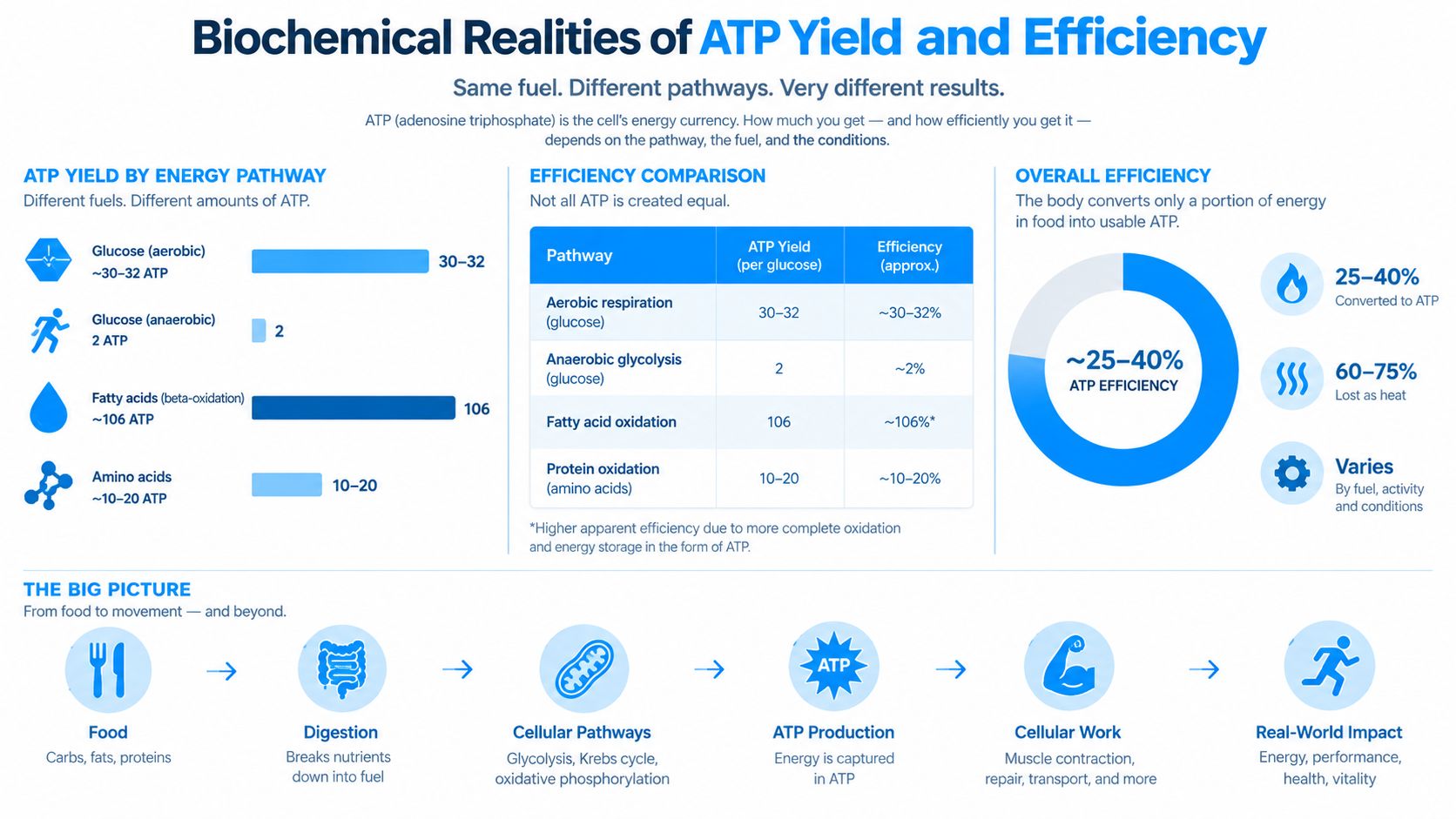
Efficiency doesn't mean perfection
Oxidative phosphorylation generates much more ATP than glycolysis alone, yet it remains a regulated system rather than a frictionless engine. Energy capture must be balanced against heat production, membrane transport costs, oxygen availability, and redox control. These factors help explain why mitochondrial capacity can restrict prolonged exercise or sustained neural work, even when fuel is available.
The distinction between ATP yield and thermodynamic efficiency prevents a common misunderstanding:
- ATP yield describes how much ATP a substrate can support.
- Thermodynamic efficiency describes how much substrate energy becomes stored cellular work.
- Heat production is energy released during metabolism rather than conserved in ATP.
Bioidentical ketone esters can shift the substrate entering this system without requiring a prior dietary change. They deliver beta-hydroxybutyrate, or BHB, for mitochondrial oxidation, including in brain and muscle tissue. The underlying requirements remain: functioning mitochondria, oxygen delivery, and appropriate cellular regulation. A product such as Tecton EDGE™ Performance Shot + Electrolytes provides liposomal R3HBG™ ketone with sodium, potassium, and magnesium, without caffeine. Understanding how oxygen supports cellular energy clarifies why changing the fuel does not remove the need for oxidative capacity.
Metabolic Transitions in Muscle and Brain Tissue
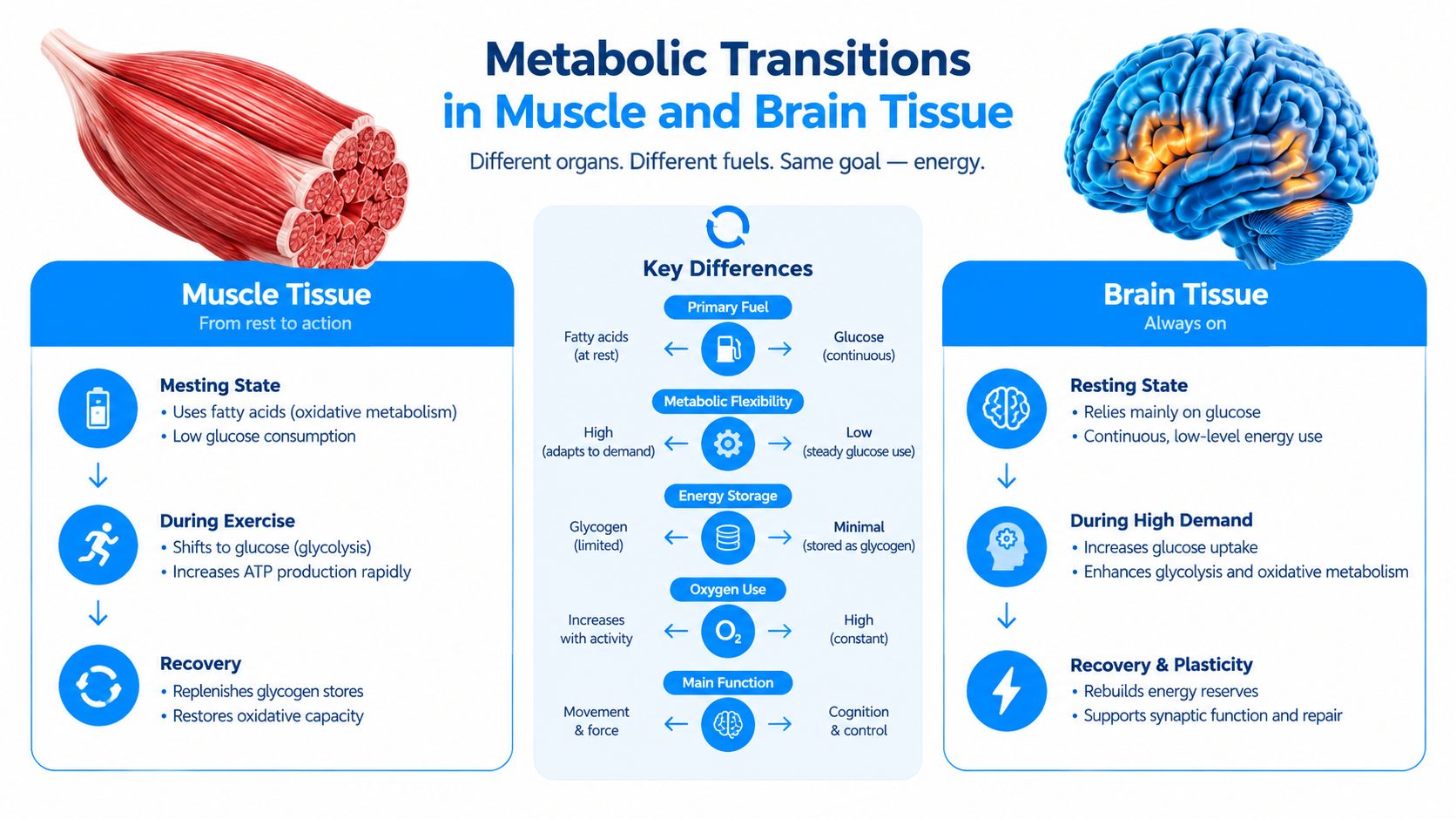
Muscle and brain tissue both depend heavily on oxidative metabolism, yet each regulates fuel use according to its workload and access to substrates. Oxidative metabolism therefore functions as a flexible control system, not a single fixed pathway.
Muscle during sustained exercise
Skeletal muscle combines several energy systems. At the start of demanding work, phosphocreatine and anaerobic glycolysis help cover the immediate ATP requirement. As exercise continues beyond roughly 1 minute, mitochondrial oxidative phosphorylation becomes the dominant ATP source, provided oxygen delivery remains adequate. A Frontiers review of skeletal muscle oxidative metabolism describes this transition and its relationship to endurance capacity.
Carbohydrates and fats can both supply the mitochondria. They enter metabolism through different routes, then contribute electrons to the respiratory chain, supporting ATP synthesis. Sustainable output consequently depends on mitochondrial density, substrate transport, electron transport function, and oxygen delivery, not only on short-term glycolytic power.
An endurance athlete's metabolic flexibility is the ability to adjust fuel selection without a disproportionate fall in output. Glucose does not need to be eliminated. The relevant question is whether muscle can shift between available fuels as intensity, duration, feeding status, and oxygen availability change.
Brain metabolism during glucose scarcity
The brain shows a related adaptation during prolonged fasting. As glucose becomes scarce, ketone bodies can supply up to about 60% of the brain's energy needs. Under extreme fasting conditions, they may contribute roughly 70% of brain energy production while reducing glucose demand by about 30%, according to a review of ketone metabolism in the brain.
Circulating beta-hydroxybutyrate crosses the blood-brain barrier through monocarboxylate transporters. Neurons convert BHB to acetoacetate through BDH1, then process it into acetyl-CoA. Acetyl-CoA enters the Krebs cycle, supporting electron transport chain activity and ATP synthesis.
BHB is a mitochondrial oxidative substrate, not merely a backup fuel. The body can produce it during fasting or carbohydrate restriction, while bioidentical ketone esters can provide BHB directly without requiring those dietary conditions. This changes substrate availability while leaving mitochondrial function and oxygen requirements in place.
Oxygen delivery and mitochondrial performance remain relevant for both endogenous and exogenous ketones. Fuel selection can change, but oxygen-supported cellular respiration still determines how effectively mitochondria convert that fuel into usable energy.
Redox Balance and Tissue-Specific Tradeoffs
More oxidative metabolism isn't automatically better. Mitochondria produce ATP, but they also influence redox balance, biosynthetic activity, and cell signaling. When electron flow becomes dysregulated, reactive oxygen species and other damaging by-products can increase. The outcome depends on the tissue, the metabolic state, and the cell's ability to manage those signals.
A regulatory system, not just a furnace
Recent literature emphasizes mitochondrial NADPH and mitochondrial fatty acid synthesis as regulators of fuel use. These systems influence how cells respond to biosynthetic demand and maintain redox balance, which means oxidative metabolism can't be reduced to a simple equation of “more fuel equals more ATP.” The review on regulatory dimensions of oxidative metabolism is useful for readers who want to move beyond the generic ATP-making definition.
This distinction matters in performance nutrition. A clean fuel source can support energy availability, but it doesn't replace sleep, recovery, oxygen delivery, or appropriate training load. Mitochondria operate within a whole physiological network, not independently of it.
The tradeoffs also vary by tissue:
- Brain: High oxidative demand supports neural work, but redox disruption can affect vulnerable neuronal systems.
- Heart: Continuous mitochondrial activity supports contraction, while metabolic stress can challenge redox control.
- Skeletal muscle: Greater oxidative capacity can support sustained work, but acute intensity still requires rapid pathways.
- Aging tissues: Fuel handling, signaling, and recovery may become more sensitive to metabolic imbalance.
Why context matters
In some cancers, oxidative phosphorylation can support progression and treatment resistance, which challenges the idea that increasing mitochondrial activity is universally beneficial. This doesn't make oxidative metabolism harmful. It shows that metabolic interventions must be tissue-specific and context-specific.
The same caution applies to popular discussions of NAD+. NAD+ participates in redox reactions and cellular metabolism, but supplement and injection claims often move faster than the evidence. Readers assessing those claims may find a practical overview of the science behind NAD+ shots useful, provided they distinguish biochemical plausibility from established clinical outcomes.
Elevating Oxidative Capacity with Bioidentical Ketones
Ketones can reach tissues through three distinct routes, each changing how the body supplies an oxidative fuel.
Nutritional ketosis follows a diet that lowers carbohydrate availability enough to increase the liver's endogenous ketone production. These endogenous ketones, made primarily from fatty acids, circulate to tissues such as the brain and skeletal muscle. Exogenous ketones are consumed directly, allowing blood BHB availability to rise without requiring a strict ketogenic diet or prolonged fasting.
This distinction matters because an exogenous ketone supplies substrate, not the complete physiological state of fasting or nutritional ketosis. Hormonal signals, dietary intake, and other metabolic conditions remain different. The molecule provides an additional fuel at the mitochondrial input, while the surrounding regulatory system still depends on the person's broader physiology.
BHB structure and delivery
Tecton Ketones™ bases its formulation approach on R3HBG, described by the brand as a tri-ester that bonds three D-BHB molecules to a glycerol backbone. Digestion separates the ester and releases D-BHB, the same molecular form naturally produced and used by the body. The formulation also uses a patented liposomal delivery system, positioned to support absorption and consistency.
Ketone formats follow different delivery paths:
| Format Type | Metabolic Pathway | Tolerability and Drawbacks |
|---|---|---|
| Ketone salts | BHB is paired with minerals and enters circulation after digestion | Mineral loads may limit repeated use when they do not fit a person's electrolyte needs |
| Ketone esters | The ester is cleaved to release BHB and an accompanying alcohol-derived component | Taste and gastrointestinal response can challenge some users |
| Ketone precursors | The body converts the precursor into ketone-related fuel | Conversion adds a metabolic step and may produce a less direct experience |
| Liposomal bioidentical ketones | Encapsulated D-BHB is designed for delivery and mitochondrial substrate use | Product quality, formulation, and individual tolerability still matter |
“Bioidentical” refers to molecular form. It does not predict a guaranteed performance response. A deeper explanation of ketone esters explains how ester chemistry differs from salts and precursors.
The practical rationale is specific: exogenous ketones can provide BHB when dietary restrictions, fasting duration, or scheduling make endogenous production impractical. They do not correct poor oxygen delivery, inadequate recovery, or an underlying medical problem. Anyone using medication or managing a medical condition should consult a qualified clinician before use.
Why This Matters for Performance and Cognition
The practical value of oxidative metabolism appears when the task demands energy over time, whether that task is a long training session, sustained concentration, or both. It is a regulatory system that adjusts fuel use to workload, oxygen availability, and recovery status.
Steadier energy
Rapid glycolysis supplies ATP quickly and remains useful during intense efforts. Longer output depends more on mitochondrial oxidation, adequate oxygen delivery, and continued access to usable fuel. Exogenous BHB adds another substrate to that system. Bioidentical ketone esters can provide BHB directly, even when dietary restrictions, meal timing, or limited fasting make substantial endogenous ketone production impractical.
The effect is context-dependent. Training status, recent food intake, exercise intensity, gastrointestinal tolerance, hydration, and recovery can all influence the response. Ketones provide substrate availability, not a guarantee of steadier energy.
Cognitive endurance
Brain cells can transport and convert ketones, allowing BHB to enter oxidative metabolism alongside glucose. During prolonged fasting, ketones can supply a substantial portion of brain energy. That physiology helps explain why direct ketone delivery may matter when a person wants access to this fuel without adopting a strict ketogenic diet.
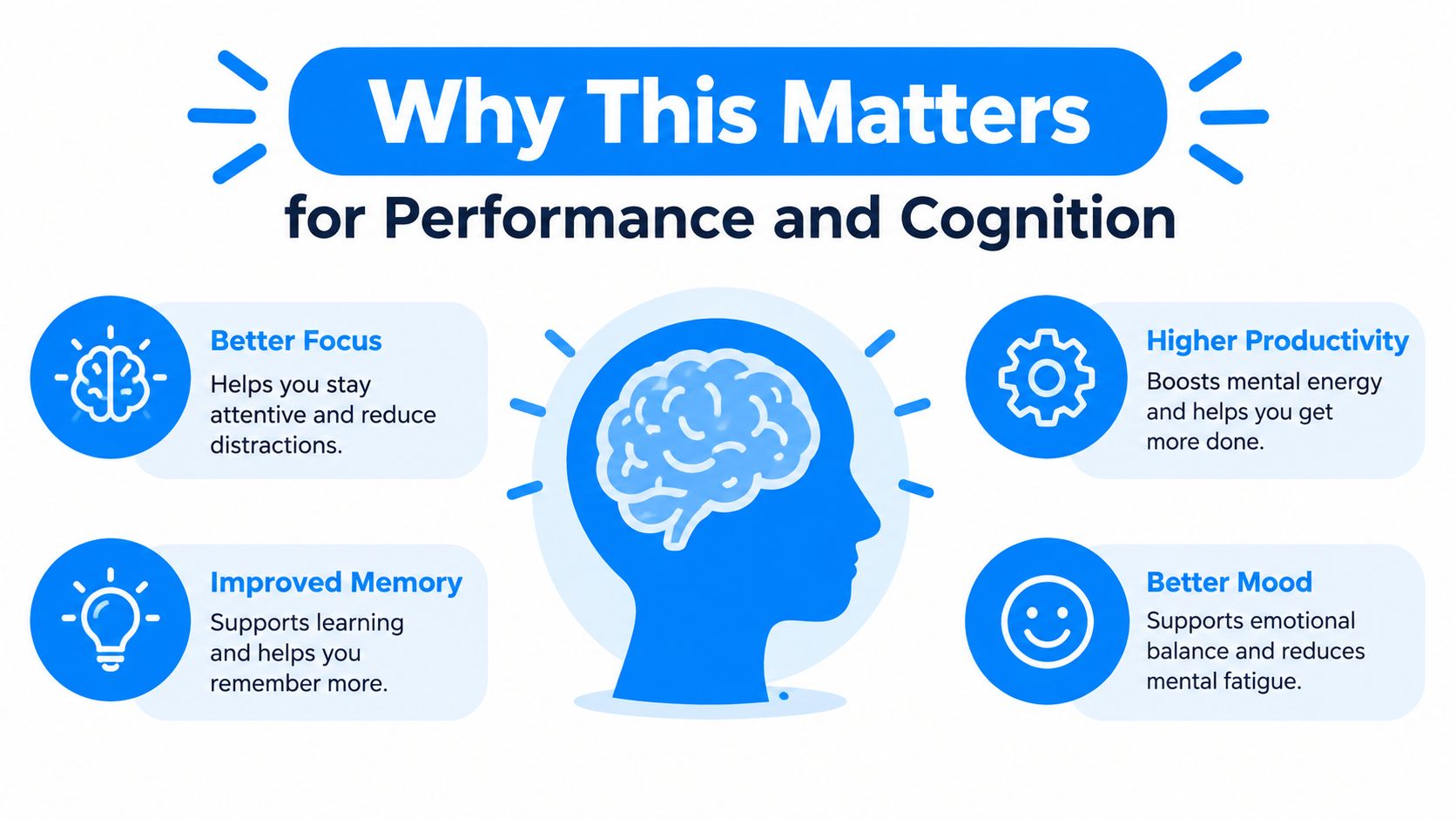
For a professional, student, or athlete, the relevant outcome is cognitive endurance. BHB is a metabolic substrate rather than a stimulant like caffeine. The reasonable expectation is support for fuel availability during demanding work, not an automatic improvement in mood, memory, or productivity.
Workout performance and efficiency
As sustained exercise continues, muscle relies increasingly on oxidative phosphorylation. Ketones can function as one substrate within that process, while carbohydrate remains important for high-intensity work that requires rapid ATP production. Longer, lower-intensity efforts generally place greater demand on mitochondrial oxidation.
A useful performance question is not “Which fuel is superior?” It is “Which fuel supports the task I'm asking the body to perform?”
Exogenous ketones may therefore suit selected endurance sessions, demanding workdays, fasting windows, or schedules where dietary restriction is impractical. They should complement adequate food, hydration, electrolyte planning, sleep, and a well-designed training program, rather than substitute for them. The neuroscience review describes the brain's capacity to use ketones as an oxidative fuel.
Application Framework for Metabolic Health
Use exogenous ketones as a context-specific fuel strategy. Their practical value depends on the task, timing, tolerance, and outcome you can observe.
Match the format to the task
A useful starting protocol is a familiar endurance session. Take one 2oz shot 30 minutes before a 90-minute zone-2 run, then repeat the same session without ketones on another day. Run this comparison across two weeks, keeping pace, hydration, and meal timing as similar as practical. Log perceived exertion, concentration, gastrointestinal comfort, and sleep afterward. This approach tests whether direct BHB availability changes the experience of a defined workload, rather than treating a noticeable sensation as proof of improved mitochondrial function.
For longer active periods, a liposomal BHB formula with electrolytes may suit training or physically demanding days where hydration and steady energy matter. A cognition-oriented formulation may fit a focused work block when sustained attention is the target. During a planned fasting window, exogenous ketones can provide BHB while still supplying energy, so they may conflict with fasting goals that require no caloric intake.
Identify who may benefit
The framework may be relevant to athletes managing sustained output, professionals facing extended cognitive demands, and people seeking ketone access without strict dietary restriction. It requires more caution during pregnancy, with medical conditions, or when using glucose-lowering medication. Anyone unsure how supplementation fits their care plan should seek clinical guidance before use.
For broader metabolic self-assessment, the Venus Health Co. 2026 guide offers a way to consider markers and routines instead of relying on one subjective feeling.
Practical takeaway
Choose a repeatable use case, apply the labeled serving guidance, and compare matched sessions or work periods. Track the outcome that matters, such as exertion during the run or focus during demanding work. The aim is metabolic flexibility with realistic expectations, not permanent ketosis or a replacement for clinical care.
Tecton Ketones™ offers bioidentical R3HBG ketone formulations intended to provide direct BHB fuel without requiring a strict ketogenic diet. Review the options at Tecton Ketones™ and select the format that fits the planned context.


