


You know the feeling. Lunch was solid. You ate enough. Your calendar isn't the problem. Yet by mid-afternoon, your brain feels dull, your legs feel flat, and your motivation starts negotiating with you.
Many individuals treat that moment like a calorie problem. It often isn't. It's a cellular energy production problem.
Your body doesn't run on food in the abstract. It runs on ATP, or adenosine triphosphate. ATP is the usable energy currency that powers muscle contraction, nerve signaling, ion transport, and the constant maintenance work that keeps you upright, alert, and adaptable. Calories only matter once your cells can convert fuel into ATP efficiently.
That's why fuel choice matters. Glucose, fatty acids, and ketones can all contribute to energy production, but they don't enter the system in the same way, and they don't feel the same in real life. An athlete notices it in pacing and durability. A professional notices it in focus, composure, and whether the second half of the day still has quality output left in it.
Why Full Does Not Always Mean Fueled
A common pattern looks like this: breakfast is rushed, lunch is large, and the afternoon still unravels. You're not underfed. You're just not getting the kind of fuel delivery your cells need for stable output.

The difference between eating and being energized
Food is raw material. ATP is the finished product.
If ATP supply is matching demand, you usually feel steady. If ATP production lags behind demand, you feel that lag as:
- Mental fog: You reread the same sentence and still don't process it.
- Flat physical output: Warm-up feels harder than it should.
- Poor recovery between efforts: You can produce effort once, but repeatability drops.
- False hunger or cravings: Sometimes the body is asking for usable fuel, not just more volume.
Often, people misunderstand this concept. They assume fullness equals readiness. It doesn't. A full stomach only tells you food entered the system. It doesn't tell you whether your cells are turning that fuel into dependable energy at the right time.
Practical rule: Don't ask only, “Did I eat enough?” Ask, “What fuel is my body using right now, and how efficiently is it converting that fuel into ATP?”
Three major fuel categories
At a high level, your body draws from three major fuel streams:
| Fuel | Typical role | Common experience |
|---|---|---|
| Glucose | Fast, accessible fuel | Quick energy, but sometimes less stable |
| Fatty acids | Large reserve fuel source | Slower, steadier support |
| Ketones | Alternative oxidative fuel | Often experienced as smooth, usable energy |
What matters for performance isn't picking one fuel and declaring it superior in all situations. It's developing metabolic flexibility, the ability to use the right substrate for the task in front of you.
A sprint finish, a long meeting, an endurance session, and a fasting morning don't place the same demand on the body. Fueling as if they do is where many energy problems begin.
The Cellular Powerhouse Understanding ATP Production
If you want to understand energy, start with the cell.
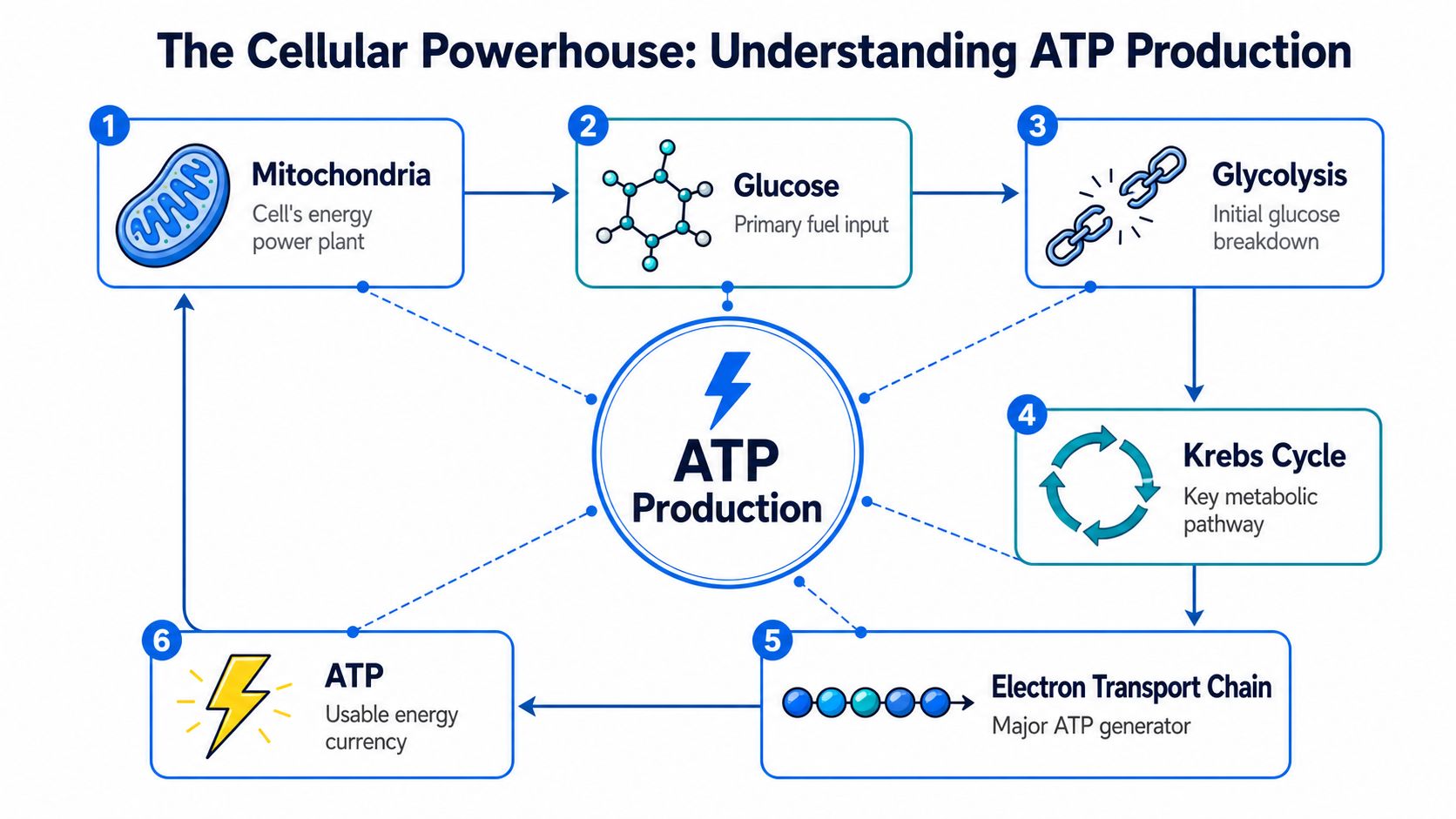
Mitochondria are often called the cell's powerhouses, and that description is directionally right. They act like compact power plants that take fuel-derived inputs and convert them into ATP. In a typical human cell, mitochondria generate approximately 90% of the ATP used, and complete glucose oxidation yields 30 to 32 ATP, which is roughly 15 to 16 times more energy than anaerobic processes like fermentation can produce according to this cellular respiration overview.
To make the process easier to picture, here's a visual map of the system:
ATP is the rechargeable battery
Think of ATP as a rechargeable battery your body spends constantly.
Every heartbeat, every stride, every thought, and every muscle relaxation cycle draws from that battery. Your body then has to recharge it continuously from available fuel. That's why energy isn't something you “have” once per day. It's something your cells are rebuilding all day long.
The basic sequence using glucose looks like this:
- Glycolysis begins in the cytosol. Glucose is broken down into smaller carbon units.
- The citric acid cycle processes those carbons further. This stage strips out high-energy electrons.
- Oxidative phosphorylation does the heavy ATP work. Inside the mitochondria, electron transfer creates a proton gradient that powers ATP synthesis.
The phrase “electron transport chain” sounds abstract, but the logic is simple. Fuel is broken down. Electrons are harvested. Their movement helps build a gradient. That gradient powers ATP synthase, the molecular machine that converts ADP back into ATP.
Why mitochondria matter so much
The mitochondrion isn't just a bag of enzymes. Its inner membrane is specialized for energy conversion. According to the NIH Bookshelf chapter on oxidative phosphorylation, ATP synthesis is driven by the proton motive force across the inner mitochondrial membrane, and ATP synthase uses that gradient to phosphorylate ADP into ATP.
That's the engine room of aerobic metabolism.
Here's the practical point: when oxygen availability, substrate delivery, and mitochondrial function are aligned, the body can generate energy with much higher efficiency than it can through low-oxygen backup pathways alone. That's one reason aerobic fitness changes how effort feels even before it changes your race times or body composition.
For readers who want a broader view of how the body distributes fuel demands across systems, Tecton has a useful explainer on the energetic systems of the body. If you're also working on lifestyle basics that support your metabolic health, it helps to think of sleep, meal timing, activity, and fuel choice as inputs into the same energy network.
Where people oversimplify the story
Consumer education often stops at “support your mitochondria,” then jumps immediately to ingredients.
That skips the more important question: what substrate are the mitochondria being asked to burn? Supporting the engine matters. Feeding it the right fuel for the demand matters too.
That's also where a product like Locked Cognition™ Shot fits conceptually. It's designed for mentally demanding days, particularly time at a desk, long meetings, presentation prep, or other work where steadiness and composure matter. Its formulation includes liposomal R3HBG™, Alpha GPC, and Lion's Mane, and many people use it when they want to feel steady and ready without relying on coffee or stimulants.
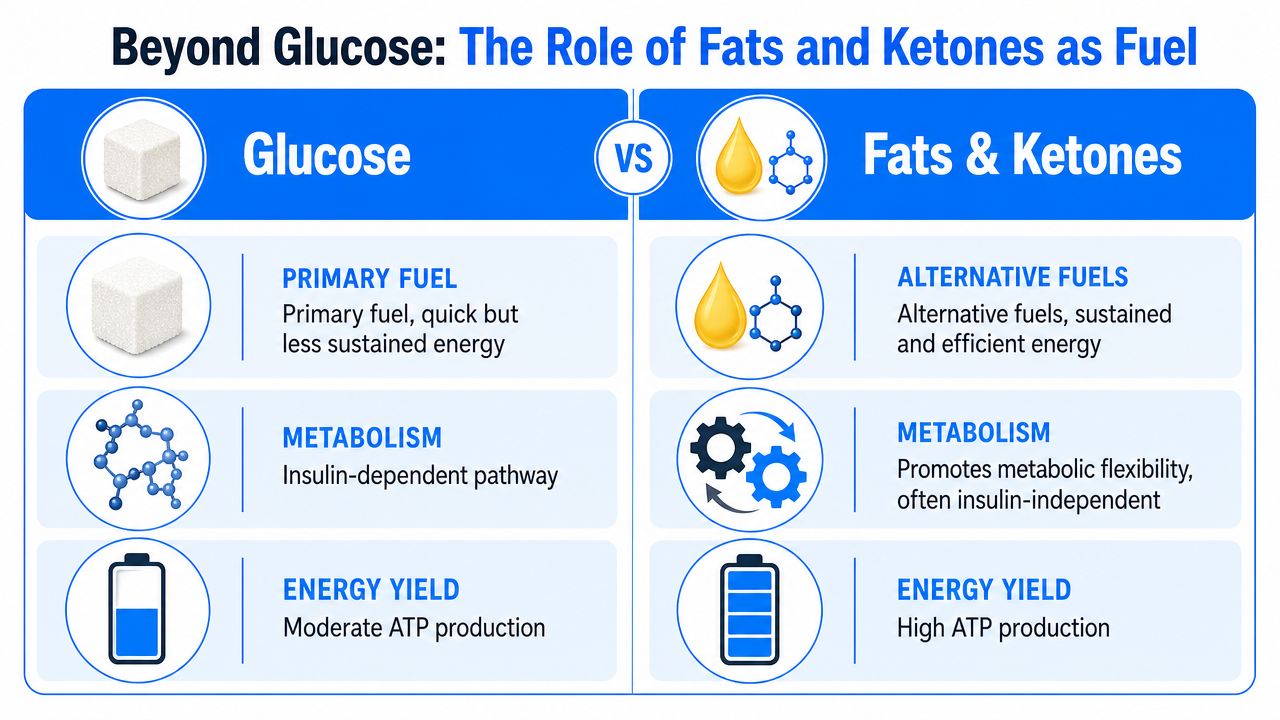
Beyond Glucose The Role of Fats and Ketones as Fuel
Glucose is important, but it's not the whole story.
A resilient metabolism can move between fuels based on context. That's metabolic flexibility. This resembles a high-performance hybrid engine that can pull from different energy sources without losing smoothness or control.
Glucose is fast-access fuel
Glucose is useful because it's accessible and versatile. It supports high-intensity work well, and your body is highly practiced at using it.
But glucose-heavy fueling can also feel less stable for some people, especially if meal composition, timing, stress, and activity level aren't aligned. In daily life, that can show up as sharp rises in energy followed by a noticeable drop in mental clarity or drive.
Fatty acids are durable fuel
Fat is the body's major reserve fuel. Through beta-oxidation, fatty acids can support sustained energy production, especially during lower-intensity work and longer-duration efforts.
This is why easy endurance training and all-day movement often feel better as the body becomes better at using fat. The output is less explosive, but the support can be durable.
Your body performs better when it isn't trapped in one fuel strategy.
Ketones are a third usable pathway
Ketones sit in an important middle ground. They're produced endogenously when the body increases fat breakdown and liver ketone production, such as during fasting or nutritional ketosis. They can also be supplied exogenously through supplementation.
A key distinction matters here:
- Nutritional ketosis: Ketone elevation achieved through diet-induced carbohydrate restriction.
- Endogenous ketone production: The body's own ketone generation.
- Exogenous ketone supplementation: Ready-made ketones supplied from outside the body.
Ketones are not a magic replacement for all other fuels. They are a viable oxidative substrate. According to the NIH review on ketosis physiology, oxidation of one molecule of acetoacetate yields 22 ATP molecules and 2 GTP molecules, showing that ketones are a dense energy source the body can use for cellular respiration.
That's why ketones are best understood as an added fuel option, not just a diet identity.
Why flexibility changes the way you perform
An athlete with poor metabolic flexibility often feels great only under narrow conditions. The meal timing has to be perfect. The training fuel has to be exact. Miss either one and performance drifts.
A more flexible system handles variation better. It can use glucose when speed is needed, fats when duration matters, and ketones when an alternative oxidative fuel is helpful.
For people exploring fat-adapted strategies, MCTs often come up because they can support ketone generation in some contexts. Tecton's article on best MCT powder options and considerations is a useful companion if you're comparing endogenous ketone support with direct ketone delivery.
Why This Matters Translating Biochemistry to Performance
Biochemistry only matters if it changes real output. Consequently, cellular fuel choice stops being academic.
Steadier energy
When people describe “smooth energy,” they're usually describing more than mood. They're describing a day with fewer swings in perceived readiness.
Glucose can be effective, especially around hard training. But many people notice that relying on it alone makes energy feel more event-driven. Eat, rise, dip, repeat. Ketone availability changes that conversation because it gives the body another oxidative substrate to work with.
For endurance athletes, the practical consequence is simple. The more stable your fuel strategy, the less likely you are to unravel late in a session. If you've ever had to avoid bonking on your mountain bike, you already know that energy management is about preserving usable output, not just stuffing in calories.
Cognitive endurance
The brain is metabolically demanding. Long stretches of concentration feel hard when fuel delivery is inconsistent, not only when sleep is poor.
This is one reason ketones remain so interesting in performance nutrition. They provide an alternative energy substrate during mentally demanding work. In practice, that can feel like steadier focus, fewer abrupt drops in clarity, and better composure in the second half of a work block or training day.
Workout performance
During exercise, the body is constantly balancing ATP demand against ATP resynthesis. Supplemental ketone availability can matter here because it changes what substrate is available during that balancing act.
A placebo-controlled human study reported in Physiological Reports found that systemic BHB decreased whole-body protein oxidation and muscle protein breakdown, indicating a protein-sparing effect under the studied conditions. Mechanistically, that means ketone availability can shift muscle metabolism away from ATP degradation and toward ATP resynthesis.
That doesn't mean ketones replace training nutrition fundamentals. It means they can participate in the fuel mix in a way that may help preserve quality when demands rise.
Metabolic efficiency
The highest performers usually aren't dependent on a single fuel input. They can tolerate variation. They can work, train, fast, recover, and still produce useful output.
That's metabolic efficiency in practice.
Performance takeaway: The goal isn't to worship one substrate. The goal is to become harder to disrupt.
Targeted Ketone Nutrition A Modern Approach to Fueling
For many people, the benefits of ketosis sound appealing, but the path sounds impractical. Strict carbohydrate restriction, fasting adaptation, and the transition period can be barriers, especially for athletes, parents, and professionals with demanding schedules.
That's where exogenous ketone supplementation enters the discussion. Instead of waiting for the body to generate more ketones internally, you supply a ketone substrate directly.
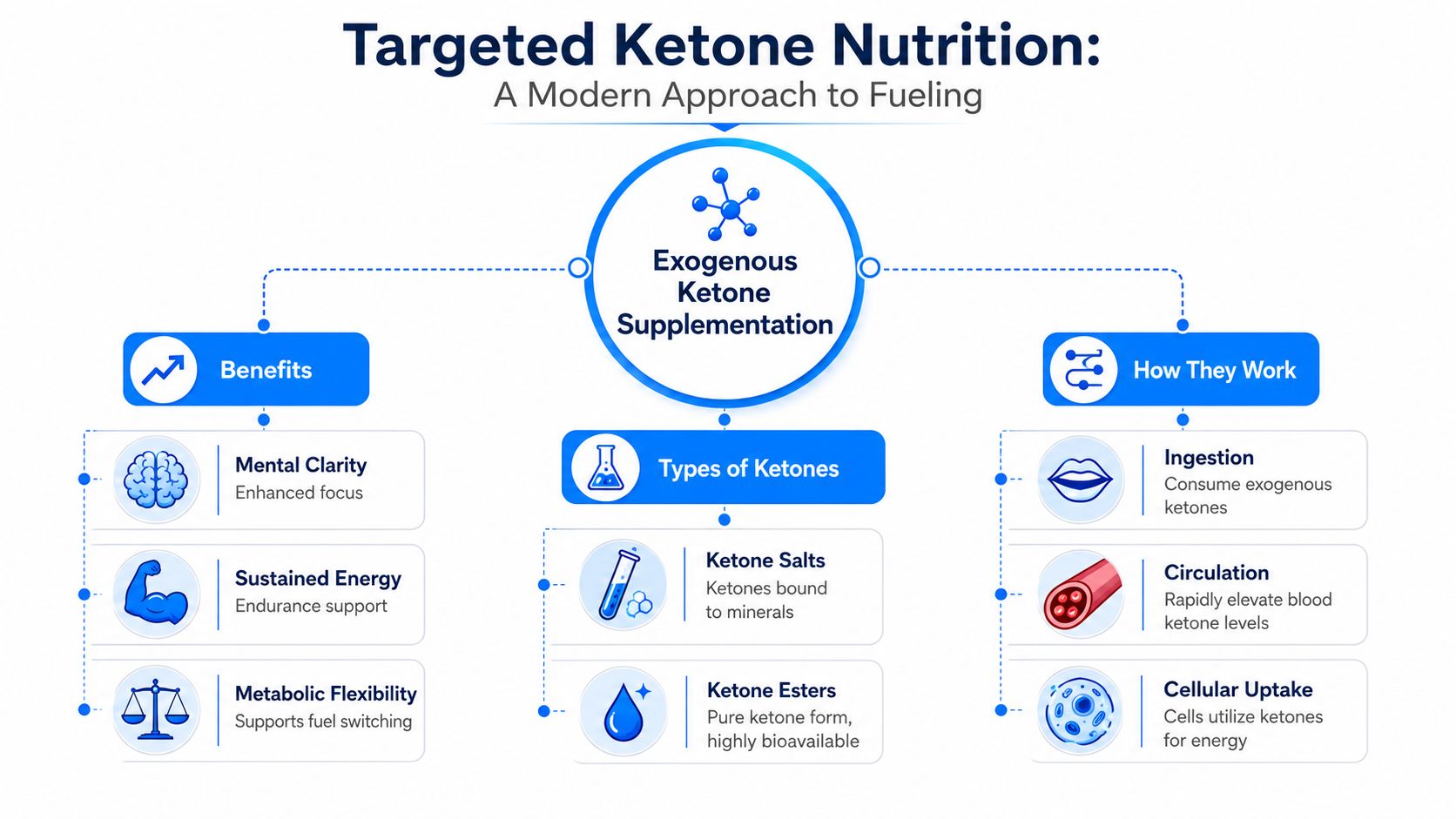
Not all ketone products are built the same
The category includes several forms:
| Format | Basic description | Key consideration |
|---|---|---|
| Ketone salts | Ketones bound to minerals | Mineral load can shape tolerability and use case |
| Ketone esters | Ketone molecules delivered in ester form | Often discussed for efficient ketone delivery |
| Precursors | Compounds intended to raise ketones indirectly | The body still has to convert them |
That distinction matters because formulation affects how a product fits into daily use, training, and gastrointestinal tolerance.
Another important distinction is bioidentical structure. D-BHB is the form the body naturally produces and uses. That's different from racemic formulations that include forms not identical to endogenous human ketones. From a performance science perspective, structure matters because metabolism is specific.
Delivery matters too
Absorption isn't just a marketing word. It's a formulation question.
Liposomal delivery systems are designed to support transport and consistency. In practical terms, that's why some products are framed for routine use rather than only occasional use. Tecton's platform centers on liposomal R3HBG, a bioidentical ketone structure intended to provide D-BHB directly without relying on a heavy mineral load.
A product example is Tecton Ketones™, which builds its exogenous ketone formulations around bioidentical R3HBG and liposomal delivery. Within that platform, the EDGE Performance™ + Electrolytes shot is positioned for active days that call for stamina, hydration, and steady output.
Exogenous ketones are systemic, not just “brain fuel”
A lot of consumer language reduces exogenous ketones to focus support. That's incomplete.
A human pilot imaging study reported in Frontiers in Nutrition found that after ingestion of a D-BHB supplement, the heart and kidneys were major contributors to its metabolism, consuming more ketones than the brain. That's an important corrective. Exogenous ketones don't only interact with cognition. They can participate in whole-body energy metabolism across high-demand organs.
That broader view fits how performance works. A sharp brain attached to an underfueled body is still a compromised system.
Signaling, endothelia, and energy regulation
Fuel also does more than supply ATP precursors. It interacts with cellular signaling. That includes tissues involved in vascular function and the dynamic regulation of energy demand.
The older public story about energy regulation often makes everything sound purely mitochondrial. Newer bioenergetic work suggests the picture is wider than that, including non-mitochondrial ATP contribution in some contexts and more nuanced control systems than most supplement marketing acknowledges. That's one reason targeted ketone nutrition remains scientifically interesting. It sits at the intersection of substrate availability, signaling, and whole-body metabolic flexibility.
If you're comparing formats and want a clean primer on definitions before making decisions, Tecton's overview of what exogenous ketones are is a practical place to start. For broader training context, some athletes also look at MEDISTIK's athlete recovery insights to think through how fueling, recovery, and tissue stress interact across a full training week.
Practical Takeaway An Application Framework
Understanding cellular energy production is useful only if you can apply it.
When exogenous ketones may fit
- Before focused cognitive work: Use them on days with long meetings, writing blocks, presentations, or travel when you want steady, non-stimulatory support.
- Before endurance training: They may fit before sessions where pacing, duration, and stable output matter more than a sharp stimulant effect.
- During fasting windows: Some people use them when they want alternative fuel availability without building the entire day around food.
- On demanding mixed days: They can make sense when physical work and mental work compete for the same energy budget.
Who may benefit most
- Endurance athletes: Especially those who value pacing, fuel flexibility, and smoother long-session support.
- Professionals and students: People who need sustained attention, composure, and less dependence on repeated caffeine hits.
- Low-carb or keto-curious users: Those who want ketone exposure without committing to strict nutritional ketosis.
- People training metabolic flexibility: Anyone trying to become less dependent on one narrow fueling pattern.
What to expect physiologically
- A different energy feel: Many people describe ketone-supported energy as smoother than stimulant-driven energy.
- Not a buzz: Exogenous ketones aren't meant to feel like a jolt. The expected experience is usually steadier availability, not intensity.
- Context still matters: Sleep, hydration, training status, and total nutrition still shape the outcome.
- A tool, not a replacement: Ketones can support a system. They don't replace sound training, meal quality, or recovery habits.
Start with the demand of the day. Then match the fuel strategy to that demand.
A simple decision filter
- Need explosive output right now? Glucose may still be central.
- Need long-duration steadiness? Fat oxidation and ketone support become more relevant.
- Need mental clarity without more stimulation? Exogenous ketones are often worth considering.
Tecton Ketones™ offers a science-led way to explore targeted ketone nutrition if you want direct access to bioidentical exogenous ketones without relying on a strict keto diet. For athletes, professionals, and practitioners who care about formulation quality, the most useful question isn't whether ketones are trendy. It's whether the product delivers a physiologically relevant fuel in a format that fits real life.


