


In 2024, 60% of 36,000 respondents across 17 countries said good sleep made them more productive at work, according to ResMed's 2024 Sleep Survey. That number reframes healthy brain all day focus. A ketone serving, a bright lamp, or another coffee sits on top of a night you either protected or gave away. The adult brain can oxidize ketones when glucose runs low, and an exogenous ketone can raise blood beta-hydroxybutyrate (BHB) without a diet overhaul. Those are metabolic measurements. They are not proof that a supplement holds attention from the first meeting to the last email. Treat ketones as one input beside sleep and light, and keep an acute lab signal separate from a full workday claim.
Build Your Daily Focus Routine
Put this schedule on tomorrow's calendar. Each row is an action, a plain read of the evidence, and the measure you write down.
| Time window | Action | Evidence strength | What to track |
|---|---|---|---|
| On waking | Fixed wake time, same every day | Well supported for alertness and sleep regularity | Reaction time over 7 days |
| First hour after waking | Bright, blue-enriched light | Supported for simple vigilance tasks, not complex planning | Morning reaction time |
| Start of first deep-work block | Ketone shot | Limited; acute effects, modest in size | Sustained attention and perceived effort |
| Before endurance work | Ketone shot, 30–45 minutes before the effort | Supported for blood BHB rise and muscle fuel use | Session output and perceived effort |
| Before high-intensity work | Ketone shot, 20 minutes before the session | Blood BHB rise supported; performance effect varies | Power or pace across the session |
| Afternoon | Last caffeine about eight hours before bed | Standard sleep-hygiene guideline | Afternoon error rate |
| Last hour before sleep | Dim light, fewer screens | Supported; late light can suppress melatonin | Sleep quality next morning |
Why the rows are in that order
Wake time is the stable anchor. Keep it fixed. The seven-day reaction-time baseline is the sleep test in the next section, so don't build a second scoring system here.
Morning light supports simple vigilance, not a complex plan. Get bright, blue-enriched light in the first hour, then start hard thinking because you are awake, not because the lamp improved planning.
Deep work is the focus test. Take the shot at the start of the work block. For recovery, it can be taken at any time. A Tecton EDGE™ Performance Shot + Electrolytes is made for training and physically demanding days, with liposomal R3HBG™ plus sodium, potassium, and magnesium, and without caffeine. Log sustained attention and perceived effort.
Session timing follows use, not a guess. Take it 30–45 minutes before endurance efforts and 20 minutes before high-intensity sessions. Track output, power, or pace.
Afternoon caffeine is a sleep decision. Use about eight hours before bed as the cutoff for the last cup, then count errors. If you want a non-stimulant sensory cue at the desk, compare essential oils for mental clarity and treat any effect as personal.
The last hour is dim light and fewer screens. After two weeks, keep the routine only if afternoon errors fall, reaction times speed up, and sleep improves. Feeling energetic for an hour is not the score.
Sleep and Light Come First
In 2020, the Centers for Disease Control and Prevention reported that 35% of U.S. adults slept fewer than seven hours in 24 hours, the threshold for insufficient sleep, with short sleep reported by 39% of adults aged 45 to 64 and 37% of men. Insufficient sleep is associated with higher risks of obesity, diabetes, hypertension, heart disease, stroke, anxiety, and depression. Sleep sets alertness, memory, emotional regulation, and decision quality. No fuel strategy works well on a short night. A ketone shot can change fuel availability; it cannot repay a sleep debt.
Athletes who extended sleep in one review of sleep interventions showed faster psychomotor-vigilance responses and reaction times. That is a higher-confidence base than an acute stimulant or a ketone level alone. Sleep works like the foundation of a building. Light works like a dimmer switch on one lamp. Ketones work like a fuel additive. None of them replaces a missing foundation. That ordering matters: sleep and light set the ceiling for attention, and ketones are one input inside that ceiling.
Run a two-week sleep test
- Fix one wake time. Use the same clock time every day, including days off.
- Record the baseline. For seven days, write down sleep duration and a simple reaction-time or lapse count.
- Add sleep. Extend scheduled sleep by 30 to 90 minutes for one to two weeks.
- Compare. Match reaction time, lapses, sleepiness, and late-day errors against that baseline. More on how nights are built is in our note on sleep architecture.
Practical rule: The score is fewer vigilance lapses and faster responses, not a feeling of being refreshed.
Three pitfalls wreck the test. Judging from one good morning ignores the week. Sliding bedtime while the alarm stays fixed still fragments the night. Caffeine that covers a deficit hides the problem you are trying to measure.
Use light as an adjunct
Brighter, short-wavelength-dominant light generally raised alertness and improved simple-task performance in a review of 59 quantitative studies. Benefits were not consistently maintained for complex tasks. Only a small number of studies used real workplaces, and many relied on self-reported alertness. Late-day bright light can suppress melatonin and cost you the next night's focus. Test morning light against your usual office light, and split the log into morning alertness, afternoon reaction time, error rate, and sleep quality. A lab window showing faster simple reactions is useful, but it is not proof of all-day focus.
How Ketones Fuel the Brain and Muscle
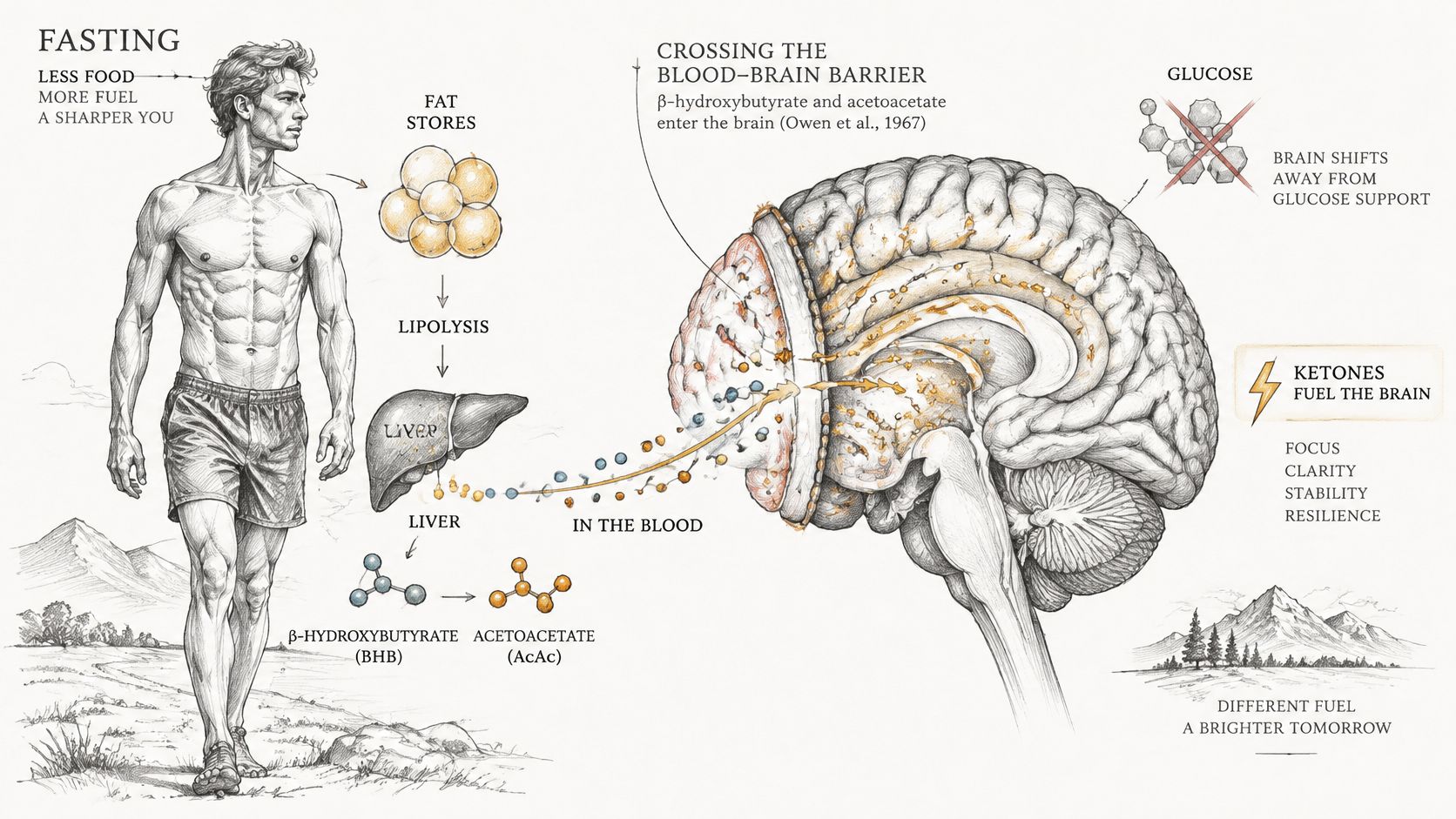
During a prolonged fast, ketone bodies can supply up to about 60% of the brain's energy needs. Owen and colleagues documented that transition in the 1960s, and this review of ketone use by the brain carries the numbers behind it: a fasting liver produces beta-hydroxybutyrate and acetoacetate, both cross the blood–brain barrier, and after roughly six weeks of fasting the brain extracted about 18.5 grams of ketones against 21.5 grams of glucose per 12 hours. People on medically supervised fasts lasting more than a month kept physiological function and mental capacity while ketones became the main brain fuel.
That is fasting physiology, and it sets a ceiling rather than a promise. A fed workday changes every variable that produced those numbers: insulin is up, liver ketone output is low, and any ketone in the blood arrived from a bottle. Ketones are one input alongside sleep timing and light exposure, and theirs is the narrowest evidence window of the three, measured in hours inside a lab rather than across a week of workdays. Whether attention improves in that state is a smaller and shorter question than the fasting data can answer.
Three states get confused when people talk about ketosis. Nutritional ketosis is a low-carbohydrate diet pushing the liver to make ketones over days. Endogenous production is fasting or very low carbohydrate availability doing the same job with no product involved. Exogenous supplementation means you ingest ketones, so blood BHB can rise within an hour without either the diet or the fast. Tecton's R3HBG falls in that third category, raising blood ketones directly and independently of what you have eaten.
From BHB to ATP
Both fuels reach the same mitochondrial machinery through different doors. BHB converts to acetoacetate, then to acetyl-CoA, which enters the tricarboxylic-acid cycle and feeds oxidative phosphorylation, where mitochondria make ATP. Glucose takes the other door: it enters glycolysis first and arrives at the same cycle as pyruvate. Metabolic flexibility is the ability to draw on either stream when it is available, and it is what training and fasting adapt. A precursor such as an MCT in coffee still has to be converted by the liver before any of this happens. A clear walk-through of that route is in this piece on the benefits of MCT oil in coffee. How the brain partitions fuels is covered in our note on brain energy metabolism.
What a blood rise does not prove
In a controlled human study, a ketone ester raised circulating D-β-hydroxybutyrate and lowered glucose, lactate, and non-esterified fatty acids, yet it did not change the cardiac phosphocreatine-to-ATP ratio or the measured skeletal-muscle parameters, according to this cardiac spectroscopy study. Blood BHB shows substrate availability. It says nothing by itself about how much ATP a mitochondrion produced or how well an organ performed.
The barrier is a separate question. In an in-vitro model of human brain endothelium, glucose deprivation reduced metabolic activity, glucose uptake, glycolysis, and barrier function, and BHB did not restore glucose uptake, as reported in this endothelial study. Ketones act as an alternative oxidative fuel for brain cells, not as a glucose substitute or a barrier repair.
Blood ketones tell you a fuel arrived. They do not tell you the tissue used it better.
Ketone Salts, Esters and Precursors Compared
The label tells you the form. The study tells you the dose, the population and the measurement. Compare all three before you assume one route will deliver the same focus signal as another.
| Form | How it delivers BHB | Human evidence in this article | Practical limit |
|---|---|---|---|
| Ketone salts | BHB bound to sodium, potassium or calcium | Plasma BHB 0.6 to 0.8 mmol/L at about 0.3 g/kg during cycling (NIH review) | Mineral load from the salt |
| Ketone esters | BHB carried by an ester bond, released after digestion | Raised circulating D-BHB; monoester raised muscle work capacity in older men only (age-comparison trial) | Taste and gut tolerance can vary |
| Precursors (e.g., medium-chain triglycerides) | Liver converts the precursor into ketones | No fixed plasma BHB range in the cycling summary | Blood rise depends on digestion and intake |
| Liposomal delivery | BHB packaged in lipid vesicles | No independent human head-to-head cited here | Absorption benefit is brand-reported only |
| Tecton R3HBG (brand description) | Raises blood ketones directly through the R3HBG formula | Brand reports a direct blood-ketone rise without a preceding fast | Brand-reported data; check the product label |
Salts bind BHB to a mineral. An NIH-hosted review of human exercise research found that salts supplying about 0.3 g of BHB per kilogram of body mass raised plasma BHB to about 0.6 to 0.8 mmol/L during low- to moderate-intensity cycling, with a lower respiratory-exchange ratio, a shift toward fat oxidation. That is a metabolic change during easy-to-moderate work. The mineral load is the tradeoff, and that study's dose is not a label you should copy. Products differ, so read the label and ask a clinician before you set a dose.
Esters release BHB after digestion. Separate ester experiments in that same review showed lower respiratory-exchange ratios, lower plasma lactate, less pyruvate, and more intramuscular triacylglycerol oxidation, with higher muscle BHB and acetyl-carnitine. In a crossover trial of men aged 20 to 25 and 65 to 85, a monoester increased skeletal-muscle ATP production and work capacity in the older men only, with no gain in metabolic economy, as reported in this age-comparison trial. Taste and gut tolerance still vary.
Precursors, including medium-chain triglycerides, wait on the liver. The blood rise follows digestion and how much you take, which is why powders differ so much. A comparison of MCT powder options is a useful place to see that spread. If you are sorting categories rather than one bottle, find supplements for proactive health and apply the same three questions: form, human measurement, and the limit.
Liposomal delivery packages the ketone in lipid vesicles. Some brands present that as support for absorption. An independent comparison is not cited here, so treat the absorption claim as brand-reported.
R3HBG is Tecton's ketone formula. Tecton reports that it raises blood ketones directly, independent of what you have eaten, and that it works alongside a normal diet. It is available without three days of fasting. Those are brand descriptions. Check the label the same way you check the other four.
Put ketones in their proper place in a focus routine. They are one input beside sleep and light. A dose that changes a lab measurement in a short window gives you a reason to test your own response, not proof that focus will hold all day. The acute signal and the all-day claim are separate questions.
What Each Ketone Claim Can and Cannot Support
Steadier energy is the claim readers feel first. Most reports describe a personal sense of smoother focus after a dose, and that feeling is difficult to separate from sleep, caffeine, or the expectation of taking something. Ketones do offer a second route into acetyl-CoA, so the mechanism is plausible. The evidence for all-day steadiness remains thin.
Cognitive endurance lives in shorter windows. A controlled task can register a change in attention during the test itself. That result is an acute signal, not a guarantee that focus survives an afternoon of meetings. Read it the way you read a sprint split: it measures one effort, not the full race.
Workout performance depends on which number you track. Fuel-use changes during exercise are measurable. Faster times and higher power are separate outcomes that need separate evidence. A change in fuel mix can be real and still leave your personal best unchanged.
Metabolic efficiency is a measured change in substrate use. Ketone experiments can alter which fuels muscle burns. Those findings describe physiology, and they sit alongside sleep, light, and diet as one input among several.
For a workday test, pick one output you can observe: deep-work blocks completed, or a focus rating at 10 a.m. and 2 p.m. Hold sleep and light steady, take the shot at the start of a work block, and compare a week with it against a week without it. If the only result is a vague good feeling while your afternoon still collapses, the ketone is not carrying the routine.
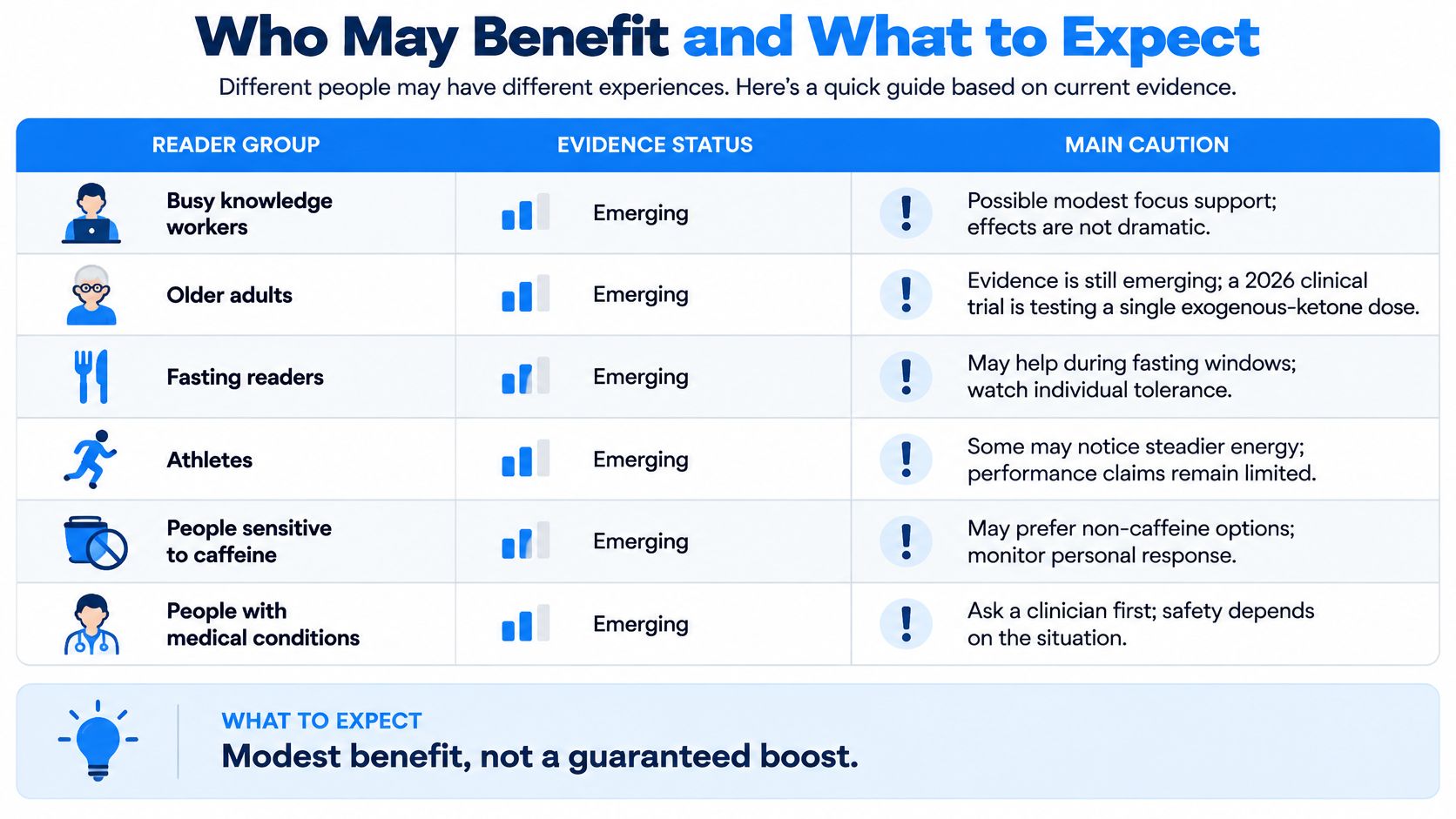
Who May Benefit and What to Expect
Six reader groups matter here, and they carry six different levels of evidence. The sorting does real work, because "does this help focus?" has a different answer depending on which research question you match. A 2026 clinical trial is testing whether a single exogenous-ketone dose changes brain energy use and processing speed in older adults with prediabetes. That group is an open question, not a settled use.
| Reader group | Evidence status | Main caution |
|---|---|---|
| Healthy adult with a demanding workday | Short-term cognitive data from controlled settings | Fix sleep and light first; judge over two weeks |
| Endurance or high-intensity athlete | Strongest data on muscle fuel use | Time the dose around sessions and track output |
| Older adult with prediabetes | Trial ongoing; unsettled | Clinician review before use |
| Adult with metabolic syndrome | Brain ketone uptake measured; memory effects mixed | Track appetite and fat intake, not only energy |
| Adult focused on appetite control | Appetite responses vary by metabolic status | Track total intake rather than assume a change |
| Adult with diabetes, a neurological condition or pregnancy | No established use case | Clinician approval before use |
Read the table by column rather than by row. The middle column tells you what has been measured. The right column tells you what that measurement does not cover. An athlete's fuel data says nothing about your afternoon spreadsheet, and a short cognitive test in a lab says nothing about hour seven of a workday.
One way to hold the whole picture: ketones are an additional fuel line, and sleep and light are the road itself. A better fuel line does not repair a road full of potholes. The people who notice the most from a ketone shot tend to be the ones whose basics are already steady. The ones who notice nothing are often running on five hours of sleep and guessing at the cause.
The evidence itself is mostly acute. Controlled sessions measure a window of a few hours, with a fixed dose, a fixed task, and no commute in the middle. Working memory has moved in some of those windows. Appetite has shifted too, and the direction depends on metabolic health: adults without metabolic syndrome have eaten less afterward in some trials, while adults with metabolic syndrome have taken in a higher share of calories from fat. Brain ketone uptake has been measured in adults with metabolic syndrome, and memory results in that group remain mixed, complicated by practice effects and by trends that favor ketones on only some measures.
What you are left with is a plausible mechanism and a thin all-day claim. Uncertainty runs highest for the most serious conditions. Dementia, Parkinson's disease, epilepsy, and traumatic brain injury have no established treatment role here.
What you can expect, and when to stop
Blood BHB rises within hours of a dose. That part is predictable. Attention, appetite, and session output are not, because they vary by person, task, and form. Ketone products can also cause gastrointestinal discomfort and may interact with glucose-lowering medication, which is why the cautions below sort by who should ask first rather than by what to buy.
- Diabetes medication: ask the prescribing clinician before you add a ketone.
- Pregnancy or breastfeeding: there is no established use case. Get approval first.
- Gut sensitivity: tolerance, not a brochure, decides whether you continue.
- A neurological condition, including Parkinson's disease, Alzheimer's disease, dementia, epilepsy, or traumatic brain injury: talk with a clinician. The studies do not establish a treatment role.
Healthy adults can run the two-week routine and keep only what they can measure. If you fall in a higher-risk group, involve a clinician before the first serving. If symptoms show up, stop and contact that clinician.
Apply the Focus Framework on Your Next Workday
A 2026 systematic review pooled 38 studies and 1,602 participants and found a statistically significant but modest cognitive benefit from exogenous ketones. The authors called for longer, well-powered trials on dose, formulation, duration, and real-world use, in this Frontiers in Nutrition review. A separate randomized crossover study reported better working-memory scores after a ketone ester, but the testing window covered only a short block. That acute result is a signal, not proof of all-day focus.
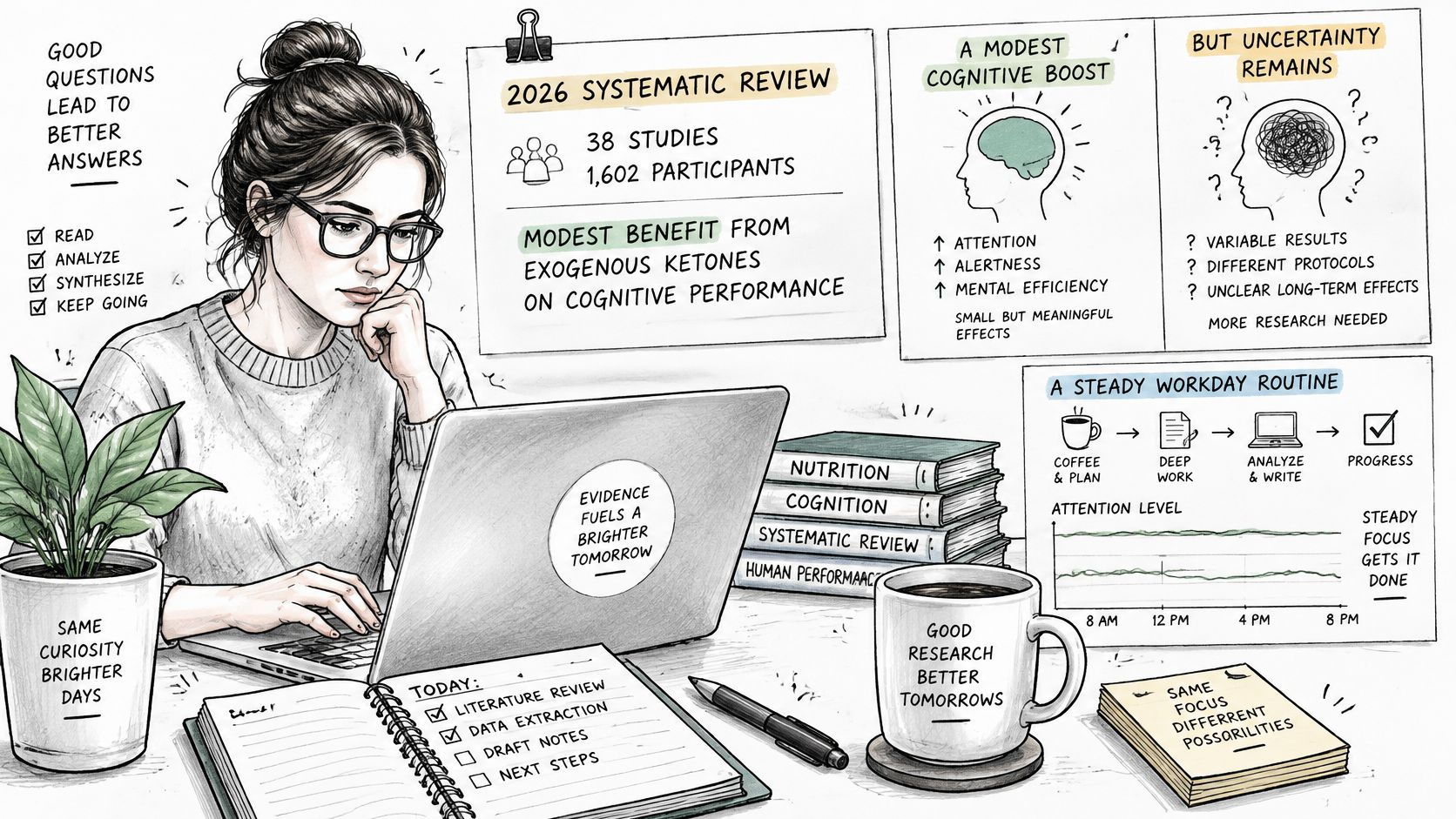
Sleep, light timing, caffeine, meal context, age, and the task itself all move the result. Change one of those at a time or you will not know which one did the work. Log the same task type at the same hour so the comparison is fair.
Fourteen workdays, one variable
- Lock the baseline. Fix your wake time and keep any sleep extension steady for two weeks, and log reaction time.
- Add morning light on workdays only. Keep recording reaction time.
- Pick one ketone route for the deep-work block or for training. Write down the clock time.
- Repeat for 14 workdays. Do not add a second new habit in the same stretch.
- Judge four outcomes against baseline: sustained attention, reaction time, perceived effort, and that evening's sleep.
Tecton sells four formulas: EDGE Caffeine, EDGE Electrolytes, Locked Cognition, and GLP-1 Activator. The Locked Cognition shot can be taken every day, with no loading phase and no cycling requirement. That is one option if you want a daily shot inside this test. It does not stand in for sleep, food, or medical care.
The video below shows a focus-block setup: one task, a timer, and a stopping point written before the block begins.
Choose one variable. Log it across 14 workdays. Keep it only if a measured outcome moves. Drop it if the only change is a feeling you can't count.
Tecton Ketones™ makes bioidentical exogenous ketone shots for readers who want a measured fuel option beside sleep and light, not a substitute for either. If you are ready to see the formulas and how they fit a workday or a training day, visit Tecton Ketones™ and match the product to the outcome you can track.


