


You can sleep for eight hours and still wake up feeling like your brain never fully came online. Another person can sleep less, rise earlier, and feel sharper all day because the night was organized differently, not just shorter or longer. That gap is the subject of sleep architecture, the pattern of wake, N1, N2, N3, and REM that repeats across the night and shapes how restored you feel the next morning polysomnography-based sleep architecture.
A healthy adult night is usually built from 4 to 6 NREM-REM cycles, with each cycle averaging roughly 90 minutes National Academies sleep architecture reference. The first half of the night leans more heavily toward deeper NREM sleep, especially N3, while REM periods become longer later on sleep architecture and timing. That timing matters because it helps explain why two nights with the same total hours can feel very different.
Why the Pattern of Sleep Matters as Much as the Hours
A stable sequence is what lets sleep do its work. If you only count hours, you miss the larger question of whether the night was organized well enough for the brain and body to move through their usual stages without getting stalled or cut short.
The next morning often reveals the difference. A person who wakes too early may lose more of the REM-rich late-night portion, even if the total loss seems small, while a fragmented night can interrupt the continuity that helps sleep stages do their work well sleep architecture timing and function. Sleep clinicians focus on the pattern and sequencing because stage proportions, cycle timing, and continuity show sleep quality more clearly than hours alone National Academies sleep architecture reference.
A simple way to think about it
The night moves like a train route.
- The first cars carry more deep NREM.
- The middle cars keep the night stable and structured.
- The last cars carry longer REM stretches.
Practical rule: if the night is shortened or repeatedly interrupted, the late REM-rich part is usually the first thing to get squeezed.
That helps explain a common complaint: “I slept enough,” but still feel foggy. The hours were present, yet the architecture was off. The issue is not only duration, it is whether sleep stayed consolidated long enough for the sequence to hold together. Newer discussions also point to how brain fuel state may interact with that continuity, including ketone-based energy use as one emerging, still qualified input, although that idea remains an adjunct to the core sleep stages rather than a replacement for them.
The Five Stages That Make Up a Single Night
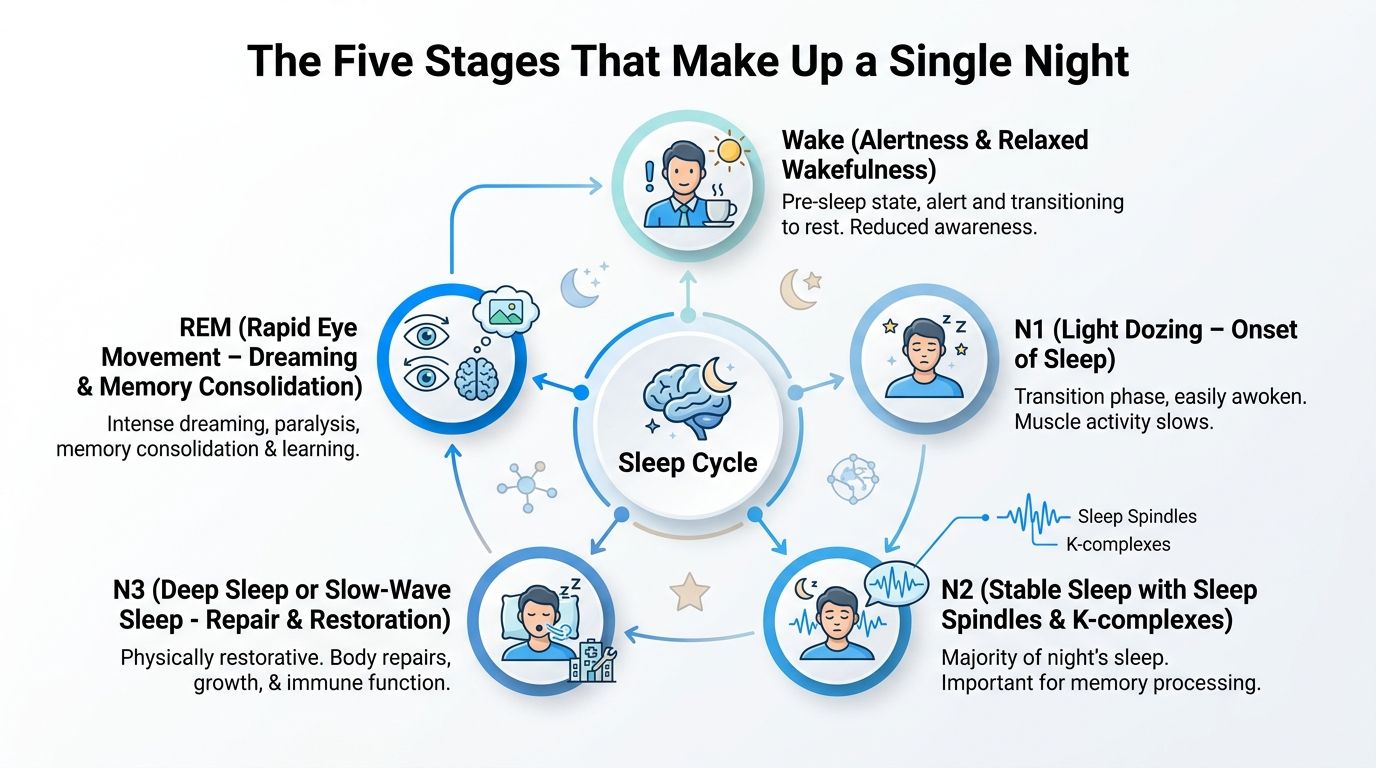
A full night starts with Wake, then moves into N1, N2, N3, and REM before cycling back again. That sequence is the basic grammar of sleep architecture, and a hypnogram is just the visual version of that grammar, a line that rises and falls as the brain shifts through stages rather than sitting flat all night.
What each stage is doing
Wake is the borderland between alertness and sleep. You can be in bed and not yet asleep, or you can have brief awakenings that you barely remember.
N1 is light dozing, the transition stage. It's easy to interrupt and usually brief.
N2 takes up the largest share of the night in most adults, and it's where sleep tends to become more stable. Teaching models often describe it with sleep spindles and K-complexes, which are useful markers of stage identity.
N3 is slow-wave sleep, the deepest non-REM stage. This is the stage people usually mean when they say they want “deep sleep.”
REM is the stage linked with vivid dreaming, rapid eye movements, and muscle atonia, and it becomes more prominent later in the night deep dive into REM sleep.
A few stage-level anchors help make the night easier to read. Healthy adult sleep is often described with roughly 5% to 10% N1, 50% to 60% N2, 13% to 23% N3, and 20% to 25% REM sleep architecture benchmarks. Those percentages are not goals to chase every night, but they help explain why N2 usually dominates the chart while N3 and REM carry special jobs.
The easiest way to read a sleep chart is to stop thinking in labels alone and start thinking in sequence. One stage sets up the next. That's the architecture.
How Sleep Cycles Shape the Architecture
Healthy adult sleep usually moves through 4 to 6 cycles that last about 90 to 110 minutes each, with the first cycle often shorter and later cycles stretching longer National Academies sleep architecture reference sleep architecture cycles. The first third of the night is biased toward slow-wave sleep, while REM stretches lengthen toward morning sleep architecture timing.
| Stage | Share of Total Sleep | When It Dominates |
|---|---|---|
| N1 | About 5% to 10% | Early transitions and brief arousals |
| N2 | About 50% to 60% | Most of the night |
| N3 | About 13% to 23% | First third of the night |
| REM | About 20% to 25% | Later cycles, especially toward morning |
That distribution explains a lot. Going to bed late and keeping wake time fixed usually compresses the later cycles, which can cut into REM more than deep sleep. Waking up early can do the same thing from the other side, trimming the REM-rich tail of the night even when the total loss seems small.
Why timing matters more than people expect
A night is not evenly mixed. It's front-loaded with deeper NREM, then gradually shifts toward longer REM periods. So the same lost hour can have different effects depending on where it falls.
One useful example is a person who falls asleep fine but gets up very early for work. They may still log a respectable total duration, yet the architecture is biased away from the late-night REM stretch. That's one reason sleep feels “off” even when the clock says it was long enough.
For active people, that timing issue matters even more if recovery depends on both physical restoration and cognitive reset. The night has to reach its later cycles to do both jobs well.
Tecton EDGE™ Performance Shot + Electrolytes is a ketone shot designed for active individuals who want steady energy during training, movement, or physically demanding days, and it uses liposomal R3HBG™ ketone plus Na, K, and Mg to fit into routines where stamina and hydration matter.
How Clinicians Measure Sleep Architecture
A smartwatch sleep score is an estimate. Clinical sleep architecture comes from polysomnography, which uses EEG for brain waves, EOG for eye movement, and EMG for muscle tone polysomnography and sleep architecture. Those three signals let a clinician see whether a person is awake, in light sleep, in deep sleep, or in REM, instead of guessing from motion and heart rate alone.
What the sensors actually tell you
EEG shows how the brain's electrical activity changes as sleep deepens and cycles. EOG detects the quick eye movements that help mark REM. EMG shows how muscle tone drops across sleep, especially in REM when the body becomes relatively still.
Consumer wearables can still be useful, but they usually estimate stages from movement and heart-rate patterns. That means they can give you a trend, not a definitive stage map. A sleep score is helpful for pattern awareness, but it is not the same thing as a lab-based hypnogram.
Useful clinical markers include sleep efficiency, REM latency, and arousal index. In common adult benchmarks, sleep efficiency of 85% or higher is usually considered normal, and an arousal index above 15 per hour suggests clinically relevant fragmentation such as obstructive sleep apnea, periodic limb movement disorder, or environmental disruption sleep architecture benchmarks. Those markers matter because they describe continuity, not just duration.
A wearable can tell you how the night looked. A sleep study can tell you why it looked that way.
People who suspect jaw tension, snoring, or sleep fragmentation sometimes start with a targeted screen before deciding on formal testing. A resource like the TMJ sleep quality test can help organize the conversation around symptoms that disturb sleep continuity.
Why Each Stage Matters for Cognition and Performance
N3, the deep slow-wave part of sleep, is the stage commonly associated with physical recovery. It's also the part of the night most vulnerable to a short sleep opportunity or repeated awakenings, which is why a person can spend enough hours in bed and still feel physically flat the next day.
REM has a different job. It supports emotional recalibration, procedural learning, and the mental flexibility that helps the brain integrate what happened during the day. N2 matters too, because it's where sleep spindles are often linked with motor-skill consolidation and stable progression through the night.
What to notice in real life
- Low N3: workouts feel harder to recover from, and the body may feel less refreshed.
- Fragmented REM: mood feels more fragile, and mental stamina can drop.
- Weak N2 continuity: learned movements or tasks may not settle in as cleanly.
The key point is that a night can look long but still be poorly consolidated. That's why a stage-heavy focus can miss the core issue, especially if awakenings keep breaking the sequence. For people trying to improve daytime focus, the goal is often better continuity, not just more time in bed. A focused guide like how to improve focus is most useful when sleep, attention, and recovery all need to be considered together.
The research also matters here. In aging cohorts, changes in stage distribution have been linked with cognitive outcomes, including the finding that a relatively smaller increase in N1 aligned with less cognitive decline and a sharp decrease in N2 aligned with decline on Trails B performance age-related sleep architecture and cognition. That doesn't mean people should chase a single stage number. It means the structure of the night has downstream consequences.
The Biggest Disruptors of Sleep Architecture
Alcohol can make a night look sleepy on the front end while still wrecking the back end. It tends to suppress REM early and then fragment sleep later, which leaves the architecture uneven even if falling asleep felt easier than usual. Late caffeine can push sleep onset later and reduce the amount of deep sleep you reach before morning.
Blue light from screens delays the body's evening wind-down and can shift cycle timing later. Irregular schedules do something similar by pulling the circadian system in different directions from one night to the next. Stress adds another layer, because a body that stays on alert has a harder time settling into stable, consolidated sleep.
The clearest disruptor from a clinical standpoint is sleep-disordered breathing. In one study, people with sleep-disordered breathing had a mean respiratory disturbance index of 34.0 events per hour versus 0.63 in those without the disorder, along with 26% and 32% higher propensities for wake-to-NREM and NREM-to-wake transitions, respectively sleep-disordered breathing and transitions. That kind of fragmentation breaks architecture, not just duration.
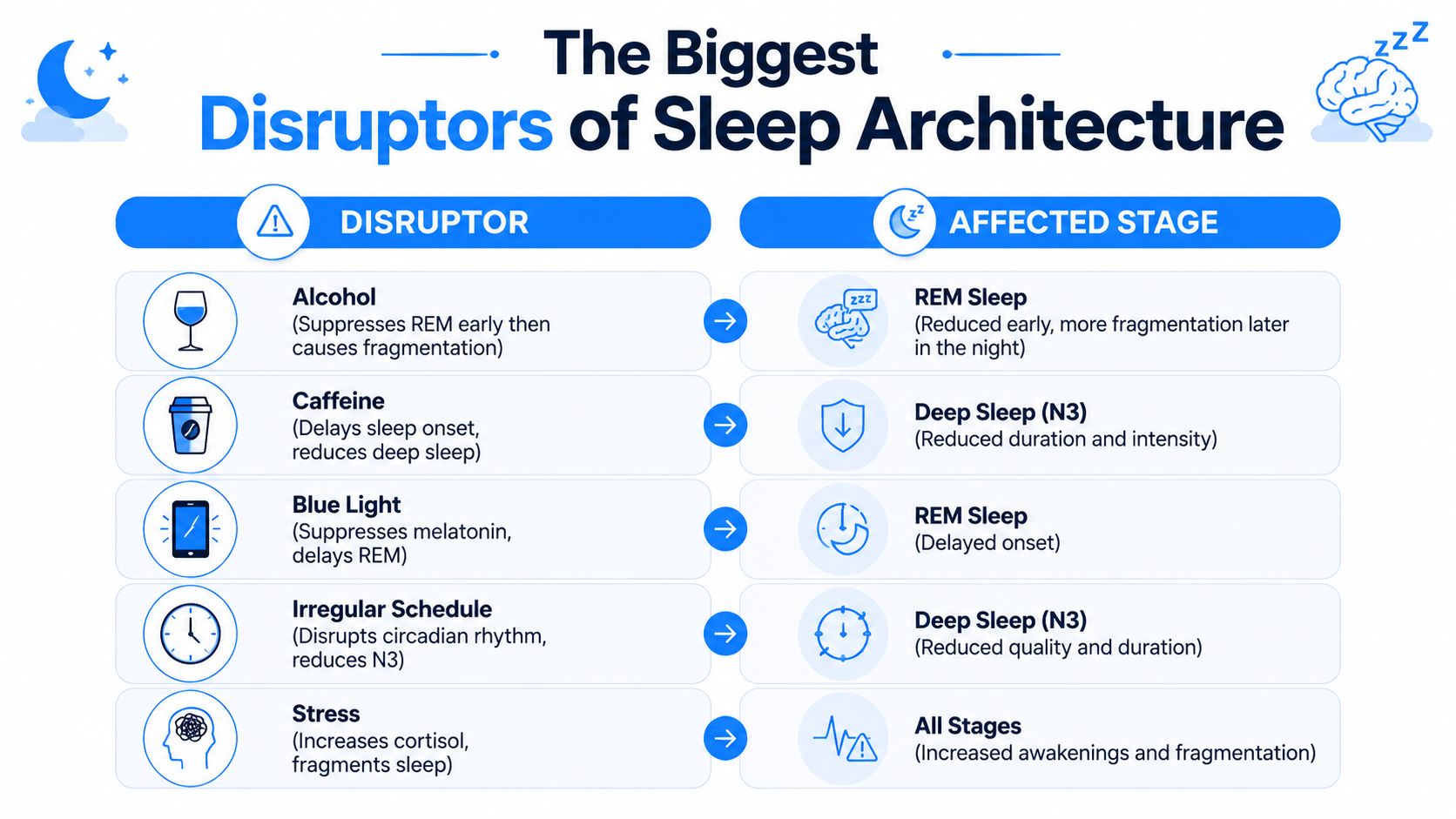
What tends to hit which stage
- Alcohol: more REM disruption, then later fragmentation.
- Caffeine: longer sleep onset and less access to deep sleep.
- Blue light: delayed timing and a later sleep shift.
- Irregular schedule: unstable cycle timing and less organized NREM progression.
- Stress: more awakenings and poorer continuity.
Aging also changes the picture. Sleep tends to become lighter with less deep sleep over time, and circadian timing often shifts earlier Harvard sleep architecture overview. That doesn't mean poor sleep is inevitable. It means the margin for disruption gets smaller.
What Predicts Good Architecture
A better question than “How much deep sleep did I get?” is “How consolidated was the night?” That shift matters because a large adult cohort study found that better sleep consolidation and the absence of obstructive sleep apnea were associated with better global cognition, while individual sleep-stage percentages were not associated with cognition across cohorts cognition and sleep consolidation. The practical lesson is simple, stage counts alone do not explain whether the brain got a steady, well-contained night of sleep.
What to target instead
If a wearable shows low REM one night, the first response usually should not be panic about the number. Look for the cause of fragmentation, a bedtime shift, alcohol timing, or a breathing issue that broke the sequence. A stable night with fewer awakenings is often more meaningful than a dramatic-looking stage graph.
That same logic applies to sleep opportunity. When sleep is shortened in a way that clips the tail end of the night, the architecture changes in a predictable way. The fix is not always to chase more deep sleep. Often it is to protect the whole cycle structure so the night can carry itself through its later phases.
Sleep architecture is dynamic. It changes across the night, and it changes across life. What predicts the best outcome is often the night that stays together long enough to reach its later cycles cleanly, with continuity that lets the brain consolidate what it has already done.
Nutrition can matter here too, but only as a supporting input. If a reader wants to understand one possible piece of that puzzle, magnesium and calcium support sleep physiology in ways that may influence how smoothly the system settles, though they are not substitutes for regular timing, light control, or breathing stability.
A Practical Plan to Improve Your Sleep Architecture
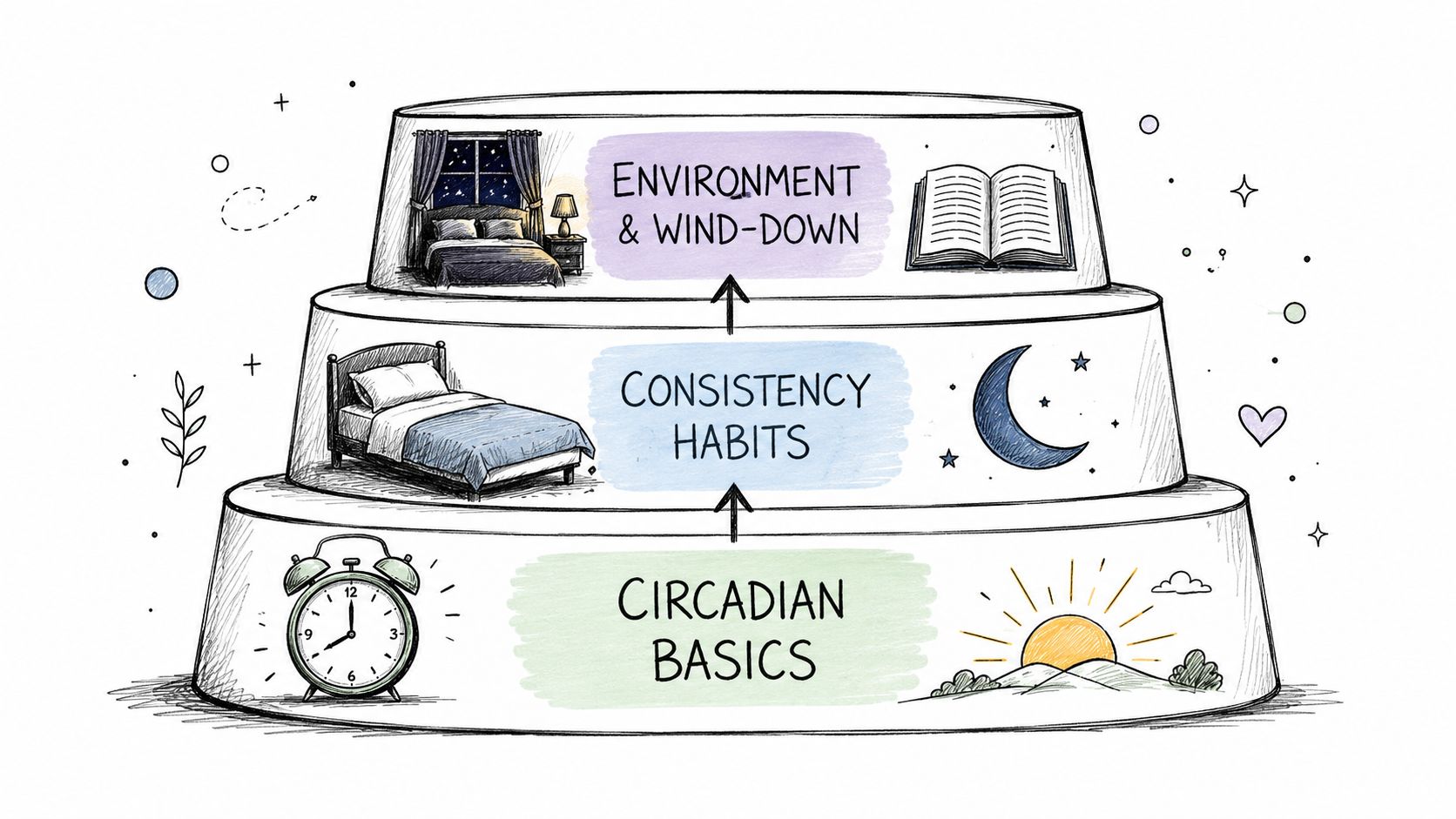
Start with the clock. A consistent sleep and wake schedule gives the circadian system a stable cue, and morning light helps anchor that timing. Protect the last hour before bed from bright screens and overhead light so the evening shift can happen without as much interference.
Next, clean up the room. A cooler sleeping environment, blackout conditions, and low noise reduce the chances that the night gets chopped into small pieces. If the room wakes you up repeatedly, the stages never get to settle into a smooth rhythm.
Then look at behavior. Caffeine is best cut well before bedtime, alcohol timing matters more than many realize, and heavy late meals can make sleep feel less stable. If you want a deeper practical guide that stays grounded in routine rather than hype, the sleep schedule guide for residents offers a useful lens on consistency and habit design.
Where ketones fit, carefully
Brain energy is one of the more interesting emerging questions in this space. Exogenous ketones provide beta-hydroxybutyrate, or BHB, which can be used as an alternative fuel pathway when the body has access to ketones, and Tecton Ketones™ uses bioidentical R3HBG with liposomal delivery to deliver direct BHB fuel without relying on a strict ketogenic diet. That's a metabolic strategy, not a sleep cure.
The practical question is whether easier access to ketone fuel changes how the brain feels during demanding periods when sleep is imperfect. That remains a research question, especially when the primary target is sleep continuity, not a supplement shortcut. If you use an exogenous ketone, the expectation should be physiological support, not a promise of better architecture.
If you want to test your own sleep with discipline rather than guesswork, a simple seven-night protocol works well. Hold total sleep time as steady as you can, then change one variable per night, such as caffeine cutoff, room temperature, alcohol timing, or light exposure. Record morning alertness, how rested you feel, and any wearable stage estimate.
For a short recovery-oriented option that fits within a broader sleep routine, 20-minute nap is a practical read, especially when a night was short but you still need to function.
If you snore loudly, someone has witnessed pauses in your breathing, or you keep waking up unrefreshed, that's a clinician conversation, not a self-experiment. Those signs point toward an evaluation that can look at the architecture directly instead of guessing from symptoms alone.
If you want a cleaner way to think about sleep, Tecton Ketones™ focuses on direct ketone fuel, bioidentical BHB, and liposomal delivery for people who care about performance and metabolic efficiency. Visit Tecton Ketones™ to review the options and decide whether a structured ketone routine fits your training, focus, or recovery plan.


