


The most popular advice about keto electrolytes is also the least useful: take more salt, buy a sugar-free powder, and assume fatigue means you need another serving. The best keto electrolytes aren't the formula with the most sodium. They're the mineral amounts that fit your diet, sweat losses, training duration, and health situation.
A ketone shot and an electrolyte drink also solve different problems. One supplies an alternative fuel; the other helps replace minerals. A scientifically credible comparison must separate those functions before judging whether combining them makes sense.
Quick Picks for Keto Electrolytes by Routine
Keto electrolyte formats at a glance
| Format | Mineral profile | Sugar and sweeteners | Best for | Main limitation |
|---|---|---|---|---|
| Stick packs or powders | Check elemental sodium, potassium, and magnesium per serving | Zero-sugar options available; inspect the sweetener | Everyday keto hydration at low activity | Dose must match your losses |
| Ready-to-drink electrolyte drinks | Check minerals per bottle, not just per serving | Some contain sugar | Hot days and long sessions when mixing is inconvenient | Check concentration; a larger bottle isn't necessarily a stronger formula |
| Ketone-plus-electrolyte shots, including Tecton EDGE™ Performance Shot + Electrolytes | Sodium, potassium, magnesium, and R3HBG ketone; confirm sodium on the current label | Brand describes the formula as sugar-free | Training days when ketone fuel and electrolytes are both wanted | Performance benefit isn't established for every user; compare cost separately |
| Ketone salt drinks | BHB bound to sodium, potassium, or magnesium | Check the product's ingredient list | Users testing an acute BHB rise | Mineral intake increases with the ketone dose |
| DIY salt-and-mineral blend | You set each mineral amount | None if unflavored | Cost-conscious users who track intake closely | Potassium dosing requires care; the finished blend isn't independently tested |
Powders offer dosing flexibility. Read the serving weight carefully rather than assuming every scoop delivers the same mineral amounts.
Ready-to-drink products prioritize convenience. Compare the entire bottle's contents with the amount you'll drink.
Our electrolyte shot combines liposomal R3HBG with sodium, potassium, and magnesium for active routines without caffeine. That makes it a combined-fuel option, not an automatic replacement for a separately planned hydration drink.
Ketone salts require accounting for minerals from the ketone ingredient itself. DIY blends offer control, but they also put measurement and mixing responsibility on you.
Buying rule: Choose the format for your routine first. Then judge the dose, rather than letting portability, flavor, or keto branding decide.
Why This Matters for Keto Electrolytes
During early nutritional ketosis, falling insulin reduces the kidneys' sodium retention and increases urinary water loss. A clinical review of ketogenic-diet implementation describes associated electrolyte losses and early symptoms including fatigue, headache, dizziness, cramps, and reduced exercise tolerance; decreased energy occurs in approximately 18–25% of adults following ketogenic diets.
These symptoms can appear during early adaptation, but they don't diagnose a mineral deficiency. The practical response is to examine fluid, food, and sodium intake together, not immediately add several supplements.
Fuel and hydration are separate systems
Nutritional ketosis is diet-induced. The liver produces endogenous ketones from fatty-acid-derived acetyl-CoA, whereas exogenous ketone supplementation supplies ketone availability without requiring the same dietary restriction.
BHB crosses the blood-brain barrier and is converted through acetoacetate to acetyl-CoA inside mitochondria. Acetyl-CoA enters the tricarboxylic-acid cycle, supporting ATP production through oxidative phosphorylation.
A review of human brain metabolism reports that ketones can supply approximately 60–70% of brain energy during longstanding starvation, a specific metabolic condition rather than an expected supplement outcome. Separately, a review summarizing human intravenous BHB research describes approximately 14% lower cerebral glucose consumption with unchanged oxygen use, consistent with ketones replacing part of the brain's glucose fuel.
Why This Matters
- Steadier energy: Correcting inadequate fluid and mineral intake may remove a source of fatigue, but it isn't a stimulant effect.
- Cognitive endurance: Alternative brain-fuel availability is plausible physiology, not proof of improved concentration.
- Workout performance: Hydration and usable fuel both matter; neither guarantees faster performance.
- Metabolic efficiency: Using another substrate demonstrates metabolic flexibility, not automatically more ATP per effort.
Electrolytes don't create ketosis. Check sodium and fluid intake before treating early-keto discomfort as a reason to add more products.
Sodium Targets by Training and Sweat Level
The Australian Institute of Sport endurance-drink range, summarized in a ketogenic-diet clinical review, is approximately 0.5–0.7 g sodium per liter, or 21–30 mmol/L. It balances replacement, thirst stimulation, and palatability; it's not a universal daily prescription.
Use this visual as a concentration reference, not permission to drink beyond your losses.
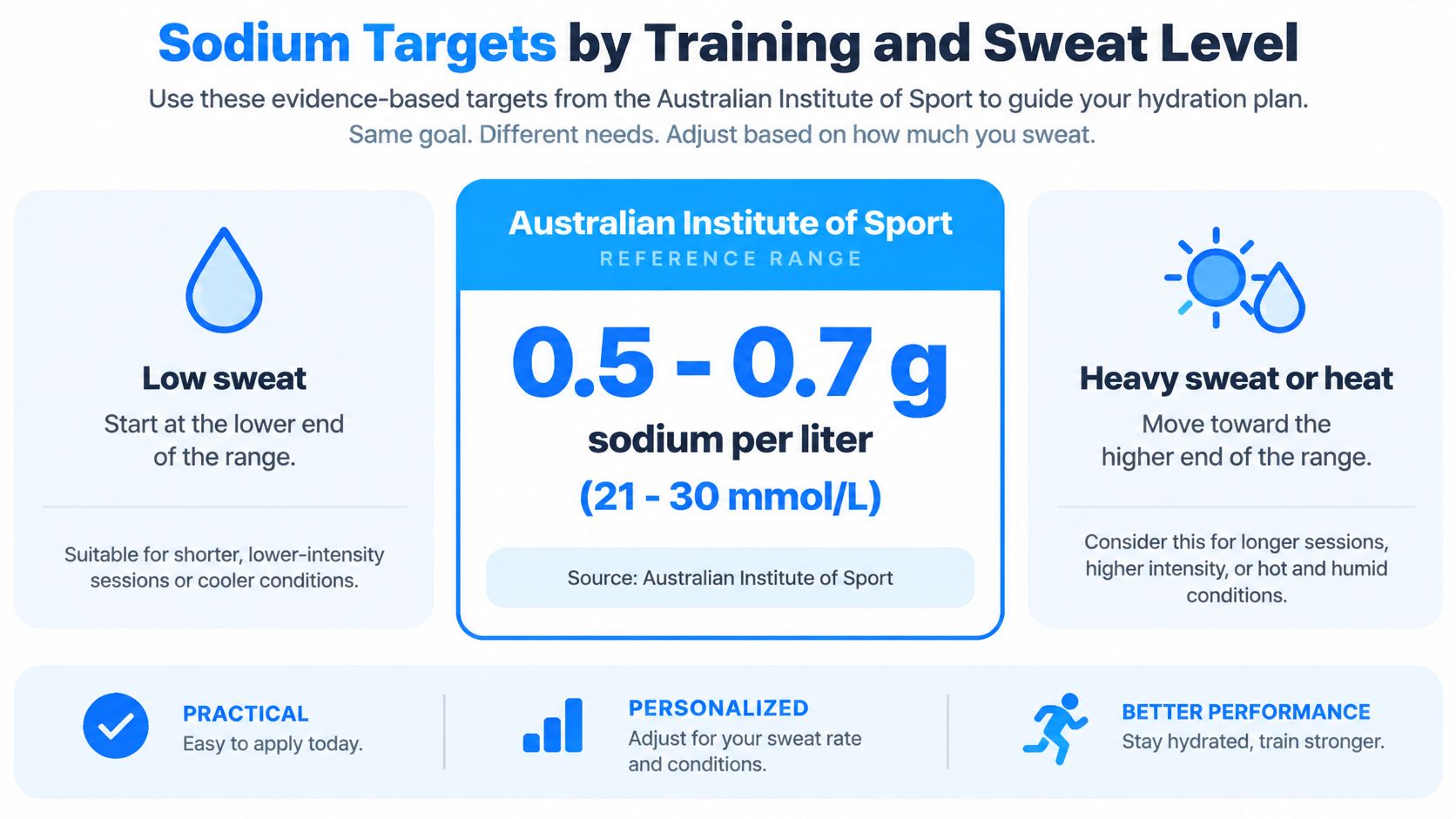
A sports-medicine position statement on fluid replacement reports adult exercise sweat rates of 0.5–4.0 liters per hour and sodium losses of 0.2–7.3 g per hour; it also discusses prolonged-exercise guidance of 300–600 mg sodium per hour, voluntary drinking that replaces about two-thirds of sweat losses, and limiting body-mass loss to less than 2% without gaining weight.
Those broad observations explain why concentration and total intake must be considered together.
Sodium guidance by situation
| Situation | Reference sodium guidance | Practical approach |
|---|---|---|
| Keto at rest, normal weather | No fixed supplemental target established | Start with food intake; assess symptoms before supplementing |
| Shorter exercise in mild conditions | Use the endurance-drink concentration as a comparison, not a compulsory dose | Check sodium per serving and intended dilution |
| Prolonged exercise or hot conditions | Consider both drink concentration and hourly replacement | Match fluid intake to sweat losses and monitor body-mass change |
| Heavy sweaters or known high sweat sodium | Individual losses can exceed general reference amounts | Assess sweat losses rather than automatically adding servings |
Apply the numbers to your bottle
For a hypothetical bottle, dissolving 300 mg sodium in 500 mL produces 600 mg/L, or 0.6 g/L, within the endurance reference range. Putting the same amount into 1 liter halves the concentration.
The weaker mixture might suit a lower-loss situation, but concentration alone can't establish whether it meets your needs. Your drinking volume and food intake still count.
For ordinary keto days, check the diet before buying a high-loss training formula. For long or hot sessions, check dilution and sodium together; our guide to the best electrolyte drink for athletes applies that distinction to sports routines.
Test the mixture during a familiar training session and record thirst, stomach comfort, and body-mass change. More sodium isn't automatically better: overdrinking can cause exercise-associated hyponatremia even when the drink contains sodium.
Five Criteria for Judging Any Keto Electrolyte
A useful label describes a complete mineral system, not just a sodium headline. Apply the same checklist to powders, bottles, shots, and homemade blends.
This checklist identifies the information you need before comparing servings.
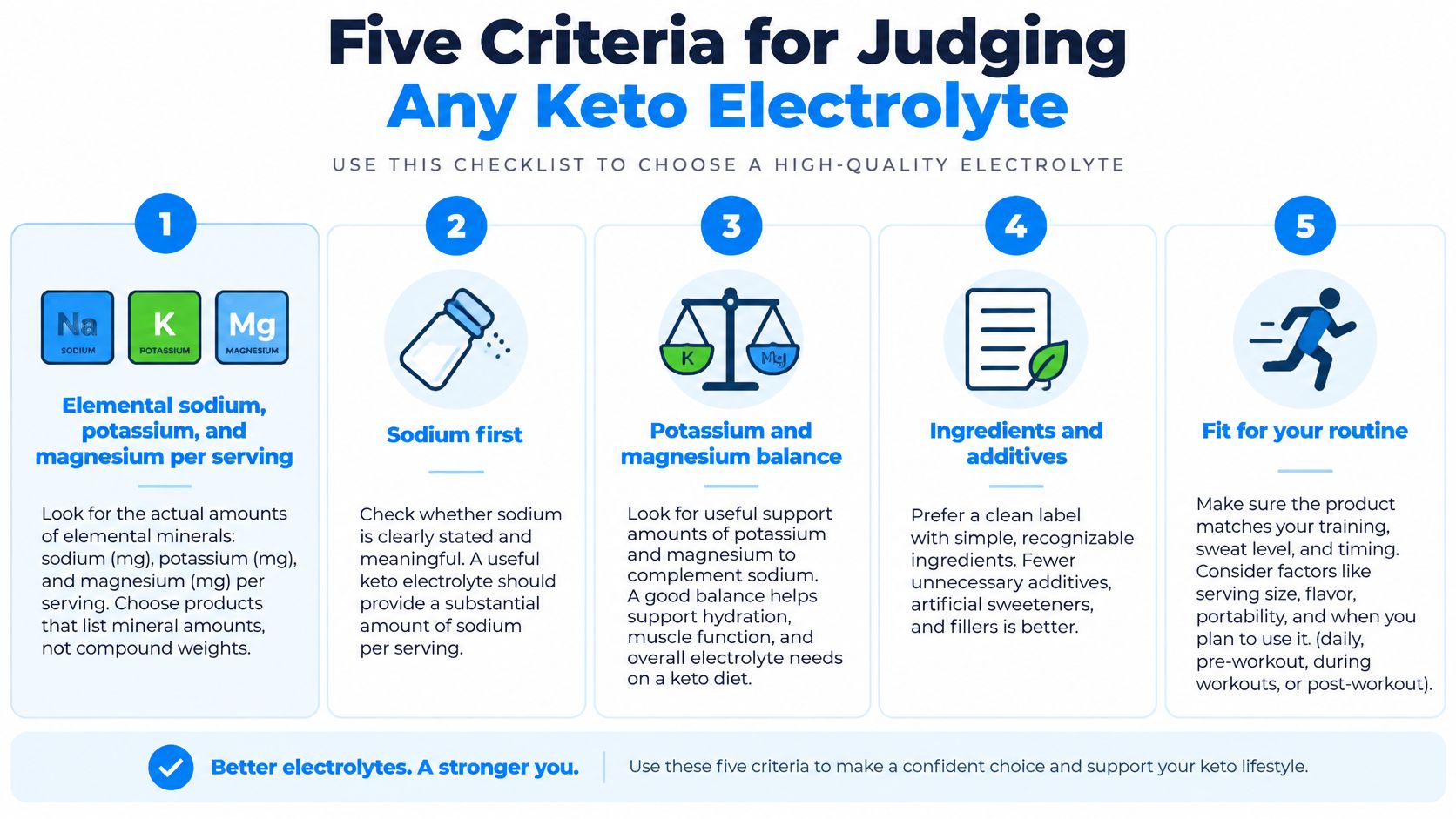
- Read elemental mineral amounts. Look for sodium, potassium, and magnesium in milligrams and percentage Daily Value, not merely the weight of sodium citrate or magnesium glycinate. The National Academies dietary-reference discussion hosted by NCBI provides the reference-intake context: adult magnesium requirements generally fall around 310–420 mg daily, while potassium adequate-intake values are approximately 2,600–3,400 mg, according to sex and life stage. These are whole-day dietary reference amounts, not instructions to obtain everything from a drink.
- Check serving size and dilution. A scoop, sachet, bottle, and shot aren't interchangeable units. Record the mineral dose you'll consume and the water volume you'll use.
- Inspect sugar and sweetener type. A sugar-free claim doesn't identify the sweetener or establish personal tolerance. Read the ingredient list, particularly if stomach discomfort has limited your use of sports drinks.
- Identify any ketone ingredient. Determine whether the product contains a salt, ester, or precursor. Otherwise, you can't separate the hydration dose from the fuel dose or compare it fairly with a plain electrolyte formula.
- Review warnings and testing. Look for kidney, cardiovascular, and medication precautions, plus clearly identified independent testing. A certification should name what was assessed; a general quality claim isn't enough.
Red flags that should stop a purchase
- Missing amounts: Electrolyte support without individual mineral quantities prevents a meaningful comparison.
- Compound-weight marketing: A large ingredient weight can obscure the smaller elemental mineral dose.
- Unclear potassium precautions: Concentrated potassium deserves particular scrutiny with kidney impairment or potassium-raising medications.
- No usable directions: A serving without mixing guidance leaves drink concentration unresolved.
A product can contain all the right minerals and still deliver the wrong amounts for your situation.
Excess supplemental magnesium can cause gastrointestinal effects, and impaired kidney function changes the safety assessment. Clinician-directed electrolyte and acid-base monitoring may be appropriate during ketogenic dieting, especially with other health conditions.
Ketone Salts, Esters and Liposomal Formats Compared
Ketone salts deliver BHB together with mineral ions. Ketone esters deliver ketone availability without the same salt burden. That distinction matters when you're already using electrolyte supplements.
A synthesis of randomized human exercise trials found that ketone supplementation increased circulating BHB and altered metabolic variables, but most trials didn't significantly improve time-trial performance, time to exhaustion, or maximal workload. Acute salts generally showed limited ergogenic benefit compared with ester formulations, with heterogeneous, context-dependent outcomes.
Ketone delivery formats compared
| Format | How ketones are delivered | Mineral load | Evidence and limits |
|---|---|---|---|
| Ketone salts | BHB bound to sodium, potassium, or magnesium | Substantial mineral contribution from the salt | Limited acute ergogenic benefit in trials |
| Ketone esters | Ketone availability supplied without mineral binding | No equivalent salt burden | Context-dependent results; tolerability and acid-base considerations remain |
| Liposomal R3HBG ester from Tecton | Company-described D-BHB tri-ester on glycerol within a liposomal shell | No salt loading from the ketone ingredient, per company statement | Independent product-specific human performance evidence isn't established here |
| Ketone precursors such as MCT | Medium-chain fatty acids provide an indirect route through liver ketone production | No mineral contribution from the oil itself | Different conversion pathway and gastrointestinal limitations |
What liposomal and bioidentical actually establish
We describe R3HBG as a tri-ester bonding three D-BHB molecules to a glycerol backbone, releasing the form of BHB the body naturally uses. Our stated role for the liposomal shell is to let R3HBG survive digestion and reach the bloodstream intact.
These are company descriptions of formulation and delivery, not independent proof of superior performance. We also state that our R3HBG products contain no salt loading and are designed to avoid gastrointestinal distress; an electrolyte-containing formula can still contain deliberately added minerals.
A controlled human ketone-ester intervention illustrates the distinction: circulating D-BHB increased, but investigators found no statistically significant change in cardiac phosphocreatine-to-ATP ratio or skeletal-muscle phosphocreatine recovery. More circulating fuel didn't automatically improve measured tissue energetics.
The same evidentiary boundary applies to endothelial function and cellular signaling. A delivery claim or higher BHB level doesn't establish improved vascular function or a meaningful signaling outcome in users.
For a mineral-focused comparison, use our keto salt supplement guide. You can also browse GoBHB weight loss supplements at Supplemynts Inc. to inspect another commercial listing, but weight-loss wording isn't clinical evidence.
Judge the format by tolerance, mineral dose, and repeatable training response, not the ketone reading alone.
Who Benefits and Who Should Check With a Clinician First
Everyone on keto doesn't need the same electrolyte dose. A clinical overview of ketogenic diets emphasizes fluid-balance considerations and medical monitoring; fixed salt-supplementation targets during keto induction aren't firmly established by clinical trials.
The reader most likely to benefit from closer electrolyte attention is not only someone avoiding carbohydrates. It is someone whose intake, losses, or medical circumstances have changed.
Match the decision to the person
- Early keto adaptation: New fatigue, headache, dizziness, or cramps justify reviewing food and fluid intake, not diagnosing yourself from symptoms.
- Endurance training and heat: Longer sessions, hot workplaces, and substantial sweating warrant a deliberate replacement plan.
- Extended fasting: Reduced food-derived mineral intake makes supervision and planning more important, rather than making concentrated supplements automatically safe.
- Low activity without symptoms: A low-carb eater with adequate food intake may not need a supplemental electrolyte product.
Symptoms overlap. Dehydration, sodium loss, inadequate food intake, caffeine-related changes, and excessive supplementation can all complicate how you feel.
Track when symptoms occur relative to meals, drinks, supplements, and exercise. A headache after a missed meal calls for a different investigation than discomfort after repeatedly increasing a concentrated powder.
Clinical guardrail: Don't use symptom relief as proof that a particular mineral dose is safe to continue indefinitely.
When medical guidance comes first
People with kidney disease, cardiovascular disease, hypertension, or diabetes should obtain guidance before increasing concentrated electrolyte intake. The same applies to people using diuretics, ACE inhibitors, potassium-sparing drugs, or other medicines affecting fluid and mineral balance.
Concentrated potassium deserves particular caution because impaired kidney clearance or medication effects can make accumulation hazardous. Magnesium also needs review when renal function is impaired.
A clinician can decide whether persistent symptoms, dietary restriction, medication use, or an existing condition warrant electrolyte, kidney-function, or acid-base testing. Don't keep escalating a supplement while unexplained symptoms continue.
Our explanation of keto and electrolyte imbalance can help organize that discussion, but it doesn't replace an individualized assessment.
How Tecton EDGE Performance + Electrolytes Measures Up
Our combined shot should meet the same disclosure standard as any competing product. Its strongest fit is a training routine that calls for both exogenous ketone fuel and added electrolytes, rather than ordinary daily hydration alone.
The scorecard separates known formulation features from information you still need to confirm.
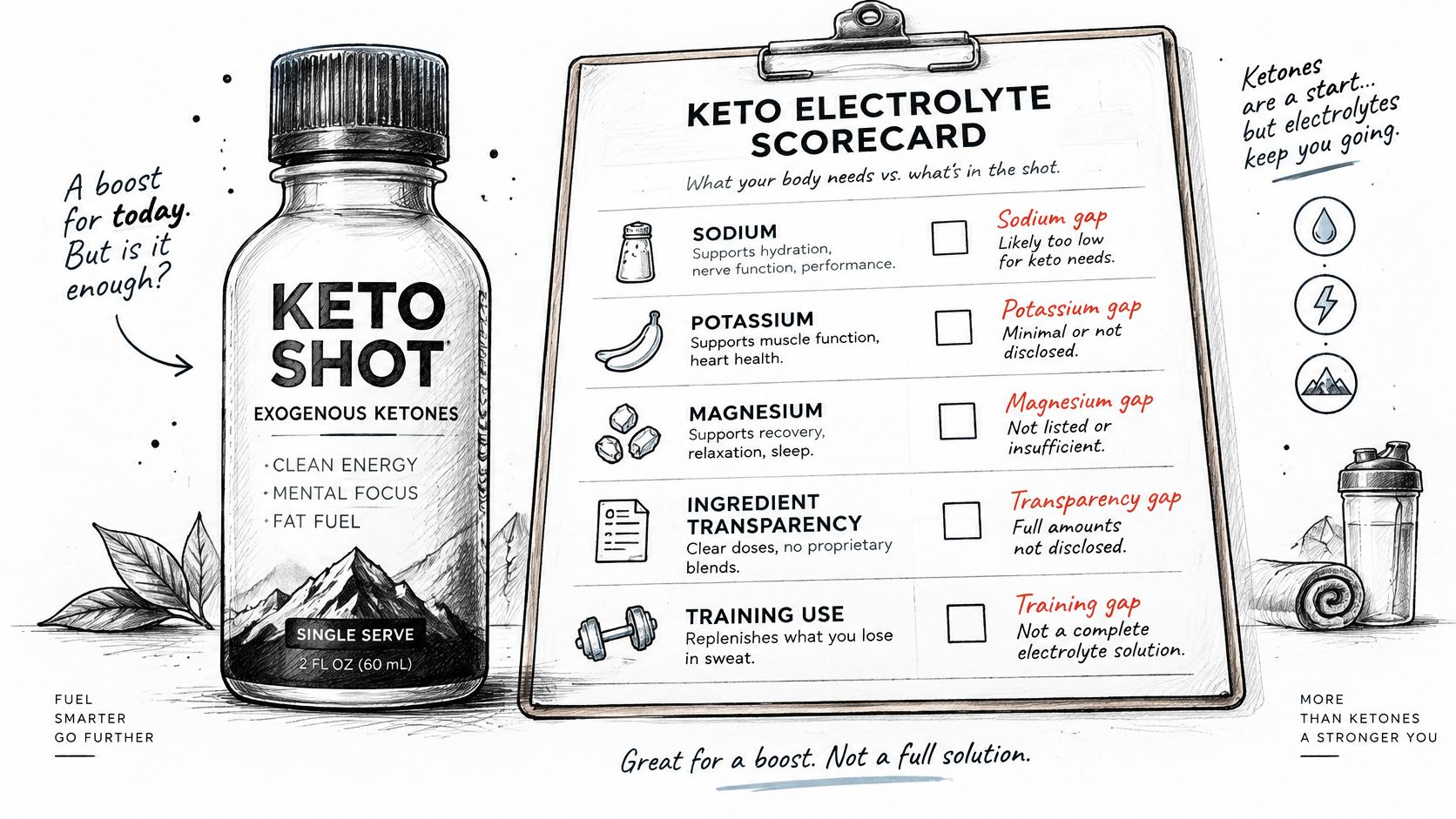
Tecton EDGE scored against the five criteria
| Criterion | Tecton EDGE status | Gap to close before buying |
|---|---|---|
| Elemental sodium, potassium, magnesium per serving | All are named; elemental amounts aren't established in the product information discussed here | Confirm current label values in milligrams |
| Serving size and dilution | Single-serve ketone shot | Verify bottle volume and any intended dilution |
| Sugar and sweetener type | Brand describes the formula as sugar-free | Inspect the current ingredient list |
| Ketone source and format | 10 g liposomal R3HBG | Don't assume a product-specific performance benefit |
| Safety content and testing | NSF Certified for Sport since its 2025 launch | Review kidney and medication warnings; certification doesn't personalize the dose |
Where the shot fits
The formula is stimulant-free, which makes it an option for readers avoiding caffeine during training. Its electrolyte blend contains sodium, potassium, and magnesium.
The listed product price is $39.99. Before making a per-serving cost comparison, verify the purchase configuration rather than assuming that figure represents the cost of an individual shot.
NSF Certified for Sport supports sport-specific banned-substance testing. It doesn't prove that the mineral dose matches your sweat rate, that the product prevents dehydration, or that you'll perform better.
Where another format makes more sense
A plain electrolyte powder may be the more direct choice when you only want measurable mineral replacement. A separately mixed drink also makes it easier to adjust water and sodium without changing your ketone intake.
For a high-loss endurance session, don't assume a portable shot constitutes a complete hydration plan. Until you confirm elemental mineral amounts, you can't calculate how much of your planned replacement it supplies.
Our scientifically rigorous position is therefore conditional: shortlist the shot for combined fuel and electrolyte convenience, then verify the label against your actual routine. No formulation replaces medical advice when kidney function, blood pressure, or medication use affects electrolyte safety.
Choose and Test Your Keto Electrolyte Routine
Application Framework
Treat your first purchase as a controlled routine test, not a commitment to daily supplementation. Change fewer variables so you can interpret what happens.
Use this process to organize the decision.
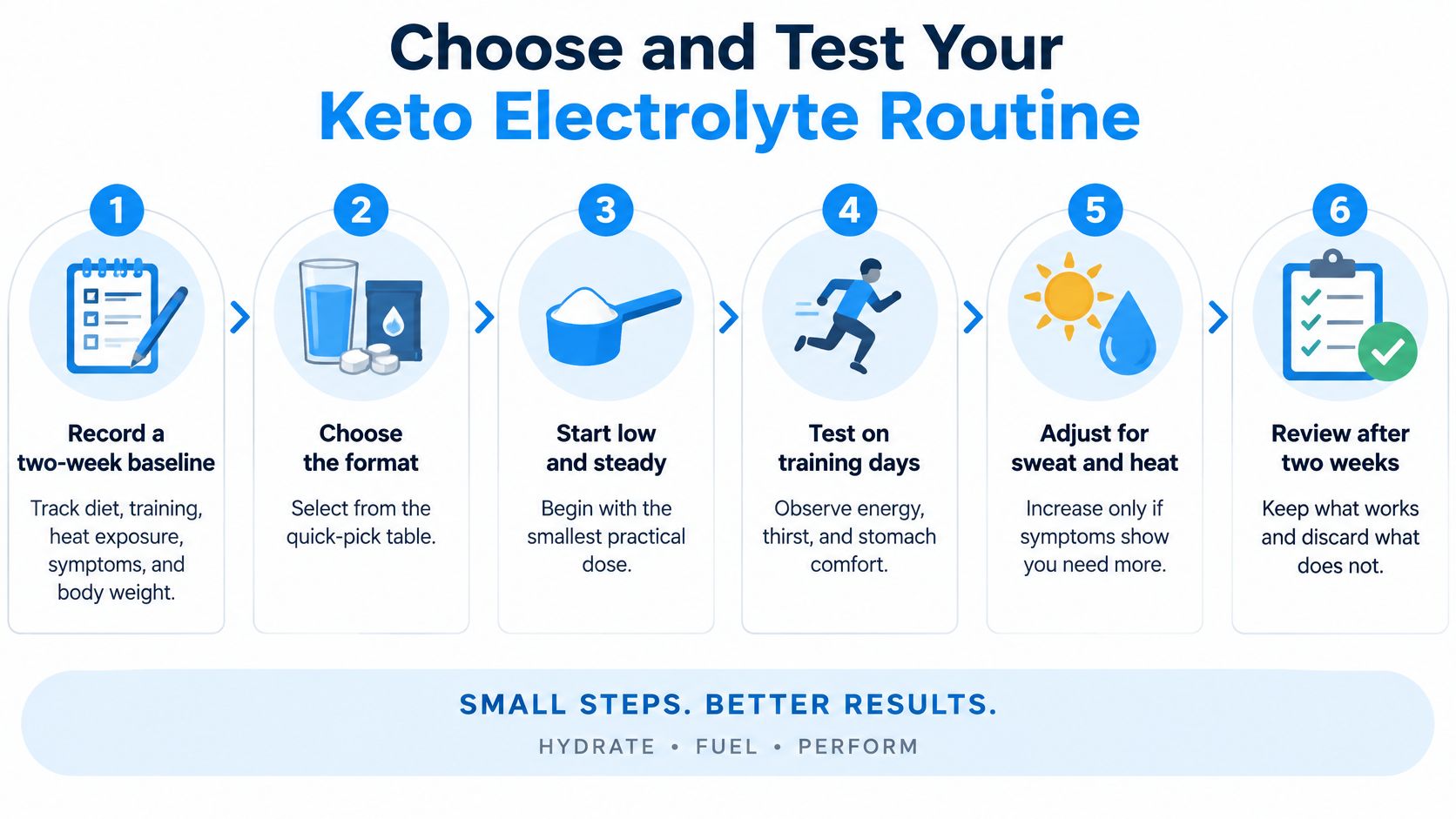
- Record a two-week baseline. As a practical tracking exercise, note diet, training, heat exposure, symptoms, and body weight so you aren't interpreting every change as a supplement effect.
- Choose a format for the task. Pick a powder for adjustable hydration, a training-day shot for combined ketone and mineral use, or a carefully measured DIY blend only if you can manage dosing reliably.
- Set sodium from the situation. Use training duration, sweat losses, and intended drink concentration rather than the brand's strongest marketing claim; don't turn an endurance reference into an automatic rest-day target.
- Audit the current label. Confirm elemental amounts, serving size, dilution, ingredients, ketone format, and safety warnings before combining products.
- Run a one-to-two-week trial. Track thirst, symptoms, body-mass change, and stomach comfort; stop or reduce the product and seek advice if gastrointestinal distress, swelling, or rising blood pressure appears.
- Reassess when conditions change. Hotter weather, longer training, a different diet, or new medication can invalidate the routine that previously suited you.
These tracking periods are a practical implementation suggestion, not clinically validated dosing protocols. Avoid starting a ketone product, changing caffeine intake, and increasing electrolyte servings simultaneously.
For additional context on the ketone option, watch the accompanying video.
Our products are dietary supplements and aren't intended to diagnose, treat, cure, or prevent any disease. Statements on the site haven't been evaluated by the FDA.
Your decision today is specific: choose the format you need and the sodium concentration appropriate to your first test. If you only need hydration, buy minerals with transparent amounts; if you also want to test ketone fuel, shortlist our combined shot once its label fits your plan.
Tecton Ketones™ offers exogenous ketone shots, including a stimulant-free option combining liposomal R3HBG with sodium, potassium, and magnesium. Visit Tecton Ketones™ to compare the formulations and review the current label before choosing a training-day option that fits your hydration plan.


