


The most popular advice about a keto salt supplement is also the least useful: “All exogenous ketones work the same, so choose the product with the most BHB.” That shortcut ignores the mineral attached to the BHB, the D- and L-isomer composition, the rate of absorption, and the amount of sodium, calcium, potassium, or magnesium you're consuming.
A ketone salt can raise blood beta-hydroxybutyrate without fasting or strict carbohydrate restriction. But that doesn't make it interchangeable with a ketone ester or a liposomal bioidentical format. The delivery system shapes the physiological response, tolerability, and practical ceiling of the dose.
| Exogenous ketone format | Peak BHB level | Mineral load | GI tolerability | Isomer purity |
|---|---|---|---|---|
| Ketone salts | Typically low to moderate ketosis; one controlled study reported R-BHB around 0.8 mM | Meaningful sodium, potassium, calcium, or magnesium load | Often limited by mineral load and gastrointestinal tolerance | May contain both D- and L-BHB |
| Ketone esters | One controlled study reached peak D-BHB of 2.8 mM | No mineral payload from the ketone bond | Often difficult to tolerate because of taste and gastrointestinal distress | Depends on the specific ester |
| Liposomal bioidentical BHB | Designed to deliver direct BHB with no heavy mineral load | Low or absent mineral load, depending on formula | Formulation-dependent, generally intended for smoother daily use | Bioidentical D-BHB formats can avoid L-BHB |
Rethinking Exogenous Ketone Formats
Exogenous ketones aren't metabolically identical. The same BHB molecule can behave differently depending on what carries it into circulation. A mineral-bound salt, an ester linked to an alcohol backbone, and a liposomal preparation each presents a different absorption and tolerability profile.
Nutritional ketosis is the state created by a dietary pattern, usually involving carbohydrate restriction that increases endogenous ketone production in the liver. Fasting can produce a similar shift because reduced food intake lowers available carbohydrate and insulin signaling. In both cases, your body makes ketones from stored or dietary fat.
Exogenous ketone supplementation takes a different route. Instead of waiting for the liver to produce more BHB, you consume a ketone-containing compound and raise circulating BHB directly. A systematic review and meta-analysis covering 30 studies and 408 participants found that exogenous ketones increased blood BHB by an average of 1.73 mM versus baseline and 1.98 mM versus placebo, while lowering blood glucose by 0.54 mM and 0.47 mM, respectively, as reported in the peer-reviewed systematic review of exogenous ketones.
That result establishes the core purpose of the category. Exogenous ketones can change fuel availability quickly, but the size and character of that change depend on the format. A salt may bring a substantial electrolyte load. An ester may produce a higher and faster BHB peak but be unpleasant to drink. A liposomal product may prioritize a more usable, daily-oriented delivery experience.
For a deeper examination of the evidence, see whether exogenous ketones work. The practical question isn't whether BHB rises. It's whether the format gives you the fuel you need without adding a mineral burden or digestive problem that undermines the intended use.
The Physiology and Mineral Payload of Keto Salts
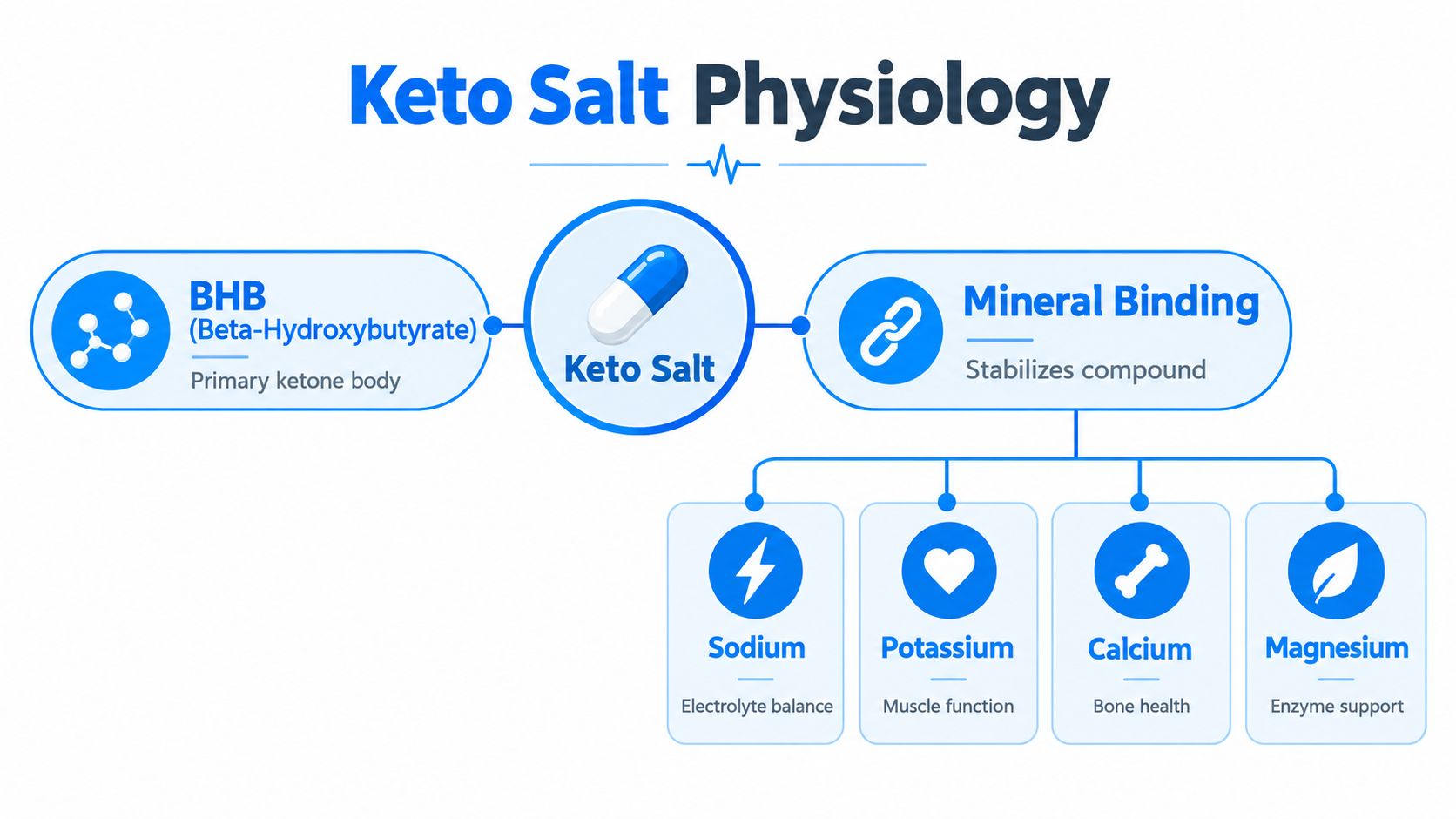
A keto salt supplement binds BHB to an electrolyte, commonly sodium, potassium, calcium, or magnesium. The bond creates a stable compound that can be consumed and then dissociated during digestion and absorption. BHB enters circulation as an alternative fuel, while the mineral contributes to the product's electrolyte profile.
BHB is a ketone body that can be converted into acetyl-CoA inside mitochondria. Acetyl-CoA enters the citric acid cycle, generating reducing equivalents that support the electron transport chain and mitochondrial ATP production. Glucose follows a different route, beginning with glycolysis before pyruvate enters mitochondrial metabolism. The body can use both fuels, and the ability to shift between them is commonly described as metabolic flexibility.
The brain can use ketones as an alternative energy substrate, while tissues including the heart and skeletal muscle can oxidize BHB for energy. A human imaging and metabolism study found that oral D-BHB was rapidly absorbed, increased blood ketones above 1 mM, and showed that the heart and kidney were major contributors to exogenous ketone metabolism. The same study found blood ketones were about 1.7-fold greater with D-BHB than with an equivalent dose of mixed D+L-BHB or MCT despite a lower caloric load, according to the human study of oral D-BHB metabolism.
The mineral load changes the decision
The main limitation of salts is often not the body's ability to use BHB. It's the amount of mineral required to deliver a larger BHB dose. One controlled study reported that a 0.5 g/kg sodium/calcium BHB salt dose delivered 1.3 mmol/kg sodium and 0.8 mmol/kg calcium. Another human trial used a serving containing 11.8 g BHB, 1,874 mg sodium, 570 mg calcium, and 57 mg magnesium, as documented in the review of exogenous ketone performance and metabolic effects.
That payload can be useful during heavy sweating, particularly when someone needs electrolyte replacement and ketone availability at the same time. It can also be excessive for a person who is sedentary, follows a sodium-restricted diet, or already consumes substantial sodium through food.
A practical electrolyte routine should account for the entire day, not just the supplement label. The electrolyte protocol from The Sleep Consultant provides broader context on how mineral intake can fit into hydration and sleep routines.
The Tecton EDGE™ Performance Shot + Electrolytes combines liposomal R3HBG™ ketone with sodium, potassium, and magnesium for active individuals seeking ketone fuel alongside electrolyte support during training or physically demanding days.
Practical rule: If the formula's mineral payload is high, treat it as both a ketone product and an electrolyte product. Don't evaluate BHB in isolation.
Comparing Salts, Esters, and Liposomal Bioidentical Formats
The meaningful comparison is not “strong” versus “weak.” It's dose, isomer, absorption, mineral burden, and tolerability.
Ketone esters are compounds in which BHB is chemically linked to another molecule. They can create a substantial rise in circulating D-BHB without adding sodium or calcium. In a controlled human study, ketone esters raised peak blood D-BHB to 2.8 mM, while ketone salts raised it to 1.0 mM. Both returned to baseline within 3 to 4 hours, but the salt drink contained 50% L-BHB, which remained higher for more than 8 hours, according to the controlled comparison of ketone esters and salts.
The distinction matters because D-BHB is the naturally produced and readily used ketone isomer. L-BHB isn't a useless ingredient, but it doesn't behave identically in human metabolism. A salt containing a mixed D+L profile may therefore produce a different metabolic pattern from a product designed around bioidentical D-BHB.
Liposomal delivery is another approach. Liposomes are lipid-based carriers intended to support dispersion and absorption. The technology itself doesn't guarantee a physiological outcome, so the label, dose, isomer identity, and human evidence still matter. A well-formulated liposomal product can be attractive when the goal is direct ketone delivery without the heavy mineral load of a salt.
| Format | Peak BHB level | Mineral load | GI tolerability | Isomer purity |
|---|---|---|---|---|
| Ketone salts | Lower than the ester peak in the controlled comparison | Mineral load may be substantial | Can be restricted by sodium, calcium, and GI tolerance | May be mixed D+L-BHB |
| Ketone esters | 2.8 mM peak D-BHB in one controlled study | No salt-associated mineral load | Taste and GI distress can limit regular use | Product-specific |
| Liposomal bioidentical BHB | Depends on formulation and dose | Designed to avoid a heavy mineral payload | Intended for practical, repeat use, but individual tolerance varies | Can be built around D-BHB |
Performance findings with salts are inconsistent. One cycling study using approximately 25 g R,S-βHB salts raised blood R-BHB to approximately 0.8 mM but reduced average power by 7%. Another 10-day study found no effect in the first running trial and reported some benefit only under fatigue conditions, as summarized in the clinical discussion of ketone esters.
The takeaway is straightforward. Esters may be useful when a high circulating ketone level is the priority and the user can tolerate the format. Salts may fit situations where electrolytes are also needed. Liposomal bioidentical formats may offer a more balanced option for people who want direct D-BHB without unnecessary mineral exposure.
Why This Matters for Performance and Cognition
BHB is not a magic stimulant. It's an alternative oxidative fuel that can support ATP production when the brain and body have access to it. That distinction helps explain why the same product can feel useful in one context and disappointing in another.
During prolonged exercise, fasting, or a demanding cognitive block, the body may benefit from having more than one fuel pathway available. Glucose remains important for high-demand work, but ketone oxidation can supplement energy production and support a broader metabolic flexibility strategy. The expected practical outcomes are:
- Steadier energy: A usable ketone supply may reduce the sense of an abrupt energy drop for some people.
- Cognitive endurance: The brain can oxidize BHB, making ketones relevant when concentration must continue through a long work period.
- Workout performance: Ketones may support fuel availability, but salt-based performance outcomes aren't consistently positive across studies.
- Metabolic efficiency: BHB provides a direct oxidative substrate rather than requiring the same sequence of carbohydrate digestion and glycolysis.

Fuel availability isn't the same as performance
A higher blood BHB value doesn't automatically mean more power, faster running, or better concentration. Esters can create a rapid rise that some users find too abrupt, while salts may be easier to integrate when hydration is already a training priority. A liposomal D-BHB format can be more practical for cognitive work or fasting support when adding a large amount of sodium would be counterproductive.
BHB also participates in cellular signaling and may influence pathways connected with oxidative metabolism and endothelial function. Those mechanisms are biologically relevant, but they shouldn't be converted into disease promises or guaranteed performance outcomes. The appropriate standard is whether the product improves a measurable task, perceived exertion, or routine consistency for the individual using it.
The following video provides additional educational context for people comparing exogenous ketone formats:
Why This Matters: The best format is the one that delivers useful fuel without creating a new problem, such as nausea during training or excessive sodium intake during sedentary work.
Situational Use Cases and Dosing Strategies
Use the product to solve a specific physiological problem. A keto salt supplement makes the most sense when BHB and electrolytes are both relevant. A lower-mineral format makes more sense when the user wants ketone fuel but has no reason to add substantial sodium, calcium, or potassium.
Match the format to the situation
Heavy endurance sweating: A mineral-bound format may be practical during long training sessions, hot-weather activity, or physically demanding work. The electrolyte contribution can complement a hydration plan, but the total mineral intake still needs review.
Cognitive work: For desk-based work, study, or prolonged concentration, a low-mineral liposomal format may be preferable. The goal is direct ketone availability without consuming an electrolyte dose that the situation doesn't require.
Fasting windows: Exogenous ketones may provide an alternative fuel during a fasting routine, but they still contain energy and therefore aren't equivalent to a zero-calorie fast. Use them to support a structured routine, not as proof that fasting physiology remains unchanged.
Sodium-sensitive diets: People limiting sodium should generally avoid choosing a salt solely because its BHB number looks attractive. The mineral panel deserves the same attention as the ketone dose.
Pre-workout use: Test tolerance before important training. A product that causes gastrointestinal distress, an unpleasant taste, or a heavy mineral sensation won't improve execution, regardless of its theoretical mechanism.
Start conservatively
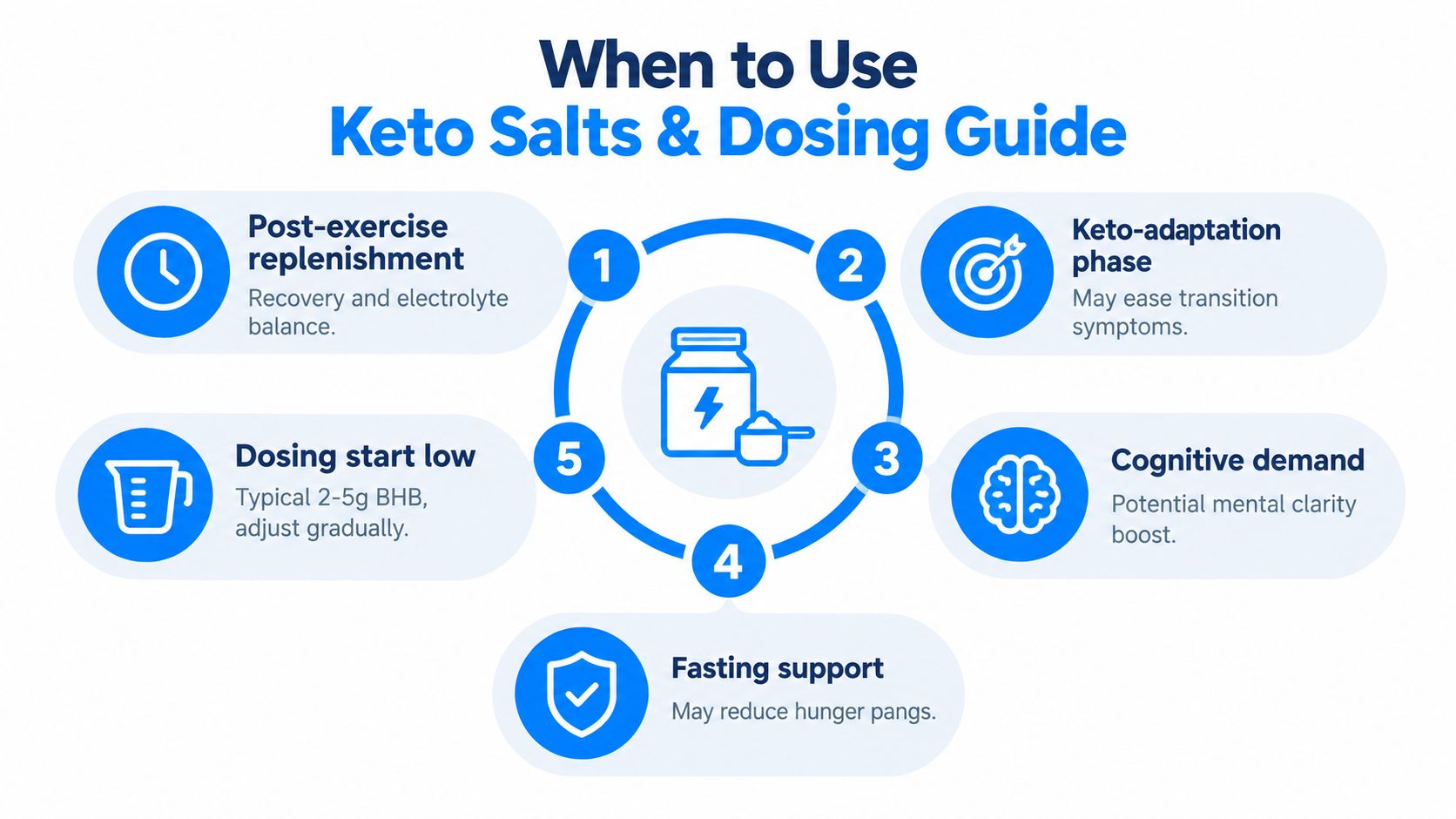
The supplied dosing guide uses 2 to 5 g BHB as a starting range, but this figure should be treated as a practical starting point rather than a universal prescription. Increase only if the initial serving is well tolerated and the mineral content fits the rest of the day.
Timing can be simple:
- Before training: Use a trial serving early enough to assess digestion before demanding work.
- During extended activity: Consider the electrolyte contribution alongside water, sweat rate, climate, and other sodium sources.
- After exercise: A salt format may fit recovery when replacing minerals is part of the plan.
- During cognitive demand: Prefer a format that doesn't add unnecessary minerals.
- During fasting: Decide whether maintaining a calorie-free fast or supporting energy is the primary goal.
No quantified salt-supplementation recommendation for keto has been established in the literature cited by independent coverage, so individual response and medical context matter more than a generic “more is better” rule. People using medication or managing a medical condition should discuss sodium, potassium, and magnesium intake with a qualified clinician.
Safety Profiles and Regulatory Considerations
The safety question has two layers. First, there's the ketone molecule and the specific formulation. Second, there's the mineral payload that accompanies a salt.
A high sodium load may be inappropriate for people with hypertension, cardiovascular risk, kidney disease, or impaired electrolyte regulation. Calcium and potassium also deserve attention when someone has a medical condition, takes medication that affects renal handling, or already consumes substantial mineral supplementation. The product label should be reviewed against the entire diet, including electrolyte powders, sports drinks, broths, and fortified foods.
A 90-day trial involving 22 healthy adolescents used 3.75 g of BHB salts twice daily, totaling 7.5 g per day. Researchers reported no significant adverse effects on fasting safety markers, bone density, emotional intelligence, happiness, or blood pressure, as described in the human tolerability trial of BHB salts. That result supports tolerability in the studied population and protocol, but it doesn't establish that every formulation is appropriate for chronic use in every adult.
The regulatory picture remains cautious. The European Food Safety Authority's 2022 review concluded that the safety of beta-hydroxybutyrate salts as a novel food had not been established. This doesn't mean every product is unsafe. It means consumers shouldn't treat a supplement category as risk-free because it raises a naturally occurring ketone.
Read regulatory language precisely
The FDA states that a manufacturer or distributor introducing a new dietary ingredient not previously present in the food supply as an article used for food must submit a premarket safety notification at least 75 days before introducing the product into interstate commerce, according to the FDA guidance on new dietary ingredient notifications.
An NDI notification framework isn't the same as a blanket endorsement of every finished product or every use. Evaluate the exact ingredient, serving instructions, manufacturing quality, and intended population.
For more practical context on nausea, diarrhea, electrolyte issues, and other concerns, review exogenous ketone side effects. Stop using a product and seek medical advice if symptoms are severe, persistent, or unusual.
Application Framework for Metabolic Fuel
A reliable ketone strategy starts with the problem, not the product category.
1. Define the use case
Choose whether you want support for endurance training, hydration, cognitive work, fasting, or general metabolic flexibility. If you can't name the intended outcome, adding exogenous ketones may create expense and complexity without improving your routine.
2. Inspect the full label
Look beyond grams of BHB. Check:
- Isomer profile: Determine whether the product contains D-BHB, L-BHB, or a mixture.
- Mineral payload: Add sodium, potassium, calcium, and magnesium to your daily totals.
- Delivery format: Compare salts, esters, precursors, and liposomal preparations.
- Formula simplicity: Avoid unnecessary artificial dyes, sweeteners, or fillers when daily tolerability matters.
- Evidence standard: Prefer transparent formulas and human research over dramatic marketing language.
3. Run a controlled personal trial
Start with a modest serving, use it in the same type of situation, and track digestion, perceived energy, focus, hydration, and workout execution. Don't test a new product for the first time before a competition or a critical workday.
4. Adjust the format, not just the dose
If a salt causes GI discomfort or pushes sodium intake too high, switching to a lower-mineral format may be more rational than forcing a smaller salt dose. If an ester is intolerable, a different delivery system may produce a more usable routine even if its peak BHB is lower.
Tecton Ketones™ focuses on liposomal R3HBG™ formulations designed to deliver bioidentical D-BHB without the heavy mineral load associated with conventional salts. Its product range is positioned around performance, cognition, electrolyte support, and structured fasting routines, so review the specific formula against your needs rather than assuming every ketone product serves the same purpose.
The practical takeaway is simple: choose the ketone format that matches your physiology and context. A keto salt supplement can be useful when electrolyte replacement and BHB delivery belong in the same plan. It isn't automatically the best choice for fasting, desk work, or sodium-sensitive users.
Tecton Ketones™ offers liposomal, bioidentical D-BHB formulations for people seeking steadier ketone fuel without the heavy mineral payload of many salts. Visit Tecton Ketones™ to compare formats and choose a product aligned with your training, cognition, hydration, or fasting routine.


