


You may know the pattern well. Mid-afternoon arrives, concentration becomes harder to sustain, and the workout that felt manageable earlier starts to lose momentum. Reaching for another stimulant can feel like the obvious answer, but many people are looking for a different kind of fuel, one that supports energy without requiring fasting or a strict ketogenic diet.
That's where exogenous ketones BHB enter the conversation. Exogenous means supplied from outside the body, while BHB, or beta-hydroxybutyrate, is the main circulating ketone body used by tissues as fuel. A supplement can raise blood BHB quickly, but a higher ketone reading doesn't automatically mean better endurance, sharper thinking, or improved athletic performance.
This distinction matters. The useful questions are not only whether a product raises BHB, but which form of BHB it provides, how it's delivered, how well it's tolerated, and whether the physiological change fits your actual goal. This guide breaks down the energy pathways, D-BHB and L-BHB chemistry, salts, esters, and liposomal R3HBG, then turns the evidence into practical guidance.
Introduction to Exogenous Ketones and BHB Energy
A person searching for exogenous ketones BHB often wants a simple answer: will this help me feel more steady during a demanding day or training session? The scientifically honest answer begins with a narrower point. Exogenous ketones can create measurable ketosis independently of fasting or a ketogenic diet, because they provide ketone fuel directly rather than waiting for the liver to make it from stored fat.
A systematic review of human trials found that acute ingestion increased blood BHB by a mean of 1.73 mM, while mean blood glucose fell by 0.54 mM. Both effects were highly significant, with P < 0.001 (systematic review of exogenous ketones). A later analysis that pooled 327 data points from 30 studies involving 408 participants again found that exogenous ketones raised BHB and reduced glucose, reinforcing the basic physiological premise.
That premise is straightforward. BHB circulates through the blood, enters tissues, and can be converted inside mitochondria into acetyl-CoA, which feeds the citric acid cycle and supports ATP production. The body can therefore access an alternative fuel without first producing ketones through carbohydrate restriction.
But fuel availability and performance are different outcomes. A cyclist may show a clear rise in BHB without riding faster. A professional may experience a smoother subjective energy pattern without measurable improvement on every cognitive task. Exercise intensity, timing, carbohydrate intake, product format, and individual metabolic state all influence the result.
For a concise explanation of the category and its use cases, see what exogenous ketones are. The central idea is simple: BHB is a real metabolic fuel, not a guaranteed performance enhancer. Understanding that difference helps you evaluate products without confusing a laboratory marker with a complete outcome.
How Your Body Makes and Uses Ketones for Fuel
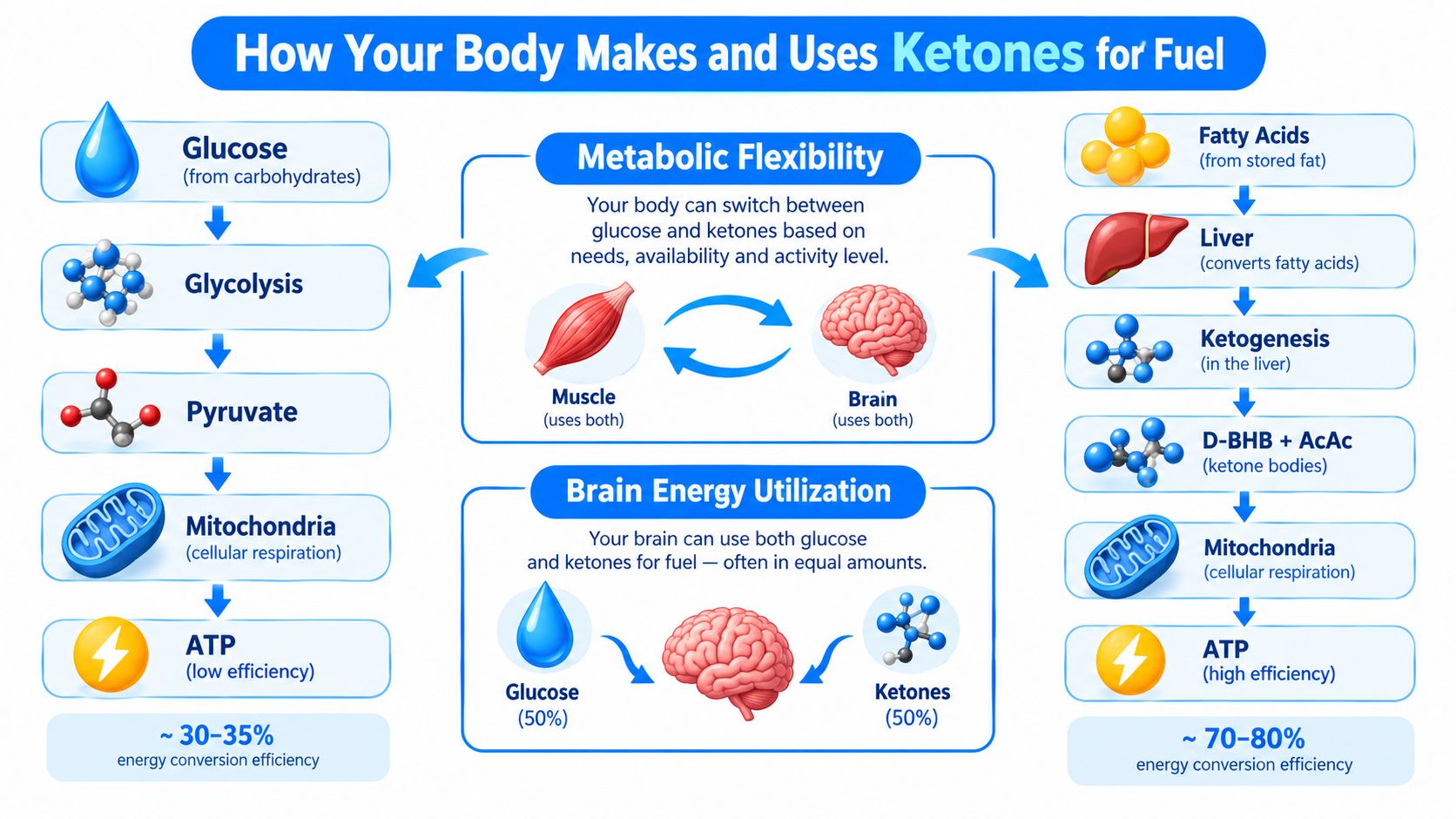
Your metabolism works more like a dual-fuel system than a single-engine machine. Glucose can be broken down through glycolysis into pyruvate, which enters the mitochondria and contributes to ATP production. Fatty acids follow a different route, undergoing oxidation and producing acetyl-CoA that also enters mitochondrial energy pathways.
During fasting, prolonged exercise, or carbohydrate restriction, the liver converts fatty-acid-derived acetyl-CoA into ketone bodies. The main products are acetoacetate and BHB. BHB travels through the circulation to tissues such as skeletal muscle, the heart, and the brain, where cells convert it back into acetyl-CoA for mitochondrial ATP production.
Three ways ketosis can occur
These terms describe different sources of the ketones in circulation:
- Nutritional ketosis results from a dietary pattern that limits carbohydrate availability sufficiently to increase endogenous ketone production.
- Endogenous ketone production means your own liver is making ketones, generally from fatty acids released from body fat.
- Exogenous ketone supplementation supplies ketones from outside the body, allowing blood BHB to rise without requiring the same dietary conditions.
Exogenous BHB doesn't recreate every adaptation associated with a long-term ketogenic diet. It provides the circulating fuel itself, while dietary ketosis also changes fat mobilization, enzyme activity, and fuel selection over time. That's why a supplement can produce acute ketosis without making someone fully adapted to using fat and ketones during every type of exercise.
Why the brain can use BHB
Fatty acids don't cross the blood-brain barrier efficiently enough to serve as the brain's direct primary fuel. BHB can cross that barrier and enter brain cells, where mitochondria metabolize it for energy. This gives the brain access to a second fuel pathway when glucose availability or demand changes.
BHB also functions as more than a fuel molecule. It participates in cellular signaling and can influence pathways related to redox balance, gene expression, and vascular biology. Those mechanisms are biologically plausible, but a plausible mechanism isn't proof of a meaningful benefit in every person or situation.
People comparing dietary options alongside ketone products may also find this overview of plant-based energy support useful for understanding how other nutrition strategies fit into an energy routine. For active days that combine ketone fuel with mineral support, the Tecton EDGE™ Performance Shot + Electrolytes uses liposomal R3HBG™ ketone with sodium, potassium, and magnesium.
Understanding D-BHB vs L-BHB and Bioidentical Ketones
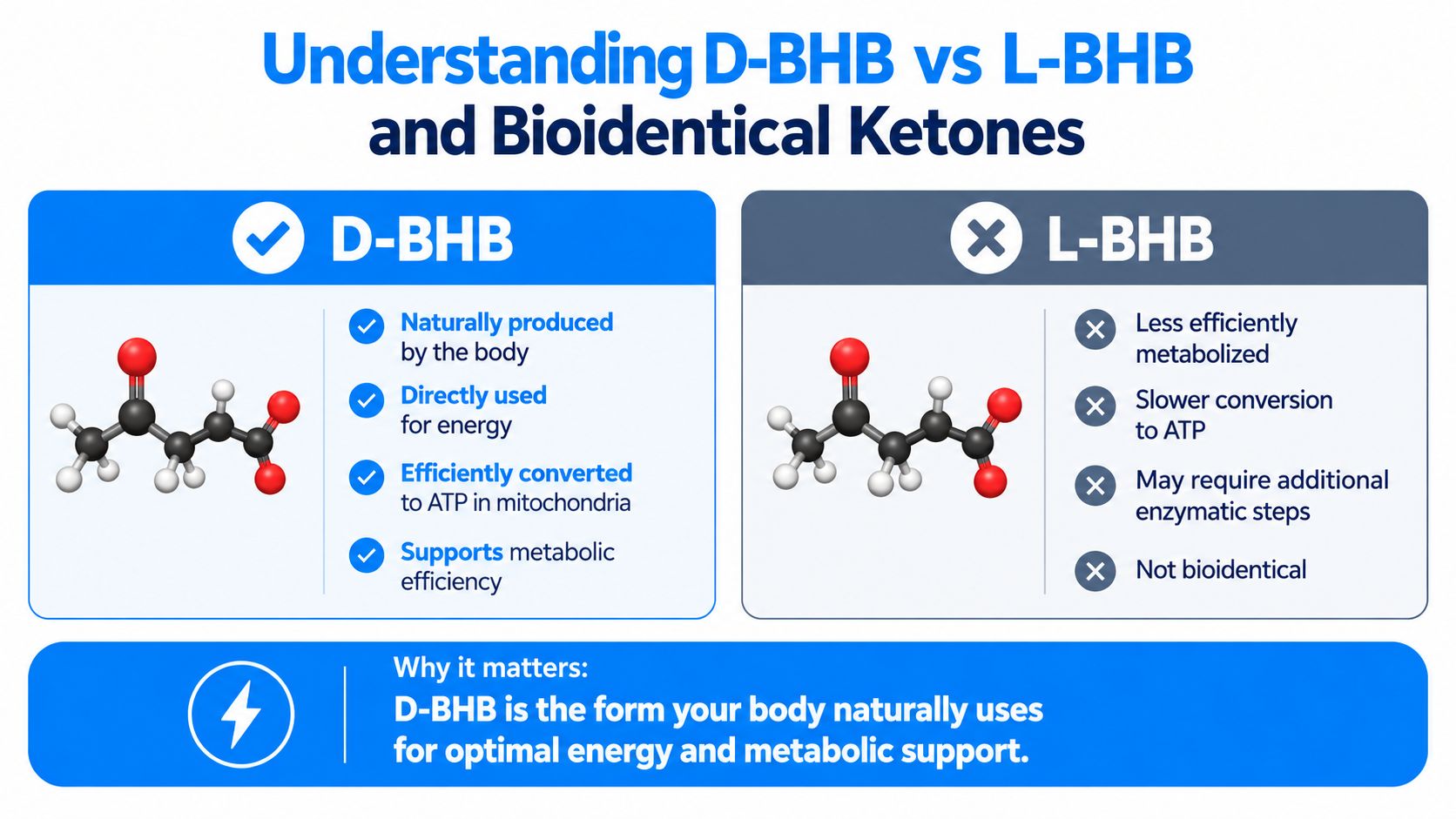
Not every BHB molecule behaves the same way. BHB exists as different molecular orientations, called isomers. The body naturally produces and efficiently uses D-BHB, while L-BHB follows a different metabolic path and may remain in circulation longer without providing the same immediate energy contribution.
Why the isomer changes the interpretation
A label may report total BHB, but that number doesn't always tell you how much is the body's directly usable D form. Human metabolism research found that both a ketone ester and a ketone salt increased D-BHB, but the ester reached a higher peak blood D-BHB concentration of 2.8 mM, compared with 1.0 mM for the salt (human comparison of ketone ester and salt).
The salt in that study contained 50% L-BHB. L-BHB stayed high for more than 8 hours, while D-BHB returned to baseline within 3–4 hours. A prolonged blood signal can therefore be misleading if it's interpreted as prolonged usable energy. The body may still be processing the molecule, but persistence isn't the same as efficient ATP production.
Interpretation rule: Ask whether a BHB value represents total BHB or bioidentical D-BHB before treating it as a measure of usable ketone fuel.
Where R3HBG fits
Tecton describes R3HBG as a tri-ester that bonds three D-BHB molecules to one glycerol backbone. After digestion, the ester bond separates and provides D-BHB without adding the heavy mineral load associated with mineral-bound ketone salts.
That structure is designed to address two common formulation questions at once:
- Isomer purity: the intended output is 100% D-BHB rather than a mixture containing L-BHB.
- Carrier choice: glycerol serves as the bonding backbone, rather than requiring a mineral counterion or a separate precursor pathway.
This doesn't mean every D-BHB product will improve performance. It means the product's chemistry is more closely aligned with the ketone form the human body naturally produces and uses. For a deeper explanation of the molecule and its role, see 3-beta-hydroxybutyrate.
Comparing Ketone Salts Esters and Liposomal Delivery
The format determines more than taste. It affects the isomer profile, the amount of accompanying material, the speed and size of the BHB rise, and whether repeated use feels practical.
A ketone salt binds BHB to minerals such as sodium, potassium, or magnesium. This can make the product convenient to manufacture and simple to formulate, but raising BHB may require a substantial mineral contribution. The isomer profile also matters, since some salts provide a mixture of D-BHB and L-BHB.
A ketone ester links a ketone body to another molecule through an ester bond. Human studies generally show that esters can produce higher D-BHB peaks than salts, but users may notice a strong taste or gastrointestinal discomfort. A high peak also isn't automatically a high-quality daily experience.
A liposomal delivery system surrounds an ingredient in lipid-based structures intended to support dispersion and absorption. In practice, the quality of a liposomal product depends on the underlying chemistry, manufacturing controls, stability, and actual human performance data. “Liposomal” should be treated as a delivery description, not as proof of superior outcomes.
A meta-analysis of 43 trials with 586 participants found that acute exogenous ketone ingestion raised blood BHB by 1.73 mM versus baseline and lowered blood glucose by 0.54 mM. It also found that ketone monoesters produced significantly larger effects than ketone salts (meta-analysis of ketone supplements).
Choosing Your Exogenous BHB Format
| Format | Peak D-BHB and Isomer Profile | Tolerability and Daily Use |
|---|---|---|
| Ketone salts | May produce a lower D-BHB peak, and some products include L-BHB alongside D-BHB | Mineral load can matter, particularly when used repeatedly; gastrointestinal tolerance varies |
| Ketone esters | Can produce a higher D-BHB peak than salts; the exact profile depends on the compound | Strong taste and gastrointestinal tolerance may limit routine use for some people |
| Liposomal R3HBG | Tecton's R3HBG is designed around three D-BHB molecules bonded to glycerol | Positioned for direct D-BHB delivery without a heavy mineral load; personal tolerance still determines suitability |
Tecton's formulation approach also excludes R-1,3-butanediol, BPA, artificial dyes, and artificial sweeteners. Those choices describe the formula's construction, not a guarantee that every user will experience the same result. A detailed discussion of the underlying distinctions appears in ketone versus ester.
What Exogenous BHB Can and Cannot Do for Performance
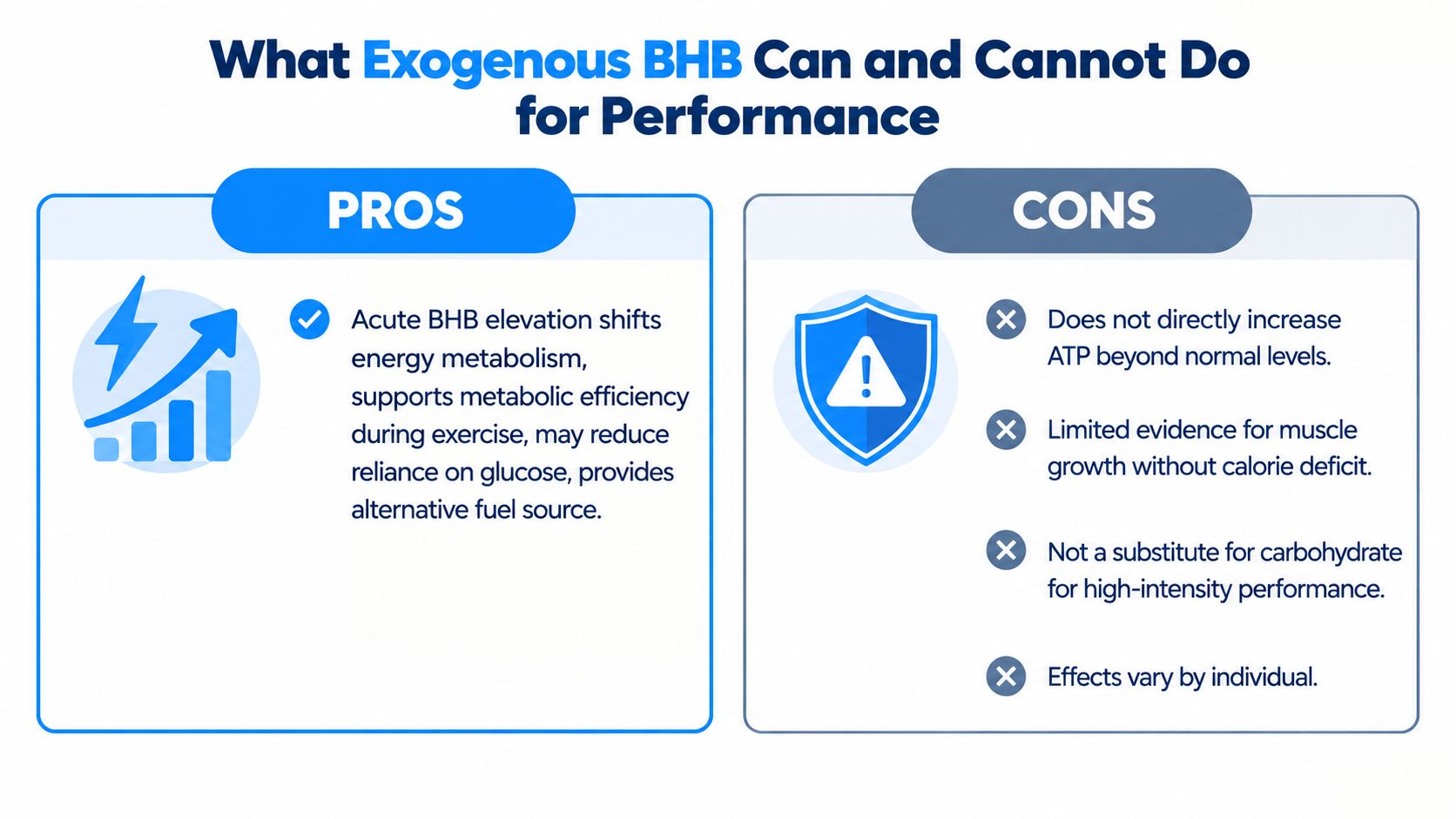
The clearest demonstrated effect is biochemical: exogenous ketones raise circulating BHB. That shift gives tissues access to an alternative substrate and may change the balance between glucose and ketone oxidation. It can also lower circulating glucose in acute settings, although the downstream experience depends on the person and the context.
The harder question is performance. Reviews describe exercise outcomes as highly heterogeneous, with many null or negative acute results and only some chronic protocols showing adaptive benefits (review of exogenous ketones in exercise contexts). A person can have higher BHB and still see no improvement in pace, power, repeated sprint capacity, or perceived exertion.
Why results vary
Several factors can change the response:
- Exercise intensity: Ketones may fit lower-intensity or endurance work differently from efforts that depend heavily on rapid glycolytic energy.
- Timing: A supplement taken long before exercise may produce a different concentration profile from one taken closer to the session.
- Carbohydrate intake: Co-ingested carbohydrate changes insulin, glucose handling, and substrate selection.
- Participant type: A recreational trainee, endurance athlete, low-carbohydrate eater, and metabolically flexible individual may not respond identically.
- Product chemistry: Total BHB, D-BHB content, mineral load, and absorption characteristics all influence the actual exposure.
A separate meta-analysis found that ketone supplements increased insulin in non-athletic healthy populations. That finding matters because lower glucose alongside higher BHB doesn't mean the body has entered a universally superior metabolic state. The physiological response includes multiple hormones and substrates, not only the ketone number.
What the evidence supports
Exogenous BHB may provide:
- An alternative fuel source during selected training or work conditions.
- A measurable shift in energy metabolism, particularly when rapid access to ketones is useful.
- A potential support for cognitive endurance, although performance findings remain unsettled.
- A way to explore metabolic flexibility without immediately adopting a strict ketogenic diet.
It can't replace carbohydrates when an activity demands rapid, high-output glycolytic energy. It also isn't a direct shortcut to muscle growth, fat loss, or superior performance. Blood BHB is a useful exposure marker, not a complete outcome measure.
Why This Matters for Energy Focus and Metabolic Health
Biochemistry becomes useful when it changes how you plan a day. Exogenous BHB doesn't need to produce a dramatic subjective sensation to be relevant. Its role may be quieter, providing another substrate during a long work block, a fasting window, or steady endurance activity.

Steadier energy
Some people use BHB when they want fuel without caffeine or a large meal. The expected physiological effect is a temporary rise in circulating ketones, not a stimulant surge. Whether that feels steadier depends on sleep, hydration, food intake, baseline metabolic state, and individual tolerance.
Cognitive endurance
The brain can use BHB after it crosses the blood-brain barrier. That makes ketones relevant to sustained mental work, but it doesn't prove that every supplement improves memory, attention, or reasoning. A recent meta-analysis reported a modest cognitive benefit across 1,602 participants, but larger and better-controlled trials are still needed before strong claims are justified.
For broader lifestyle context, readers evaluating sleep, nutrition, movement, and other brain health essentials can place ketone use inside a more complete cognitive-support routine.
Workout performance
Endurance athletes may be interested in an alternative fuel during prolonged, submaximal work. Others may find that the same product doesn't help during high-intensity efforts, where carbohydrate metabolism remains important. The sensible approach is to test it in training rather than introduce it for the first time during competition.
Metabolic efficiency
Metabolic flexibility means the capacity to move between glucose and fat-derived fuels as conditions change. Exogenous BHB offers the ketone side of that equation directly, but it doesn't automatically create the long-term adaptations associated with repeated dietary ketosis, fasting, or endurance training.
Application Framework for Safe and Effective Use
Use exogenous BHB for a defined purpose, not because a blood meter can detect it. A practical starting point is a low-stakes situation where you can observe energy, digestion, focus, and training quality without changing several other variables at once.
Match the format to the situation
- For endurance or physically demanding days: A D-BHB product that includes electrolytes may fit sessions where hydration and sustained output are relevant.
- For focused work: A caffeine-free formula may suit people who want to test ketone fuel without adding a stimulant.
- For fasting windows: Exogenous ketones may raise BHB while food intake is limited, but they still provide energy and should be considered within the day's overall intake.
- For high-intensity training: Don't assume ketones will replace carbohydrate. Test the product during ordinary sessions and keep the fuel strategy appropriate to the demands of the activity.
What to expect physiologically
You may see BHB rise relatively quickly. You may also see glucose fall, as observed in the acute human evidence, but that response isn't a promise of improved performance or a reason to chase a particular meter value. Subjective effects can be subtle, and gastrointestinal tolerance can determine whether a formulation belongs in a daily routine.
Repeat-use evidence is encouraging but limited. In a controlled 28-day human study, 24 healthy adults aged 18 to 70 consumed 25 mL, providing 26.8 g, of ketone monoester three times daily. Blood BHB rose from 0.1 to 4.1 ± 1.1 mM, and the study reported no adverse changes in body weight, body composition, fasting glucose, cholesterol, triglycerides, electrolytes, blood gases, or kidney function (28-day ketone monoester study). The findings apply to healthy adults and a specific monoester protocol, not automatically to every product or population.
Safety boundary: People with diabetes, kidney conditions, pregnancy, significant metabolic disease, or prescription medications should discuss ketone supplementation with a qualified healthcare professional before use.
The FDA's new dietary ingredient process requires notification at least 75 days before interstate introduction when an ingredient hasn't been present in the food supply as an article used for food. The FDA describes this as a safety-notification framework, not an agency approval or marketing endorsement (FDA guidance on new dietary ingredient notifications).
A simple tracking checklist
- Define one outcome: Track focus, perceived energy, training pace, or tolerance.
- Keep the context stable: Don't change caffeine, meals, hydration, and training simultaneously.
- Read the label: Check total BHB, D-BHB and L-BHB disclosure, minerals, sweeteners, and serving size.
- Assess over repeated sessions: One experience can reflect sleep, stress, or meal timing rather than the product.
- Use sensors carefully: Continuous ketone data may be useful, but a 2026 randomized study found a gradual decline in day-to-day BHB area under the curve over 14 days in both ketone and placebo groups, likely reflecting sensor drift rather than true physiology (continuous ketone monitoring study).
- Stop if tolerance is poor: Nausea, cramping, reflux, or diarrhea are practical reasons to reassess the product and dose with a clinician.
The practical takeaway is disciplined experimentation. Choose a transparent D-BHB format, use it for a specific demand, and judge it by repeatable real-world outcomes rather than by the highest blood ketone value.
Tecton Ketones™ offers liposomal R3HBG™ formulations designed to provide direct D-BHB fuel for performance, focus, and structured fasting routines without requiring a strict ketogenic diet. To review the delivery approach and available use-case formulations, visit Tecton Ketones™ and choose the option that matches your training or cognitive demands.


