


Are ketone supplements safe if the answer changes with the molecule, mineral load, dose, and duration of use? That's the more useful question than a simple yes or no. A ketone ester used occasionally by a healthy adult isn't the same exposure as a ketone salt taken every day by someone managing blood pressure, kidney concerns, or glucose-lowering medication.
Short-term human trials offer a reasonably reassuring picture for carefully studied products. They don't prove that every commercial formula is equally tolerable, and they don't establish what daily use over months or years will do. Readers evaluating supplements should separate short-term tolerability, meaning how people respond during a controlled study, from long-term safety, meaning the effects of repeated real-world use. For a broader discussion of how to assess claims, labels, and common misconceptions, review these facts about supplement safety.
Rethinking Whether Ketone Supplements Are Safe
Safety isn't a property of the word “ketone” alone. It depends on which ketone structure is present, what it's bound to, how much a person consumes, and the context in which it's used. The two major categories, ketone esters and ketone salts, can produce different gastrointestinal experiences and different mineral exposures.
Duration matters just as much. A controlled trial lasting a few weeks can identify nausea, reflux, changes in laboratory markers, or problems with vital signs during that period. It can't reliably answer whether someone will tolerate the same product every day for years, whether kidney or lipid markers might change gradually, or whether medication requirements could shift as routines change.
The safety question has two parts
A careful assessment asks:
- Does the formulation appear tolerable in human testing? Look for peer-reviewed research that records adverse events, laboratory values, and vital signs rather than relying only on testimonials.
- Does the evidence match the intended use? Occasional use in healthy adults offers less information about chronic daily use, older adults, people with metabolic conditions, or anyone taking medication.
- What else comes with the ketone? Salts may deliver sodium or other minerals, while esters provide ketone molecules without the same mineral burden.
- What happens in practice? Repeated nausea, diarrhea, reflux, or appetite suppression can make a product difficult to use consistently, even when no serious laboratory abnormality appears.
The short answer is therefore qualified. Modern exogenous ketones have demonstrated short-term tolerability in controlled human studies, but long-term daily safety remains unsettled. Treating every product as interchangeable hides the variables that matter most.
How Exogenous Ketones Support Cellular Energy
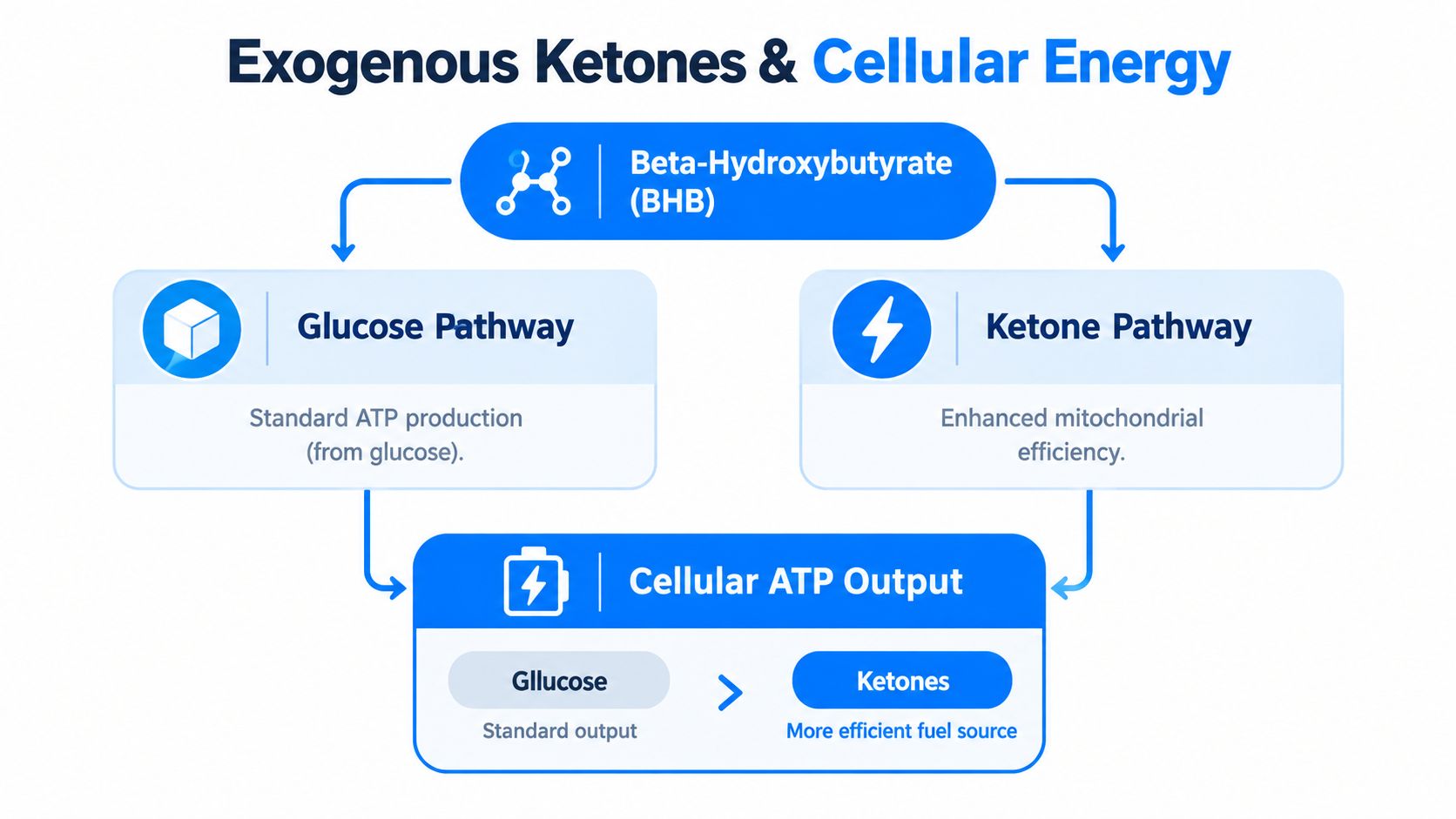
Your body produces ketones when stored fat is converted into molecules that can supply energy, particularly when carbohydrate availability falls during fasting, carbohydrate restriction, or prolonged exercise. The main circulating ketone is beta-hydroxybutyrate, commonly called BHB.
Endogenous BHB is made in the liver. Exogenous ketones provide ketone material from outside the body, allowing blood BHB to rise without waiting for the liver to increase production. That distinction separates three states:
- Nutritional ketosis, induced by a dietary pattern that lowers carbohydrate availability.
- Endogenous ketone production, where the body makes its own ketones in response to metabolic conditions.
- Exogenous ketone supplementation, where an ingested compound raises circulating ketones directly.
BHB enters tissues and is converted into acetyl-CoA, which feeds the mitochondrial tricarboxylic acid cycle. The resulting reducing equivalents support the electron transport chain, where mitochondria generate ATP, the cell's usable energy currency. Glucose follows a different entry route, beginning with glycolysis before its carbon can enter mitochondrial oxidation. Neither fuel is universally superior. The body's ability to shift between them is metabolic flexibility.
Why molecule identity matters
The naturally used form is D-BHB. Some products may contain mixtures that include L-BHB, an isomer that doesn't follow the same metabolic path as D-BHB. A bioidentical structure can therefore offer a more predictable biochemical identity than a racemic mixture, although predictable identity doesn't automatically prove long-term safety.
The brain can use ketones as an alternative fuel, especially when ketone availability rises. Ketones also participate in cellular signaling and may influence processes related to oxidative metabolism and endothelial function. Those mechanisms are scientifically interesting, but they shouldn't be converted into disease-treatment promises or guaranteed performance outcomes.
For active users, a product such as Tecton EDGE™ Performance Shot + Electrolytes is described as a liposomal R3HBG™ ketone shot with sodium, potassium, and magnesium for training, movement, or physically demanding days. Its relevance to safety depends on the complete label, the user's mineral tolerance, and the serving pattern, not on the presence of BHB.
Ketone Esters Versus Ketone Salts
Ketone esters and ketone salts both deliver exogenous ketones, but they do so through different chemical arrangements. A ketone ester links a ketone body or precursor to another compound. A ketone salt binds BHB to a mineral, commonly sodium, potassium, magnesium, or calcium.
That binding choice changes the exposure that accompanies each serving. A salt formula may contribute a meaningful mineral load, which can matter to people watching sodium intake, managing blood pressure, monitoring kidney function, or trying to maintain a narrow electrolyte balance. A person may tolerate the ketone itself but react poorly to the total mineral content or the concentration of a serving.
A systematic review found adverse events in roughly 48.5 percent of comparisons overall, with gastrointestinal effects dominating. Ketone salts were associated with side effects in about 85 percent of comparisons, compared with about 40 percent for ketone monoesters in the systematic review. These figures describe comparisons in the reviewed literature, not the guaranteed experience of an individual and not every product on the market.
What the symptoms usually look like
Reported problems have included bloating, abdominal pain, diarrhea, vomiting, reflux, nausea, and headache. This pattern points toward dose-related gastrointestinal intolerance as the main practical limitation in short-term research, rather than assuming that all adverse effects reflect systemic toxicity.
Esters can also cause nausea, reflux, or diarrhea, particularly when the dose is difficult to tolerate. Salts can create a different problem because the mineral carrier adds another physiological variable. Consumers comparing options may find broader decision support in resources covering AI-powered supplement recommendations, but automated suggestions still can't replace review of medications, kidney status, blood pressure, or the product's mineral label.
A useful comparison is:
| Feature | Ketone esters | Ketone salts |
|---|---|---|
| Main design | Ketone linked to another compound | BHB bound to minerals |
| Common limitation | Taste and gastrointestinal discomfort | Gastrointestinal symptoms and mineral load |
| Safety question | Can the user tolerate the ketone dose? | Can the user tolerate both ketones and added minerals? |
| Evaluation priority | Human tolerability data | Human tolerability data plus sodium and electrolyte review |
For a deeper explanation of the chemistry and use cases, see what ketone esters are.
Human Safety Data From Controlled Trials
The strongest evidence for short-term tolerability comes from controlled human studies that monitor more than how participants feel. Researchers can track adverse events alongside body weight, body composition, fasting glucose, lipids, electrolytes, blood gases, kidney function, vital signs, and clinical laboratory values.
One foundational 28-day study included 24 healthy adults aged 18 to 70. Participants consumed 25 mL of a ketone monoester three times daily, and each dosing period raised blood BHB from about 0.1 mM to 4.1 ± 1.1 mM. The study recorded 6 mild nausea events out of 2,016 drinks, or about 0.3 percent of doses, and reported no adverse changes in body weight, body composition, fasting glucose, cholesterol, triglycerides, electrolytes, blood gases, or kidney function in the published human safety study.
That result supports a narrow conclusion. A carefully studied ketone monoester was generally well tolerated by healthy adults during the study period. It doesn't establish that all esters, salts, doses, or consumer formulations will produce the same experience.
Evidence in older adults
A later two-week trial in healthy older adults also found daily ketone ester use generally well tolerated. The prespecified safety outcome, moderate or severe nausea, headache, or dizziness on more than one day, occurred in 2 of 14 ketone participants, or 14.3 percent, compared with 1 of 14 placebo participants, or 7.1 percent in the later clinical trial.
A related 28-day study of up to 25 g per day of a ketone diester concluded that daily use was safe and well tolerated. Separately, a randomized study of a novel ketogenic ester reported no clinically meaningful changes in safety measures, including vital signs and clinical laboratory values, and concluded that the product was tolerated at doses up to 25 g per day. Doubling servings didn't worsen composite tolerability scores in the randomized study.
Together, these trials make short-term tolerability plausible for selected healthy populations and studied ester formulations. They don't answer whether a person with chronic conditions, complex medication use, or long-term daily exposure will respond in the same way.
The Long-Term Safety Gap
The most important unresolved issue is not whether a ketone drink can cause nausea after a serving. It's what happens when someone uses it repeatedly over months or years, particularly while taking medication or managing an existing metabolic concern.
Recent clinical reviews identify several evidence limitations, including small sample sizes, short follow-up periods, high dropout rates, and reliance on surrogate endpoints in the clinical review. These limitations make it difficult to draw firm conclusions about long-term safety or clinically meaningful outcomes.
A surrogate marker can be useful, but it isn't the same as a long-term health outcome. A study may show stable kidney markers during its observation period, yet still lack enough duration to evaluate gradual changes. Similarly, a tolerability questionnaire can capture symptoms during a trial without showing whether daily use changes appetite, medication needs, lipid patterns, hydration behavior, or adherence over time.
Why daily use deserves separate scrutiny
People often use exogenous ketones in situations that differ from clinical research:
- They may combine supplements with fasting, intense training, low-carbohydrate eating, or reduced calorie intake.
- They may take glucose-lowering drugs, blood-pressure therapies, or appetite-management treatments.
- They may increase serving frequency because the first exposure felt manageable.
- They may ignore recurring mild nausea, reflux, diarrhea, dizziness, or appetite suppression because no severe event occurred.
That last point matters. A symptom doesn't need to be dangerous to make a routine unsafe in practice. Persistent gastrointestinal distress can reduce food and fluid intake, disrupt training, or encourage people to continue a poorly tolerated formula.
Evidence boundary: Short-term controlled studies are reassuring for selected products and populations. They don't establish chronic daily safety for everyone.
The responsible position is neither alarmist nor dismissive. Long-term safety remains a research question, and people should match their use pattern to the strength of the evidence available.
Contraindications and Practical Screening Guidance
People taking glucose-lowering medication, blood-pressure medication, or appetite-management therapy should speak with a clinician before adding exogenous ketones. The concern isn't that ketones are automatically unsafe. It's that a supplement can alter energy intake, appetite, hydration habits, or electrolyte exposure within an existing treatment plan.
Salt formulations deserve particular attention. Added sodium and other minerals may matter for people with kidney concerns, blood-pressure management, electrolyte sensitivity, or changing hydration demands. Read the mineral amounts on the label rather than judging a product by its flavor, format, or “keto” branding.

A simple pre-use screen
Before starting, ask:
- What medication do I take? Include prescriptions and products that affect glucose, blood pressure, appetite, fluid balance, or electrolytes.
- What does the formula contain? Identify ester, salt, precursor, mineral, caffeine, fiber, and sweetener ingredients.
- What is my baseline? Note usual energy, appetite, hydration, digestion, and any clinician-monitored laboratory markers.
- Can I test it conservatively? Use the labeled serving, avoid stacking several new products, and try it in a low-stakes setting.
- What symptoms mean I should stop? Pause use for persistent vomiting, significant diarrhea, worsening reflux, repeated dizziness, unusual weakness, or symptoms that concern you.
Additional discussion of exogenous ketone side effects can help you organize symptoms, but it shouldn't substitute for clinical advice when symptoms are persistent or severe.
A clinician can also help determine whether the product's mineral load and intended frequency fit your current plan. Pregnant or breastfeeding people, those with diagnosed medical conditions, and people preparing for a procedure should obtain individualized guidance before use.
Why Product Quality and Formulation Matter for Safety
A label tells you more than the flavor and serving format. It should identify the ketone structure, distinguish D-BHB from racemic mixtures when relevant, disclose mineral content, and list additional active ingredients clearly.
Bioidentical ketone structures may offer a clearer metabolic identity than products that contain an inactive or less directly used isomer. Liposomal delivery systems are designed to support dispersion and absorption, but “liposomal” isn't a guarantee of safety or efficacy. The manufacturer still needs to demonstrate what the finished product contains and how consistently it delivers that composition.
Practical quality signals
Look for:
- Transparent chemistry: The label explains whether the product uses an ester, salt, or precursor.
- Complete mineral disclosure: Sodium, potassium, magnesium, and other carriers aren't hidden behind a proprietary blend.
- Finished-product testing: Independent verification can help confirm identity, purity, and consistency. Tecton's explanation of third-party verification provides useful context for this evaluation.
- Human evidence: Research on one ester shouldn't be presented as proof for every product category.
- Reasonable positioning: Structure and performance support claims are more credible than promises to treat or prevent disease.
Regulatory language also needs precision. FDA guidance for the New Dietary Ingredient pathway says manufacturers must provide information showing that an ingredient is “reasonably expected to be safe” under labeled conditions of use, and the notification must be submitted at least 75 days before marketing under FDA guidance. That process is a safety notification standard, not FDA approval of efficacy.
Actionable Takeaways for Safer Ketone Use
The safest decision starts with matching the product to the person and the evidence. Don't treat a ketone salt, ketone monoester, and ketone precursor as one interchangeable category.
Use this framework:
- Identify the format. Confirm whether the product is an ester or salt, and note the mineral load.
- Check the molecule. Look for clear disclosure of the BHB form and avoid assuming that every “BHB” label describes the same composition.
- Start with tolerability. Test a labeled serving in a calm setting. Don't introduce it for the first time before a race, demanding workout, or long fast.
- Track your response. Record nausea, reflux, bloating, bowel changes, headache, dizziness, appetite, hydration, and perceived energy.
- Review medications first. Consult a clinician if you use glucose-lowering, blood-pressure, appetite-management, or fluid-affecting therapies.
- Stop when symptoms persist. Repeated gastrointestinal symptoms are a reason to reassess the product, serving pattern, and mineral exposure.
- Keep claims proportional. Short-term human studies support reasonable tolerability for selected healthy adults and tested formulations. They don't establish long-term daily safety across the wider population.
Why This Matters
For performance, the practical goal isn't to chase the highest ketone reading. It's to determine whether an exogenous ketone provides steadier energy, supports cognitive endurance, fits a sustainable workout-fueling plan, and contributes to the ability to shift between glucose and ketones. Carbohydrates remain important when intensity is high, and ketones should be evaluated as a complementary fuel rather than an automatic replacement.
The bottom line is precise: ketone supplements can be short-term tolerable, but safety is formulation-dependent and long-term daily use is not fully established. Choose transparent products, use conservative testing, and involve a clinician when medication or chronic health considerations are present.
Tecton Ketones™ offers bioidentical exogenous ketone formulations, including liposomal R3HBG-based options designed for performance and cognitive energy without requiring a strict ketogenic diet. Visit Tecton Ketones™ to review the formulations, ingredients, and intended use cases before deciding whether they fit your routine.


