


You're halfway through a long training session, a demanding work block, or a fasted morning, and the usual caffeine hit no longer feels predictable. It may sharpen alertness, but it doesn't necessarily provide usable fuel for working muscle or the brain. Exogenous ketones with caffeine address that gap by combining two distinct physiological inputs: circulating beta-hydroxybutyrate (BHB) as an alternative fuel and caffeine as an acute signal that influences alertness and effort tolerance.
That distinction matters. This is not just a stronger energy drink. Ketones and caffeine act through different pathways, so the practical question is not whether one ingredient makes the other “more powerful.” It is whether a carefully formulated combination can provide fuel and stimulation without confusing a temporary rise in blood ketones with nutritional ketosis or guaranteed performance improvement. A useful starting point is this overview of what exogenous ketones are.
Introduction to Exogenous Ketones With Caffeine
A professional preparing for a long presentation and an endurance athlete approaching the final hours of training face a similar problem. Both need sustained attention, but neither can rely indefinitely on repeated stimulant doses. The athlete must manage movement, perceived effort, hydration, and available fuel. The professional must maintain working memory, decision-making, and composure while fatigue builds.
Coffee can increase alertness, but caffeine alone doesn't supply BHB as a direct circulating fuel. Carbohydrate products can provide glucose quickly, but they may not suit every training context or fasting window. Exogenous ketones offer another route by placing ketone bodies directly into circulation, while caffeine acts primarily on the nervous system.
Two inputs, two physiological jobs
BHB can be taken up by tissues and metabolized in mitochondria to generate ATP, the chemical energy used for muscle contraction and cellular work. Caffeine, by contrast, is best understood as an adenosine-receptor antagonist. It reduces the signaling associated with sleep pressure and can make effort feel more tolerable.
That doesn't mean the combination always produces an additive benefit. Human results vary with the ketone form, dose, task, timing, diet, and individual response. A controlled human study found improved cycling performance and lower perceived exertion with a ketone and caffeine supplement, but no improvement in cognitive function versus control, as reported in the OhioLINK human crossover study.
The most accurate way to view the pairing is as a dual-pathway strategy. Ketones supply an alternative substrate, while caffeine modifies arousal, attention, and effort perception. The rest of the article examines what that means in practical terms, where the evidence is strongest, and how product form changes the physiological response.
How D-BHB and Caffeine Work Together
A ketone drink and a coffee can feel like one intervention, but they act at different points in the exercise system. D-BHB, the biologically active D-isomer of beta-hydroxybutyrate, enters circulation directly when supplied exogenously. The liver normally produces ketones from fatty acids when carbohydrate availability and insulin signaling favor greater fat use. Supplementation bypasses that production step.
After absorption, BHB reaches skeletal muscle, the heart, and the brain. Cells convert it to acetyl-CoA, which enters the citric acid cycle in mitochondria. Electron-transfer reactions then support oxidative phosphorylation and mitochondrial ATP production. Glucose often supports rapid, high-demand output, while ketones can serve as a sustained oxidative substrate. Caffeine does not supply that fuel. It lowers adenosine signaling, which can reduce perceived effort and increase alertness while the circulating substrate is available.
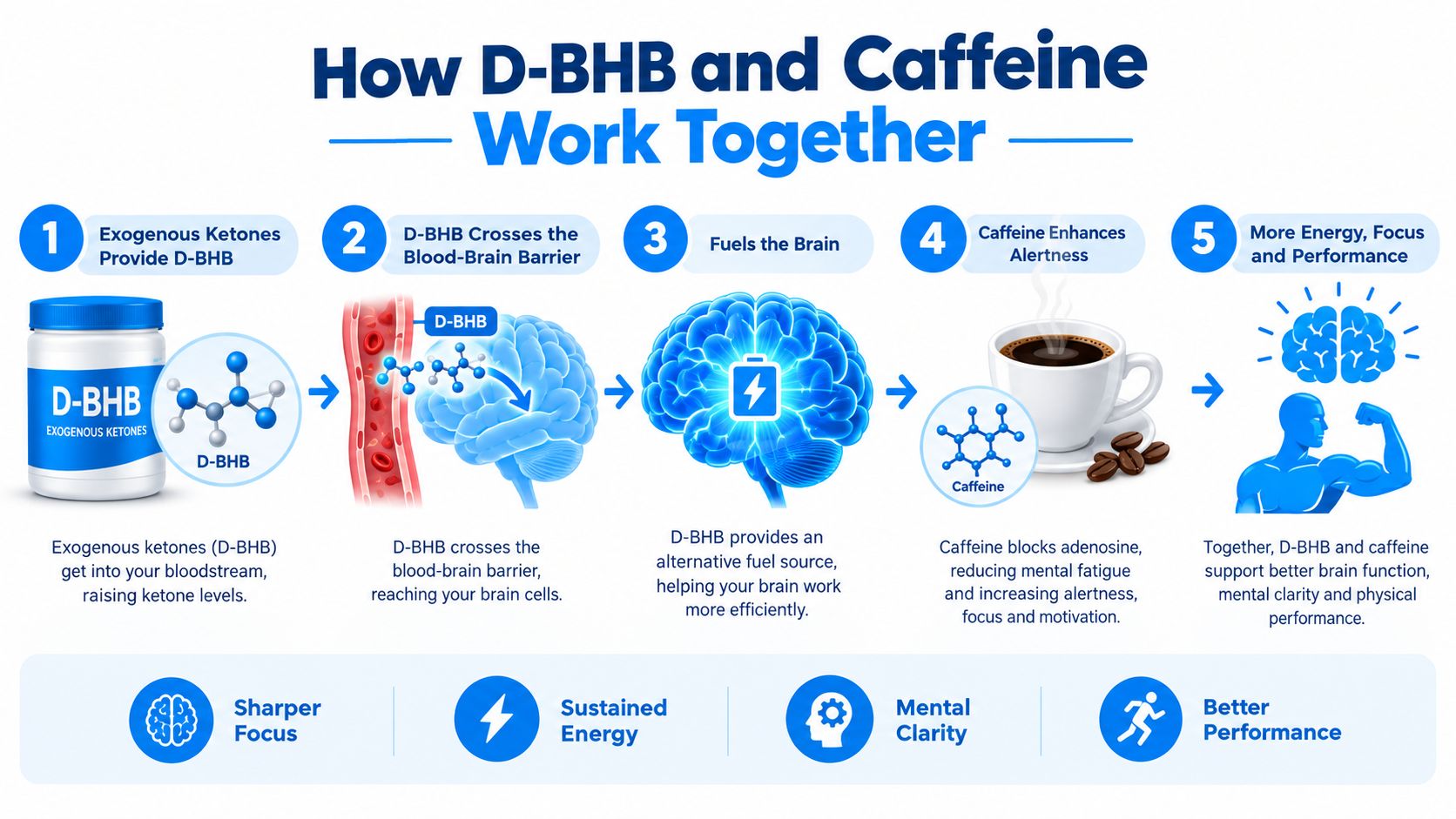
Ketones provide substrate, caffeine changes perception
The brain can oxidize ketones when glucose availability is reduced or energetic demand continues for a prolonged period. BHB also participates in cellular signaling, including pathways linked with oxidative-stress responses and endothelial function. Those pathways explain why researchers study ketones beyond their role as calories, without making them a treatment for disease.
Caffeine operates through a separate control system. By antagonizing adenosine receptors, it can increase wakefulness and make exercise feel less difficult. It may also influence fatty-acid mobilization, adding a metabolic signal without replacing BHB's direct contribution as a circulating fuel. Caffeine also interacts with ketone metabolism, as explained in ketosis and caffeine.
A 2017 review in Frontiers in Physiology reported that exogenous ketones, supplied as esters or salts, can raise blood BHB in humans. It also noted that ketone drinks can lower blood glucose and lipids without suppressing endogenous insulin secretion. These findings provide a physiological basis for studying ketones alongside stimulants. See the peer-reviewed metabolic review.
Caffeine may affect ketone availability even before a ketone ingredient is consumed. In a controlled study of 10 healthy adults, 2.5 mg/kg of caffeine increased ketones by 88%, while 5.0 mg/kg increased them by 116% after breakfast, according to the 2016 PubMed study. The result does not show that every combined product will improve performance. It shows that caffeine can alter the metabolic setting in which exogenous BHB is used.
Athletes seeking ketone fuel without caffeine can consider Tecton EDGE™ Performance Shot + Electrolytes, which combines liposomal R3HBG™ ketone with sodium, potassium, and magnesium for training, movement, and physically demanding days.
Performance and Cognitive Benefits From Research
The research supports a measured interpretation. Exogenous ketones can raise circulating BHB, and caffeine can influence alertness and perceived effort. Whether the combination improves a particular task depends on the task itself.
A 2026 randomized crossover study reported that ketone monoester combined with caffeine improved select working-memory measures and significantly extended time to exhaustion during prolonged loaded exercise in the heat compared with carbohydrate control. The study reported no increase in cardiovascular or thermal strain, as described in the controlled trial published in the International Journal of Sport Nutrition and Exercise Metabolism. Because this is a specific protocol, it shouldn't be generalized to every workout or cognitive task.
The Ohio State crossover study points in the opposite direction for cognition. Participants experienced higher blood ketones, improved cycling performance, and lower perceived exertion, but the combination didn't improve cognitive function versus control. The practical lesson is that exercise performance may be a more dependable target than mental performance, although the 2026 study indicates that cognitive benefits can appear under selected conditions.
What the acute metabolic shift means
A systematic review and meta-analysis found that acute exogenous ketone ingestion increased mean BHB by 1.73 mM and decreased mean blood glucose by 0.54 mM. Those values come from the human systematic review and meta-analysis. They demonstrate a real shift in circulating substrate availability, not proof of fat loss or a universal performance effect.
| Study | Intervention | Primary Outcome | Secondary Outcome |
|---|---|---|---|
| 2016 controlled human study | Caffeine alone after breakfast | Plasma ketones rose in a dose-dependent manner | Demonstrated caffeine's metabolic signaling effect |
| Ohio State human crossover study | Ketone and caffeine supplement | Cycling performance improved and perceived exertion decreased | Cognitive function did not improve versus control |
| 2026 randomized crossover study | Ketone monoester plus caffeine | Time to exhaustion increased during loaded exercise in heat | Select working-memory measures improved without increased cardiovascular or thermal strain |
For practical use, expect a change in circulating fuel availability, not an instant transformation. Some people notice steadier energy during prolonged activity or a demanding work period. Others mainly notice caffeine's alerting effect, while gastrointestinal tolerance, sleep, diet, and training status determine whether the ketone component feels useful.
Practical rule: Judge the product against the task you actually care about. A supplement that helps perceived exertion during endurance work may not improve a quiet desk-based cognitive test.
Dosing, Timing, and Formulation Considerations
Product form determines how much BHB enters circulation, which is why “ketones” isn't a sufficiently precise label. Sports nutrition reviews report that tolerable acute doses generally raise R-βHB by about 0.3 to 1.0 mM for salts and related forms, while ketone esters can raise R-βHB into roughly the 3 to 6 mM range. The same review found that acute performance outcomes remain inconsistent, with insufficient evidence for a clear athletic benefit across studies. These findings are summarized in the sports nutrition review.
Choose the form before adjusting the dose
Ketone salts bind BHB to minerals. They can be practical, but the mineral load and the presence of both D- and L-BHB may affect tolerance and interpretation. Ketone esters generally produce higher D-BHB exposure, but taste and gastrointestinal comfort can be limiting factors. A human metabolic review explains that esters typically produce higher βHB exposure, while racemic salts can keep L-βHB higher for longer because the L-isomer is handled differently from D-BHB. See the review of ketone ester and salt metabolism.
Precursors, such as R-1,3-butanediol, rely on conversion inside the body rather than delivering BHB directly. That conversion can be less predictable and produces different metabolic byproducts. A bioidentical D-BHB structure provides a more direct substrate, while liposomal delivery systems are intended to support more consistent absorption than conventional formats. The actual result still depends on the product and the person taking it.
Use timing as an experiment rather than a rigid rule. Many athletes try a serving before a prolonged session, while professionals may use one before a demanding work block. A fasting individual may prefer a caffeine-free ketone product if preserving sleep and avoiding stimulation matter more than acute alertness. Guidance on scheduling can be found in this resource about the best time to take ketones.
The Locked Cognition™ Shot is designed for mentally demanding workdays and combines liposomal R3HBG™ with Alpha GPC and Lion's Mane, without positioning the routine around coffee or stimulants.
Start with the lowest labeled serving that lets you assess tolerance, especially when caffeine is included. Test the formulation during ordinary training or work before using it in competition or a high-stakes setting.
A practical comparison looks like this:
- Before endurance training: Use the product early enough to observe tolerance and allow absorption before sustained work begins.
- During cognitive work: Consider whether caffeine will interfere with sleep, anxiety control, or later recovery.
- During fasting: A ketone product can provide circulating ketones, but it doesn't reproduce every feature of diet-induced ketosis.
- For repeated use: Track subjective energy, gastrointestinal comfort, sleep, and training output rather than chasing the highest possible BHB reading.
Comparing Ketone-Caffeine to Alternatives
The right formulation depends on the job. Exogenous ketones with caffeine make the most sense when a person wants both an alternative fuel signal and acute alertness. A caffeine-free ketone product may be more appropriate when stimulation isn't desired, especially later in the day or during a fasting routine.
Traditional caffeine sources such as coffee can be simple and familiar. Pre-workout products may combine caffeine with several stimulants, but their broader ingredient profiles can make it harder to identify what caused a benefit or side effect. A ketone-caffeine formulation separates the roles more clearly: BHB supplies substrate, while caffeine supports arousal and effort tolerance.
Match the fuel to the demand
Carbohydrates remain a useful option for short, intense efforts that depend heavily on readily available glycogen. Ketones don't automatically replace that pathway. Caffeine-free ketones can suit people who want ketone availability without changing alertness, while caffeine-containing products are more relevant to early training, competition, or concentrated work.
Some alternatives use R-1,3-butanediol precursors rather than direct BHB. These products depend on conversion and may generate different metabolic byproducts, so they shouldn't be treated as interchangeable with a bioidentical D-BHB formulation. Salts, esters, and precursors also differ in mineral exposure, taste, absorption, and peak BHB response.
For people looking beyond conventional stimulants, a guide to caffeine-free energy drink options can help identify beverages that support energy routines without adding caffeine.
A simple decision framework:
- Choose ketone-caffeine for demanding endurance work or focused performance windows where stimulation is appropriate.
- Choose caffeine-free ketones for fasting support, evening use, or routines where sleep protection matters.
- Choose traditional stimulants when you want a familiar, occasional alertness tool and don't need an added ketone substrate.
- Choose carbohydrates when rapid glucose availability and high glycogen demand are central to the task.
The strongest product choice is the one with a transparent formulation, a clearly identified ketone structure, and tolerability that fits repeated use.
Who Should Use This and When to Avoid It
A ketone-caffeine product may appeal to an endurance athlete facing prolonged work, a professional managing a concentrated work block, or someone experimenting with low-carbohydrate training. The likely benefit is situational: steady access to an alternative substrate plus caffeine-mediated alertness, not a substitute for adequate food, fluid, sleep, or training.
Potentially relevant users include:
- Endurance athletes: Those testing fuel strategies for long sessions may value an additional circulating substrate, especially when maintaining energy is difficult.
- High-demand professionals and students: People working through extended periods of concentration may be interested in the separate fuel and arousal pathways.
- Low-carbohydrate practitioners: Exogenous ketones can raise blood BHB without requiring the liver to produce all of it immediately.
- Fasted individuals: A ketone product may provide circulating fuel during a fasting window, although it doesn't recreate the complete hormonal context of nutritional ketosis.
Situations requiring caution
People with caffeine sensitivity should use particular care because caffeine can contribute to restlessness, anxiety, palpitations, or sleep disruption. Anyone taking glucose-lowering medication should consult a qualified healthcare professional before using ketone products, because human studies show that acute ingestion can lower blood glucose.
Individuals with known intolerance to ketosis, significant medical conditions, or concerns about electrolyte intake should also seek individualized advice. A product's mineral content matters, particularly when ketone salts are used repeatedly.
The FDA's New Dietary Ingredient framework provides regulatory context, not a blanket endorsement. If a supplement contains an NDI not marketed in the United States before October 15, 1994, the manufacturer or distributor generally must submit a premarket safety notification at least 75 days before introducing it into interstate commerce, with safety information supporting a reasonable expectation of safety under labeled conditions of use. The FDA background on the NDI notification process explains the framework.
Start with a controlled setting, use one formulation consistently, and record how your body responds before adding complexity.
Practical Takeaway
Use exogenous ketones with caffeine when the task requires both alertness and sustained physical or mental output. Start conservatively, time the product around the demand, monitor sleep and gastrointestinal response, and consult a healthcare professional if medication, glucose regulation, or medical history raises concerns. Ketones supplement foundational nutrition, recovery, and training. They don't replace them.
Common Misconceptions About Ketone Supplements
The first misconception is that every ketone product works the same way. Salts, esters, and precursors create different BHB exposures, mineral loads, conversion steps, and tolerance profiles. Racemic salts also contain L-BHB, which stays higher longer in some studies because the body handles it differently from D-BHB.
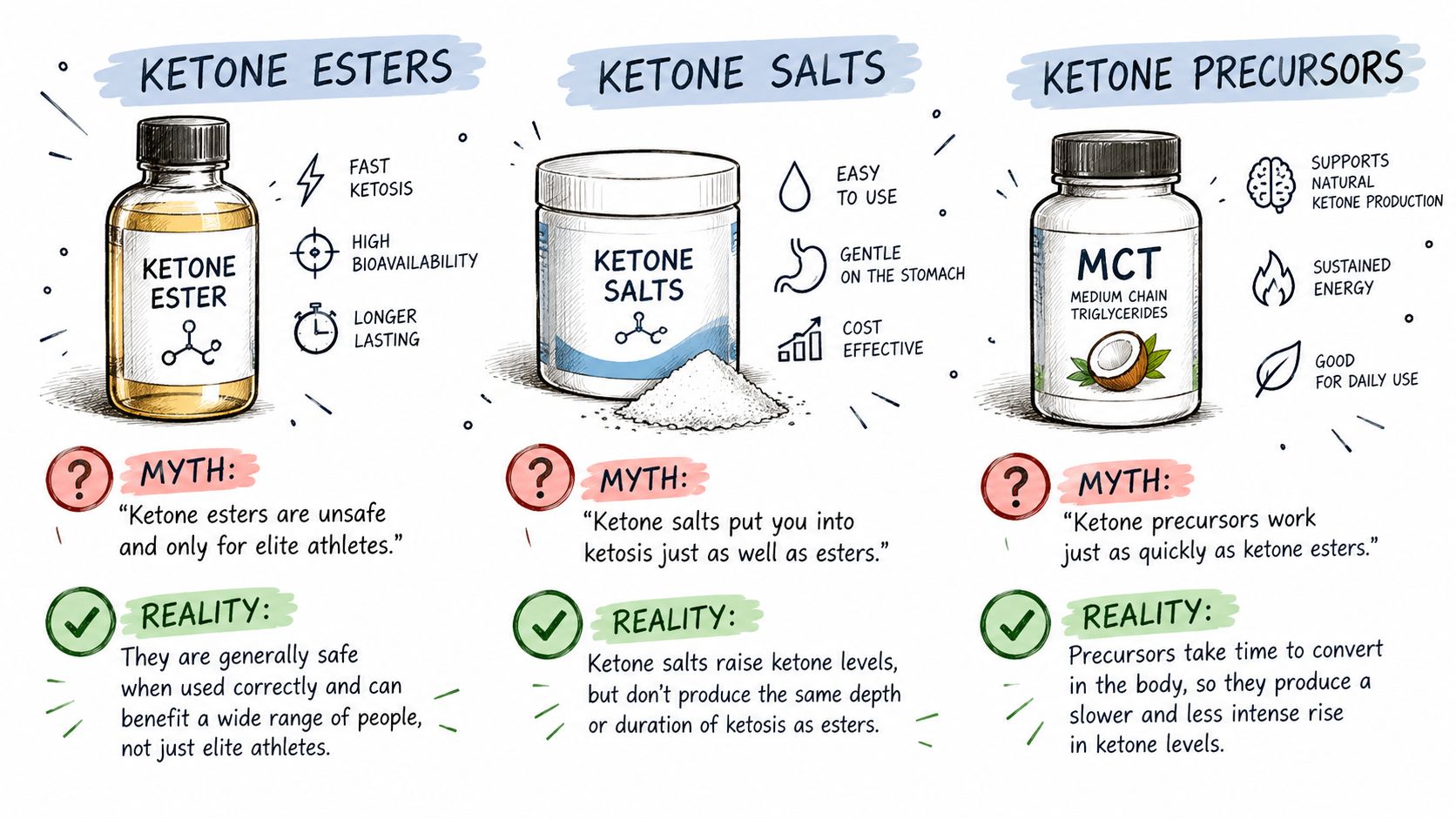
A blood ketone rise isn't the same as nutritional ketosis
Exogenous ketones provide fuel from outside the body. Nutritional ketosis is a diet-induced state in which carbohydrate restriction changes hormonal signaling and increases endogenous ketone production by the liver. A supplement can raise blood BHB even when a person hasn't made the dietary changes that drive endogenous production, so the two states shouldn't be treated as identical.
More BHB also doesn't automatically mean better performance. Human studies show inconsistent acute athletic outcomes, and individual responses differ. Ketones may support a particular endurance or cognitive context, but they don't guarantee improved output.
What ketones can and can't replace
Ketones don't replace carbohydrates for every high-intensity effort. When rapid glycolytic energy and glycogen availability dominate, carbohydrate remains relevant. Exogenous ketones also create an acute substrate shift, but that doesn't prove they increase endogenous ketone production, mitochondrial density, or long-term metabolic adaptation without appropriate diet and training.
Finally, caffeine isn't a “booster” for ketones. It has its own adenosine-related effects, and the combination may help one task while failing to improve another. Treat exogenous ketones with caffeine as a targeted tool, not a standalone solution or a shortcut around basic performance practice.
Tecton Ketones™ offers bioidentical ketone formulations, including options built for performance, cognition, electrolytes, and caffeine-supported output. Visit Tecton Ketones™ to review the formulations and choose a product that matches your training, work, or fasting routine.


