


You've bought a rope, cleared a small space, and started with the workout that looked easiest online. A few minutes later, the rope catches repeatedly, your landings get loud, and your calves feel tight enough to change how you walk the next morning. That experience usually doesn't mean jump rope is a poor choice. It means the routine ignored impact tolerance, technique, and recovery.
A useful jump rope training routine should do more than assign a duration or jump count. It should tell you how to start, what to measure, when to progress, and when to substitute lower-impact conditioning. The most practical progression combines controlled intervals, stable cadence, quiet contacts, and enough recovery for the calves, Achilles tendons, feet, and lower legs to adapt.
Building a Jump Rope Training Routine Around Your Impact Tolerance
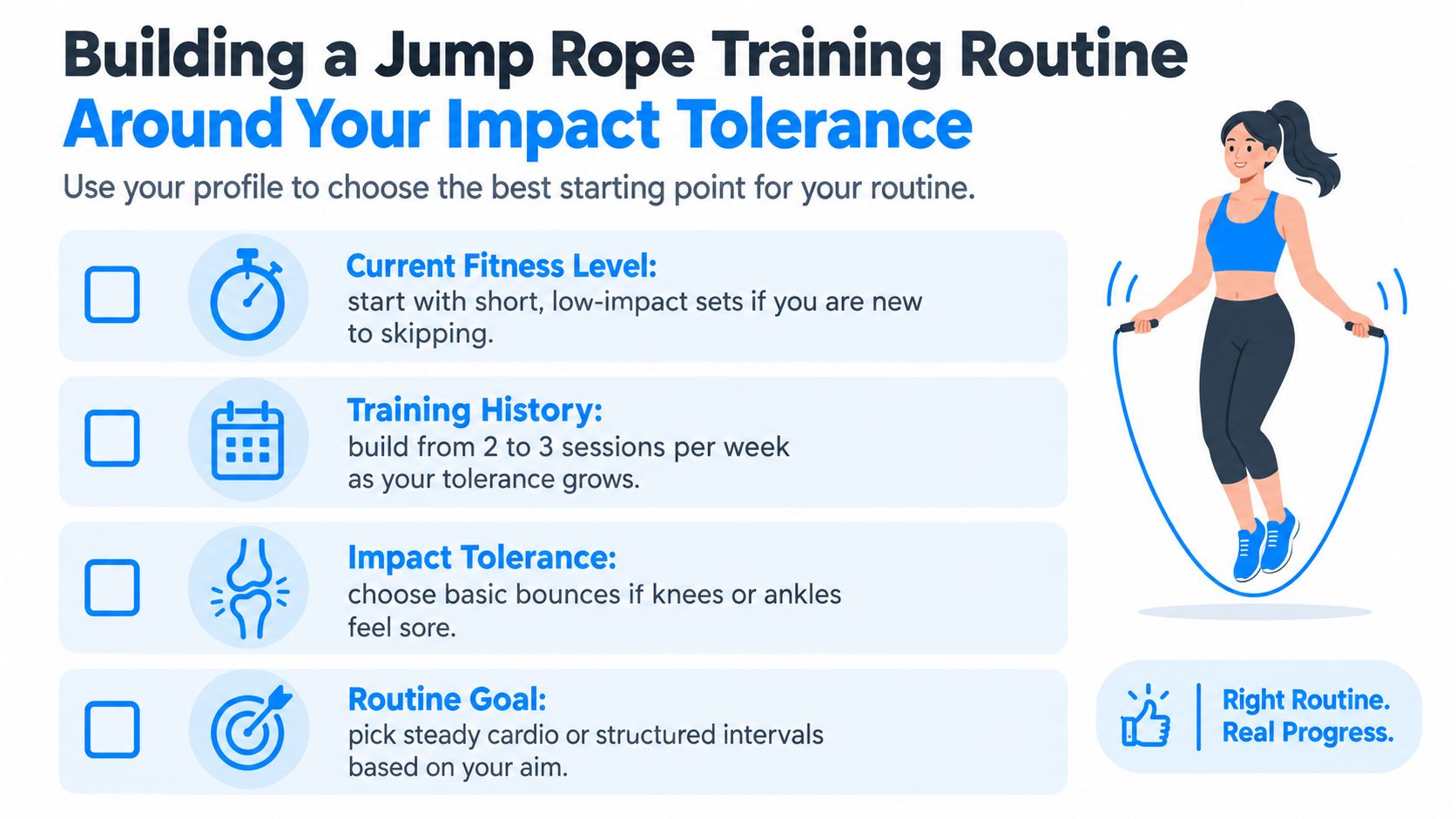
The first decision is whether your body can handle repeated contacts with sound mechanics. I coach beginners and trained athletes differently here because rope skipping punishes a mismatch between fitness and tissue readiness. Someone who runs, jumps, or plays court sports often has a higher starting tolerance. Someone with a history of Achilles, calf, shin, or plantar symptoms usually needs a slower ramp and tighter monitoring.
A useful routine starts with the category that fits your current loading capacity, not with a generic workout pulled from a video.
- New to impact: Use short work bouts on nonconsecutive days. Focus on quiet contacts, low jump height, and clean rope clearance. Two-foot and alternate-foot patterns can both work at this stage if landings stay controlled.
- Experienced with jumping: Start with measured intervals. Increase cadence or total work over time, but keep one variable steady while the other changes.
- Managing symptoms: Reduce or pause rope contacts and keep conditioning with cycling, walking, or strength work while impact exposure comes down. Be careful about copying routines built around young, healthy adults. Tolerance varies more than motivation does.
Use technique as your first progress marker
Duration alone is a poor guide. Two athletes can both finish the same interval block, but one does it with quiet, repeatable contacts and the other starts slapping the floor, overjumping, and catching the rope every few reps. Only one of those athletes is ready to progress.
Track whether you can complete the planned sets with stable rhythm, soft landings, and no obvious drop in coordination. End the set when rope catches become frequent or landing quality changes. That approach keeps the routine tied to measurable execution rather than arbitrary time.
Check the next day too. Calf tightness that settles is different from Achilles irritation, foot soreness, or a walking pattern that feels altered. Hold the current dose, or swap in low-impact work, when symptoms trend upward instead of resolving.
Practical rule: Progress only one variable at a time. Change cadence, work interval, or total jumping time, but not all three together.
Recovery history matters as much as training history. A runner may have the engine for long sets and still struggle with rope rhythm. A skilled jumper may feel technically comfortable and still accumulate lower-leg stress fast because the contacts add up steadily. If foot support is part of the equation, review matched insoles for athletes as one piece of the footwear decision, while remembering that insoles do not replace load management.
Keep the weekly picture in view. Guidance on overtraining prevention for repeated high-impact sessions applies here because connective tissue usually adapts more slowly than your conditioning. Start with the highest dose you can repeat with clean mechanics and steady recovery.
Landing Strategy and Injury-Safe Progression in Jump Rope Training
A beginner can look aerobically fresh and still overload the lower legs in a few minutes if the landing pattern is wrong. In practice, that is the gap that matters most early on. Alternate-foot jumping usually gives new jumpers a more forgiving entry point because contact is shared side to side, while two-foot jumping creates a bigger loading spike with each simultaneous landing. The biomechanical comparison is available in this peer-reviewed study
Use two-foot skipping as a progression, not a default. I introduce it once rhythm is stable, contacts stay quiet, and the athlete can finish short sets without calf or Achilles symptoms climbing afterward. That approach respects impact tolerance instead of assuming everyone should start with the same style.
Prepare the tissues before the rope starts
A short ramp-up changes how the session feels. Use 5–8 minutes of preparation before jumping, with ankle mobility, calf raises, and low-amplitude pogo contacts. Then perform 4–6 sets of 20–30 seconds of relaxed alternate-foot skipping, taking 30–60 seconds of recovery between sets.
Keep the movement economical and repeatable:
- Arms: Keep elbows near the torso and turn the rope mainly from the wrists.
- Landing: Touch down softly on the forefoot with slight knee flexion.
- Jump height: Clear the rope with the least vertical lift you can manage.
- Surface: Use a more resilient surface, not concrete or tile.
- Progression: Build toward 30–60 seconds of continuous work only after cadence stays even and the contacts remain quiet.
These details are small, but they decide whether volume builds fitness or just adds stress.
The mistakes are consistent across beginners and fit adults. Jumping higher than needed raises landing demand without improving the session. Loud contacts usually mean force is no longer being absorbed well. Early double-under practice adds speed and impact before basic timing is reliable. Back-to-back high-impact days can also expose a common mismatch. The heart and lungs may be ready for more work before the feet, calves, and tendons are.
A structured intervention that paired jump rope with resistance-band work reported 99.3% protocol adherence and no major injuries. That matters, but only in context. The result came from a defined progression and supervised execution, not from random high-volume skipping. If you also use broader strategies to reduce sports injury risk, apply the same rule here. Control landing quality and total contacts before adding speed, duration, or harder variations.
For active individuals who want an option combining ketone nutrition and electrolytes during physically demanding days, Tecton EDGE™ Performance Shot + Electrolytes uses liposomal R3HBG™ ketone with sodium, potassium, and magnesium. It can fit into a training routine where steady energy and hydration are considerations, but it does not make poor landing mechanics safer.
Choosing Between Continuous Skipping and Jump Rope HIIT
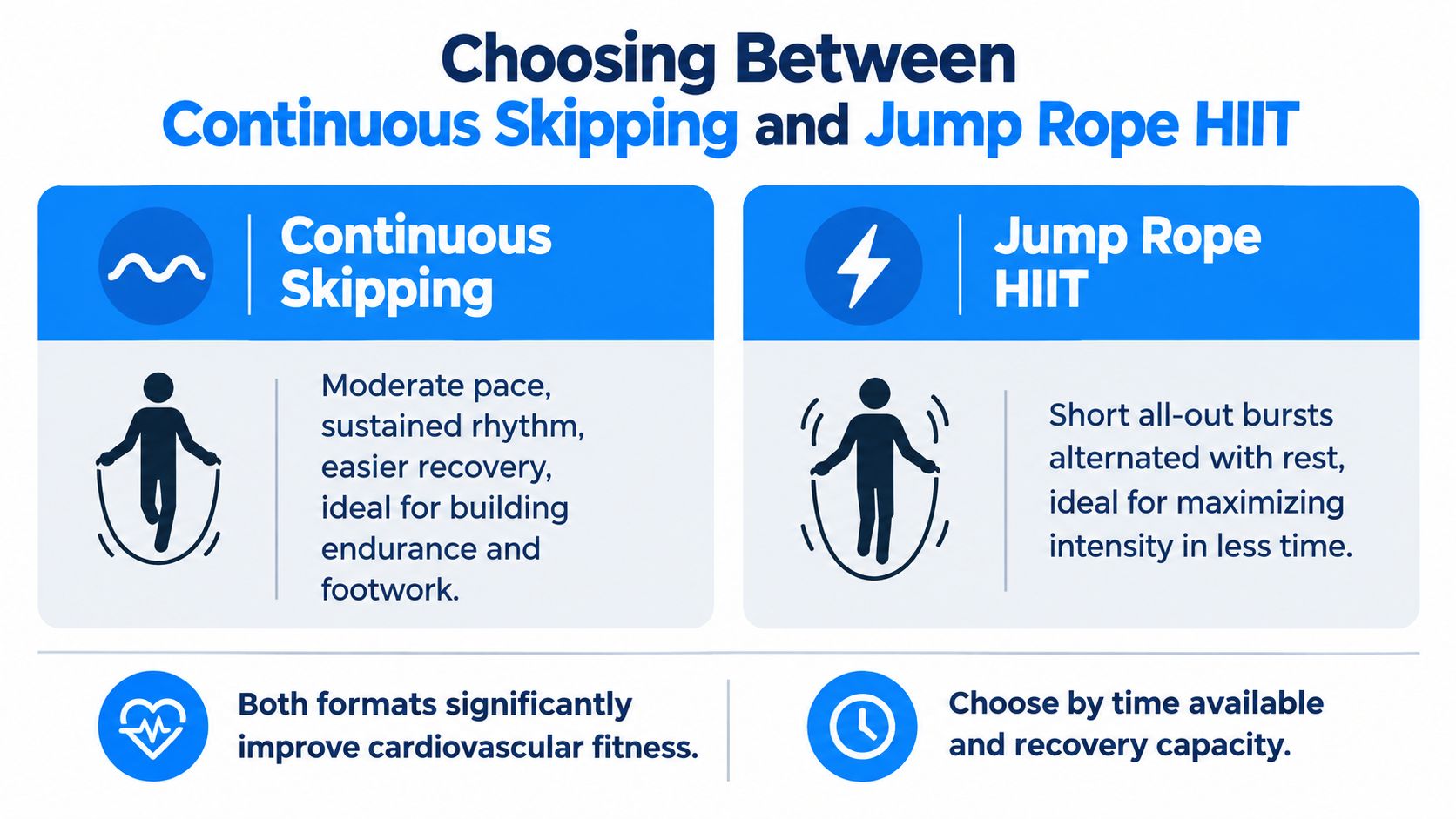
Two athletes can finish the same rope session and get very different results. One needs steady aerobic work that builds rhythm without beating up the calves. The other needs harder conditioning in less time. Continuous skipping and jump rope HIIT both improve fitness, but they are not interchangeable, and the better choice depends on what you need the session to do.
Recent clinical comparison data in healthy young adults showed that both approaches improved cardiorespiratory fitness. The interval protocol used nine two-minute bouts at 80% of maximum heart rate with one-minute active recovery, performed three times per week. The continuous group skipped for 30 minutes at a moderate pace, five times per week. In that comparison, HIIT did not produce superior body-composition change, which is a useful reminder that harder is not automatically better for every goal or every schedule, as noted earlier.
Match the format to the adaptation
| Format | Best fit | Main trade-off |
|---|---|---|
| Continuous skipping | Aerobic development, steady rhythm, footwork | Requires more frequent exposure in the cited comparison |
| Jump rope HIIT | Time-efficient conditioning and higher-intensity work | Places greater demands on recovery and technique |
| Mixed format | Athletes who need both rhythm and intensity | Requires careful separation of hard sessions |
Continuous skipping works well when the target is repeatable rhythm, aerobic tolerance, and technical economy. Keep the pace controlled enough that your shoulders stay relaxed and your foot strike stays quiet. If speech gets choppy, the rope starts catching, or the contacts get loud, the session has drifted out of steady work and into something more fatiguing than planned.
HIIT fits better when training time is tighter or when you want a clearer conditioning stimulus without adding long sessions. In a clinical protocol for young adults with obesity, the program used four sets of four 30-second efforts, with 30 seconds of recovery between repetitions and one minute between sets. Cadence progressed from 100 jumps per minute in weeks 1 to 4, to 110 in weeks 5 to 6, and 120 in weeks 7 to 8. The clinical protocol and outcomes are reported in the published study
Watch the embedded demonstration for rhythm and rope control, but keep your own pace anchored to mechanics, not appearance.
Track the session like a coach would. Record completed intervals, cadence, perceived exertion, and next-day lower-leg symptoms. If you want more context on how hard efforts interact with recovery between rounds, lactate clearance is worth understanding. It still does not excuse painful contacts or sloppy mechanics.
Progressive 12-Week Jump Rope Training Routine
By week 3, the pattern is usually clear. One athlete can handle three weekly rope sessions and add cadence on schedule, while another needs to hold the same dose longer because the lower legs are still absorbing too much impact. A good 12-week routine accounts for that difference instead of forcing everyone through one generic template.
Use three jump-rope sessions per week for 12 weeks, ideally on nonconsecutive days. The tested cadence progression moved from 100 jumps per minute during weeks 1–4, to 110 during weeks 5–8, and 120 during weeks 9–12. The protocol and broader fitness findings are described in the peer-reviewed research.
Weeks 1–4
Start with an interval structure that matches your current impact tolerance. Use either 10 rounds of 30 seconds jumping followed by 30 seconds rest, or 5 rounds of 60 seconds jumping followed by 60 seconds rest. Begin around 100 jumps per minute and stick to two-foot or alternate-foot contacts only if you can keep them quiet, low, and repeatable.
A practical session looks like this:
- Prepare with ankle mobility, calf raises, and low-amplitude contacts.
- Complete the chosen interval format at the current cadence.
- Cut a work interval short if the rope catches repeatedly or landings get loud.
- Record completed work, perceived exertion, and next-day calf or Achilles symptoms.
Weeks 5–8
Progress only if the first block stayed mechanically clean. Move toward 110 jumps per minute, or keep cadence steady and lengthen the work interval. Change one variable at a time. That makes it easier to tell whether the limit is fitness, rhythm, or impact tolerance.
This is also where the trade-off gets real. If cadence looks good but contacts are noisy, more speed is the wrong fix. Keep the dose where it is, reduce jump height, and sharpen alternate-foot rhythm until the session sounds controlled again.
Weeks 9–12
Build toward 120 jumps per minute only when rope path, landing softness, and interval completion stay consistent across sessions. Use the same tested protocol as your benchmark. Complete the prescribed work at roughly 100–120 jumps per minute without technique deterioration before you add more challenge.
Record this after every session: completed intervals, cadence, work-to-rest ratio, perceived exertion, and next-day calf or Achilles symptoms.
Pause progression when catches become frequent, cadence starts drifting, or heavy contacts show up. The target is completed quality work, not chasing the highest jump count. If you are fitting rope work around races or longer endurance training, HYDAWAY's race day essentials can help with practical prep, but hydration gear does not change the need for recovery between impact sessions.
Goal-Specific Jump Rope Programs for Endurance, HIIT, and Metabolic Health
A good rope routine starts with the outcome you want, then works backward to the format your legs can repeat. Endurance work, HIIT, and vascular-focused training can all come from the same rope, but they do not use the same interval structure, cadence target, or weekly frequency.
Endurance and footwork
For aerobic development and cleaner footwork, use continuous skipping or moderate intervals that let you hold rhythm without forcing jump height up. Keep the pace steady enough that contacts stay light and timing stays repeatable from the first minute to the last. That gives you useful conditioning without stacking another maximal session on top of sprint work, lifting, or sport practice.
I usually program this for field-sport athletes and general trainees who already get plenty of intensity elsewhere. They need more aerobic volume and better rope economy, not another session that trashes the calves. If you want a clearer picture of how this format can improve your aerobic ceiling, see our guide to VO2 max improvement.
High-intensity conditioning
For conditioning, shorter work intervals with planned recovery tend to work better than turning every session into nonstop fatigue. The young-adult obesity protocol described earlier used four sets of four 30-second efforts, recovery between repetitions, and a longer recovery between sets, with cadence progressing through the training period.
The benefit of that structure is simple. It keeps power output and timing from falling apart late in the session. Once the last reps become high, loud, or mistimed, you are no longer training the quality you intended. Cut cadence or shorten the work bout before adding rounds.
Vascular and metabolic health
A randomized 12-week study in 20 adults with overweight or obesity used 12 intervals per session, with one minute at 85–95% of maximal heart rate followed by one minute at 50–70% of maximal heart rate, performed five sessions each week. Compared with usual lifestyle, the jump-rope group showed significant improvements in brachial-artery flow-mediated dilation, peak artery diameter, and mean blood-flow velocity, while baseline artery diameter and body-fat percentage did not change significantly. The study reports these vascular findings and protocol details
Flow-mediated dilation is a noninvasive marker of endothelial vasodilatory function. Use that study as support for a specific vascular protocol, not as proof that any rope workout will produce the same response.
If your calves, shins, or Achilles start pushing back, swap some rope sessions for cycling, walking, or strength work while you settle the tissue down. GLP-1 Shot is described as a metabolic-support ketone shot containing liposomal R3HBG™ ketone, 5-HTP, and prebiotic fiber, but no supplement changes the need to match impact dose to what your body can recover from.
Jump Rope Training Application Framework and Next Steps
A good jump rope training routine works when the plan matches your body, your schedule, and the outcome you care about. In practice, that means setting the routine by impact tolerance, choosing the format that fits your week, and judging progress by repeatable training markers instead of arbitrary session length.
Start simple, then earn more.
Use this framework to make the routine practical:
- Choose the dose: Start with nonconsecutive sessions and short bouts if your recent jumping exposure is low.
- Prepare the landing system: Build in ankle mobility, calf raises, and low-amplitude contacts before rope work.
- Protect technique: Keep jumps low, land softly, and end the set when catches or heavy contacts start showing up often.
- Progress one variable: Increase cadence, work interval, or total jumping time, but not all three in the same step.
- Track adaptation: Record completed intervals, cadence, work-to-rest ratio, perceived exertion, and next-day calf or Achilles response.
- Substitute intelligently: Use walking, cycling, or strength training when lower-leg symptoms make more impact a poor choice.
Routine design is not one-size-fits-all. Continuous skipping works well when the goal is aerobic rhythm and relaxed repeatability. Intervals make more sense when time is tight or you are targeting higher-intensity conditioning. Higher-frequency protocols can support vascular or metabolic goals, but only if recovery and weekly consistency are realistic. Occasional all-out sessions do not replace steady exposure and sensible loading.
The bigger benchmark is session quality. Look for stable cadence, quiet contacts, and recovery that lets you start the next workout without worsening symptoms. If those markers stay in place, progress gradually. If they slip, reduce the dose, rebuild the pattern, and keep the routine sustainable.
Tecton Ketones™ offers bioidentical exogenous ketone nutrition built around liposomal R3HBG for people who want direct BHB availability during training, fasting windows, or demanding work. Explore Tecton Ketones™ to review performance, electrolyte, cognition, and metabolic-support options that can complement a well-programmed jump rope routine.


