


A Keto Chow meal serving and a dedicated electrolyte mix are different products: adequacy means totaling sodium, potassium, and magnesium in milligrams against the day's food and sweat, not trusting the word electrolytes on a tub. For context, WHO's adult benchmarks are less than 2,000 mg sodium and at least 3,510 mg potassium daily, not personalized supplement doses.
If a shake contains minerals, does that mean it also covers a hot training session? Not necessarily. Meal minerals, sweat replacement, and ketone fuel are three separate jobs, even when a product combines them.
The useful question isn't whether Keto Chow electrolytes are good or bad. It's what the exact label contributes, what else you consume, and what your body is losing.
Does Keto Chow Contain Electrolytes
A product that lists sodium, potassium, and magnesium contains those electrolytes. A product listing only one is a partial source. Neither result establishes that it meets your daily needs or provides an appropriate exercise drink.
Read the Nutrition Facts or Supplement Facts panel on the exact Keto Chow meal or electrolyte mix you have. Without that panel, there's no defensible brand-wide milligram answer.
Read the panel before judging adequacy
Record the serving size, sodium, potassium, magnesium, and prepared fluid volume. Check whether the panel describes powder alone or the finished meal, because added ingredients may contribute minerals too.
If a mineral amount is missing, mark it as unknown in your personal notes. Don't infer an amount from the ingredient list, flavor, or product name.
Benchmarks for reading a Keto Chow electrolyte label
| Mineral or use | Reference value | Main job | What to read on the label |
|---|---|---|---|
| Sodium | Under 2,000 mg/day WHO; about 2,400 mg on many U.S. label references | Plasma volume, thirst, and fluid retention | mg of sodium, not grams of salt |
| Potassium | At least 3,510 mg/day WHO; AI 3,400 mg men and 2,600 mg women ages 19–50; DV 4,700 mg | Intracellular mineral and membrane potential | mg or mEq per serving |
| Magnesium | About 400 mg on a 2,000 kcal label reference; needs vary by age and sex | Energy metabolism and neuromuscular function | mg per serving times servings used |
| Sodium in exercise fluid | 0.3–0.7 g per liter, about 13–30 mmol/L | Helps retain fluid in long or hot sessions | mg sodium per prepared liter, not only per scoop |
The NIH-hosted water and electrolytes reference provides context for WHO's less-than-2,000 mg sodium and at-least-3,510 mg potassium benchmarks, NIH potassium adequate intakes of 3,400 mg for men and 2,600 mg for women ages 19–50, and the 4,700 mg potassium Daily Value.
The NIH-hosted dietary reference document describes U.S. label reference values of 2,400 mg sodium and 400 mg magnesium on a 2,000-kcal reference diet. These are reference values, not a current-label guarantee or an individualized prescription.
The exercise-fluid row serves a different purpose: interpreting drink concentration during meaningful sweat loss. It isn't an additional daily intake target.
Keep the units and caveats beside the numbers
Salt and sodium aren't interchangeable units. Approximately 1 g sodium equals 2.5 g salt, so a salt weight cannot be entered directly into a sodium tally.
Likewise, a Daily Value, an adequate intake, and a public-health limit answer different questions. Don't treat them as equivalent targets to fill with supplements.
Label rule: A mineral amount becomes useful only when you know the serving size, how much you actually use, and what else you consume.
People with kidney disease, heart failure, hypertension, or medicines affecting sodium or potassium balance should obtain clinical guidance before increasing either mineral. A population benchmark doesn't override a clinician-set restriction.
What Sodium, Potassium, and Magnesium Do
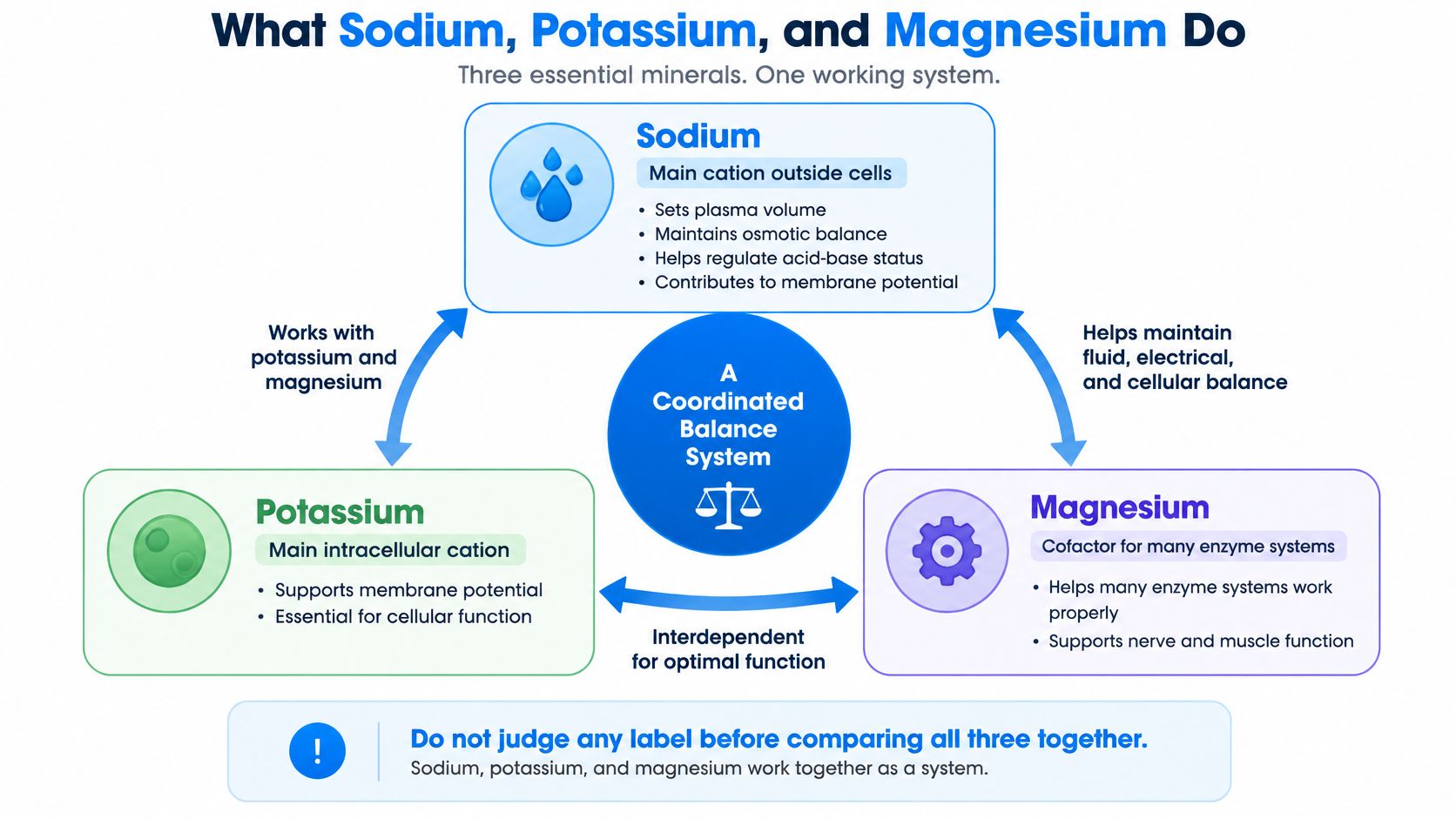
Electrolytes form a coordinated system, not a collection of interchangeable ingredients. A generous magnesium amount cannot compensate for substantial sodium loss, and extra potassium doesn't automatically improve hydration.
This diagram shows the relationships behind the label.
Sodium manages the extracellular space
Sodium is the principal positively charged mineral outside cells. It helps regulate plasma volume, osmotic balance, acid–base status, and the electrical conditions across cell membranes.
Sodium and potassium work through ion pumps that support nerve transmission, skeletal-muscle contraction, and normal heart function. That's why electrolyte balance matters outside endurance sport.
WHO reported average adult sodium intake of 4,278 mg per day in 2021, approximately 11 g of salt, more than twice its recommended limit, as summarized in the NIH-hosted electrolyte physiology reference. Starting keto doesn't mean everyone begins with low sodium intake.
Potassium and magnesium support cellular work
- Potassium: Predominantly inside cells, it helps maintain membrane potential and normal cellular function. Increasing it without considering kidney function or relevant medicines can be hazardous.
- Magnesium: It supports enzyme systems, energy metabolism, and neuromuscular function. Its role overlaps with the other minerals, but its dose must still be assessed separately.
- The combined system: Food, beverages, supplements, and losses determine the practical balance. A label's largest number doesn't identify the mineral you personally need.
For more context on mineral interactions, our explanation of magnesium and calcium can help distinguish related physiological roles without treating minerals as substitutes.
Energy-metabolism language can also cause confusion between vitamins and electrolytes. CalVitamin's listing for pantothenic acid in a 100-capsule bottle is an example of a vitamin product, not a replacement for sodium, potassium, or magnesium.
Headache, fatigue, dizziness, cramps, and constipation aren't reliable mineral tests. They can accompany fluid or electrolyte problems, but they can also have unrelated causes.
Persistent or worsening symptoms deserve assessment rather than repeated scoops. The practical task is to establish intake and likely losses before deciding that more supplementation is appropriate.
Add Up a Meal Replacement Label
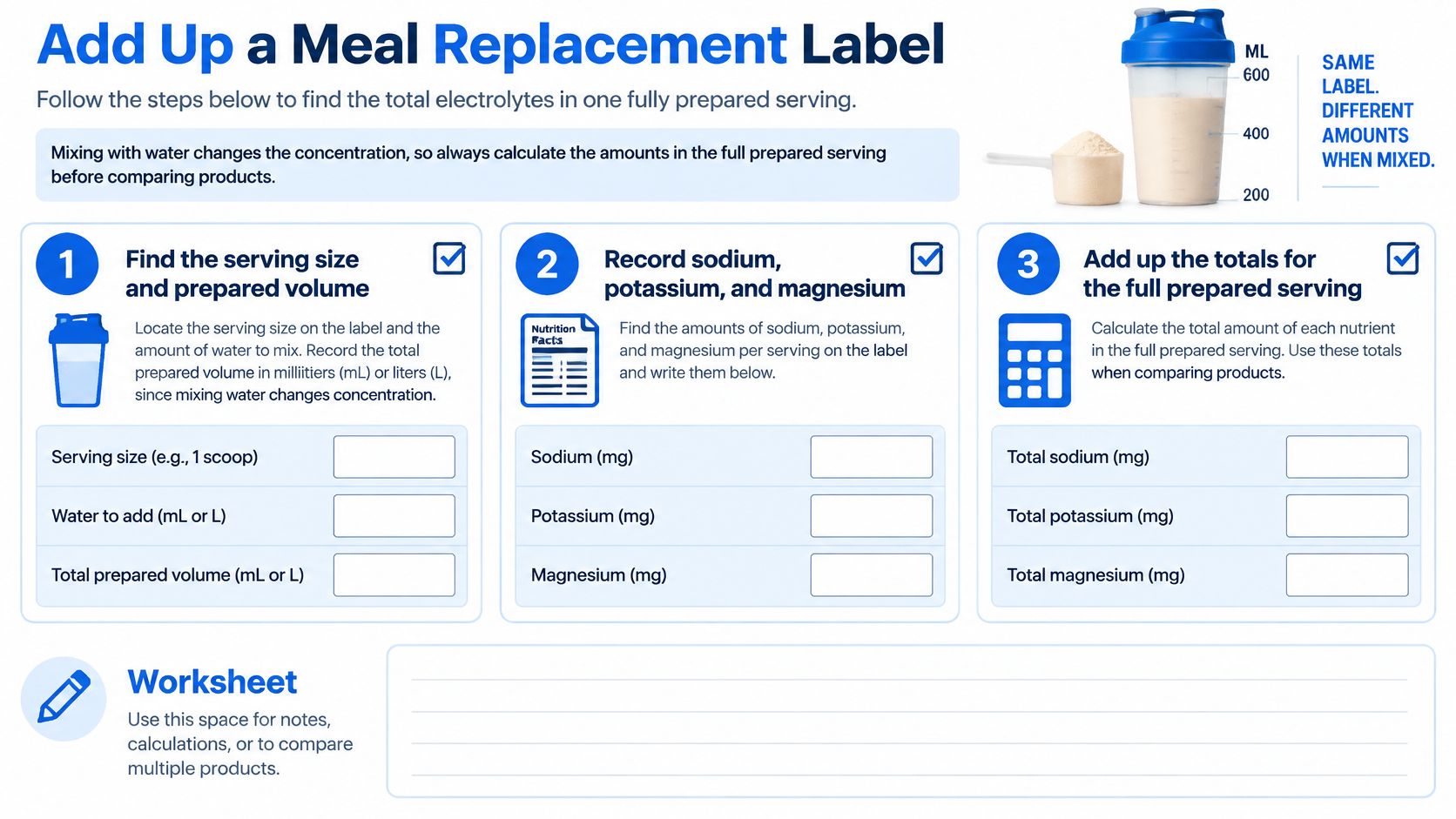
Use the package, a food log, a calculator, and the volume markings on your shaker. Comparing scoop sizes or percentages alone won't tell you what you're consuming.
The worksheet below separates intake from concentration, which prevents a common mistake: assuming a more diluted drink contains fewer total minerals.
Follow the label arithmetic
- Find the serving and prepared volume. Record whether the mineral values apply to dry powder or a finished meal. Water changes concentration, while added milk or other ingredients can change the mineral total.
- Copy each mineral separately. Enter sodium, potassium, and magnesium in milligrams. If a label uses mEq, don't assume it means milligrams or mmol; have a pharmacist or dietitian verify the conversion, particularly for magnesium.
- Multiply by actual servings. Include every shake, partial serving, and dedicated electrolyte mix you use. Count what goes into the container, not what you intended to drink.
- Add food and other beverages. Include ingredients added to the shake, salted meals, broth, sports drinks, and supplements. Keep a separate line for an optional extra scoop so you can see what it changes.
- Calculate bottle concentration. Divide the bottle's sodium milligrams by its prepared liters. This distinguishes total sodium intake from the concentration you drink during training.
- Resolve overlaps before adding more. Check whether a meal replacement and an electrolyte mix are addressing the same perceived gap. Flavor drops count only if their label lists minerals.
- Reassess when circumstances change. A change in carbohydrate intake, weather, training, or medication can make yesterday's routine inappropriate. Don't convert a temporary adjustment into a permanent habit.
Daily electrolyte tally worksheet
| Line item | Your value |
|---|---|
| Food sodium, mg per day | Sum sodium from meals, snacks, and added salt |
| Keto Chow sodium, mg per serving times servings used | Label sodium multiplied by actual servings |
| Other drinks sodium, mg | Sum beverages and separate electrolyte products |
| Total sodium, mg per day | Food plus shakes, drinks, and supplements |
| Total potassium, mg per day | Sum potassium from all consumed sources |
| Total magnesium, mg per day | Sum magnesium from all consumed sources |
| Training bottle sodium, mg per liter | Bottle sodium in mg divided by prepared liters |
Say you use a meal shake at breakfast and an electrolyte mix during a workout. Enter them on separate lines rather than assuming either one covers the other.
If you dilute the workout bottle more, its sodium concentration falls, but the total sodium stays the same if you finish the bottle. If you drink only part of it, your consumed sodium falls too.
A complete tally can reveal a gap. An incomplete tally cannot prove that you need another serving.
The pass test is straightforward: you can state your day's mineral totals and your training bottle's sodium concentration. Unknown label values remain unresolved, not automatically zero.
Matching Electrolytes to the Day
Electrolyte decisions by day and session
| Situation | Fluid and sodium focus | What to avoid |
|---|---|---|
| Ordinary adapted day | Food plus the measured shake or mix if a real gap remains | Stacking several products by habit |
| First 7 days of low carb | Expect higher sodium excretion; correct fluid and sodium when appropriate | Treating the first week as a permanent high dose |
| Session under about 2 hours | Routine hydration unless sweat or heat is heavy | Assuming every workout needs a sports-level bottle |
| Endurance over about 2 hours or heavy sweat | About 0.3–0.7 g sodium per liter plus food | Replacing substantial sweat losses with plain water only |
| Fasting window | Match mineral losses without confusing a shake's calories with fluid | Using a meal replacement as if it were only salt |
| Hypertension, kidney disease, heart failure, or related medicines | Clinician-set sodium and potassium limits | Self-escalating either mineral |
The National Athletic Trainers' Association fluid-replacement guidance supports approximately 0.3–0.7 g sodium per liter, equivalent to about 13–30 mmol/L, with additional attention to sodium during endurance sessions lasting more than roughly two hours or producing heavy sweat losses.
The duration boundary isn't a switch. A shorter, hot session can produce meaningful losses, while an easy session in cool conditions may require less intervention.
Don't turn adaptation into a permanent dose
Early carbohydrate restriction can change water and sodium handling. Some people notice dizziness, fatigue, or reduced exercise tolerance, but those symptoms alone don't establish the appropriate correction.
The distinction is between addressing a plausible, measured problem and repeatedly escalating supplements because a symptom persists. Our guide to low carb and electrolytes provides additional context for that transition.
A clinical review of ketogenic-diet initiation discusses an older practical recommendation of 1–2 grams of additional sodium daily, with an extra serving before exercise, but does not establish it as a universally validated dosing rule. Kidney function, medicines, adaptation, and sweat losses prevent that advice from becoming a blanket prescription.
Match the adjustment to the actual session
For an ordinary day, start with the measured baseline rather than a sports-drink formula. During prolonged or hot activity, sodium helps maintain extracellular fluid volume, stimulate thirst, and retain consumed water.
Fasting doesn't remove these physiological needs. It does change which products fit your eating plan: a calorie-containing meal shake is still a meal, not just a mineral drink.
- Before activity: Prepare the bottle deliberately rather than improvising extra scoops.
- During activity: Consider conditions, sweat, food, and fluid together.
- After activity: Count replacement drinks in the same daily tally instead of treating recovery intake as separate.
Don't force excessive plain water to compensate for uncertainty about sodium. If you have a sodium restriction or relevant medical condition, use an individualized plan rather than the general sports range.
Why This Matters
Minerals support electrical signaling and fluid balance. Beta-hydroxybutyrate, or BHB, provides an oxidative fuel substrate. Supplying one doesn't eliminate the need for the other.
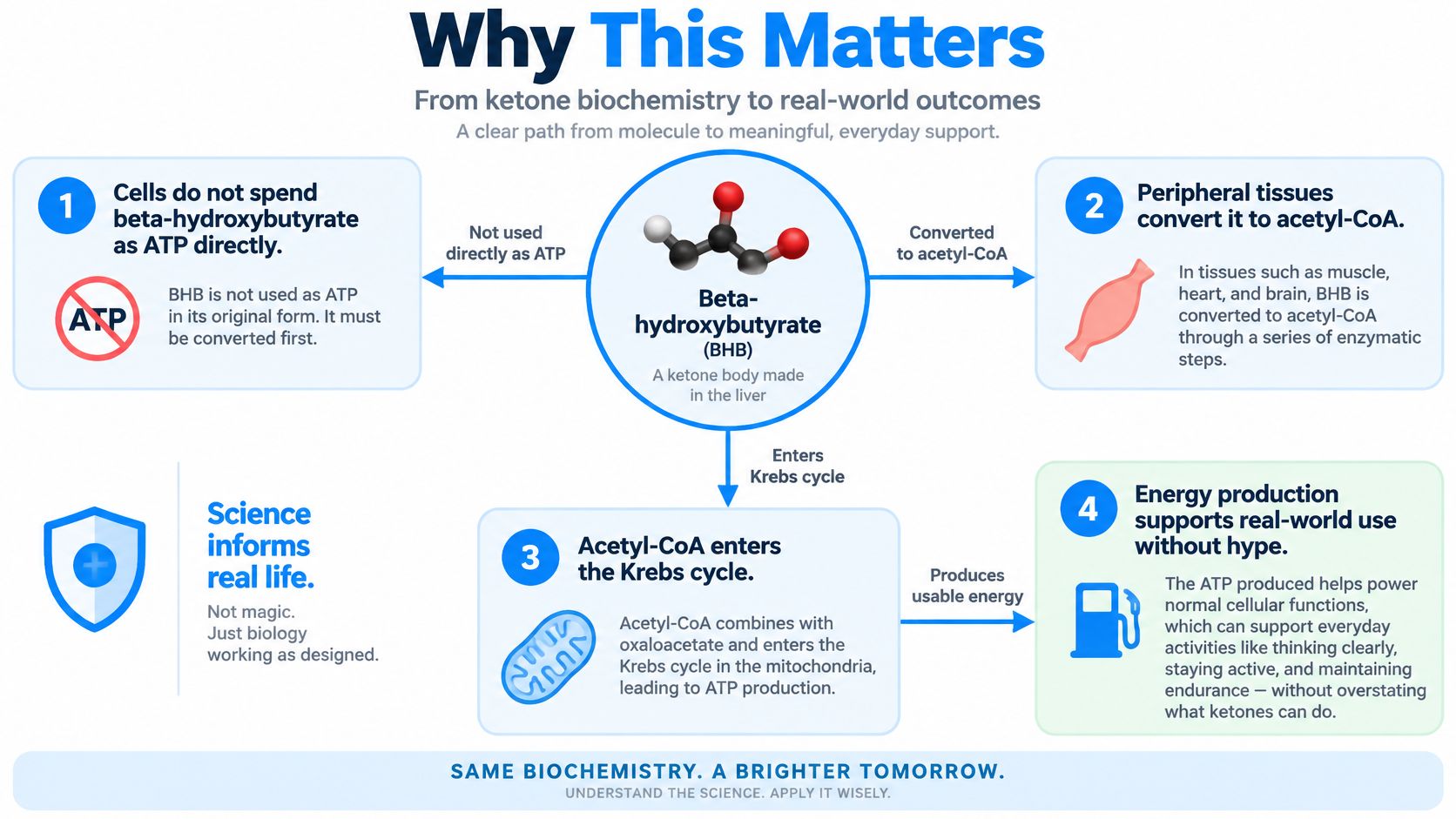
The pathway below explains why a higher ketone reading isn't the same thing as instant cellular energy or guaranteed performance.
From BHB to mitochondrial ATP
Cells don't spend BHB directly as ATP. Peripheral tissues convert ketone bodies into acetyl-CoA, which enters the mitochondrial tricarboxylic-acid cycle and supports oxidative phosphorylation and ATP production, as described in the clinical review of ketones and brain energy metabolism.
Glucose follows a different entry pathway: glycolysis first converts it to pyruvate in the cytosol before mitochondrial oxidation. Ketones can also cross the blood–brain barrier and provide an alternative brain substrate.
Keep these terms separate:
- Nutritional ketosis: A diet-induced metabolic state associated with carbohydrate restriction.
- Endogenous ketone production: Ketones made within the body, mainly by the liver, as insulin signaling and fuel availability change.
- Exogenous ketone supplementation: Ingested ketones that temporarily add to circulating BHB without requiring the same dietary transition.
Metabolic flexibility means the capacity to use different fuels as conditions change. It doesn't mean that taking ketones reproduces every adaptation to fasting or a ketogenic diet.
What human trials establish
A 2022 systematic review of 43 human trials involving 586 participants found that exogenous ketones increased BHB by an average of 1.73 mmol/L from baseline, with a 95% confidence interval of 1.26–2.21 mmol/L; versus placebo, BHB increased 1.98 mmol/L, while mean glucose decreased 0.47 mmol/L.
Those are physiological responses, not proof of universal improvements in cognition or exercise. Dose, formulation, timing, nutritional state, and the individual all matter.
A randomized crossover study of adults with and without metabolic syndrome found that ketone monoester ingestion increased carbohydrate oxidation and decreased fat oxidation without changing resting energy expenditure. Additional circulating ketones shouldn't be interpreted as increased calorie burning or automatic fat loss.
Formulation changes the practical calculation
Ketone salts bind BHB to minerals, so their sodium, potassium, or magnesium belongs in the tally. Ketone esters use a different chemical delivery structure; the specific ester determines what digestion releases.
D-BHB is the naturally produced, oxidizable form of BHB. Bioidentical describes molecular identity, not proof that every formulation produces the same outcome.
Precursors require metabolic conversion before contributing to circulating ketones. Liposomal delivery is a formulation choice, not a substitute for human outcome evidence or electrolyte arithmetic.
BHB also participates in cellular signaling, including pathways associated with mitochondrial energy metabolism. Endothelial function concerns how the blood-vessel lining regulates vascular behavior, but these mechanisms don't justify claiming that a particular shot improves endothelial function without product-specific human evidence.
The video offers another way to visualize ketone fuel.
Translate the mechanism into realistic goals
- Steadier energy: An additional substrate may be useful during demanding periods, but it doesn't replace adequate meals or sleep.
- Cognitive endurance: Brain access to ketones provides a physiological rationale, not a guarantee of sharper thinking.
- Workout performance: Assess tolerance and actual output during familiar training before using a new supplement in competition.
- Metabolic efficiency: Flexible fuel use is a more defensible goal than promising greater fat burning.
For readers organizing clinical questions, Vital iQ Health's explanation of what a complete blood panel includes can help with terminology; your clinician should determine which tests fit your situation. Our guide to keto and electrolyte imbalance addresses the separate mineral-balance concern.
Performance perspective: Judge a routine by tolerability, useful output, and appropriate intake, not by the highest ketone reading.
Build Your Electrolyte and Ketone Routine
- Write down today's intake. Use the worksheet to total sodium, potassium, and magnesium from food, the Keto Chow meal or mix, and other products. Resolve missing label values before using the tally to justify an increase.
- Choose the situation that applies. Distinguish an ordinary adapted day from dietary transition, prolonged exercise, heat, or fasting. Record your goal in plain language, such as replacing sweat losses or testing an additional fuel source.
- Prepare a purposeful training bottle. Use the measured sodium concentration appropriate to the session rather than automatically making every drink a sports drink. Include food consumed during training and keep clinician-set restrictions in place.
- Choose ketone fuel separately from mineral replacement. Our Tecton EDGE™ Performance Shot + Electrolytes is one option combining these functions: it's stimulant-free, contains 10 g of R3HBG, and includes a full electrolyte load of sodium, potassium, and magnesium. Check the current panel for serving size and exact mineral amounts before fitting it into your plan.
Our EDGE Electrolytes certification is NSF Certified for Sport, and it has applied since the product's 2025 launch. Certification is a relevant selection criterion for athletes, but it doesn't determine your personal dose.
Application Framework
Begin any optional ketone trial during a familiar, lower-stakes day. Follow the labeled serving directions, avoid changing several supplements simultaneously, and note digestive tolerance, perceived energy, and whether the intended task feels more manageable.
Readers who react strongly to caffeine should verify stimulant content rather than assuming every ketone product is alike. Those using medication or navigating a medical condition should discuss the complete ingredient panel with their clinician.
A controlled study in healthy adults found repeated ketone monoester intake was tolerated under its tested conditions without changes in body weight or composition. That finding doesn't establish long-term safety for every formulation or population.
Your working plan should answer three questions:
- Minerals: What am I already consuming?
- Losses: What does this day reasonably require me to replace?
- Fuel: Is an optional ketone serving relevant to my actual goal?
Skip self-directed increases when a clinician has limited sodium or potassium. These dietary supplements aren't intended to diagnose, treat, cure, or prevent any disease.
Tecton Ketones™ offers exogenous ketone nutrition, including a stimulant-free formula that combines ketone fuel with sodium, potassium, and magnesium. Visit Tecton Ketones™ to review the options, then use the current label and your daily tally to decide whether a formula fits your routine.


