


Weight-resistance exercise produced a pooled vertical-jump improvement of 9.9 cm in healthy athletes, larger than the gain from plyometrics alone, according to the 2025 systematic review and meta-analysis of physical-training programs. That result reframes how to improve jump vertical performance. Jumping higher isn't mainly about collecting more jump drills or finding a better supplement. It's about building more force, expressing that force faster, landing well enough to repeat the work, and testing under conditions you can trust.
What Raises Vertical Jump Height
A vertical jump is a short, violent problem. You have to move your whole body mass upward in a fraction of a second, so two qualities decide the result. The first is maximal force, how much force your hips, knees, and ankles can produce. The second is rate of force development, how quickly you can produce it before your feet leave the floor.
Strength work raises the ceiling. Plyometrics teach you to use that strength at jump speed through a rapid stretch-shortening cycle, where tendons and muscles absorb force in the dip and return it at takeoff. Technique ties the two together, because a clean countermovement, aggressive arm swing, and full extension through hip, knee, and ankle waste less of the force you've built.
What the Pooled Gains Mean
In the same pooled analysis, plyometric training added 5.2 cm over routine training (95% CI 2.6 to 7.7 cm), less than half the gain from weight-resistance work. Treat every pooled figure as a group average across different athletes and programs, not a promise for your next test. An untrained athlete with a low strength base may gain quickly. A trained jumper near his current ceiling may fight for a centimeter.
Other syntheses land in the same place from different angles. Complex training edges traditional resistance work on percentage gains and clearly beats plyometrics-only training on effect size, while plyometrics still improves on no training at all in individual-sport athletes. Read the comparison before the number: beating routine training, beating no training, and beating another good method are three different claims.
| Method | Typical gain | Comparison note | Evidence |
|---|---|---|---|
| Plyometrics versus routine training | 5.2 cm (95% CI 2.6–7.7) | Explosive practice on top of usual sport work | Meta-analysis of physical-training programs in healthy athletes |
| Weight-resistance exercise | 9.9 cm | Largest pooled gain among the methods compared | Meta-analysis of physical-training programs in healthy athletes |
| Traditional resistance training | 12.5% improvement | Builds maximal lower-body force | 2020 meta-analysis of complex training |
| Complex training | 13.2% improvement | Effect size 0.86 versus plyometrics-only | Same 2020 meta-analysis |
| Plyometrics in individual-sport athletes | Effect size 0.49 (95% CI 0.32–0.65) | Smaller but consistent versus non-training controls | Meta-analysis of plyometric jump training |
Test Before You Judge a Program
None of those figures helps if your own test wobbles. Use a standardized countermovement jump every time.
- Same setup: same shoes, same surface, same warm-up.
- Same instructions: arm swing, dip depth, and starting position held consistent.
- Same attempts: two or three maximal efforts, best clean jump recorded.
A deeper dip one week and a bigger arm swing the next can manufacture progress you didn't earn. Test at the same point in your weekly schedule, before any fatiguing work, so heavy legs don't masquerade as lost progress. Film from the side if you can; a slow dip, a soft plant, or incomplete hip extension shows up on video long before you can feel it.
Build more maximal force first, then learn to express it faster with technically clean takeoffs.
That principle also explains why jump work pairs well with broader explosive training. If your sport also demands acceleration and change of direction, our guide to speed and agility training covers where those qualities overlap without turning every session into conditioning.
Force first. Speed of expression second. Clean landings throughout.
Jump Dose for Different Athletes
The right weekly dose depends less on motivation than on training age, sport schedule, and recovery capacity. A young athlete in her first structured off-season doesn't need an adult's program with the weights turned down. She needs fewer exposures, longer to adapt, and a clear rule for when to stop.
| Athlete | Strength work | Plyometric work | Time frame |
|---|---|---|---|
| Female adolescent, early training age | Up to 2 sessions per week, 3–8 controlled reps | 1 low-contact session per week, building past 14 total sessions | Strength at least 10 weeks; plyometrics longer than 9 weeks |
| Trained adult, off-season | 2 sessions per week, 3–8 reps | 2 low-fatigue sessions per week, full rest between efforts | 8–12 weeks, test every 4 weeks |
| In-season team-sport player | 1–2 shorter sessions | 1 session, stop when height drops | Maintain; do not chase new volume |
The 2025 systematic review and meta-analysis of 26 studies involving 705 female adolescent team-sport athletes found moderate-to-large vertical-jump improvements from both strength training, with an effect size of 0.74, and plyometric training, with an effect size of 0.87, with no statistically meaningful difference between approaches. Strength programs lasting at least 10 weeks and using no more than two sessions per week were particularly effective, while plyometric programs longer than nine weeks and exceeding 14 sessions were more effective. Duration and consistency beat weekly cramming.
Two Athletes, Two Different Weeks
Say a 15-year-old volleyball player starts her first serious off-season. I'd give her two short strength sessions and one low-contact plyometric session per week. She'd learn a goblet squat or trap-bar pattern, a split squat, and controlled landings before anyone mentions depth jumps. She judges progress across ten weeks, not from one testing day to the next, because growth, school sport, and sleep all add noise.
A trained adult in an off-season block can handle the fuller structure, two strength days and two power days spaced through the week. He has the tendon tolerance and lifting skill to use heavier loads and slightly higher jump intensity. Even then, the stop rule stays the same. When jump height visibly falls inside a set, the set is over.
Use Symptoms as a Volume Dial
For female athletes, menstrual-cycle symptoms are useful information, not a reason to abandon training for months or push through at all costs. On a high-symptom day with heavy cramping, headache, or poor sleep, keep the strength pattern at a moderate load and cut jump contacts. On a normal day, train as planned. You're adjusting one dial, contact volume, while keeping the habit and the strength stimulus intact.
Force-velocity testing can hint at whether an athlete needs more maximal strength or more speed work. Don't delay training to chase a perfect profile. A 2025 meta-analysis of force-velocity-profile-optimized jump training found overall vertical-jump improvements of approximately 8 to 11%, but optimized programming produced gains similar to conventional training. A simple comparison can help guide your training. If your paused squat jump is close to your countermovement jump, you likely need more elastic, reactive work. If the countermovement jump is much higher, you're already springy and raw force is probably the limiter.
Run a 12-Week Jump Block
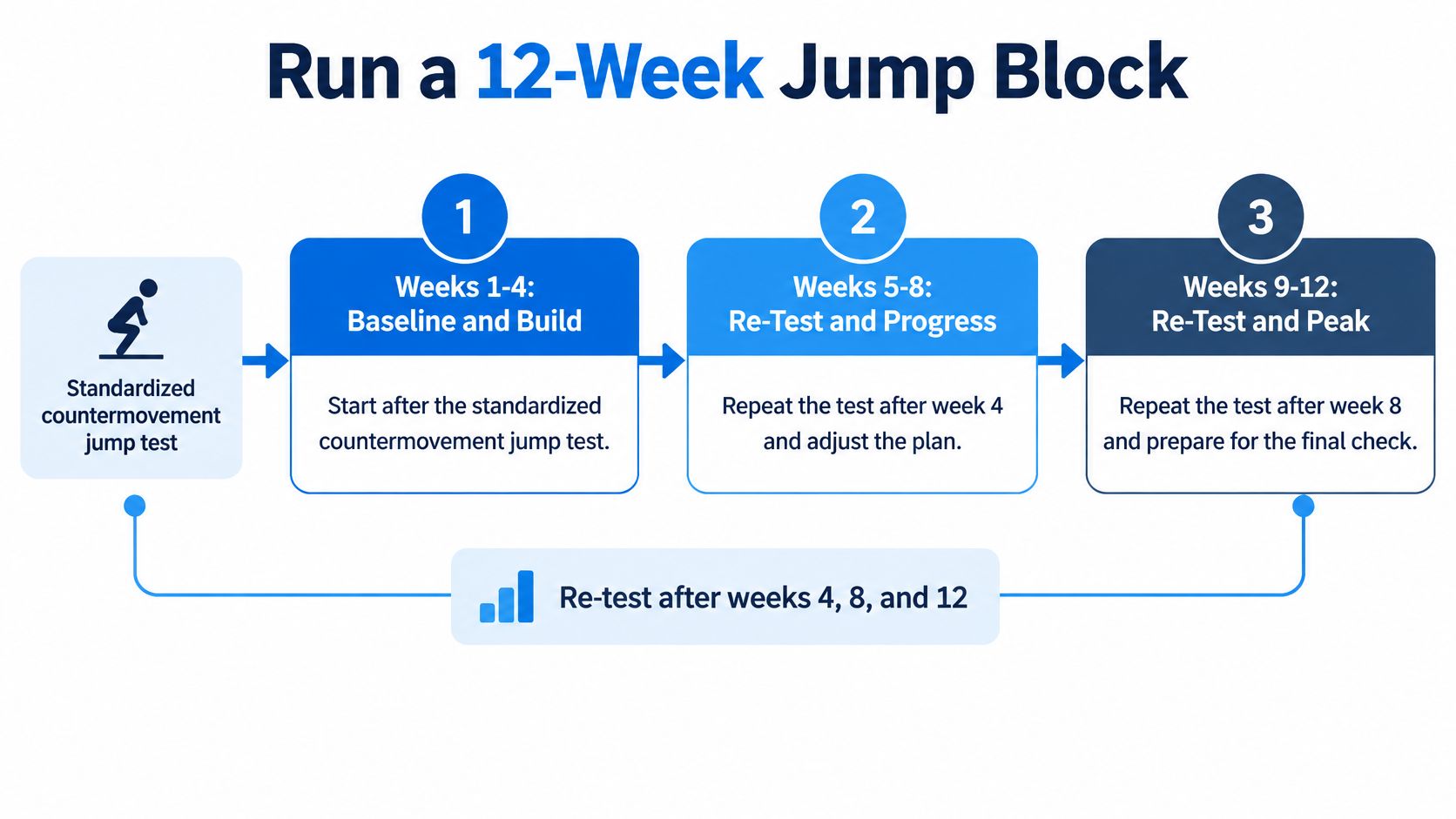
Start with the standardized countermovement jump test, then train in three four-week blocks and retest after weeks 4, 8, and 12. The plan below suits a recreational or team-sport athlete who can train lower body work across four days. It follows the practical structure described in the Scandinavian Journal of Medicine and Science in Sports plyometric synthesis, which paired progressive resistance work in the 3 to 8 repetition range with high-quality, low-fatigue jump contacts and repeat testing after each block.
Five Actions That Carry the Block
- Lift for force twice a week. Use a squat or trap-bar squat pattern, a rear-foot-raised or walking split squat, and a hip-extension pattern such as a Romanian deadlift. Work in 3 to 5 sets of 3 to 8 controlled reps and stop most sets with one or two reps in reserve. Add load only when bar speed and positions stay clean. Relative strength, force per kilo of body weight, is the target, not a gym total that leaves you too sore to jump.
- Jump for power twice a week, fresh. Rotate pogo jumps for ankle stiffness, countermovement jumps for maximal intent, and unloaded or lightly loaded jump squats for fast force. Rest long enough between efforts that each jump looks like the first. Stop the set when height drops or landings get loud. Tired jumps are slow jumps, and slow jumps teach the wrong skill.
- Open the positions before power work. Spend 8 to 10 minutes on ankle dorsiflexion, hip extension, and thoracic extension. Use a knee-to-wall ankle rock, a couch stretch or half-kneeling hip-flexor drill with a glute squeeze, and thoracic rotations over a foam roller. Mobility isn't a separate hobby here. It lets you reach a deeper, balanced dip and extend fully at takeoff.
- Change one variable per block. In weeks 1 to 4, own landing and takeoff mechanics at roughly 60 to 80 quality contacts per week. In weeks 5 to 8, raise intensity with higher countermovement jumps, low box jumps, or light loaded jumps at roughly 80 to 100 contacts. In weeks 9 to 12, add slight load or approach-jump specificity for your sport without adding contacts. One change at a time tells you what worked.
- Protect the gaps. Leave at least 48 hours between demanding lower-body sessions. Adaptation happens between sessions, in sleep, food, and ordinary recovery. Our overview of post-workout recovery tips fits here as a checklist for the hours after a hard day, not as a substitute for spacing the days correctly.
A Sample Week Around Saturday Sport
- Monday: Strength session one, squat pattern, split squat, calf raises
- Tuesday: Power session one, pogo jumps and countermovement jumps
- Wednesday: Easy mobility and upper-body work if you want it
- Thursday: Strength session two, trap-bar pattern, Romanian deadlift, split squat
- Friday: Power session two, jump squats and approach jumps at low volume
- Saturday: Sport practice
- Sunday: Full rest
Friday needs discipline. If Saturday practice matters, Friday's jumps stay few and fast, and you cut them entirely if your legs feel flat. For volleyball and basketball players, count the jumps in practice as part of the week's load. A program that ignores sport practice isn't a program, it's just added fatigue.
Quality rule: If the third jump in a set is visibly lower than the first, you're now training endurance, not vertical jump height.
Expect your response to differ from the pooled averages. Training age, body mass, current strength, tendon tolerance, and measurement consistency all shape the result. A beginner may see the test move in the first block from technique alone. A stronger athlete may need the full twelve weeks before new force shows up as height. Judge the block by the same test, on a fresh day, not by how destroyed a session felt.
Landings That Protect the Jump
Every jump you count as training also includes a landing you have to absorb. Most athletes rehearse leaving the floor and improvise the return. That is backwards for knees, Achilles tendons, and feet, and the load adds up fast when training contacts and sport-practice contacts stack into the same week.
Rehearse the positions below before your weekly volume rises.
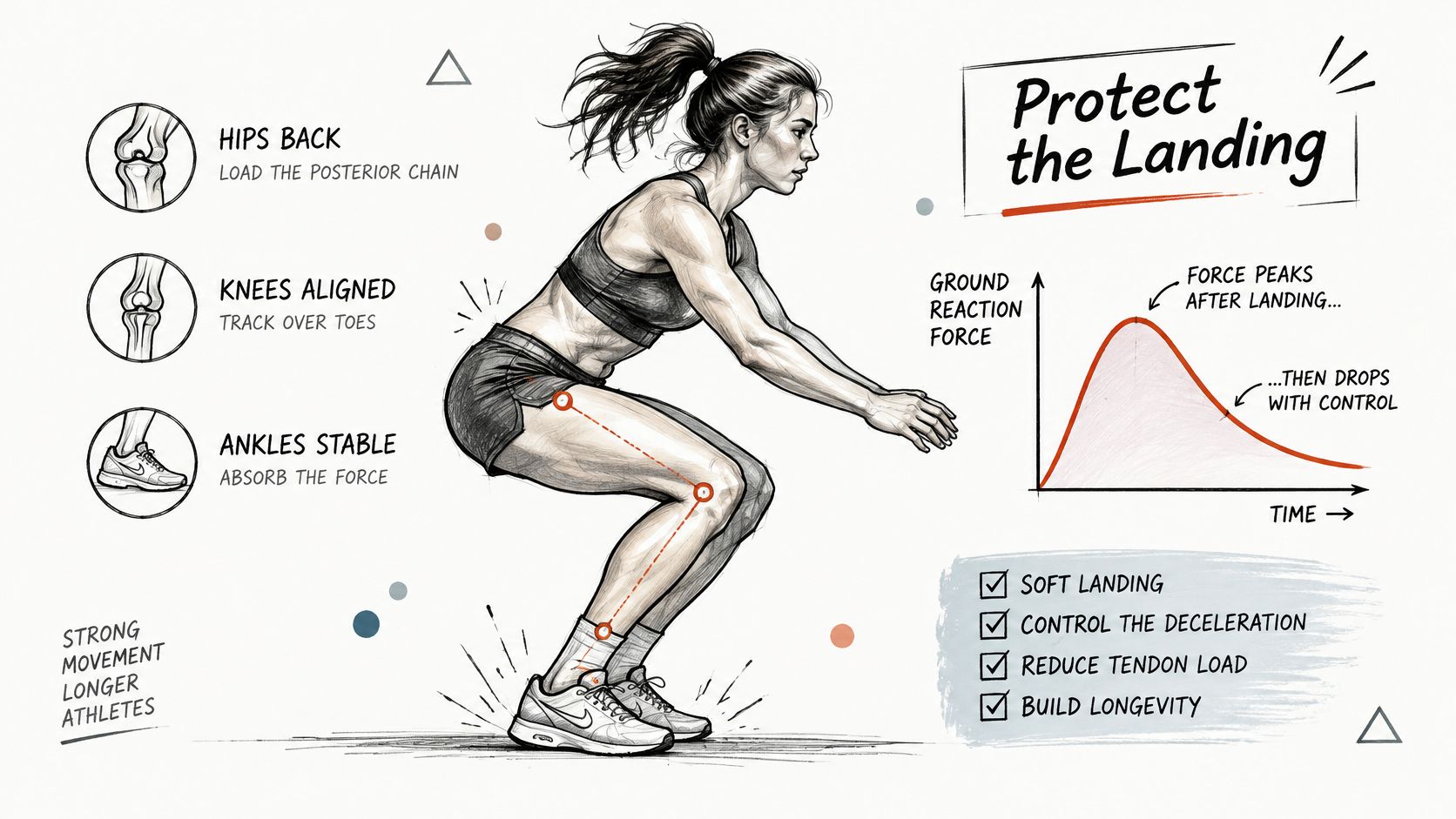
A 2025 prospective study of male volleyball players found that greater concentric knee joint work predicted patellar tendinopathy during block jumps, spike jumps, and drop jumps, with hazard ratios of 1.323, 1.200, and 1.240 respectively and eccentric knee work during block jumps also predictive at 1.246, and it described a 33 cm landing task with estimated metatarsal-injury risk of 62.45% barefoot versus 54.6% with shoes. Hazard ratios above 1 mean risk climbed as knee loading climbed: athletes who repeatedly made the knee do more of the work in jumping tasks were more likely to develop patellar tendon pain. Read those laboratory percentages as a caution about footwear and surface, and not as a personal diagnosis.
Teach a Quiet Landing
Use the same four cues for a drop landing, a box jump step-down, and the end of a countermovement jump.
- Hips travel back: Sit into the landing so hips and knees share the work. Sharing is the point, since the loading pattern that predicted tendon trouble was the knee carrying a bigger share alone.
- Knees track over the midfoot: Don't let them cave inward as you absorb force.
- Heel kisses the floor: Land through the forefoot, then let the heel settle without slamming.
- Balance before the next rep: Stand still for a breath. If you stumble, the rep was too hard or you were too tired.
Wear court shoes on wood or rubber flooring for repeated jumps. Skip depth jumps on concrete, and don't run high-contact plyometrics barefoot on a hard surface just because it feels more natural; the footwear figures above tell you what the lab found when athletes tried it. If you're reviewing your whole week, Aspen Falls Wellness has a useful primer on managing training loads to prevent injuries that pairs well with the contact limits in this plan.
Watch this demonstration before your next plyometric session, focusing on hip position and knee tracking at the moment of contact.
Run a Morning Tendon Check
Before a power day, do ten slow bodyweight squats and a few small pogo hops during your warm-up. Mild stiffness at the front of the knee that fades as you warm up usually means you can train at reduced contacts. Sharp pain at the patellar tendon, pain that grows rep to rep, or a visible drop in jump height means you halve the contacts and pull depth jumps for that week.
Practice approach steps, arm swing, and landing in the same session. A volleyball hitter who drills a clean penultimate step and then lands stiff-legged with knees collapsing has trained half a skill. Finish every approach rep the way you would want to land in a match, balanced and quiet, before you walk back for the next one.
Fixes When Jump Progress Stalls
A stall usually has a boring cause. You're jumping tired, testing on the wrong day, adding contacts when you need load, or stacking too much into one week. Fix one variable, keep it fixed for a full block, and retest. Changing three things at once feels decisive and tells you nothing.
The most common stall shows up inside the set. Your first countermovement jump is sharp, the second is lower, and by the fourth you're muscling through a slow dip. That's fatigue lowering takeoff velocity, not a character flaw. End the set, take full rest, and keep the next power day at least 48 hours away.
| What you notice | Likely driver | Change next session |
|---|---|---|
| Jump height falls during the set | Fatigue lowering takeoff speed | Stop the set; keep 48 hours before the next power day |
| No gain on the same test after 4 weeks | Force capacity lagging | Add load to squats; do not add contacts |
| Ankles feel blocked on the approach | Limited dorsiflexion | Do mobility before plyometrics, not after |
| Sport practice plus two power days feels flat | Weekly density too high | Drop one power session until the season eases |
| Jump test feels worse after poor sleep | Recovery deficit | Skip maximal-height testing that day |
Check the Test Before You Blame the Program
Don't stack a maximal-height test on the same day as your highest-contact session, and don't test after a short night of sleep. You'll record fatigue and call it a plateau. Retest on a fresh day with the standard setup. If the number still hasn't moved after four weeks, look at the squat pattern. Add a small amount of load across the next block rather than doubling pogo contacts. More contacts mostly buy more landing exposure.
Weekly density is the other quiet culprit. Two power days plus two sport practices plus a game can leave no day when your nervous system is fresh. Drop one power session and keep the strength work shorter. Our guide to overtraining prevention is relevant when flat jumps come with poor sleep, heavy legs, and declining motivation across several weeks.
One boundary matters more than any adjustment in the table. If pain is sharp, swelling appears, or you start limping, stop jumping and see a clinician. A program edit isn't a diagnosis, and tendons don't reward stubbornness.
Why This Matters
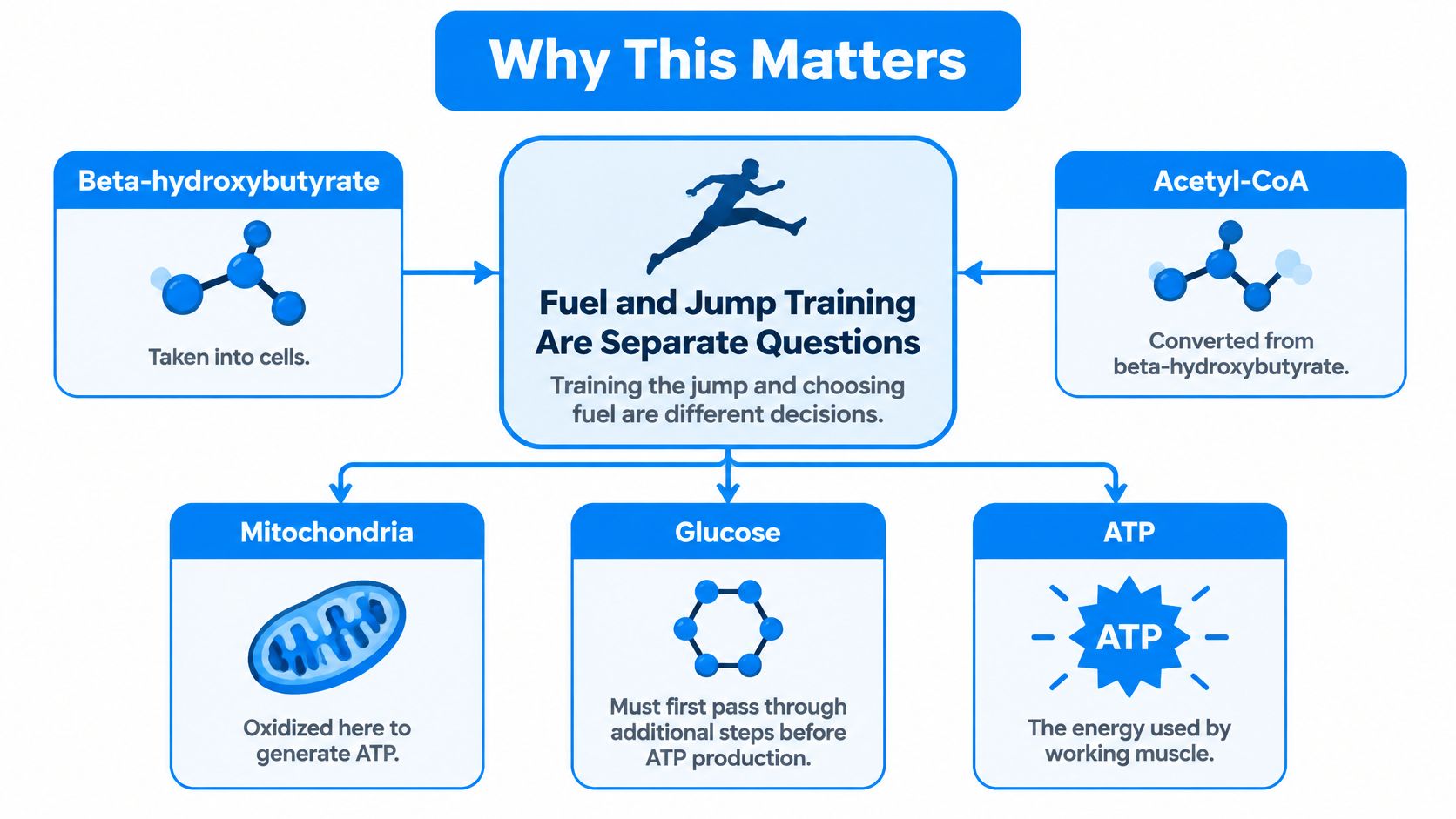
Training remodels tissue and the nervous system over weeks. A drink changes which substrates are available to burn for a few hours. Expecting centimeters from fuel is how athletes end up neglecting the squats that produce them.
How Ketones and Glucose Reach ATP
Beta-hydroxybutyrate, or BHB, is the main circulating ketone. The peer-reviewed review of BHB metabolism describes BHB being taken into cells and metabolized inside mitochondria, where it's converted to acetyl-CoA, enters the tricarboxylic-acid cycle, and contributes to ATP generation. Glucose takes a longer front end. It must first pass through glycolysis in the cell fluid before its carbon reaches mitochondrial acetyl-CoA production. Both pathways end at ATP, the energy currency muscle uses to contract. They differ in the steps, the tissues that prefer them, and how diet and training state shift the mix.
That ability to use more than one fuel is metabolic flexibility. A sprinter doing repeated maximal jumps leans heavily on stored phosphocreatine and carbohydrate for very fast energy. A longer mixed session of lifting, drills, and conditioning draws more on fat and, when available, ketones between efforts. The brain also uses ketones readily when they're in circulation, which is why researchers study them for cognitive endurance as well as muscle work.
Three terms need separating, because the market blurs them.
- Nutritional ketosis: Your liver raises endogenous ketone production because carbohydrate intake is very low or you're fasting.
- Endogenous production: The ketones your own body makes, mainly in the liver from fatty acids.
- Exogenous supplementation: Ketones or ketone-forming compounds you ingest, which raise circulating levels without a ketogenic diet.
What Human Exercise Data Actually Show
The evidence is narrower than the marketing. The peer-reviewed review of exogenous ketones and exercise covered a controlled study in which ketone-ester ingestion raised plasma D-BHB to approximately 2 to 3.5 mmol/L, spared muscle glycogen versus a carbohydrate drink, and produced a performance gain of about 2%, while its meta-analysis of 13 acute studies found no significant overall exercise-performance benefit (Hedges' g of −0.05, 95% confidence interval of −0.30 to 0.20, P = 0.682). The strongest measured result in the literature, from Cox et al. 2016 in Cell Metabolism, had athletes covering 28% farther on the same effort. Notice the shape of that finding: it is an endurance result, not a jump-height result. Ketones change fuel availability. They are not a reliable acute enhancer and not a method for buying vertical-jump centimeters.
Format still matters for what reaches your blood. Ketone esters break apart to release BHB directly. Ketone salts pair BHB with minerals, adding a mineral load for the same BHB dose. Precursors such as R-1,3-butanediol aren't BHB themselves and must be converted first. Our Tecton EDGE™ Performance Shot + Electrolytes uses liposomal R3HBG ketone, a tri-ester designed to deliver bioidentical D-BHB.
Practical Outcomes, Stated Honestly
On a training day, realistic expectations are steadier energy across a mixed session, more even effort between lifting and sport work, and metabolic flexibility without eating a strict ketogenic diet. The clearest fit is an athlete who wants ketone availability for a long practice, a double session, or a physically demanding day, and who already handles the basics.
The honest scale of benefit sounds like Marcus, a website reviewer: "I would say i do notice a bit of a jump in my focus. Hard to explain it, but feels very steady without any jittery feeling!" That is what a fuel substrate can credibly offer. Expect a shift in fuel mix over minutes. The centimeters still come from loaded squats, quality contacts, and controlled landings.
Application Framework for the Next Session
Use this checklist before your next workout. It takes two minutes and prevents most of the mistakes that stall a jump block.
- Confirm the day type: Decide whether today is strength, power, or rest. Keep the 48-hour gap after the last hard lower-body session, and use the in-season dose if you're competing.
- Run the tendon check: If squats and small hops produce sharp patellar pain, make today strength technique or upper-body work and skip plyometrics.
- Fuel the session you planned: Eat a carbohydrate-containing meal before repeated maximal jumps, keep protein consistent across the week, and protect 7 to 9 hours of sleep for the tendon and nervous-system adaptations you're training.
- Retest only when fresh: Use the same shoes, surface, and arm swing at weeks 4, 8, and 12, never after a heavy practice.
If you want exogenous ketones for steadier effort and focus, take one serving with training, not instead of it. One reviewer said they had steady energy and felt locked in during gym workouts, which is the right scale of expectation. Ketones don't outrun a sloppy landing or a missed strength day.
At week 12, keep the program only if the same test moved and your landings stayed quiet. If height rose but knees complain every morning, reduce contacts and get assessed. If landings are clean and height didn't move, add load to the strength work in the next block.
If you're building a twelve-week jump block and want ketone fuel that fits training days without a strict ketogenic diet, Tecton Ketones™ offers liposomal, bioidentical D-BHB shots designed for steady energy, focus, and metabolic flexibility. Pair one with the strength, plyometric, and landing work above, and let the test at weeks 4, 8, and 12 tell you what's working.


