


The usual advice is to buy the exogenous ketone that pushes the meter highest, then treat that spike as proof of fat burning. That advice confuses a blood reading with an energy deficit. The better standard for the best exogenous ketones for weight loss is usable D-BHB, a dose you can repeat without feeling sick, and a plausible effect on hunger or adherence. A drink that only inflates a strip for an hour does not change your waist.
Three states get mixed together in marketing. Nutritional ketosis is the rise in ketones that follows carbohydrate restriction. Endogenous ketone production is what your liver does from fatty acids during a fast or hard exercise. Exogenous ketone supplementation hands you beta-hydroxybutyrate (BHB) without requiring that diet. Only the third is a product choice, and the product is still fuel.
Criteria for the Best Exogenous Ketones
A higher ketone number is not weight loss. Score a bottle on six pass-fail tests before you care about flavor or a before-and-after photo of a meter.
| Criterion | What to look for | Why it matters | Red flag |
|---|---|---|---|
| Usable ketone form | D-BHB or a bioidentical ester, not unlabeled total BHB | L-BHB is less readily metabolized | Racemic salt sold as if all BHB were equal |
| Dose transparency | Grams of D-BHB or ester per serving | Blood response depends on dose and isomer | Only a proprietary blend |
| Calorie accounting | Serving calories counted in daily intake | Ketones are fuel and can add energy | Marketed as a zero-calorie fat burner |
| Appetite versus fat loss | Hunger, intake, or adherence data separated from body-fat claims | Acute fullness is not fat loss | Ketone rise treated as proof of fat burning |
| Tolerability | Human GI-event notes and mineral load | Daily use fails if nausea or salt load is high | No tolerability information |
| Outcome window | 8–12 weeks of weight, waist, intake, and lean mass | Short ketone spikes do not show durable loss | Before-and-after strips only |
Usable form: Demand the isomer. If the label says only "BHB" and the human data never split D from L, it fails.
Dose: You need grams of D-BHB or ester in the serving. A blend with no gram amount fails, because you cannot compare it with any drink that was tested.
Calories: Write the serving into the day's intake. A claim of a calorie-free fat burner fails on its face, because the molecule is an energy substrate.
Appetite: A few hours of less hunger is a signal. It is not a change in fat mass. Any ad that treats the meter as proof of fat burning fails.
Tolerability: Look for gastrointestinal notes and the mineral load. Silence on nausea or salt fails a product you would have to take on ordinary days.
Window: Judge 8 to 12 weeks of body weight, waist, energy intake, and lean mass. Strips alone fail.
Decision rule: If isomer, D-BHB dose, and tolerability are missing, skip the product, regardless of taste or marketing.
How BHB Becomes Cellular Fuel
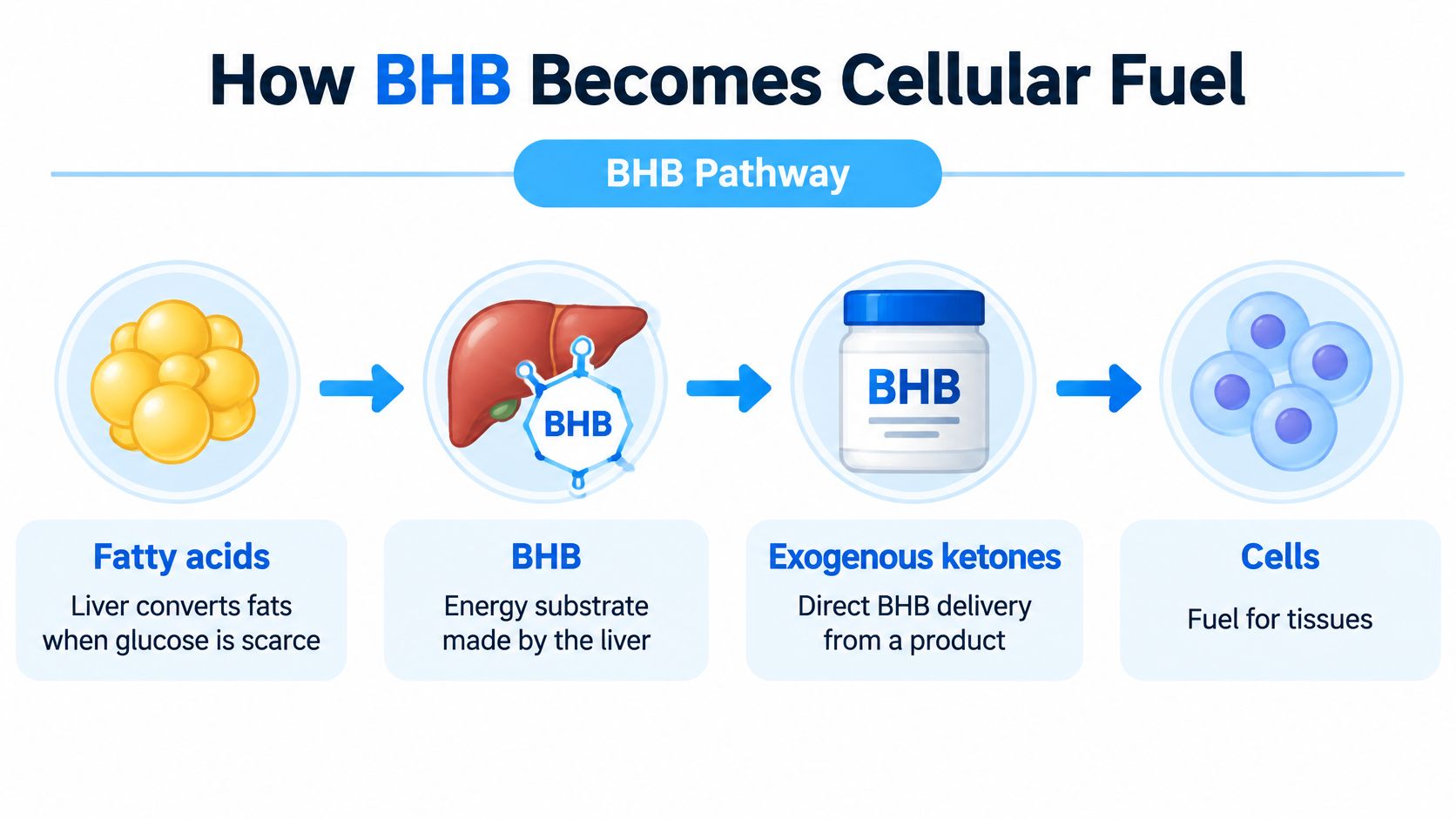
Beta-hydroxybutyrate is the energy substrate your liver makes from fatty acids when glucose is scarce. An exogenous product can also deliver BHB, or a precursor of it, without that wait. Either way, the useful question is whether tissues can oxidize it.
The path into ATP
Muscle, heart, and brain take up BHB. Inside the cell it is converted toward acetoacetate and then acetyl-CoA. Mitochondria oxidize that acetyl-CoA through the tricarboxylic-acid cycle and make ATP. Glucose also ends as acetyl-CoA, but it gets there through glycolysis. Ketone oxidation is a second door into the same cycle, not a separate calorie-erasing pathway.
If you are sorting diet styles before you add a drink, it helps to compare keto and low-carb diets so you know which fuel pattern you are already in.
What a controlled rise actually did
In healthy post-absorptive men, raising blood BHB from a basal range of 160–450 µmol/L reduced glucose appearance by 14 ± 2% and lipolytic rate by 37 ± 4%, without changing insulin or glucagon, while cerebral BHB uptake and oxidation rose with arterial concentration, according to a controlled metabolic study. That is metabolic flexibility: tissues oxidize ketones when ketones are available. It is not automatic fat loss. The experiment measured acute fuel handling, not body composition over weeks.
Brain, heart, and a vascular signal
In brain cells, ketones become acetyl-CoA and can be oxidized. A blood number by itself does not prove that step happened. In heart muscle, the same style of controlled hyperketonemia can shift fuel off glucose. One infusion study in eight healthy adults raised circulating sodium BHB and increased myocardial blood flow by about 75%, reported in human cardiac ketone research. That is a vascular signaling effect of ketones under lab conditions. It is not evidence that a commercial drink improves endothelial health, and it is not a treatment claim.
A measurable BHB rise matters only if the form can be oxidized.
Why This Matters
For weight loss, a higher ketone reading is not the outcome to optimize. What matters is whether ketones fit into daily life and support habits a person can sustain.
Steadier energy. Having another fuel available between meals may make a long gap before lunch feel more manageable. The effect varies, and ketones do not guarantee that fatigue will disappear.
Cognitive endurance. Some people may find a ketone product useful during a long desk session. Any perceived benefit is individual and should not be treated as evidence of improved cognition or disease treatment.
Workout performance. Ketones may provide another fuel source during training, but a higher blood reading does not establish a performance benefit. The relevant test is whether training feels or performs better in a way that can be sustained.
Appetite and adherence. If a product makes a planned eating routine easier to follow, that may help indirectly. It does not ensure a calorie deficit or weight loss.
A useful choice is one that delivers usable D-BHB, is tolerable for regular use, and supports appetite or adherence without replacing the eating and training habits that drive results.
Salts Esters Precursors and Bioidentical Forms
The isomer and peak level matter more than the word “ketone” on a label. In a controlled study, 15 participants drank about 12 or 24 grams of BHB as an ester or a salt. The ester peaked at 2.8 mmol/L D-BHB versus 1.0 mmol/L for the salt (P < 0.001); ester drinks raised D-BHB more than 50% above salt drinks, racemic salts increased L-BHB, and ketones were near baseline in about 3–4 hours, according to human ketone ester and salt research. The study measured acute metabolism, not body fat. Exogenous ketones also do not turn on liver ketogenesis.
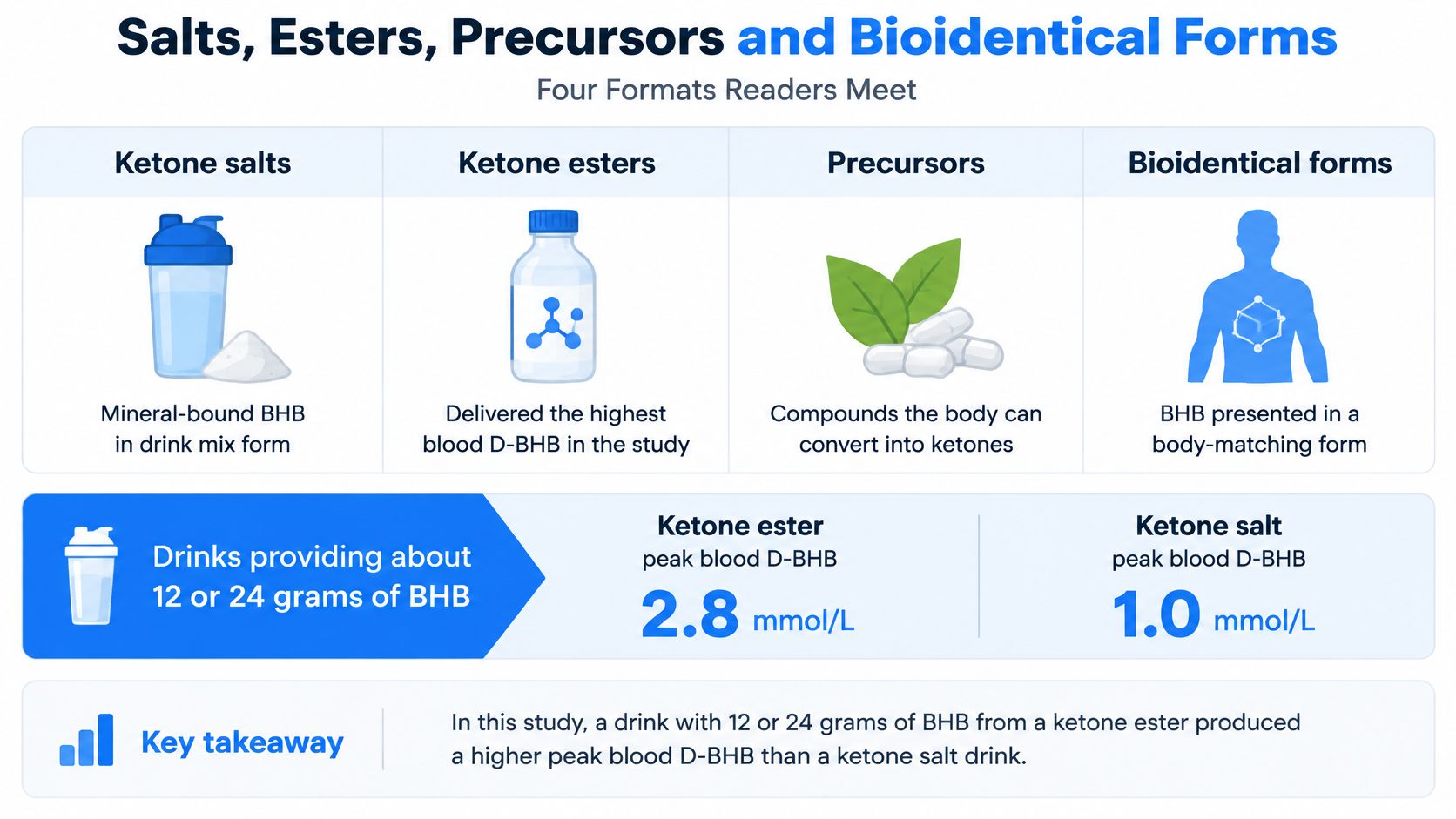
The useful comparison is delivered D-BHB alongside tolerability, rather than total BHB listed on a label.
| Formulation | Studied or labeled dose | Peak blood D-BHB | Duration | Main drawback |
|---|---|---|---|---|
| Ketone salts | About 12 or 24 g BHB in a controlled drink | 1.0 mmol/L | Near baseline in about 3–4 hours | Racemic L-BHB and mineral load |
| Ketone esters | About 12 or 24 g BHB in a controlled drink | 2.8 mmol/L | Near baseline in about 3–4 hours | Calories, taste, and GI tolerance |
| R-1,3-butanediol precursors | Precursor dose, not preformed BHB | No preformed D-BHB peak reported | No BHB duration reported | Requires conversion before a ketone appears |
| Bioidentical D-BHB ester (R3HBG) | 10 g R3HBG per bottle | No published peak for this 10 g bottle in that comparison | Not reported in that drink study | Still a caloric fuel; this dose lacks the same published peak |
Ketone salts bind BHB to minerals. Total BHB can look similar on a label even when much of it is the L-isomer, which is cleared more slowly and used less readily. Mineral load can also limit how much a serving delivers before it causes digestive discomfort.
Ketone esters release D-BHB when the ester is cleaved. The controlled comparison showed a higher D-BHB peak than salts, while taste, calories, and possible nausea remain practical considerations.
R-1,3-butanediol is a precursor: the body converts it before a ketone appears. If you are comparing fat-based precursors with preformed ketones, this guide to MCT powder and ketone esters explains the difference in their routes.
Bioidentical esters supply a ketone molecule the body also produces. Tecton Ketones products contain 10 g of R3HBG per bottle. R3HBG is wrapped in a patented liposomal shell designed to help it survive digestion and reach the bloodstream intact. Tecton says its R3HBG products contain no salt loading and are designed to avoid GI distress. The ester-versus-salt study did not report a peak for this 10 g bottle, so the values in the table should not be treated as a direct product comparison.
The Tecton EDGE Performance + Electrolytes ketone shot combines ketones with electrolytes. A formula's practical value depends on whether its dose is tolerable enough for regular use, not on the largest reading it can produce.
The short explainer below shows how isomer and delivery can affect measured ketone levels.
How to Read Ketone Measurements
A ketone number answers one question: did circulating ketones rise? It does not answer whether weight, waist, or intake changed.
Three tools, three different signals
| Method | What it measures | Use for |
|---|---|---|
| Blood D-BHB meter | Circulating D-BHB in mmol/L | Most direct check on delivery |
| Breath acetone meter | Volatile acetone trend | Rough trend only |
| Urine strips | Acetoacetate excretion | Weak fit for judging supplement intake |
Blood meters report circulating D-BHB in mmol/L, the isomer ester formats are built to deliver. A single stick at a random time is a poor stand-in for peak exposure, because levels rise and then fall back toward baseline over a few hours.
Breath acetone meters track a volatile byproduct. They are useful as a rough trend, not as a dose check.
Urine strips detect acetoacetate leaving the body. That reflects overall ketone status, not freshly delivered D-BHB, and hydration or how adapted you already are can push the color high or low for reasons unrelated to the serving.
A simple reading routine
- Baseline: Read before the first serving.
- Fixed interval: Read at the same time after the serving each day you test.
- Clearance: Read again around the few-hour mark to see the return toward baseline.
- Context: Log meals, whether you were fasting, and hydration next to the number.
- Stop stacking: Do not chase a higher number with a second serving. Extra fuel is extra calories, and GI tolerance usually fails first.
Keep the meter in its lane. Body weight, waist, and intake belong in an 8 to 12 week log, not on the strip.
Weight Appetite and Glucose Evidence
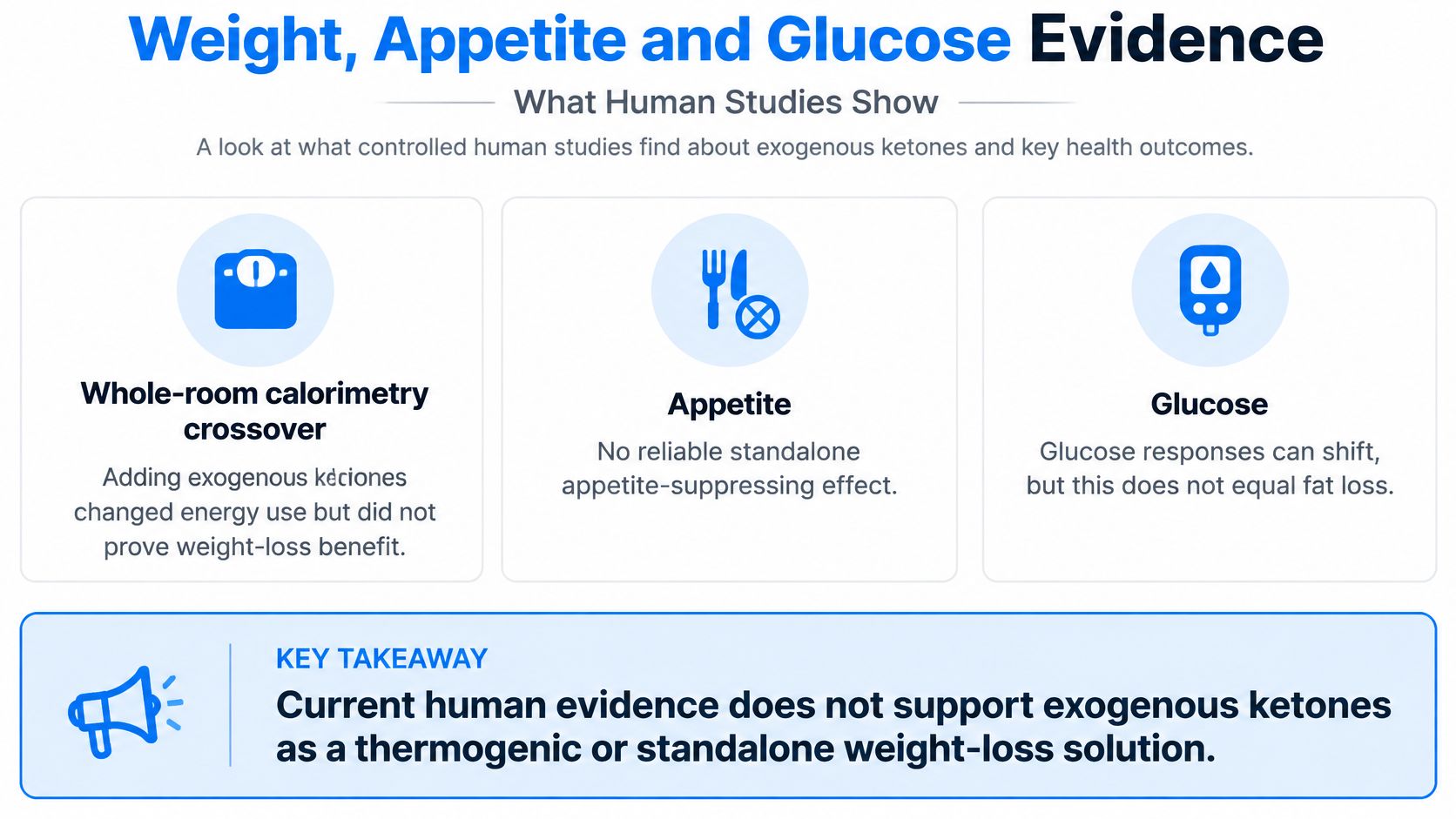
A higher ketone reading does not mean more body fat is being burned. Human studies have not established exogenous ketones as a standalone weight-loss method; their more plausible role is as a fuel or, for some people, temporary appetite support.
Expenditure did not rise
In a randomized crossover study using whole-room indirect calorimetry, adding exogenous ketones to an isocaloric diet did not significantly increase total or sleeping energy expenditure, according to a clinical review of exogenous ketones and body weight. When calories were matched, ketones did not produce a measurable increase in energy expenditure.
Within-group fat change is not placebo-proven loss
An eight-week randomized, double-blind, placebo-controlled trial of BHB mineral salts with modest calorie restriction reported about 2 kg of within-group fat-mass reduction, along with improved body-fat percentage and lean-to-fat ratio and largely preserved lean mass, as summarized in the clinical review of exogenous ketones and body weight. The changes were mainly within the salt group, rather than clear evidence of superiority over placebo. The review describes weight evidence as incomplete, and short studies cannot establish durable loss.
Acute ketone monoester drinks reduced hunger and desire to eat, while increasing fullness compared with an isocaloric dextrose control, in Oxford ketone monoester research. That is a short-term appetite response, not proof of sustained calorie reduction or fat loss. Practical strategies for managing hunger can support adherence without treating a ketone rise as a weight-loss result.
| Outcome | What studies found | What it does not prove |
|---|---|---|
| Energy expenditure | No significant rise in total or sleeping expenditure on an isocaloric diet | A thermogenic fat-burning effect |
| Body composition | About 2 kg within-group fat-mass loss over 8 weeks with salts plus calorie restriction; lean mass largely kept | That ketones beat placebo for fat loss |
| Appetite | Acute ester drinks reduced hunger for hours | A sustained drop in calorie intake for every user |
| Body weight attribution | Weight fell when BHB was paired with a low-calorie diet in a 2025 trial | That BHB caused the loss; between-group body-composition differences were not significant |
What to track instead
For 8 to 12 weeks, log body weight, waist, fat and lean mass, energy intake, hunger ratings, and whether you took the serving. These measures help distinguish a possible appetite benefit from lasting fat loss. A temporary change in glucose is a separate response, not evidence of fat loss, and does not establish that everyone will respond the same way.
Safety, Medication Cautions and Who Should Use Ketones
Ketones can change glucose handling and cause digestive symptoms, so safety depends on the person and the formula. The practical question is whether a serving fits your medication, health status, and ability to use it comfortably.
Medication, glucose, and pregnancy
People who use insulin or other glucose-lowering medication should speak with a clinician before trying exogenous ketones. A change in glucose can affect how medication and meals need to be managed. Do not use a ketone drink to replace a prescribed meal or treatment.
Pregnancy is another reason to seek clinical advice before use. People with a health condition or a prescribed diet should also check with their care team, particularly before using ketones while fasting.
Digestive effects and formula differences
Nausea or abdominal discomfort can occur with ketone drinks. Mineral-heavy ketone salts add sodium or potassium, while ketone esters avoid that salt load but still provide calories and may still cause digestive symptoms. For a closer look at common exogenous ketone side effects, consider how the formula and serving fit your routine.
A tolerable serving matters because discomfort can make regular use impractical. The best option is the one that provides usable D-BHB, feels manageable in everyday use, and may help with appetite or adherence, rather than one chosen for a high ketone reading or a promise of standalone fat loss.
Match use to the goal
Appetite within a weight plan. R3HBG raises blood ketones directly, regardless of what you have eaten, and works alongside a normal diet. The GLP-1 Shot is designed to support structured habits without relying on aggressive stimulants or appetite suppressants. Any use should fit a broader plan, not replace meals or prescribed care.
Training. Choose a formula according to the practical need. If sweat loss is a concern, an electrolyte formula may be more relevant than adding another ketone serving.
A long focus block. If a product includes caffeine, account for that stimulant separately from the ketones. Consider whether it suits your usual tolerance and the time of day.
If weight has returned after dieting, addressing weight regain with clinical guidance may be more appropriate than adding servings. Dietary-supplement statements have not been evaluated by the FDA. These products are not intended to diagnose, treat, cure, or prevent any disease.
Application Framework for a Weight Plan
Run one 8 to 12 week test. Do not add a new theory in the middle of it.
- Pick the form first. Choose a D-BHB or bioidentical ester with a stated gram dose. Skip racemic salt blends and butanediol precursors if daily GI comfort matters.
- Account for the fuel. Write the serving calories into the day's intake and set a protein target so the drink does not push a meal off the plate.
- Tie one serving to one job. Use it at a consistent time, such as an afternoon hunger window or a focus block. Our 10 g R3HBG bottle is one bioidentical ester option, and only after steps 1 and 2 are met. We sell four formulas: EDGE Caffeine, EDGE Electrolytes, Locked Cognition, and GLP-1 Activator.
- Skip the ramp-up myth. There is no loading phase, and you do not need to be in ketosis first for the serving to raise ketones.
- Log the first two weeks for feel, not fat. Note hunger, GI symptoms, and whether workouts or focus feel steadier.
- Judge weeks 8 to 12 on the body, not the strip. Compare weight, waist, how clothes fit, and intake. If only ketone readings changed, stop.
- Keep the claim in bounds. Do not treat the product as a diagnosis, treatment, cure, or prevention. Statements have not been evaluated by the FDA.
Practical takeaway: use a tolerable bioidentical D-BHB serving inside a calorie deficit, and judge it by adherence and body measures, not by the meter. If you want a clinician in the loop while you test that plan, you can find physician-guided weight management options rather than guessing at medication interactions alone.
Tecton Ketones™ offers bioidentical R3HBG servings designed to raise usable D-BHB without salt loading, so a weight plan can test adherence and fuel rather than a meter spike. If you are choosing a daily ketone for hunger windows, training, or focus inside a calorie deficit, start with the form and the gram dose, then track waist, intake, and how the serving feels. Visit Tecton Ketones™ to see the four formulas and pick the one that matches the job you are testing.


