


You cut carbs, clean up your meals, drink more water, and expect to feel lighter and sharper within a few days. Instead, you wake up tired. Your calves tighten at night. A workout that usually feels normal suddenly feels flat. By midafternoon, your head feels dull and your focus slips.
The initial read on that experience is often “carb withdrawal,” or a belief that low carb is being done incorrectly. In practice, the early problem is often more specific. Your kidneys start handling sodium and water differently when insulin falls, and that fluid shift can pull other electrolytes into the picture. What feels like low motivation can be a hydration and mineral management problem.
That distinction matters whether you're trying a ketogenic diet, reducing starches and sugars, extending fasting windows, or building meals from a practical template like Recipe One's veggie meal plan. The food pattern matters, but the transition physiology matters too.
Athletes notice it during training. Busy professionals notice it as brain fog. New low-carb eaters notice it as the classic “keto flu” cluster. The common thread isn't weakness or poor discipline. It's that low carb and electrolytes are tightly linked from the start.
Introduction to Low Carb and Electrolytes
You lower carbs, keep your meals clean, and expect a steady transition. Instead, two or three days later, your mouth feels dry, your energy fades by afternoon, and standing up quickly feels a little off. Another person notices calf cramps at night. Someone else gets through meals and hydration just fine on paper, yet still feels flat.
That pattern is common because low carb changes fluid regulation before it feels fully settled. The key shift is not just “carb withdrawal.” It is a predictable kidney and hormone response to lower insulin. As insulin falls, the kidneys tend to release more sodium, and water follows. Early symptoms often show up because intake has not caught up with those losses, as outlined in this review guide on electrolytes for low-carb diets.
A simple comparison helps here. Glycogen storage works a bit like a sponge that holds both carbohydrate and water. Lower carb eating reduces that stored fuel over time, but the more important early signal is renal. The kidneys receive less of the usual sodium-retention signal, so the body shifts into a higher-loss state. That is why drinking more plain water does not always make someone feel better.
Why people get confused
The same symptom cluster can come from different phases, and that is where low-carb advice often gets muddled.
Early adaptation is mainly a fluid and sodium management problem. Long-term maintenance is different. Once the initial shift settles, needs depend more on sweat losses, food choices, training volume, medications, and how strict the diet is. A person eating very low carb with frequent fasting may need a different plan than someone eating a moderate low-carb pattern with stable energy and minimal sweating.
That distinction matters for people using a ketogenic diet, reducing starch and sugar, experimenting with fasting, or building meals from a practical template like Recipe One's veggie meal plan.
Who this helps
This is most useful for people who are:
- Starting low carb for the first time
- Using fasting windows
- Training regularly or sweating heavily
- Eating low carb but still getting headaches, cramps, lightheadedness, or low energy
The practical takeaway is straightforward. Electrolyte needs on low carb are not random, and they are not the same forever. They follow a predictable early adaptation phase, then shift into a maintenance phase where replacement should match your actual losses.
Why Low Carb Diets Increase Electrolyte Needs
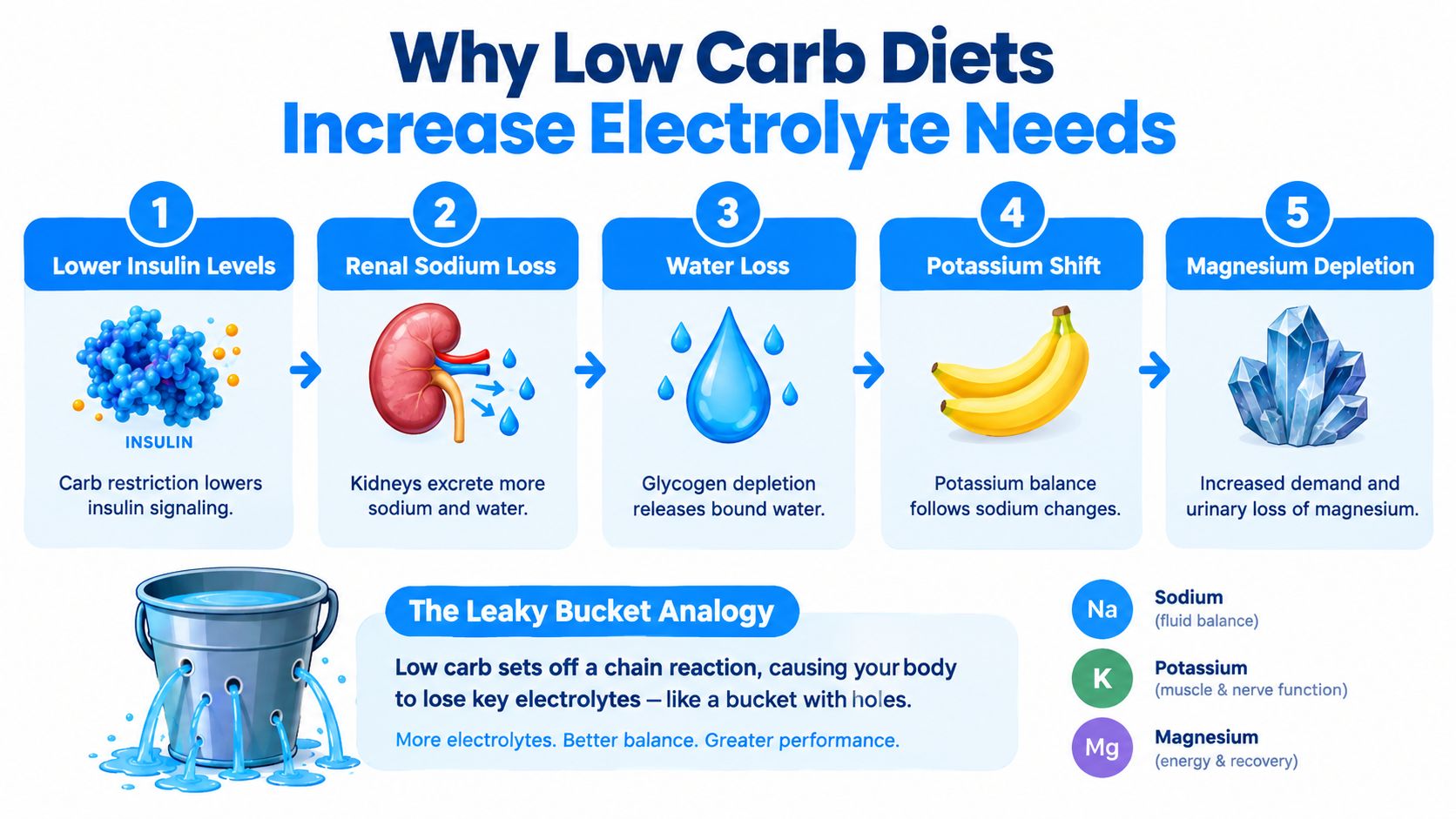
Lowering carbohydrate intake changes more than fuel selection. It changes hormone signaling, and the kidneys respond quickly.
The core mechanism
Think of body fluid balance like a reservoir with a drain valve. When insulin is higher, the kidneys get more of a “hold on to sodium” signal. When insulin drops during low-carb eating, that signal weakens. The drain opens wider. Sodium leaves more easily, and water follows it.
Core mechanism: lower insulin leads the kidneys to excrete more sodium and water, and that early natriuresis can set up fatigue, dizziness, cramps, and brain fog if replacement lags behind losses.
A 2026 peer-reviewed nutrition paper reported that ketogenic meal plans used in clinical reference settings targeted sodium and potassium at or below 100 mmol each, showing that electrolyte planning is built directly into structured ketogenic interventions, not treated as an afterthought (Oxford Academic nutrition paper).
Why symptoms cluster early
The first adaptation window is where most confusion happens. Sodium falls first, water follows, and then other minerals can become harder to manage.
A 2025 scoping review found that low-carb and ketogenic diets commonly cause natriuresis and kaliuresis during initiation, but also concluded that concrete, trial-based salt supplementation recommendations do not appear to exist. In other words, the physiology is real, but one-size-fits-all dosing is not well established by trials (Frontiers scoping review).
That's why people can have similar symptoms for different reasons:
- One person is mainly volume depleted
- Another is under-consuming sodium
- Another is training hard in heat
- Another is fine after adaptation but struggles only on long fasting days
If you want a broader symptom-focused overview, Tecton's article on the keto flu cure is a useful companion.
Nutritional ketosis, endogenous ketones, and exogenous ketones
These terms often get blurred together, but they are not the same.
- Nutritional ketosis means diet-induced ketosis. Carbohydrate intake is low enough that the body increases ketone availability.
- Endogenous ketone production means your body is making ketones itself, mainly in the liver.
- Exogenous ketone supplementation means ketones are consumed directly rather than produced from diet restriction alone.
Electrolyte losses are tied most directly to the hormonal and renal shift that happens when carbs drop and insulin falls. Taking ketones isn't the same thing as reproducing the full low-carb adaptation state.
Signs of Electrolyte Imbalance and How to Recognize Them
Recognition matters because not every symptom means the same thing. “Keto flu” gets used as a catch-all, but that can hide lever you need to pull.
Early adaptation usually feels systemic
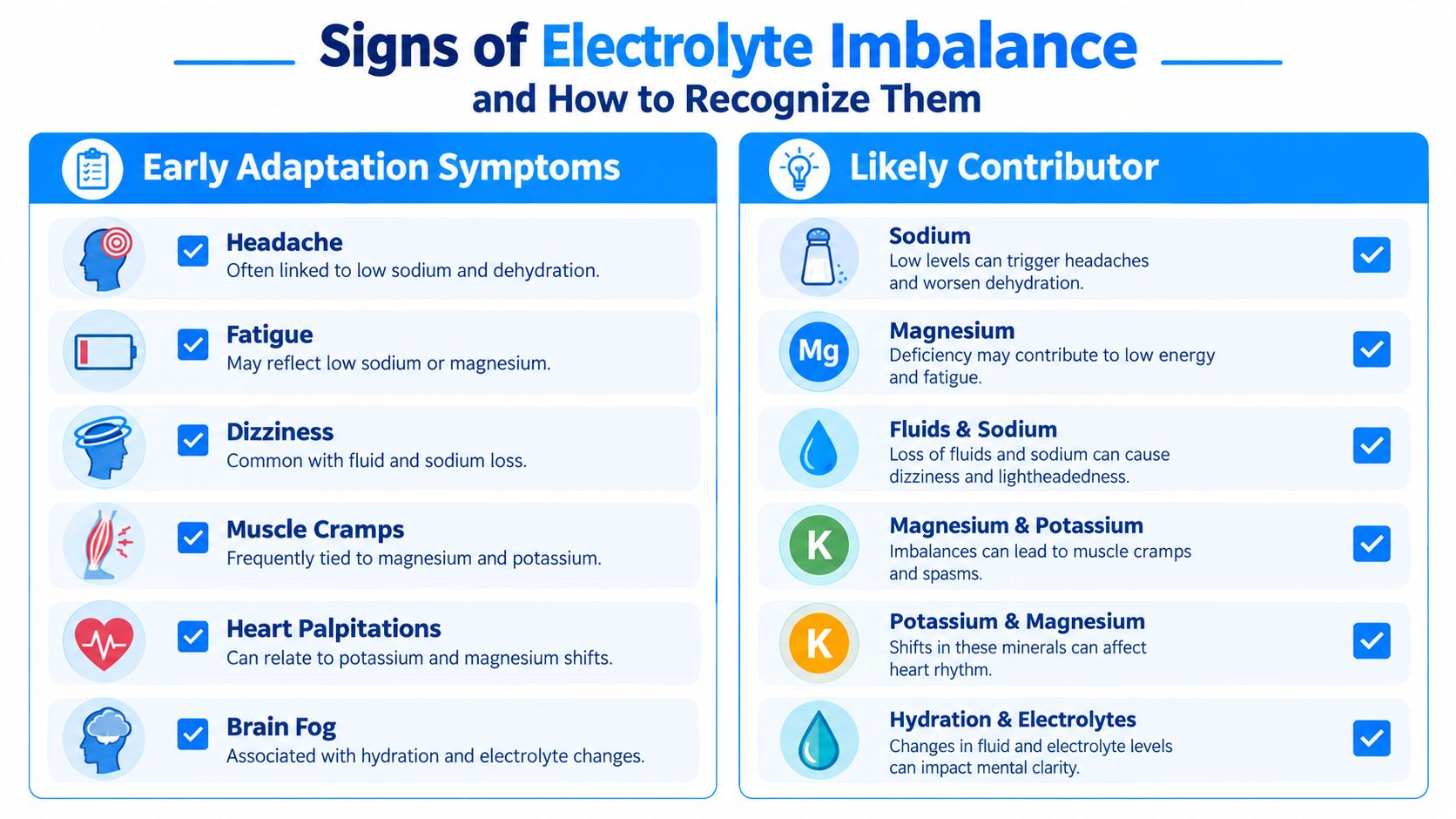
In the early phase, symptoms often come as a cluster rather than one isolated problem. You may notice headache, fatigue, dizziness, cramps, or brain fog showing up together. That pattern often points toward fluid and sodium loss first, with potassium and magnesium becoming relevant depending on food intake, sweat loss, and individual susceptibility.
A useful self-check is to ask whether symptoms change with posture, heat, or activity.
- Lightheaded when standing up quickly often fits volume depletion.
- Workout feels unusually flat or crampy can suggest sodium and fluid replacement are lagging behind output.
- Evening muscle tightness may put magnesium and potassium adequacy on the radar, especially if food variety is narrow.
Ongoing issues look different
Later on, the picture changes. A person who is fully adapted may feel fine day to day but run into trouble during:
- Long training sessions
- Hot weather
- Heavy sweating
- Extended fasting
- Very low food volume days
That isn't the same as the first-week transition. It's a maintenance problem, not an adaptation problem.
Here's a practical way to separate the two:
| Pattern | More likely issue |
|---|---|
| Symptoms started soon after cutting carbs | Early adaptation shift |
| Symptoms mainly appear during exercise or heat | Activity-related replacement gap |
| Symptoms improve after salty fluids and meals | Volume and sodium issue is likely involved |
| Symptoms persist despite basic correction | Broader assessment may be needed |
A short visual explanation can also help clarify the common symptom pattern:
When to get clinical input
Seek professional guidance if symptoms are persistent, unusually intense, or if you take medications that affect blood pressure or fluid balance. The same caution applies if you have a history of blood pressure instability or kidney-related concerns.
Some low-carb symptoms reflect volume depletion, not a vague “mineral deficiency.” That difference changes what usually helps first.
Key Electrolytes and Recommended Daily Targets
Electrolyte planning on low carb works better when you start with the mechanism. As insulin falls, the kidneys tend to release more sodium and water. That renal shift changes fluid balance first. Potassium and magnesium still matter, but they usually become easier to place once sodium is in the right range.
Sodium usually sets the floor
In the early adaptation phase, sodium is often the first intake variable to correct. A practical target often cited for low-carb eating is about 3,000 to 5,000 mg of sodium per day, with the exact amount adjusted to symptoms, food intake, sweat losses, blood pressure context, and clinician guidance when needed.
A simple way to picture it is a bucket with a lower water line. When sodium drops, the body often carries less fluid with it. That helps explain why low energy, dull headache, and standing lightheadedness can improve faster from sodium and fluids than from adding magnesium alone.
This is also where one-size-fits-all advice falls short. Someone in the first week of carbohydrate restriction may need more deliberate sodium replacement than someone who is months into maintenance and only runs into issues during training or heat exposure.
Potassium and magnesium have different jobs
Potassium supports nerve and muscle function, heart rhythm, and intracellular fluid balance. On low carb, it often makes sense to treat potassium as a food-first mineral unless a clinician recommends otherwise. Avocado, leafy greens, mushrooms, fish, meat, and dairy can all help close the gap.
Magnesium is different. It does not usually produce the same quick change in how someone feels that sodium can, but it often matters for muscle relaxation, sleep quality, and cramp tendency. If intake is low, smaller supplemental doses are often tolerated better than large catch-up doses.
For a related discussion of mineral balance, including how these nutrients interact, see Tecton's piece on magnesium and calcium balance.
Practical targets by electrolyte
| Electrolyte | Why it matters on low carb | Practical target or approach |
|---|---|---|
| Sodium | Helps maintain plasma volume as kidneys excrete more sodium and water when insulin falls | Often around 3,000 to 5,000 mg/day in low-carb adaptation, then adjusted to context |
| Potassium | Supports muscle contraction, nerve signaling, and intracellular fluid balance | Prioritize food intake and avoid supplementing aggressively without guidance |
| Magnesium | Supports muscle and nerve function, recovery, and sleep | Aim for adequacy through food first, with modest supplementation if needed |
Match the target to the phase
Early adaptation and long-term maintenance are not the same problem.
During early adaptation, the main question is often whether sodium intake is high enough to match the temporary renal losses that follow lower insulin. During long-term maintenance, the question shifts. Are you replacing what you lose on high-sweat days, fasting days, or low-food-volume days?
That distinction keeps the plan practical. Start by setting a sodium baseline, build potassium mainly through food, and use magnesium as a support tool when diet, symptoms, or tolerance point that way.
Practical Meal and Supplement Strategies for Daily Balance
Daily execution works best when it's simple, repeated, and adjusted by context rather than guesswork.
Build the day around meals, not rescue fixes
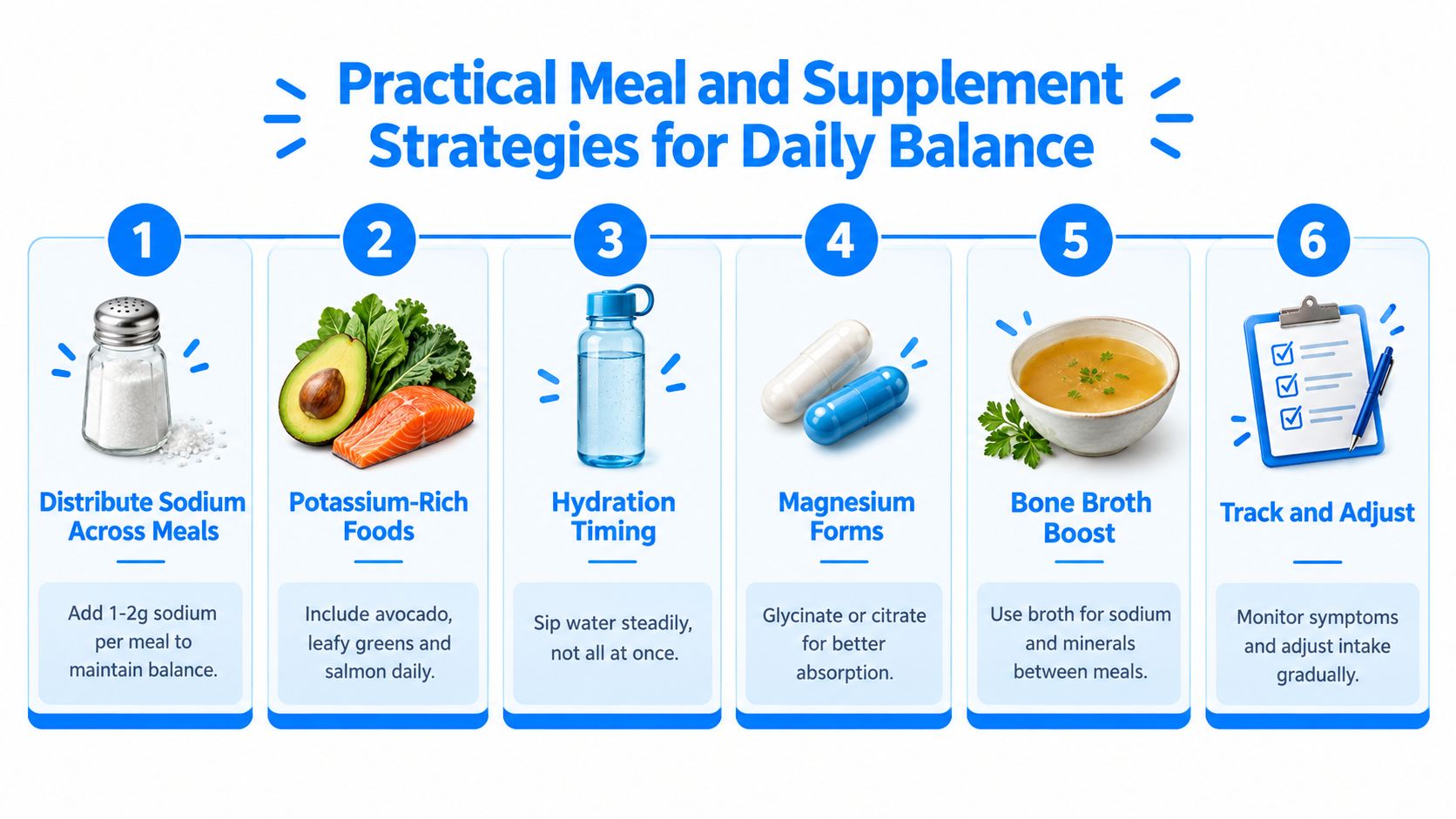
A better approach is to spread intake across the day instead of waiting for a crash.
- Salt meals deliberately. If you only think about sodium after a headache starts, you're already behind.
- Use potassium-rich low-carb foods. Avocado, leafy greens, and fish fit well here.
- Layer magnesium thoughtfully. Many people tolerate smaller evening amounts better than large daytime doses.
A practical breakfast can help anchor the day. If you want an easy low-carb option that pairs well with a mineral-conscious approach, low carb cottage cheese pancakes can work well alongside salted eggs, yogurt, or a mineral-rich side.
Match strategy to the situation
Your approach should change with the day.
On regular workdays
- Prioritize meal salting and steady fluid intake.
- Don't overcorrect with plain water alone.
On fasting days
- Fluid intake often rises while food minerals fall.
- Electrolyte planning becomes more important, not less.
On training days or in heat
- Sweat increases replacement needs.
- Under-fueling plus under-salting is a common pairing.
For broader hydration ideas within a ketogenic routine, Tecton's guide to the best drinks for keto gives practical beverage options.
Choosing between electrolytes and exogenous ketones
The market gets noisy, so the distinctions matter.
- Ketone salts provide ketones attached to minerals. They can contribute to mineral load, but the formulation tradeoffs vary.
- Ketone esters are different compounds that can raise ketones without relying on the same mineral pairing.
- Ketone precursors are not the same as delivering bioidentical BHB directly.
- Liposomal delivery systems are designed to support absorption characteristics and consistency.
- Bioidentical ketone structures matter because D-BHB is the form the body naturally produces and uses.
A human metabolism study found oral D-beta-hydroxybutyrate is rapidly absorbed and metabolized, raises blood ketones above 1 mM, and produces a ketone level about 1.7-fold greater than the same dose of D+L-BHB or MCT despite a lower caloric load. The study also found that the heart and kidneys are major sites of exogenous ketone metabolism (human metabolism study on oral D-BHB).
One example of a combined format is Tecton EDGE™ Performance Shot + Electrolytes. It's designed for active individuals who want steady energy during training, movement, or physically demanding days, and it combines liposomal R3HBG™ ketone with sodium, potassium, and magnesium. That kind of format fits days where stamina, hydration, and metabolic efficiency all matter at once.
The goal isn't to chase products. It's to match the tool to the physiology in front of you.
Why This Matters for Energy Cognition and Performance
BHB is more than a buzzword
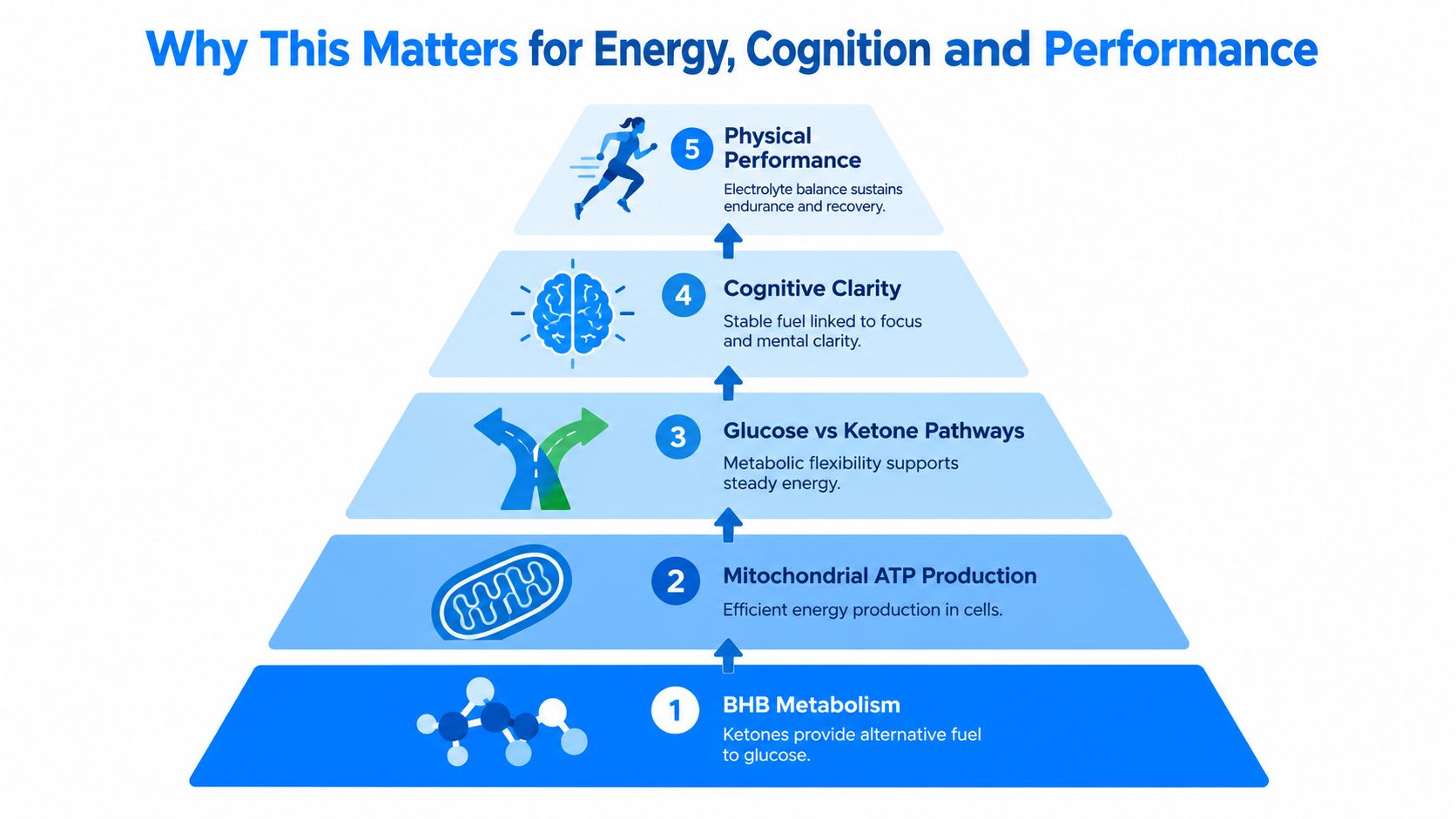
Beta-hydroxybutyrate, or BHB, is a circulating ketone that the body can use as fuel. Once available, it enters tissues and contributes to mitochondrial ATP production, which is the cell's core energy currency. Glucose and ketones both feed energy metabolism, but they arrive through different pathways.
That matters because the point of ketone physiology isn't to declare one fuel “good” and the other “bad.” The useful concept is metabolic flexibility. A flexible system can use glucose when it's available and ketones when conditions call for them.
Why This Matters
For everyday function and performance, the biochemistry translates into a few practical outcomes:
- Steadier energy through access to more than one fuel pathway
- Cognitive endurance when the brain can use ketones as an additional energy substrate
- Workout performance that depends not only on fuel, but on hydration and neuromuscular stability
- Metabolic efficiency when fuel selection and fluid balance are working together
A 28-day human trial in 24 healthy adults found that drinking a ketone monoester three times daily raised blood beta-hydroxybutyrate from about 0.1 mM to 4.1 ± 1.1 mM, while showing no effect on body weight, fasting glucose, cholesterol, triglycerides, electrolyte concentrations, blood gases, or kidney function. Mild nausea occurred in 6 of 2,016 drinks (28-day human ketone monoester trial).
A meta-analysis of 30 studies with 408 participants reported that exogenous ketones significantly increased blood BHB and reduced blood glucose, with effect sizes of Hedge's g = 1.4994 for BHB and -0.3796 for glucose (meta-analysis of exogenous ketones).
A 2026 systematic review and meta-analysis of 38 studies, 41 protocols, and 1,602 participants found that exogenous ketone supplementation was associated with modest but significant improvements in cognitive performance across diverse populations (systematic review on ketones and cognition).
Brain use and signaling
The brain can use ketones as an alternative fuel, which is one reason mentally demanding days feel different for some people when ketone availability is higher. Ketones are also discussed in the literature beyond fuel alone, including roles in cellular signaling. Endothelial and metabolic signaling discussions are still best interpreted carefully, but they are part of why ketone biology gets attention outside sports nutrition.
For people whose main demand is cognitive rather than physical, Locked Cognition™ Shot is designed for mentally demanding days and combines liposomal R3HBG™, Alpha GPC, and Lion's Mane in a format meant to fit workday routines.
Application Framework and Practical Takeaways
A workable plan starts by separating early adaptation from long-term maintenance. Most mistakes happen when people use one rule for both.
Use this decision framework
If you are in the first adaptation window
- Expect fluid and sodium handling to shift.
- Prioritize salted meals, steady hydration, and food-based potassium.
- Use magnesium thoughtfully if cramps or muscle tightness show up.
If you are already adapted
- Judge needs by context, not by internet folklore.
- Training load, sweating, heat, and fasting usually matter more than the label “keto.”
If you are considering exogenous ketones
- Think of them as a separate tool from diet-induced ketosis.
- They may fit before mentally demanding work, during physically demanding days, or when you want ketone availability without relying on strict dietary restriction alone.
What to expect physiologically
A common search is for the same practical signals:
- More stable energy
- Fewer transition headaches
- Less cramping
- Better tolerance of workouts or fasting windows
- Cleaner mental output
If symptoms improve after addressing sodium and hydration, you've learned something useful about the mechanism. If they don't, don't keep guessing forever.
Practical rule: start with the simplest lever that fits the physiology. On low carb, that often means sodium and fluid timing before it means exotic supplements.
Your next 7 to 14 days
Use a short checklist.
- Track timing. Did symptoms begin right after lowering carbs, or only during training and heat?
- Audit meals. Are you eating potassium-rich low-carb foods consistently?
- Review fluids. Are you drinking a lot of plain water without much sodium?
- Adjust gradually. Small, steady changes are easier to interpret than dramatic swings.
- Get help when needed. If you take blood pressure or fluid-related medications, individualization matters.
The main takeaway is simple. Low carb and electrolytes belong in the same conversation. If you treat symptoms as a predictable renal and hormonal shift rather than a vague crash, the path gets clearer and the strategy gets more effective.
Tecton Ketones™ builds exogenous ketone products around clinically informed ketone physiology, including options that fit mentally demanding days and active routines where hydration and steady energy matter. If you want a cleaner, science-led way to explore ketone support alongside smart electrolyte planning, visit Tecton Ketones™.


