


You've probably had this session: pick up a heavy medicine ball, perform slams until your breathing is ragged, and leave feeling as though the workout must have worked. Yet your jump, throw, rotation, or ability to produce force quickly hasn't clearly improved. The problem usually isn't effort. It's that the ball, movement, and intensity were chosen by appearance rather than by the quality you wanted to develop.
Weight ball training works best when the load serves a specific transfer target. A lighter ball can make speed and coordination the priority. A moderate ball can add resistance to trunk and hip movement. A heavier ball can build control and force, but it may also slow the action enough to undermine power. The practical question isn't, “How heavy can I go?” It's, “What should this movement improve?”
Why Most Weight Ball Sessions Miss the Point
A trainee stands over a heavy ball and prepares for a set of slams. The first repetition is sharp, with full-body extension and a fast release. By the sixth, the arms are doing more of the work. By the tenth, the person is bending through the spine, catching the rebound poorly, and chasing fatigue. The session looks intense, but the intended training quality has changed.
That change matters. Power is force produced quickly, while conditioning is the ability to sustain effort. A ball that's appropriate for repeated slams may be entirely wrong for rotational throws intended to improve bat speed or change-of-direction force. The same exercise can train different qualities depending on the load, rest interval, range of motion, and whether every repetition is performed with genuine intent.
A medicine ball has a long therapeutic history. Claudius Galen, a Greek physician who lived approximately from A.D. 130 to 200, is credited with prescribing ball exercises to restore health, vigor, and physical function after illness or injury. Later balls used feathers, air, or sand to create different resistance, and the method eventually moved into military and athletic preparation, including use at the United States Military Academy and by the U.S. Army during World War II. The historical review of medicine-ball training shows why the tool remains relevant: it combines external resistance with movement.
Start with the transfer target
Before choosing a ball, name the quality you want to practice:
- Rotation: Use a side throw or rotational pass, and stop before the trunk loses control.
- Upper-body projection: Use a chest pass, with enough space to release forcefully.
- Full-body extension: Choose a scoop toss or overhead launch, allowing the hips and legs to contribute.
- Conditioning: Use controlled slams, carries, or lunges with longer work periods.
The four foundational patterns are push, rotate, lift, and carry. They give you a more useful starting point than copying a random circuit online. A hard session isn't automatically a productive session. Weight ball training earns its place when the movement quality resembles the action you want to improve.
Ball Selection, Grip, and Foundational Movement Patterns
Select the ball by goal first, body size second. If speed and coordination are the priority, choose a load you can accelerate without hesitation. If you're training resisted movement, use a heavier ball that challenges the trunk while preserving posture and control. If you're new to the exercise, the correct ball is the one that lets you learn the pattern without bracing excessively or gripping so hard that your shoulders rise.
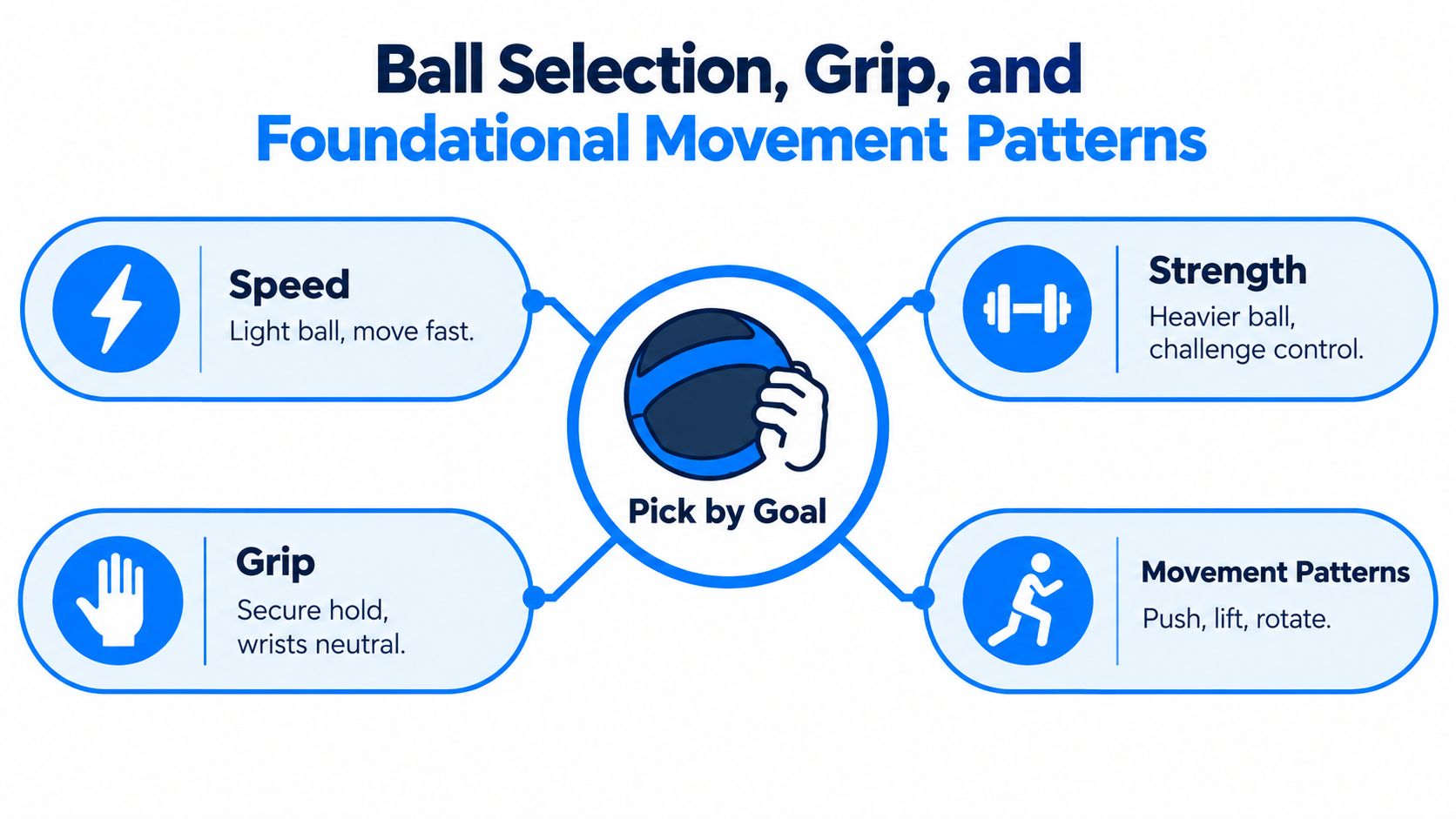
Use a full-hand grip with the wrists mostly neutral. Keep the ball close during loaded lunges and carries, and create space between the ball and your body during throws only when you can control the release. A ball that slips, shifts, or forces the wrists into awkward positions is too difficult for the current drill.
Push and project
Chest pass: Stand with one foot slightly ahead of the other, hold the ball at the sternum, and push through both hands. Keep the ribs stacked over the pelvis rather than leaning backward. Against a wall, listen for a crisp, consistent rebound. A softer or delayed rebound often signals declining effort.
Scoop toss: Start with the ball near the thighs, hinge at the hips, and extend the hips, knees, and ankles together as you launch the ball forward or upward. The legs should initiate the action. Don't turn the movement into an arm raise.
Rotate and transfer
Rotational throw: Stand side-on to a wall with the ball near the rear hip. Load the hips, rotate the pelvis, then allow the trunk and arms to follow. Don't twist only through the lumbar spine. Side throws place meaningful demands on the obliques, shoulders, and lumbar-control system, as shown in human biomechanics research using a 4 kg ball. The medicine-ball side-throw study-Trunk-and-shoulder-EMG-and-lumbar-kinematics-of-medicine-ball-side-trow%5BEuro.-J.-Human-Mvmt%5D.pdf) supports treating the movement as a whole-body transfer, not an arm exercise.
For additional trunk-control ideas, this guide to core stability routines can help you compare medicine-ball work with slower stability drills. You can also pair the ball with a lower-body movement such as the DB squat clean, provided you can maintain a stable receiving position.
Lift and carry
Overhead slam: Raise the ball only as high as you can keep the ribs controlled. Extend through the hips and drive the ball down using the whole body. A dead-ball version is often better for beginners because it removes the unpredictable rebound.
Carry or lunge: Hold the ball at the chest, overhead, or in one hand if you can keep the torso level. Step into a lunge without allowing the front knee or trunk to collapse inward. Carries and lunges develop loaded coordination, but they aren't substitutes for maximal-speed throws.
For mentally demanding work outside the gym, the Locked Cognition™ Shot is designed around liposomal R3HBG™, Alpha GPC, and Lion's Mane for workdays, meetings, presentations, and other situations where steady focus matters more than intensity.
What the Research Actually Shows About Transfer
The strongest evidence for medicine-ball work concerns movement-specific power, especially throwing and rotation. In a randomized 12-week study of 49 high-school baseball players, the medicine-ball group trained three days per week and produced larger gains in dominant-side torso rotational strength, nondominant-side rotational strength, and the medicine-ball hitter's throw than the comparison program. The reported improvements were 17.1% versus 10.5%, 18.3% versus 10.2%, and 10.6% versus 3.0%, respectively. The PubMed record for the baseball study provides the study reference.
Both groups improved predicted squat and bench-press one-repetition-maximum performance, but there wasn't a significant between-group difference for those maximal-strength outcomes. That distinction is central. Medicine-ball training can improve the ability to express force through a rotational or throwing pattern without replacing progressive barbell work for maximal strength.
A separate randomized 12-week study of 21 young female handball players, with 11 in the medicine-ball group and 10 controls, found significantly greater improvements in medicine-ball throw tests and upper-body power at 30% and 50% of one-repetition maximum. The reported significance levels were p < 0.01 for throwing tests and p < 0.05 for power outcomes, again favoring movement-specific transfer rather than a universal strength effect.
| Study population | Program length | Outcome measured | Reported gain |
|---|---|---|---|
| High-school baseball players | 12 weeks | Dominant-side torso rotational strength | 17.1% versus 10.5% |
| High-school baseball players | 12 weeks | Nondominant-side torso rotational strength | 18.3% versus 10.2% |
| High-school baseball players | 12 weeks | Medicine-ball hitter's throw | 10.6% versus 3.0% |
| Young female handball players | 12 weeks | Throwing tests and upper-body power | p < 0.01 for throwing tests, p < 0.05 for power outcomes |
A 2023 systematic review and meta-analysis found that medicine balls were among the most frequently used implements in core-training programs. Programs lasted 4–12 weeks, with 6–8 weeks most common, and generally used 2–3 sessions per week. For throwing or hitting performance, the analysis reported better velocity or distance when training occurred more than twice weekly, continued longer than 6 weeks, and lasted more than 30 minutes per session. The systematic review and meta-analysis examined core-training interventions, so it shouldn't be treated as a universal prescription for every ball program.
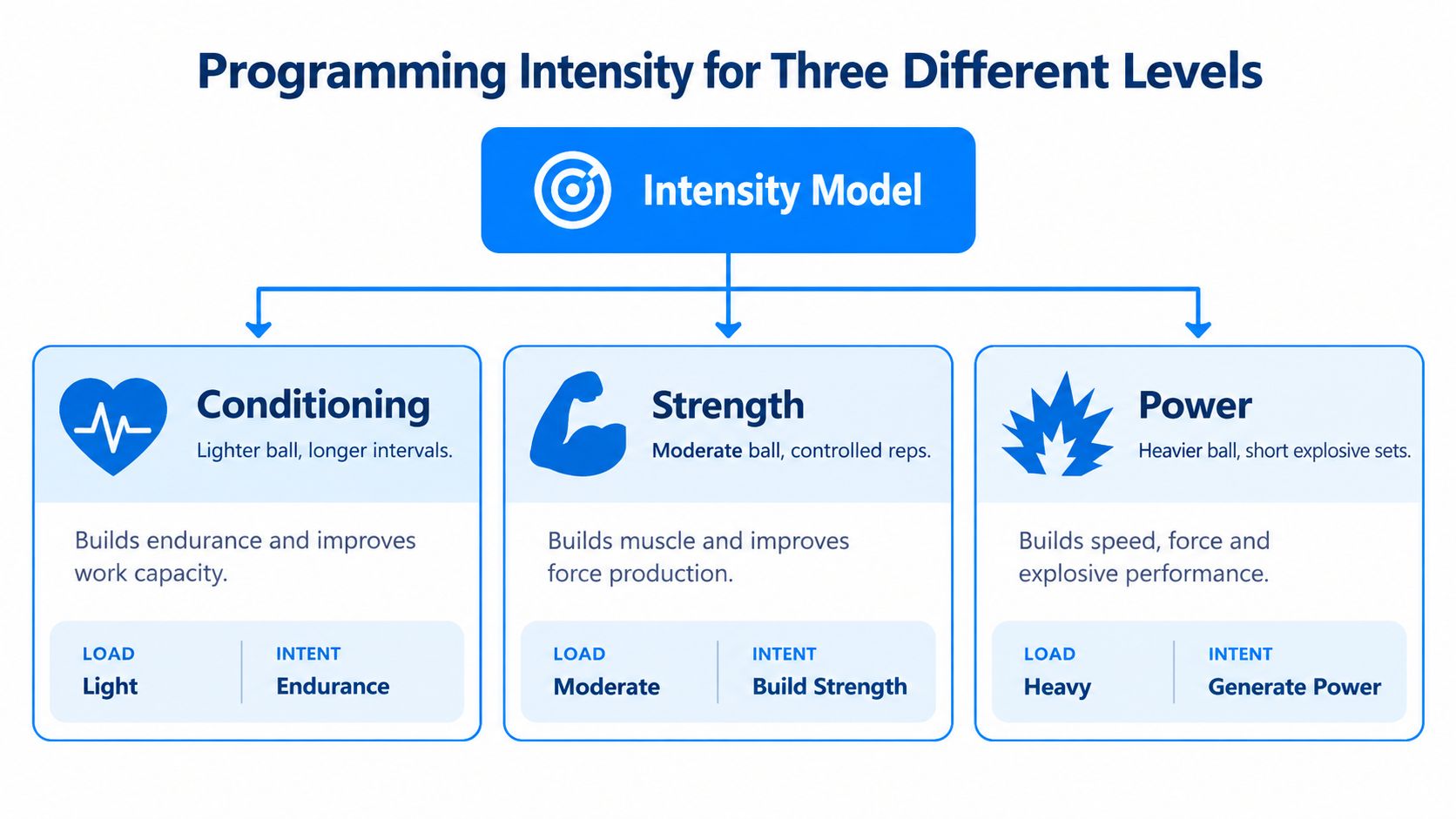
Programming Intensity for Three Different Levels
Intensity should describe how the ball is used, not just its mass. A moderate ball thrown with maximal intent can create a very different stimulus from the same ball moved slowly through a controlled lunge. Use the following model as a decision tool, then adjust it according to skill, recovery, and the quality of each repetition.
Tier 1 for conditioning
Choose a lighter ball, roughly 5% to 10% of body weight, for longer intervals and repeated efforts. Use controlled slams, carries, alternating lunges, or chest passes. Work for 20 to 40 seconds, rest for 20 to 40 seconds, and complete 3 to 5 rounds.
The cue is simple: keep moving without losing posture. This tier suits general fitness clients and people who want a repeatable conditioning tool. It isn't the best choice for measuring maximum throwing power because fatigue becomes the dominant variable.
Tier 2 for resisted movement
Use a moderate ball, roughly 10% to 15% of body weight, for 4 to 8 controlled repetitions. Rest for 45 to 90 seconds between sets. Chest passes, rotational holds with short throws, loaded lunges, and dead-ball slams work well here.
The reminder is: challenge control, then release cleanly. If the ball pulls you out of position, reduce the load. For broader movement variety, these essential fitness drills for 2026 can provide ideas for adapting athletic patterns, but the ball should still match your objective rather than the appearance of the drill.
Tier 3 for speed and power
For high-speed work, choose a light-to-moderate ball, often roughly 3% to 10% of body weight, and perform 2 to 5 explosive repetitions. Rest for 60 to 120 seconds, or until your breathing and technique settle. Scoop tosses, side throws, chest passes, and overhead launches belong here.
The cue is: every repetition should look fast. A controlled study using seated throws with 0.43 kg, 2 kg, 4 kg, and 6 kg balls found that velocity decreased as voluntary effort fell across all loads, while force and power declines were more pronounced with the heavier balls. The controlled seated-throw study supports lighter implements when velocity is the priority.
If a session also includes high-intensity conditioning, use anaerobic-threshold training principles to avoid turning every power set into a fatigue test. The EDGE Performance™ + Electrolytes shot is designed for active individuals who want steady energy during training or physically demanding days, with liposomal R3HBG™ ketone and Na, K, and Mg electrolytes.
When Heavier Loads Hurt More Than Help
“Heavier” sounds like a straightforward path to greater strength. That logic works only while the movement remains appropriate. A heavy ball used for a controlled carry or dead-ball slam is not the same training exposure as a heavier or lighter baseball thrown at maximal velocity.
Throwing-specific overload deserves separate treatment. A systematic review found that weighted-baseball studies used highly heterogeneous protocols, ball weights, and participant groups, with very poor evidence quality and insufficient evidence to determine injury risk. In a prospective study summarized by the International Journal of Sports Physical Therapy review, nearly 25% of participants sustained a shoulder or elbow injury during a six-week weighted-baseball program, despite a reported 3.3% greater pitching-velocity improvement than controls.
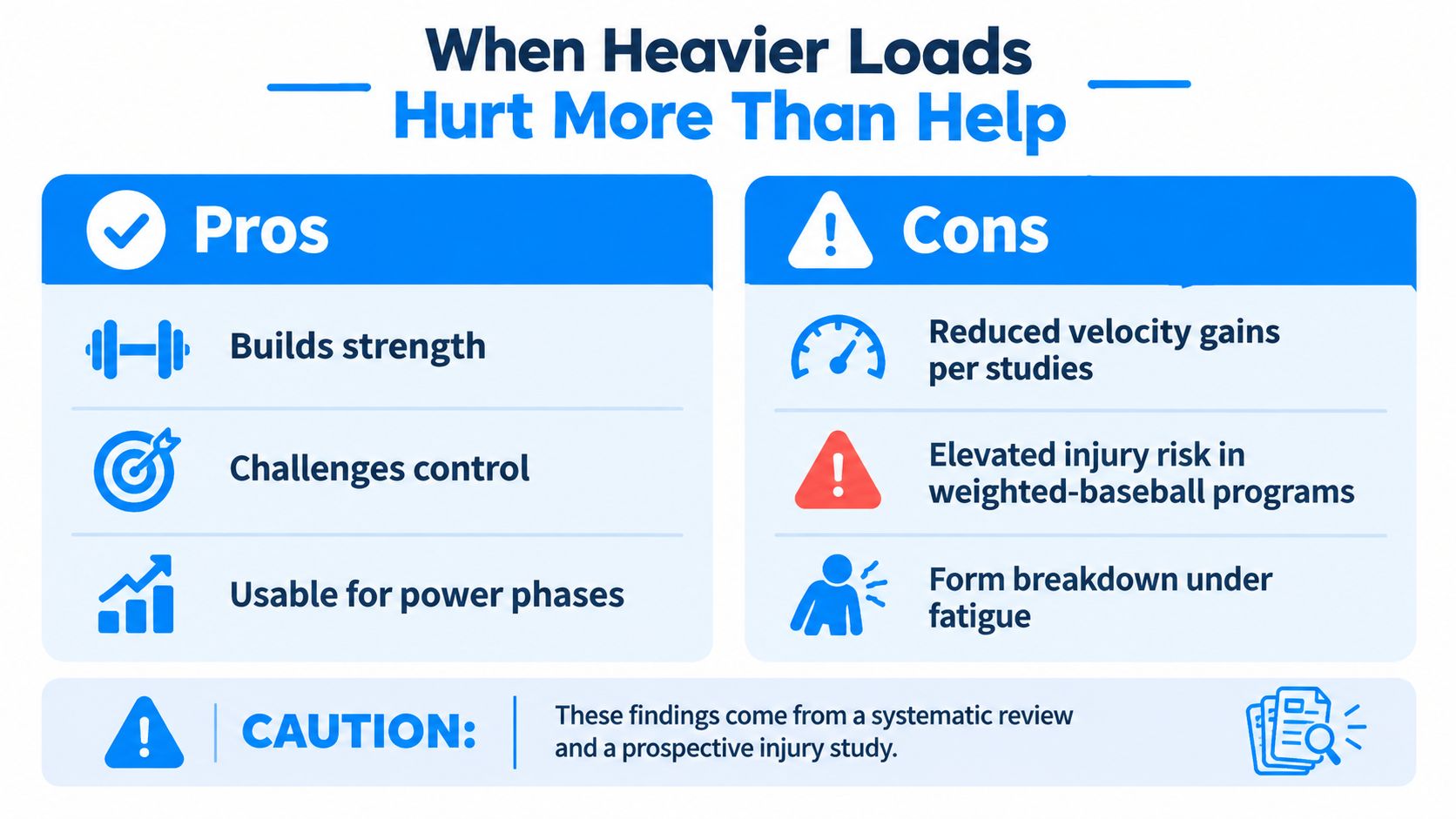
General training is not pitching overload
General medicine-ball exercises usually allow you to control the direction, distance, release, and stopping point. Baseball pitching combines high velocity with a highly specific arm action, and total throwing volume matters. A general fitness client copying a pitcher's overload and underload sequence is not automatically receiving an advanced version of medicine-ball training. They may just be adding stress without the screening and workload management that the method requires.
Practical rule: Stop a set when velocity drops visibly, the release changes, or the trunk and shoulder no longer coordinate.
Screening matters most for people with a throwing history, prior pain, limited mobility, or a current return-to-sport plan. Sport-specific overload should account for age, throwing history, tissue capacity, season phase, and total throw count. It shouldn't be selected from a generic video because the exercise looks athletic.
Heavier balls still have a place. They can challenge force production and control when the movement is deliberate. But if the target is speed, a controlled study of seated throws indicates that increasing load can reduce movement velocity and alter the balance between force and power. The GLP-1 Shot is a separate metabolic-support product designed around liposomal R3HBG™, 5-HTP, and prebiotic fiber for routines involving fasting windows, spaced meals, or mid-day energy dips. It doesn't change the need to select ball load conservatively.
Two Sample Sessions You Can Run Today
These sessions use different objectives. Session A builds general strength and conditioning with moderate resistance. Session B treats the ball as a speed tool, so repetitions stay low and rest stays long enough to preserve intent.
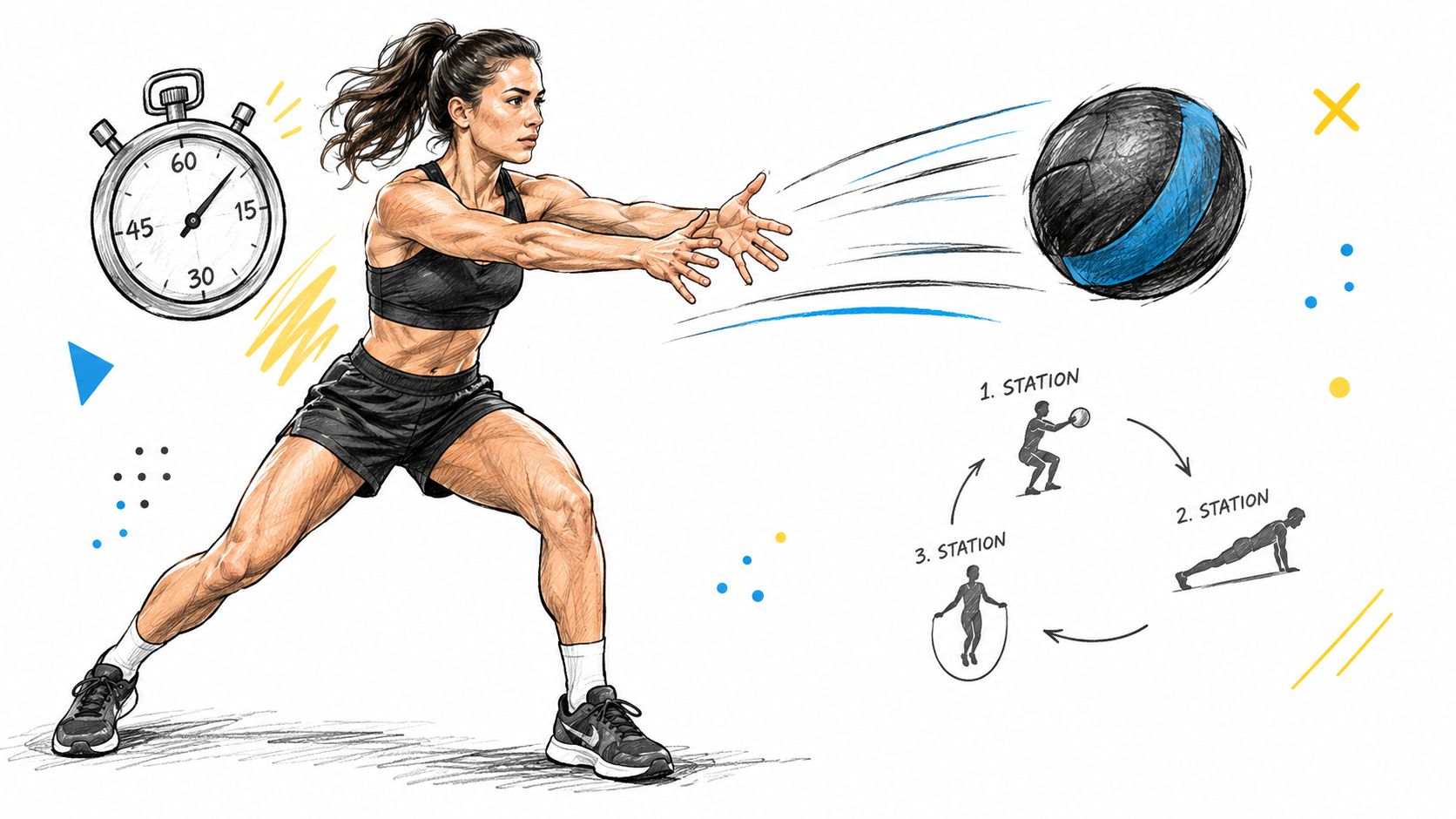
Session A for strength and conditioning
Complete the following circuit for 4 rounds. Use a ball around 10% to 15% of body weight, or choose a load that allows every repetition to stay controlled. Rest 30 to 60 seconds between exercises and up to 90 seconds between rounds.
- Chest pass: 8 repetitions. Push through both feet and keep the ribs stacked.
- Rotational throw: 6 repetitions per side. Load the hips before the trunk rotates.
- Loaded reverse lunge: 6 repetitions per leg. Hold the ball at the chest and keep the front foot grounded.
- Dead-ball slam: 8 repetitions. Lift only as high as you can control, then drive through the floor.
The session should feel demanding without becoming chaotic. If the ball gets slower or your landing position changes, reduce the repetitions before reducing the rest.
A beginner can perform chest passes from a seated position, replace rotational throws with seated rotational passes, and use short-range dead-ball slams. An older adult or someone returning from injury can begin with 4 repetitions per side, a lighter ball, and longer rest. Pain during a movement is a reason to stop and seek individual assessment rather than push through.
The exercise selection can also complement other conditioning tools, such as the movement patterns described in kettlebell swings for cardio, but don't combine every demanding ballistic drill in one session.
Use this video as a visual reference for medicine-ball circuit movement, then match the exercise to your ability rather than copying its pace.
Session B for power
Perform 3 to 5 sets of each exercise before moving to the next. Use a lighter-to-moderate ball, roughly 3% to 10% of body weight, and rest 60 to 120 seconds between sets.
- Kneeling scoop toss: 3 repetitions per side. Start tall on both knees, rotate slightly, and throw without using a large lower-body drive.
- Standing scoop toss: 3 repetitions per side. Let the hips and legs contribute, then release the ball aggressively.
- Overhead launch: 3 repetitions. Extend through the hips and release forward, not down into the spine.
- Side throw: 3 repetitions per side. Rotate from the ground up and finish balanced.
Choose a wall or open space that provides a predictable rebound and enough distance to avoid catching the ball while off balance. If peak velocity falls across consecutive sets, end the exercise. More repetitions won't restore power once fatigue has become the main stimulus.
For beginners, use kneeling scoop tosses and seated rotational passes. Older adults can use chest passes into a wall, short-range slams, and controlled carries. Someone returning from injury should use a clinically appropriate progression, with range, speed, and catch distance advanced one variable at a time.
Your Programming Checklist and Decision Framework
Run through these questions before every weight ball session:
- What quality am I training? Choose conditioning, resisted movement, or speed.
- Which tier matches that quality? Don't use a power load for a fatigue circuit, or a conditioning load for a maximal-speed test.
- What load preserves the movement? The ball should challenge the target without changing the pattern.
- What rest keeps intent high? Short rests suit conditioning. Longer rests protect speed and precision.
- What's my stop rule? End the set when velocity, posture, release, or pain changes.
Standing throws permit contribution from the legs, hips, trunk, and arms, while sitting or kneeling limits lower-body involvement. A study of 10 collegiate male basketball players found that standing throws produced higher peak velocity than sitting and kneeling conditions, showing how body position changes the physical quality being tested. The positional medicine-ball throw study
That principle makes programming more precise. Use seated or kneeling variations when you want to reduce lower-body contribution or provide a regression. Use standing throws when the transfer target includes the full kinetic chain. Weight ball training is a transfer tool, not a punishment circuit. The best session is the one in which load, intent, movement pattern, and recovery all point toward the same outcome.
Tecton Ketones™ provides bioidentical exogenous ketone nutrition built around liposomal R3HBG™ for performance, cognitive endurance, and metabolic flexibility without requiring a strict keto diet. Visit Tecton Ketones™ to explore options that can fit alongside structured training, conditioning sessions, and recovery-focused routines.


