


You're staring at the screen, the task is important, and your brain has switched from sharp to syrupy. You reread the same sentence twice, your attention keeps sliding off the page, and the thing you were going to handle in ten minutes now feels oddly heavy. That's not a character flaw. It's usually a mental stamina problem, which means a fuel-and-fatigue problem you can train, support, and manage.
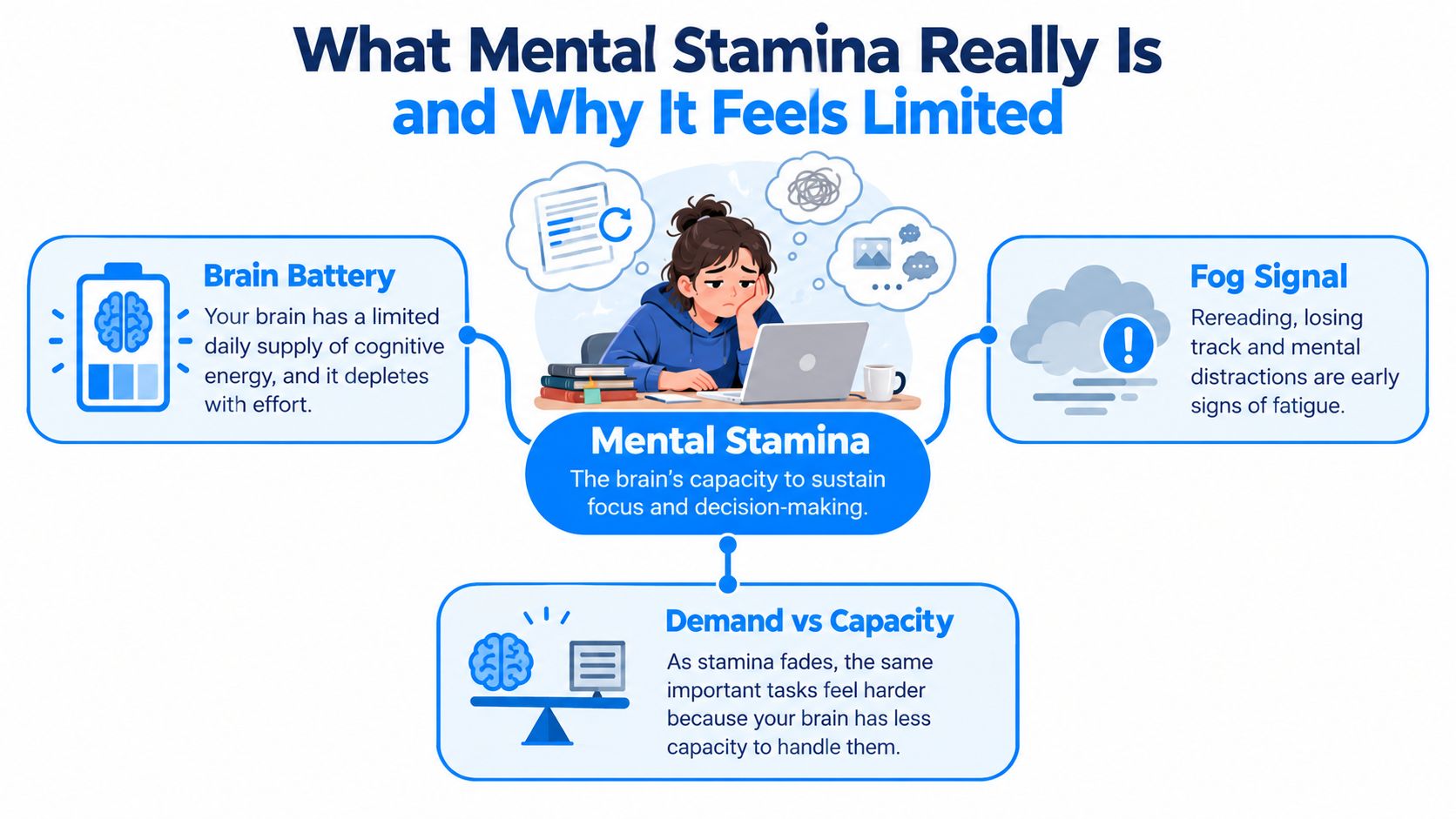
What Mental Stamina Really Is and Why It Feels Limited
Mental stamina is the brain's ability to keep paying attention, hold information in working memory, and make decent decisions under prolonged cognitive load. It's what lets you stay composed in a long meeting, finish a difficult draft, or keep your head clear after a day packed with interruptions. When it fades, people often blame motivation, but the failure usually sits downstream of fatigue, low energy availability, or both.
That distinction matters because the wrong diagnosis leads to the wrong fix. If you think you're lazy, you try to “push harder.” If the actual issue is accumulated fatigue, the better move is to protect brain energy, reduce unnecessary demand, and recover on purpose. That shift changes everything about how to improve mental stamina in a way that lasts.
Practical rule: if focus drops, rereading starts, and decisions get sloppy, treat that as a signal, not a verdict.
What to watch for
- Early fatigue cues, rereading, wandering attention, and slower recall.
- Demand mismatch, an important task arriving after a long stretch of effort.
- False willpower stories, where you assume more discipline will fix a biologic limit.
The most useful way to think about stamina is this, the brain has a limited daily budget, and tough work spends from it. The goal is not endless output, it's better timing, better fuel, and better recovery. That's why the rest of this guide focuses on four levers, foundational habits, cognitive-load training, recovery practices, and strategic fuel choices.
The Brain Energy System Behind Sustained Focus
The brain is metabolically expensive tissue, and sustained attention depends on a steady supply of ATP, the cell's immediate energy currency. Neurons make that ATP mainly through mitochondria, and when supply gets shaky, performance gets noisy. You feel that as fog, impatience, slower thinking, and a shorter fuse for complexity.
Glucose and ketones use different paths
Glucose is the familiar fuel. It's fast, useful, and easy to access, but when intake swings hard, attention can swing with it. Ketones, especially beta-hydroxybutyrate, or BHB, give the brain another route to ATP production and can support energy delivery when glucose is less stable. That's one reason ketone metabolism is often discussed in the context of metabolic flexibility, the brain's ability to shift between fuels without losing output.
The practical difference shows up in ordinary life. A heavy lunch can pull you into a slump. A stable fasted state can feel crisp for some people. Sleep loss makes the whole system feel underpowered, which aligns with evidence that sleep is foundational for cognition and mental stamina, not optional recovery. In older adults, sleeping less than 6 hours per night was linked with faster 10-year cognitive decline, while 6 to 8 hours and higher physical activity were independently associated with better cognitive function as summarized in this review of the study line.
| Factor | Glucose | Ketones (BHB) |
|---|---|---|
| Main role | Primary day-to-day fuel | Alternative brain fuel |
| Feel in practice | Can be steady or swingy depending on intake | Often used when people want steadier output |
| Energy pathway | Fast, familiar carbohydrate metabolism | Supports ATP through ketone metabolism |
| Cognitive relevance | Strong when supply is stable | Useful when glucose availability is less reliable |
If you want a deeper explanation of how cells generate usable energy, the overview in cellular energy production is a helpful companion.
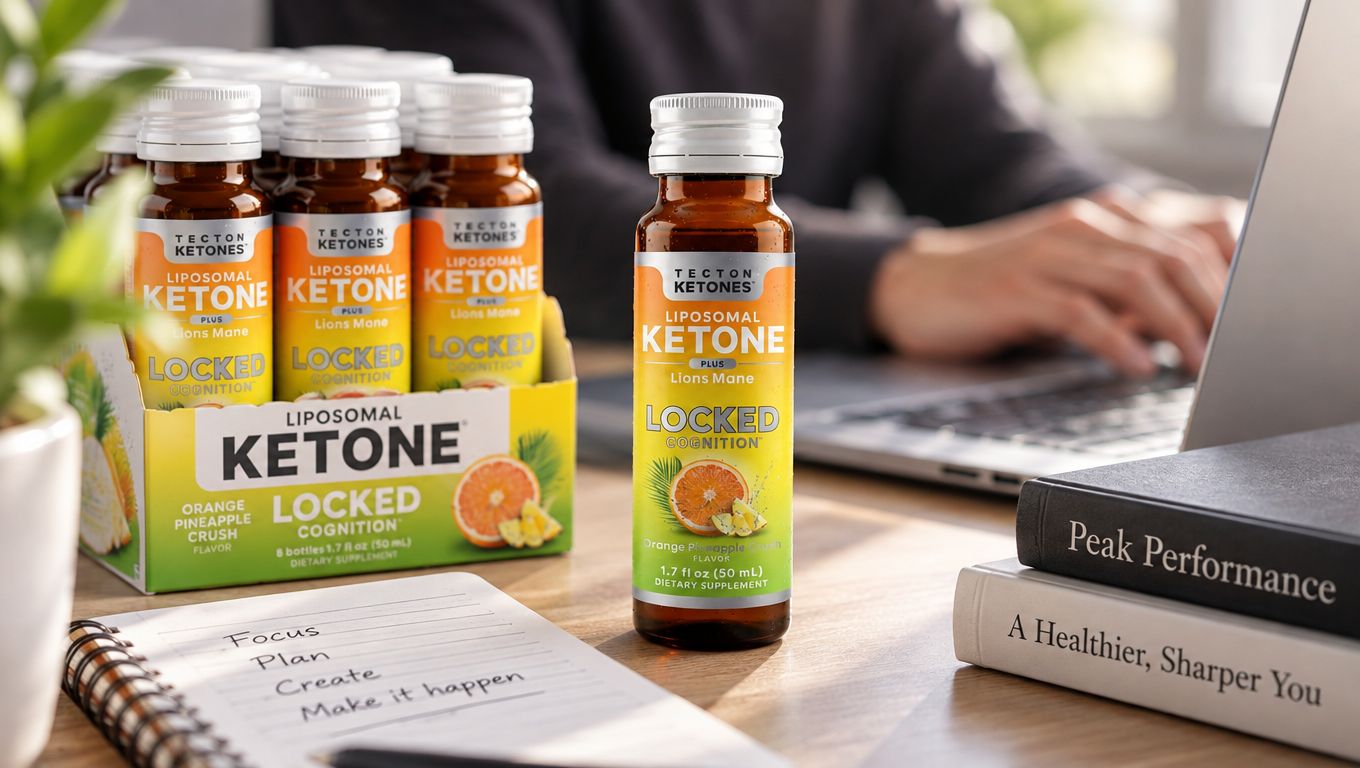
Ketones also do more than provide fuel. Human and translational literature indicates BHB can act as a signaling molecule, with effects on vascular function and mitochondrial state. For readers who want a practical, food-and-fuel lens, a measured ketone product can fit into a workday routine. One example is Locked Cognition™ Shot, which combines liposomal R3HBG™, Alpha GPC, and Lion's Mane in a format aimed at mentally demanding days.
The body doesn't just “run on motivation.” The brain runs on chemistry, timing, and usable energy.
For people who also want a simple caffeine-adjacent resource, the article on boost focus with l-theanine is a useful contrast because it frames alertness differently from ketone-based fuel support.
Foundational Daily Habits That Protect Mental Energy
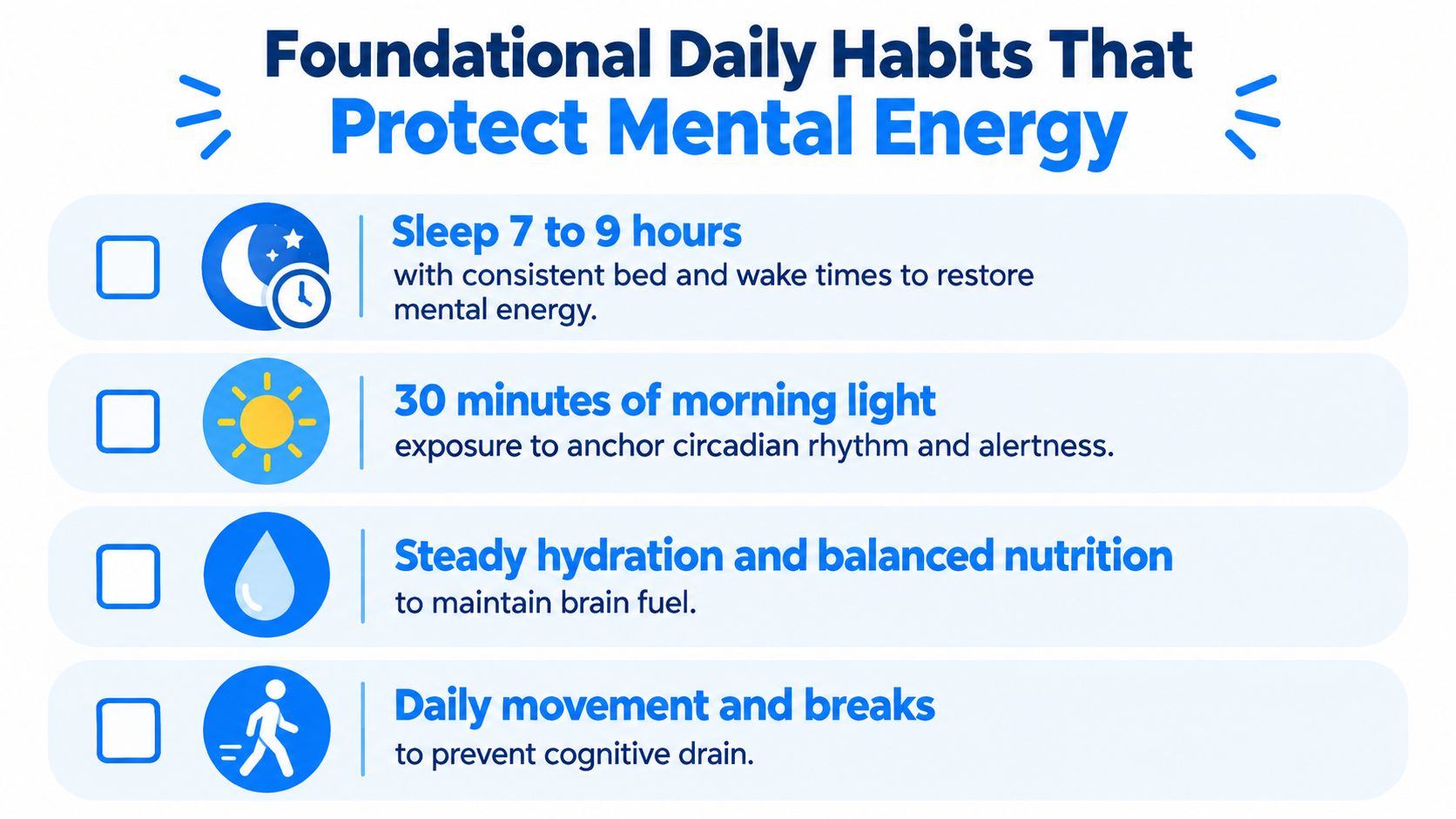
The most reliable way to improve mental stamina is to stop draining the system faster than it can recover. That starts with sleep, food, water, and movement, because each one changes how much energy the brain can generate and how cleanly it can use that energy.
Sleep comes first
Sleep is the highest-yield lever because the brain's cognitive reserves are obviously worse when sleep is short or inconsistent. A steady bedtime and wake time help more than random catch-up sleep. Morning light exposure also matters because it anchors circadian timing, which helps alertness line up with the day instead of drifting.
Food and hydration should steady the system
Meals built around protein, fiber, and slow-release carbohydrates are less likely to trigger the sharp rise-and-fall pattern that leaves people foggy. Hydration matters too, because even mild dehydration can make attention feel brittle. During periods of intense cognitive work, drinking enough water and eating in a way that avoids big glycemic swings is not a wellness bonus, it's a performance constraint.
Movement keeps the brain more available
Regular aerobic work and resistance training support cognition through broad recovery and neurotrophic effects. You don't need to turn the workday into a training block, but you do need to avoid being motionless for too long. Short walks, posture changes, and training sessions outside deep-focus windows help keep the brain from feeling trapped in one activation state.
A simple way to think about the day is this:
- Sleep: protect the recovery window.
- Morning light: set the timing signal.
- Nutrition and hydration: keep fuel delivery stable.
- Movement: prevent the brain from getting stuck in fatigue.
The YouTube routine below is a reasonable visual companion if you like guided structure.
Brain Endurance Training to Stretch Cognitive Limits
At 10:00, you can write clearly. By mid-afternoon, the same task feels heavier, and small decisions consume disproportionate effort. That shift does not automatically mean weak discipline. Mental stamina depends partly on how much cognitive fuel and fatigue the task is consuming, so training should dose effort rather than demand endless willpower.
Train under controlled cognitive load
Brain Endurance Training applies the logic of physical conditioning to demanding mental work. Select one task, remove competing inputs, and work long enough to create manageable strain without allowing accuracy to collapse. Timed reading, structured writing, working-memory drills, and deliberate practice on a weak skill can all provide that stimulus.
The goal is a useful training signal, not exhaustion. If the task becomes chaotic, the session is measuring overload more than endurance. If it feels effortless, the load may be too light to prompt adaptation. Treat each block like a measured exercise set: challenging, repeatable, and followed by recovery.
Evidence supports testing this approach under fatigue rather than only when you feel fresh. A meta-analysis found that endurance performance improved more in fatigued states, with a standardized mean difference of 0.87 under fatigue versus 0.21 at baseline, while mental fatigue resistance improved by 9.22 units in fatigued conditions Frontiers in Physiology. These findings support the method, but they do not establish one perfect schedule for every person.
Run the practice with four controls:
- Choose one cognitive target, such as comprehension, writing, or difficult planning.
- Set a focused block, ending before quality drops sharply.
- Repeat the dose consistently, rather than training only during a crisis.
- Record effort and output, including session length, accuracy, and perceived strain.
For planning, self-control, and decision-making demands, strengthening executive functioning skills offers a leadership-oriented reference.
Signs the dose is working
- Single-tasking: keep the phone out of reach.
- Defined boundaries: use clear start and stop times.
- Brief records: note duration, effort, and accuracy.
- Planned recovery: allow the system to adapt after strain.
Increase difficulty gradually. A longer block, a more complex task, or fewer supports can raise the load, but changing everything at once makes results impossible to interpret. The right session feels demanding while leaving enough control to produce useful work.
Recovery Strategies When the Brain Is Already Fatigued
Not every fade is a training issue. Sometimes the brain is overstimulated, sometimes it's stressed, and sometimes it's underfueled. Matching the recovery method to the fatigue pattern saves time and keeps people from confusing rest with avoidance.
| Strategy | Dominant Symptom | Dose | Expected Effect |
|---|---|---|---|
| Low-stimulation walk or nature exposure | Sensory overload, mental clutter | Brief reset when focus is scattered | Easier attention and less mental friction |
| Short nap or genuine rest | Sleep pressure, exhaustion | Use when the whole system feels flat | Better alertness after recovery |
| Slow breathing or non-sleep deep rest | Anxiety, tension, internal pressure | 7 to 10 minutes | Lower arousal and better task re-entry |
| Structured meditation program | Persistent fatigue with stress load | A supervised program over weeks | Reduced fatigue and improved persistence |
| Supplemental ketone fuel | Low energy under cognitive demand | Use strategically before a demanding block | More stable output when fuel is the issue |
A 2025 systematic review of fatigue interventions found promising results for physical activity, CBT, online programs, and multidimensional approaches, but also reported high heterogeneity and limited evidence for many interventions Neurosity guide. That means there isn't one universal fix, and there probably won't be one soon.
If you want a practical scheduling pattern for balancing effort and recovery, the focus and recovery schedule is a clean external example of how people structure demanding work without pretending the brain is infinite.
Match the recovery tool to the symptom. If the issue is stress, calm the nervous system. If it's distraction, reduce stimulation. If it's low fuel, rest alone may not be enough.
This is also where exogenous ketones become relevant for some users. They're not a replacement for sleep or behavior, but they can fit when the problem looks more metabolic than motivational. The point is precision, not magic.
How Exogenous Ketones Fit Into a Mental Stamina Routine
Exogenous ketones are a separate fuel stream the brain can use alongside glucose. They're not the same thing as diet-induced nutritional ketosis, and they're not the same thing as your body producing ketones endogenously during fasting or carbohydrate restriction. That distinction matters because the form of ketone, the dose, and the delivery method all shape the experience.
What they do in plain language
BHB can cross the blood-brain barrier through monocarboxylate transporters, then feed mitochondrial ATP production. In human and review literature, exogenous ketone supplementation is associated with modest cognitive benefits versus placebo, with a standardized mean difference of 0.26 PubMed review. Other human and translational work also supports ketones as both fuel and signal, including effects on vascular function and cellular energetics JACC review.
The practical appeal is steadier effort. If a person tends to feel mid-task dips after meals or during long cognitive stretches, a clean ketone source may support a smoother transition into focused work. A measured shot taken before a hard block, paired with water and a small protein-containing snack, is a reasonable use pattern for many healthy adults.
Why product form matters
Ketone salts, ketone esters, and precursors are not identical. They differ in chemistry, mineral load, taste, and likely metabolic effects. Liposomal delivery is often used to support absorption and consistency, and bioidentical D-BHB matters because the body naturally uses that structure. A product that discloses actual R3HBG content is more informative than a vague BHB blend.
A 28-day human study of sustained exogenous ketosis reported that raising blood beta-hydroxybutyrate from about 0.1 to 4.1 ± 1.1 mmol/L three times daily produced no meaningful changes in body weight, fasting glucose, cholesterol, triglycerides, electrolytes, blood gases, or kidney function, and concluded that a ketone monoester was safe and well tolerated in healthy adults Oxford study.
That said, ketones aren't for everyone. People using diabetes medication, people in a ketogenic transition, and anyone with medical complexity should treat them carefully and get personalized guidance when needed. For a broader product-use overview, the guide on how to use exogenous ketones is a useful reference, and the broader recovery protocols page can help frame them as one tool among several.
Six-Week Implementation Plan and Practical Takeaways
The cleanest way to improve mental stamina is to stack small inputs in a sequence your nervous system can absorb. Trying to change everything at once usually creates a short burst of effort, then confusion, then dropout. A six-week rollout works better because it lets recovery, fuel, and training build on each other.
Weeks 1 to 2
Lock in the basics first. Aim for 7 to 9 hours of sleep, consistent bed and wake times, morning light, steady hydration, and meals that don't cause obvious energy swings. Keep this phase simple, because the goal is to remove obvious drains before adding more load.
Weeks 3 to 4
Add aerobic movement and one or two cognitive-load sessions per week. Keep the sessions focused, not sprawling, and log how you feel before and after. This is when you learn whether your mental ceiling is a motivation issue, a fuel issue, or a pure endurance issue.
Weeks 5 to 6
Layer in structured recovery and, if appropriate, a strategic exogenous ketone trial before your hardest cognitive block. If you use a ketone product, keep the context consistent so you can judge the effect accurately. Don't stack three new variables at once.
A weekly self-check keeps the plan honest:
- Focus rating, one simple 1 to 10 score after your hardest work block.
- Reading or n-back benchmark, the same short test each week.
- Resting heart rate trend, because fatigue often shows up in recovery signals first.
- Post-meeting fatigue log, a brief note on how quickly your brain drains under load.
The practical takeaway is simple. Mental stamina is built, not wished into existence. If you protect sleep, stabilize fuel, train cognitive load, and recover with intent, the brain gets better at staying online when the work gets hard.
If you want a cleaner way to support focus without leaning on more caffeine, Tecton Ketones™ offers bioidentical ketone nutrition designed for steady performance, cognitive endurance, and metabolic flexibility. Explore Tecton Ketones™ to see how ketone fuel can fit into a routine built around real-world stamina, not hype.


