A common assumption in ketosis advice is that a higher ketone reading automatically means better focus, easier workouts, or faster fat loss. A rise in blood beta-hydroxybutyrate (BHB) is measurable, but it isn't proof that a particular outcome has improved. BHB is a fuel the body can use. Whether more circulating BHB helps with a specific task depends on the person, the formulation, and what you're measuring.
Consider someone who reaches for a ketone product during an afternoon slump, expecting it to sharpen concentration and improve a workout in the same way. Those are separate outcomes, and neither is guaranteed by a blood-ketone increase. The evidence for BHB supplement benefits is best understood by looking at cognition, glucose responses, exercise performance, and subjective energy individually.
What BHB Supplement Benefits Actually Mean
The body can reach higher ketone availability by different routes. Nutritional ketosis is a metabolic state encouraged by a dietary pattern such as sustained carbohydrate restriction. In that setting, the liver makes ketones from fatty acids. This is endogenous ketone production: your body produces the ketones itself.
Exogenous ketone supplementation takes a different route. You consume a ketone product, which can raise circulating BHB without first following a ketogenic diet or fasting for a prolonged period. Human research has demonstrated that orally consumed ketones are bioavailable and can shift blood ketone concentrations within a practical supplementation window, although the magnitude and composition of the response vary by formulation (human research on ketone esters and salts).
That distinction matters because a higher blood ketone reading describes a metabolic response, not a guaranteed benefit. It doesn't, by itself, establish better thinking, faster running, weight loss, or protection from disease. A supplement might raise ketones while leaving someone's performance on a particular task unchanged.
Formulation also matters. Different products can change how much of the body's preferred D-BHB appears, how long the L-isomer stays high, and whether the supplement brings a substantial mineral load such as sodium or potassium. That means “BHB supplementation” doesn't describe one uniform intervention.
This article uses structure-function language: it considers fuel availability, measured metabolic changes, and performance on specific tasks without claiming that supplements treat or prevent disease. The useful question isn't whether a product raises BHB. It's whether that change aligns with the outcome you care about.
How BHB Fuels Cells and the Brain
Glucose and ketones are different fuels, but both can contribute to cellular energy production. Glucose is broken down through pathways that ultimately help provide material for mitochondrial ATP production. BHB enters a different route: inside mitochondria, it's converted to acetoacetate, then to acetyl-CoA. Acetyl-CoA enters the citric-acid cycle, generating reducing equivalents that support oxidative phosphorylation and ATP production.
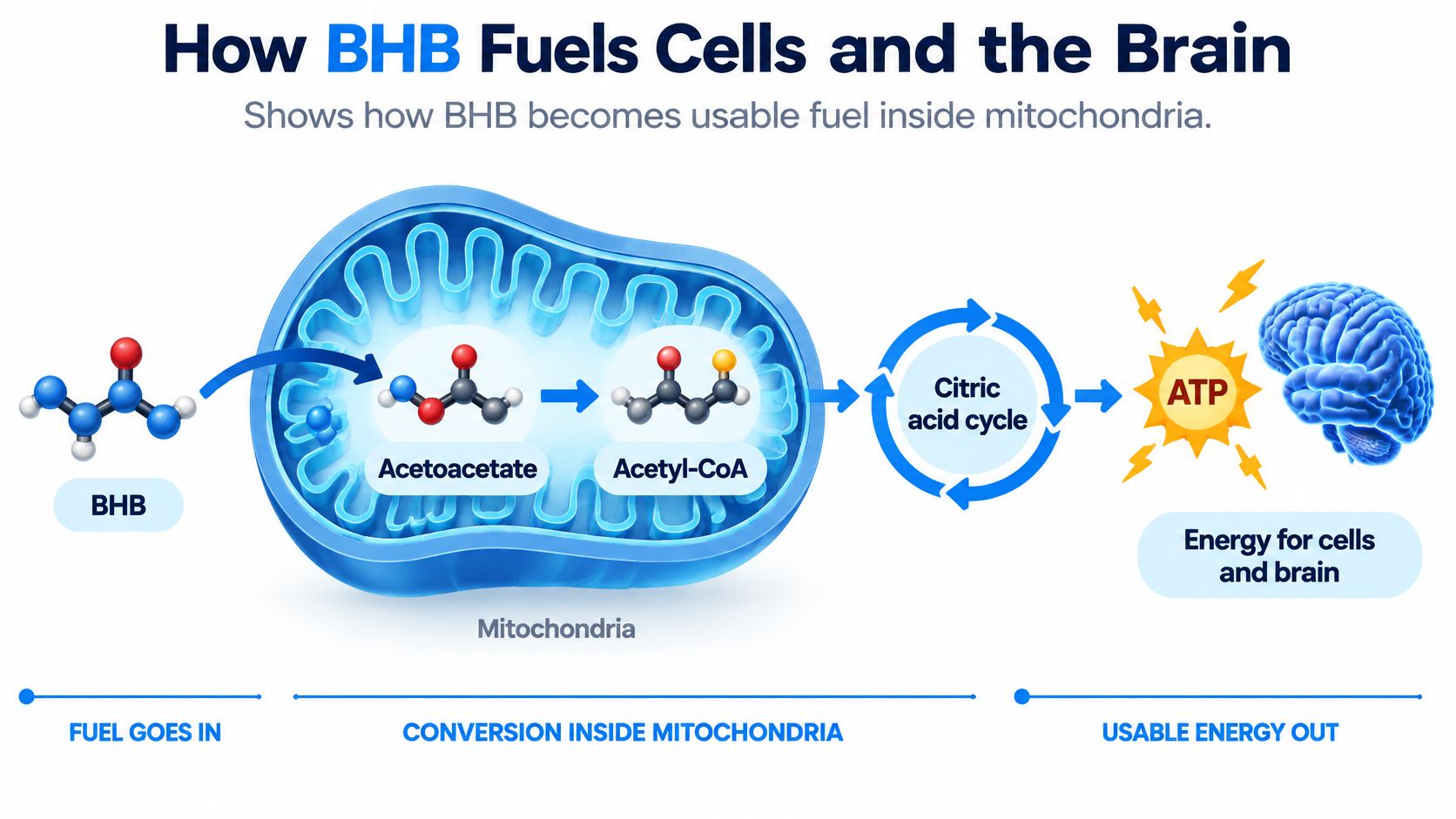
This is an additional fuel pathway, not a switch that turns glucose off. The body can use glucose and ketones, and metabolic flexibility means adjusting fuel use as availability and demand change. A controlled human study illustrates how quickly the fuel environment can shift: in 28 healthy adults, a 25 g ketone monoester increased mean blood D-BHB from 0.7 ± 0.3 mmol/L to 4.0 ± 1.1 mmol/L within 30 minutes, while glucose fell 28.8%, non-esterified fatty acids fell 49.1%, and lactate fell 28.2% (the controlled human ketone monoester study). Those acute changes describe fuel availability and circulating markers, not proof of lasting performance or health benefits.
The brain can also use ketones. They cross the blood-brain barrier through monocarboxylate transporters, enter neuronal mitochondria, and provide acetyl-CoA for ATP generation. When circulating BHB rises, ketones can supplement or partly replace glucose oxidation. A helpful analogy is that glucose is the household current the brain normally runs on, while ketones are a second circuit that can carry some of the load when available. For a deeper explanation of this pathway, see how brain energy metabolism uses fuel.
The body naturally produces and preferentially oxidizes D-BHB. The L-isomer follows different metabolic handling.
Diet-induced ketosis depends on the liver making ketones from fatty acids. Exogenous supplementation bypasses that production step, so circulating BHB can rise even when the body's own ketone production is quiet. Researchers have also examined acute effects on endothelial function, a measure related to blood-vessel responses. That's a cellular signaling endpoint, not evidence that ketones prevent or treat heart disease.
Evidence Behind Claimed BHB Supplement Benefits
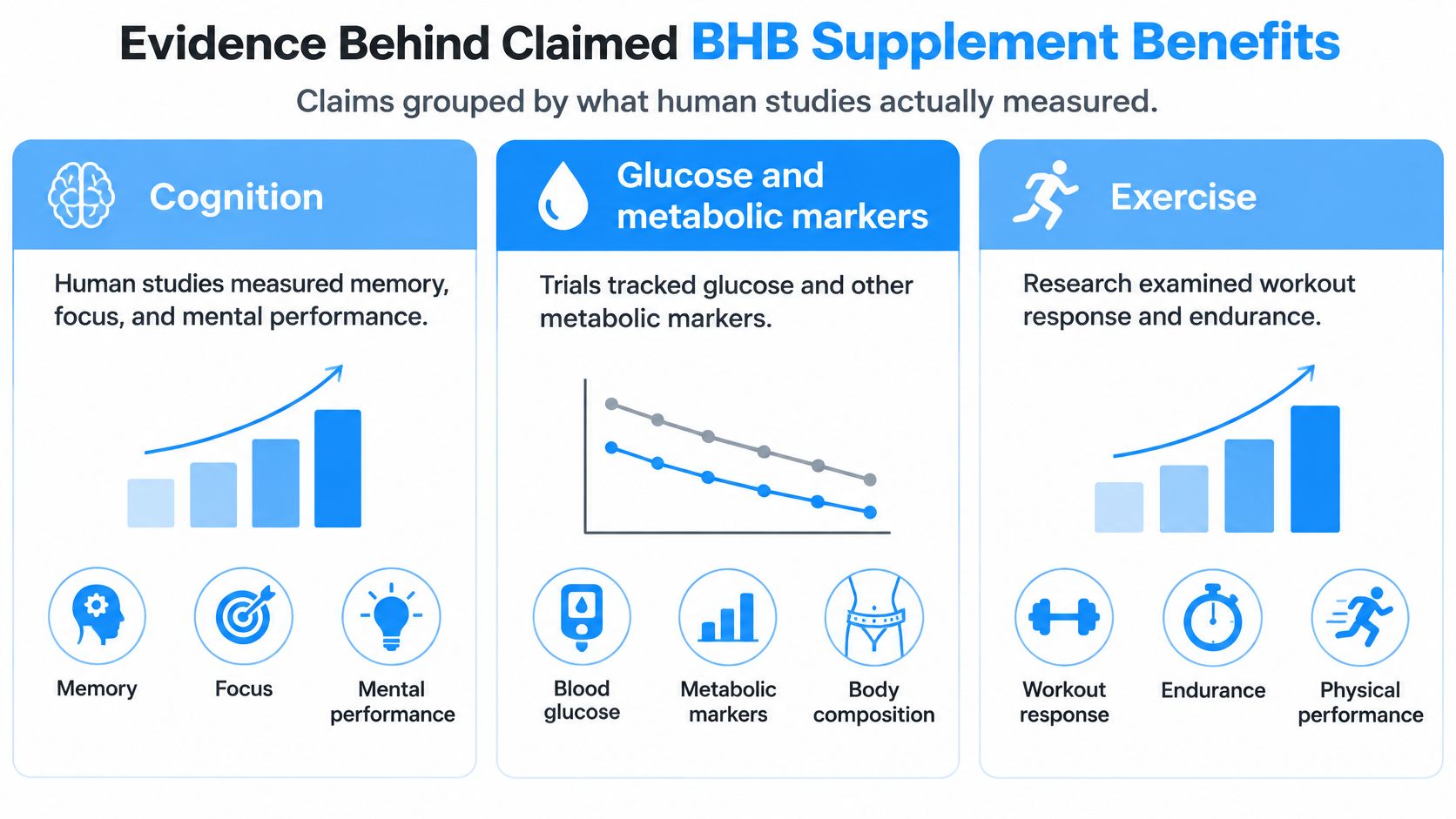
Human studies measure different outcomes, so their findings shouldn't be collapsed into one claim about “energy.” A result on a cognitive task doesn't establish an improvement in running, appetite, or day-to-day alertness.
Cognition: A 2026 systematic review and meta-analysis included 38 studies involving 1,602 participants, with quantitative analysis of 29 protocols and 1,117 participants. It found a statistically significant but modest average cognitive effect compared with placebo, with a standardized mean difference of 0.29 (95% CI 0.16 to 0.41, p < 0.001) (the systematic review and meta-analysis of cognitive outcomes). That average doesn't promise a noticeable change for each person. The review also found no statistically significant differences by supplement type, study duration, participant health status, or the presence of an acute cognitive stressor. So far, the evidence doesn't establish one clearly superior format or target group.
Glucose and metabolic markers: In a 31-day controlled trial, recreational runners consumed a ketone monoester or an isocaloric placebo. The supplement raised post-ingestion R-β-hydroxybutyrate to approximately 3.0 mmol/L and reduced glycemia by 15% versus placebo. These findings show that ketone availability and glucose measurements can shift together in a study setting, but they don't establish weight loss or a lasting metabolic benefit.
Task-specific performance: In the same trial, response times improved on selected Stroop incongruent and switching tasks, while 5-km running performance didn't improve. The ketone group later retained higher absolute VO₂ during graded exercise after supplementation ended, but that measure isn't the same as a faster race result (the runner trial of ketone monoester supplementation).
Taken together, the evidence supports a selective conclusion: ketone availability, some glucose measures, and performance on certain cognitive tasks can change without a corresponding improvement in endurance performance. A blood-ketone rise is a useful measure of exposure, but the relevant test is whether the outcome you care about changes too.
Limits of Ketone Levels as Proof
A ketone reading tells you that BHB is present in circulation. It doesn't tell you whether you'll run faster, think more clearly, or feel less hungry. Researchers have repeatedly found that raising ketones and improving a chosen outcome aren't interchangeable.
A 2025 review reported that many studies found no improvement in exercise capacity after acute exogenous-ketone ingestion. Possible effects on recovery, sleep, overreaching, or training adaptation remain exploratory and need stronger testing (the 2025 review of exogenous ketones and exercise). In other words, a product can supply fuel without producing a measurable gain on a particular exercise test.
Responses can differ by task and context. A BHB-plus-MCT formulation produced a dose-related increase in R-BHB and improved pre-exercise cognitive performance at the higher dose, but didn't improve exercise performance, heart rate, perceived exertion, or affect. In a separate repeated Wingate cycling study, a D-BHB drink didn't improve high-intensity cycling or cognition. These results make it important to distinguish mental performance before exercise from maximal physical work.
The same caution applies to appetite and brain-related measurements. A 2025 trial found that ketone monoester ingestion improved working-memory measures and lowered blood glucose, but appetite responses differed by metabolic-status group: appetite decreased in participants without metabolic syndrome, while participants with metabolic syndrome later consumed more fat. In cognitively intact adults over 55 with metabolic syndrome, a four-week ketone-ester study raised brain BHB and reduced brain glutamate, but memory and executive-function findings were suggestive, not definitive. Showing that BHB reaches a tissue is not the same as showing a long-term clinical benefit.
A broad 2025 review described potential therapeutic applications across neurological and metabolic areas while concluding that evidence remains insufficient to establish clear clinical efficacy. Healthy-adult tolerability over weeks also doesn't establish safety or suitability for people taking glucose-lowering medication, following prescribed ketogenic therapy, or living with neurological disease. Those situations call for guidance from a qualified clinician.
For athletes, monitoring can help distinguish dietary ketosis from a response to a supplement. A practical primer on ketogenic diet testing for athletes can help clarify what a ketone measure does, and doesn't, tell you. For a plain-language guide to interpreting ketosis signs, see how to know when you're in ketosis. The point is to test against a specific goal, not to treat a number as proof of an all-purpose benefit.
How BHB Formats Differ in Practice
Ketone products can raise blood BHB through different routes, and a higher reading alone does not establish a benefit. The ketone form, accompanying ingredients, and delivery approach shape what the body receives and how to interpret that response.
A randomized crossover study compared equal BHB quantities delivered as ketone ester or ketone salts at two dose levels in healthy adults. Both formats raised blood BHB. The ester produced a more direct D-BHB response, while racemic salts left L-BHB higher for longer. Mineral-based salts also supply sodium or potassium, whereas esters can deliver ketones with a lower mineral load. That distinction matters when considering the full formulation, not just the ketone reading.
| BHB Formats at a Glance | |||
|---|---|---|---|
| Format | Ketone form | Extra load | Practical note |
| Ketone salts | Often a mixture of D-BHB and L-BHB | Sodium or potassium minerals | Can raise blood BHB; account for the accompanying minerals. |
| Ketone esters | Can provide a more direct D-BHB response | Less mineral burden than mineral salts | Human studies show a measurable ketone response, but outcome benefits still depend on what's tested. |
| Precursors such as butanediol | A precursor that must be metabolized to affect ketone availability | Depends on the formulation | Not the same as delivering BHB directly. |
Tecton describes its R3HBG as a tri-ester designed to release bioidentical D-BHB. The company also describes its liposomal delivery as supporting absorption and consistency. Those are product claims, not evidence of superior clinical outcomes. Tecton states that its formulations exclude R-1,3-butanediol, BPA packaging, artificial dyes, and sweeteners. NDI status is a safety-notification pathway for use under labeled conditions, not proof of efficacy.
For people comparing mineral-based products, how ketone salt supplements work explains how that format delivers ketones alongside minerals. Tecton EDGE™ Performance Shot + Electrolytes is one example: a liposomal R3HBG ketone shot formulated with sodium, potassium, and magnesium. It is presented as a caffeine-free option for training, movement, or physically demanding days. The format may help explain how BHB is delivered, but the product description alone cannot show whether it improves performance.
Why This Matters
The value of a fuel pathway depends on the job the body is doing. Acetyl-CoA supply can help cells meet energy needs, while the observable effect may vary from one person or task to another. Brain fuel research offers a useful mechanistic example: a single ketone-ester dose raised blood BHB from 0.2 ± 0.2 mmol/L to 4.1 ± 1.3 mmol/L at 120 minutes, about twentyfold, while whole-brain glucose metabolic rate fell 17%, from 17.3 ± 2.9 to 14.3 ± 2.3 micromol/100 g/min (the human neuroimaging research on brain fuel use). That shows a measurable shift in brain fuel use. It doesn't prove better memory or treatment of injury or neurodegeneration.
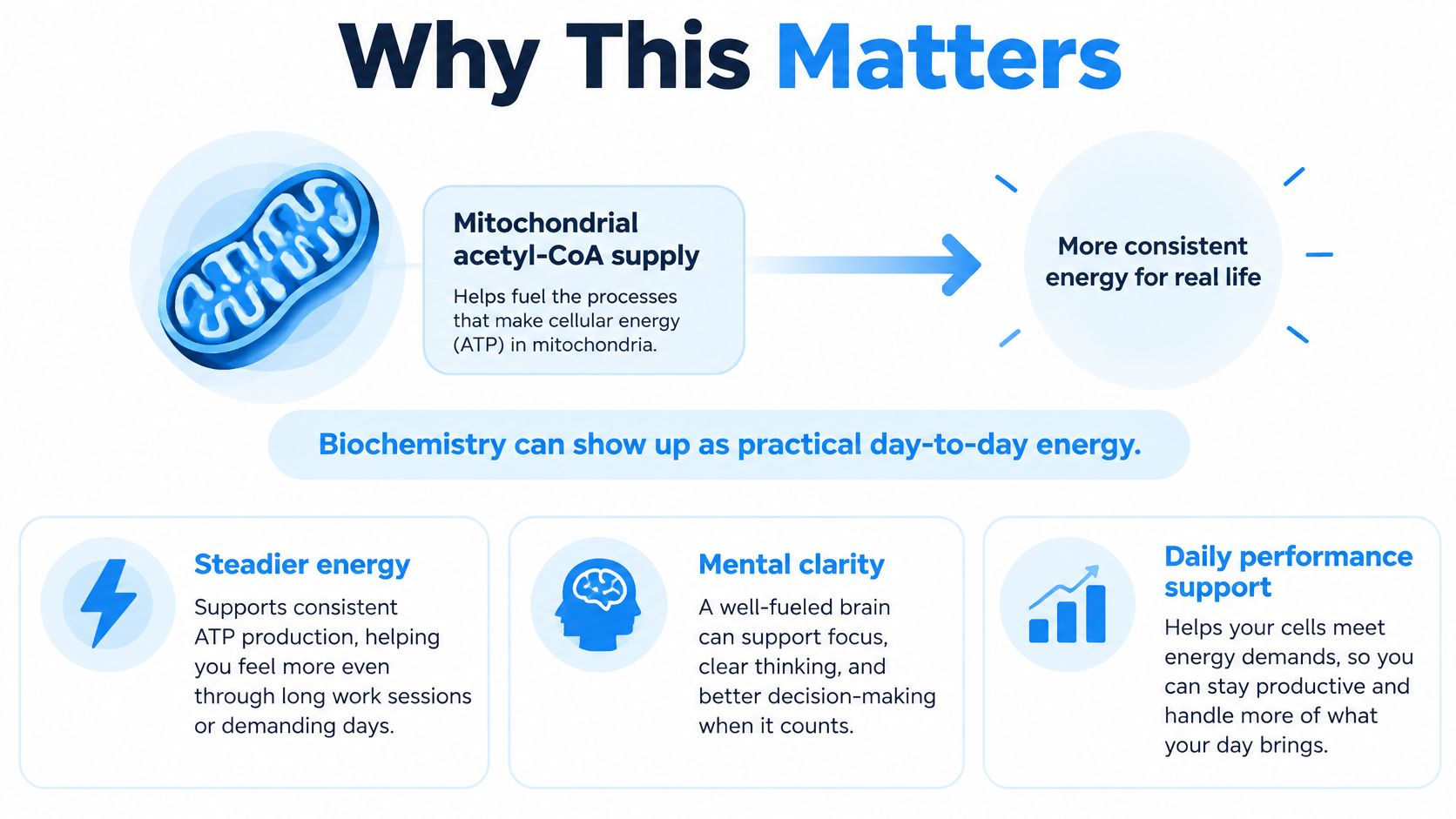
Steadier energy may mean having another fuel available when glucose availability changes. It doesn't guarantee that an afternoon slump will disappear.
Cognitive endurance is a reasonable use case to evaluate during a long focus block. A measurable brain-fuel shift doesn't guarantee better memory, and it isn't evidence of disease treatment. Dr. Kevin T. Foley, a neurosurgeon, discusses brain energy demand under stress; that rationale shouldn't be read as a claim that a supplement treats concussion.
Workout fuel describes potential access to ketones during physical effort. Hydration and steady output may matter for some routines, but greater fuel availability doesn't guarantee improved maximal power or race time.
Metabolic efficiency can refer to an acute shift in circulating fuels such as glucose and fatty acids. That's not weight-loss proof. The practical value lies in matching a plausible mechanism to a measurable personal outcome, without expecting every benefit to appear at once.
Application Framework for Daily Ketone Use
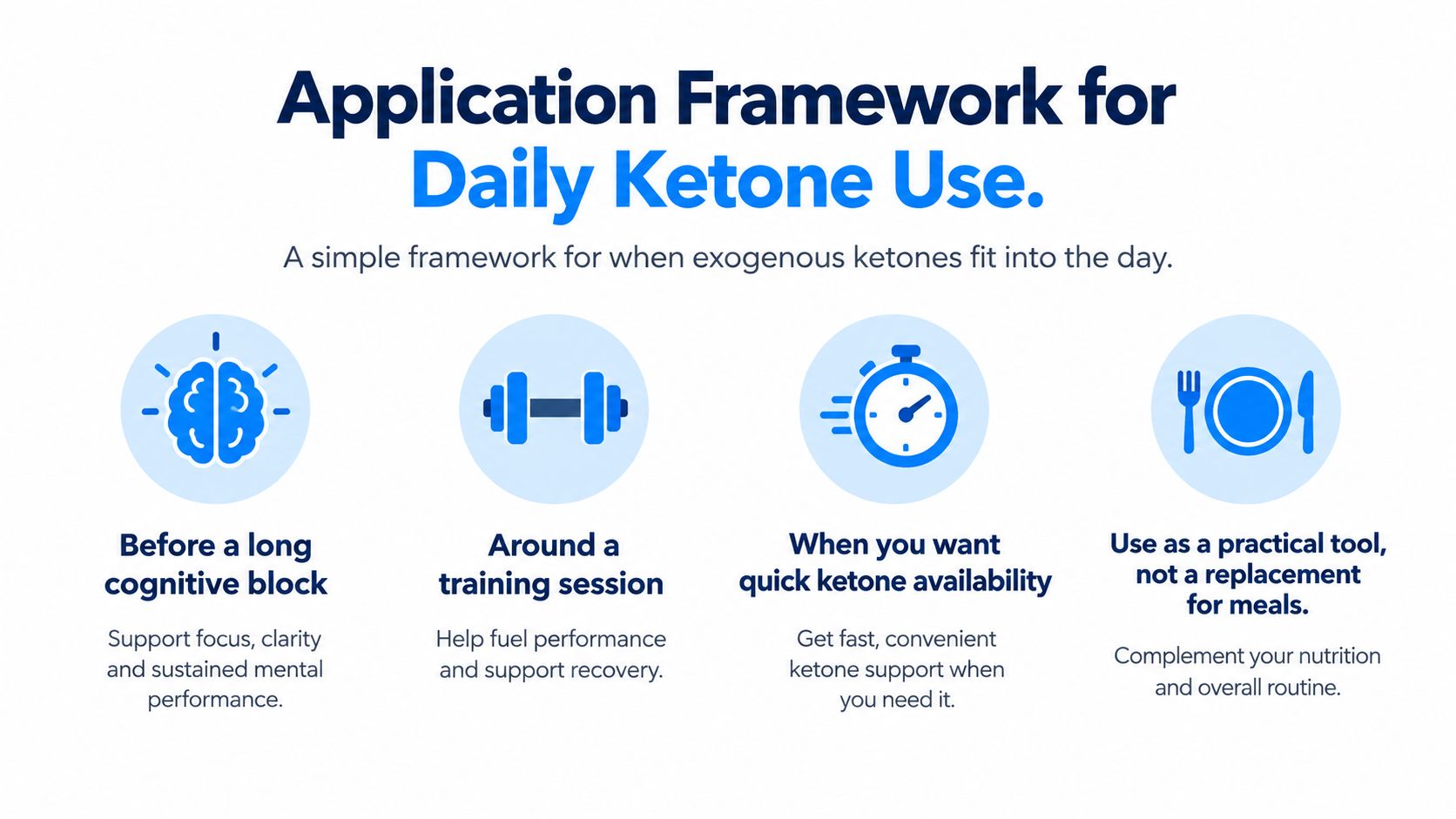
Exogenous ketones may suit a long focus block, a training session where fuel availability is the aim, or a fasting window when you want ketone exposure without a strict ketogenic diet. They change which fuels are available; they do not replace meals or the effects of training and nutrition.
Choose a use case first. Someone interested in focus, endurance or high-intensity training, or ketone exposure without a dietary change can evaluate a product against a specific, practical outcome. Anyone taking glucose-lowering medication, following prescribed ketogenic therapy, or living with neurological disease should consult a clinician before use.
The blood ketone reading is only one part of the picture. Expect a transient rise in ketones; glucose may also fall, while changes in focus, appetite, or performance can vary. If the outcome you chose to track stays the same, a higher reading alone is not evidence of success.
Practical rule: Pick one outcome before use. Record the timing and dose, then judge the result by that outcome, not the ketone number.
For a useful comparison, repeat the same kind of task or training session and note what changes. A focus response does not predict a running response, and a glucose shift does not establish weight loss.
Product formats can help match the routine to the goal. Edge Performance + Electrolytes provides sodium, potassium, and magnesium without caffeine for training and hydration. Edge adds caffeine for intense work and focus, while Locked Cognition is positioned for mental stamina. GLP-1 is intended for appetite awareness and metabolic balance. Start by matching a format to a clear goal, not a disease protocol.