


In a 1983 crossover study of five well trained male cyclists, time to exhaustion at 63% of peak oxygen uptake averaged 151 minutes on a ketogenic diet versus 147 minutes on a high carbohydrate diet, a difference that wasn't statistically significant, according to the foundational human study summary. That result still frames running on a keto diet correctly. Adaptation can preserve prolonged, moderate intensity work for some athletes. It doesn't prove that keto improves racing, replaces carbohydrate at high intensity, or works the same for every session. Treat keto as a tool you apply session by session, then test.
Which Running Sessions and Goals Suit Keto
Keto fits easy and long running far better than fast running, and the evidence splits along intensity. The 2024 International Society of Sports Nutrition position stand reviewed 16 controlled trials comparing ketogenic and higher carbohydrate diets and found only one trial with a statistically significant performance improvement favoring keto. Other controlled studies reported significantly poorer 10 kilometer time trial performance, reduced work during a 45 minute time trial, lower Wingate power, and less distance in a Yo-Yo intermittent recovery test, while seven studies found no statistically significant difference. The one positive trial doesn't settle the question, and several trials were small and narrow.
Keto Fit by Running Session Type
| Session | Typical intensity | Keto fit | Reason |
|---|---|---|---|
| Easy aerobic run | Conversational, below about 60% VO₂max | Good fit | Efficiency maintained in controlled crossover work |
| Long steady run | Easy to moderate, under about 70% VO₂max | Good fit, watch pace drift | Moderate intensity endurance preserved in trials |
| Tempo or threshold run | Comfortably hard, about 70% VO₂max and above | Mixed, test before committing | Oxygen cost and effort rise above about 70% VO₂max |
| Hill repeats | Hard, short bursts | Poor fit | Demands rapid glycolytic ATP supply |
| Interval sessions | Near VO₂max | Poor fit | High intensity work is the most carbohydrate dependent |
| 5 km or 10 km race | Near maximal, sustained | Poor fit for personal bests | 10 km time trials were significantly slower on keto in controlled trials |
| Half marathon or marathon | Moderate to hard, sustained | Conditional, depends on goal pace | Carbohydrate availability likely limits goal pace |
| Ultramarathon | Sustained, long duration | Conditional, fueling plan first | No evidence that keto improves ultramarathon performance |
The rule behind the table is simple. Greater fat oxidation doesn't mean carbohydrate independence. As pace rises, you need ATP faster, and fast running draws heavily on glycolytic carbohydrate supply. You can oxidize more fat and still lose economy, because fat derived ATP costs more oxygen per unit of work than glucose derived ATP at high output.
A Goal Based Verdict
- Base and marathon building: Keto is workable for easy and long runs, with carbohydrate placed around quality sessions and the race itself.
- Personal best 5 km or 10 km: Keep carbohydrate available. The clearest losses show up in fast, short efforts.
- Half marathon or marathon goal pace: Don't assume. Run matched session tests and rehearse your race fueling before you commit.
- Ultramarathon: Build the fueling and sodium plan first. Treat keto as optional, not as the plan.
- Appetite or fasting support: Keto may suit low intensity phases where pace isn't the priority.
Practical rule: If the session decides your race result, don't make it the session where you restrict carbohydrate hardest.
Speak with a clinician before changing diet if you have diabetes, take glucose lowering or blood pressure medication, are pregnant, or have a history of disordered eating. That check comes before any training experiment.
Adaptation Timeline and What Running Feels Like
Nutritional ketosis is diet induced. When you restrict carbohydrate, insulin falls and circulating beta-hydroxybutyrate, or BHB, rises. Endogenous ketone production describes your liver converting fatty acids into ketones during fasting or restriction. Exogenous supplementation is different, because it supplies ketones directly without requiring that dietary change.
Muscle and brain tissue can take up BHB and oxidize it in mitochondria to produce ATP. That pathway explains why easy running can feel stable once you've adapted, and it also explains the limit. Fat and ketone derived ATP arrives more slowly per unit of oxygen than glucose derived ATP, so top end pace and economy don't respond the way easy pace does. BHB also has cellular signaling roles beyond fuel, but signaling isn't the same as speed.
The timeline graphic below maps that physiology to what you'll feel on the road.
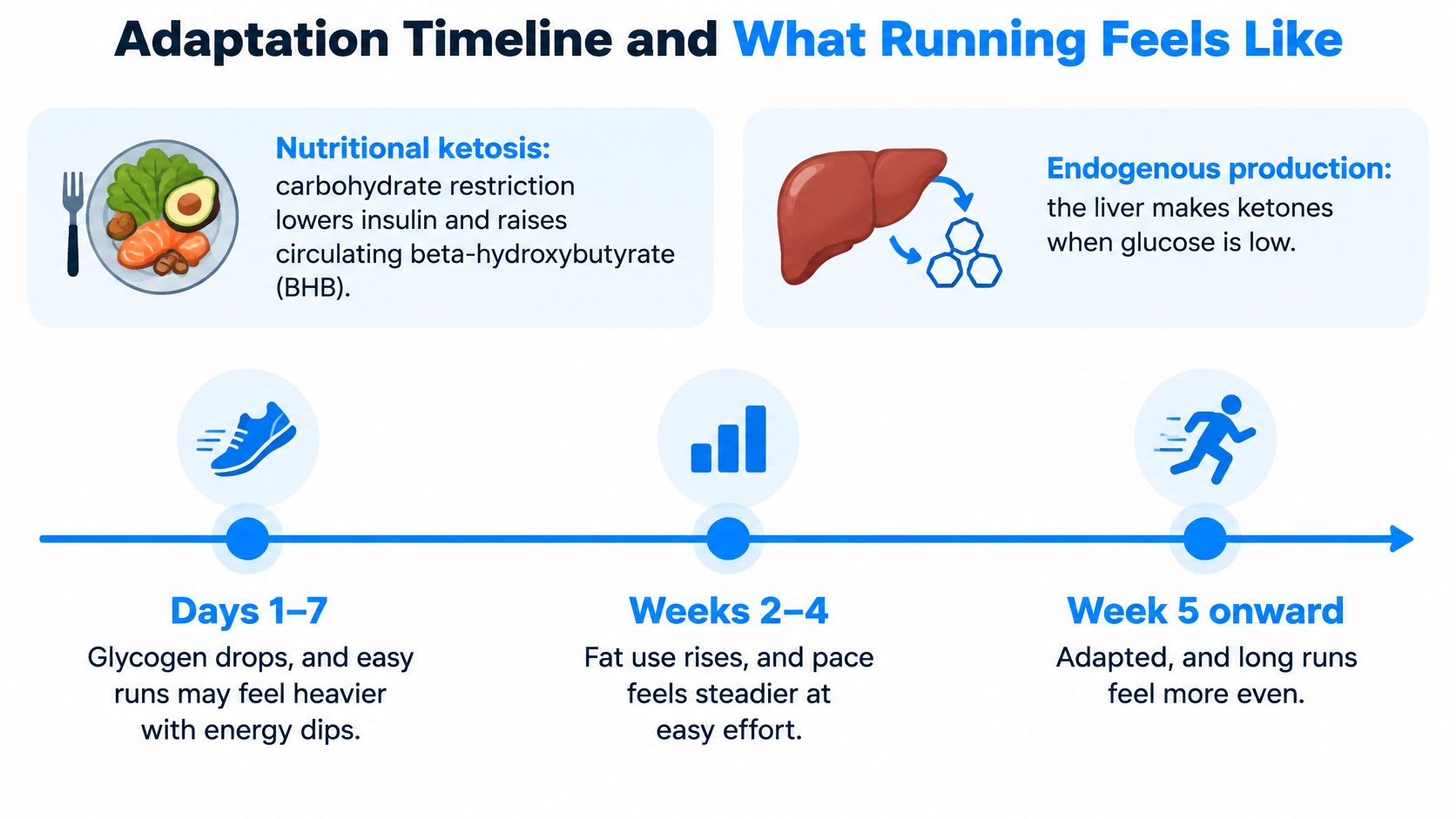
In a controlled crossover study of eight recreationally competitive male runners, the ketogenic phase supplied approximately 7% of energy from carbohydrate, 29% from protein, and 64% from fat for three weeks, and pre-exercise blood BHB reached approximately 0.7 mmol/L. Respiratory exchange ratio fell at every race pace tested, showing greater reliance on fat derived fuels, yet the 5 km time trial showed no statistically significant performance improvement and body mass fell by approximately 2.5 kg. Fuel selection changed. Speed didn't.
Adaptation Phases and Running Expectations
| Phase | What is happening | What running feels like | What to do |
|---|---|---|---|
| Days 1 to 7 | Glycogen stores fall and BHB begins to rise | Flat legs, heavier effort, possibly lower pace | Keep easy runs at familiar effort and skip intensity |
| Weeks 2 to 3 | Fat oxidation rises and respiratory exchange ratio drops | Easy pace often holds, hard efforts cost more | Keep quality sessions off the plan |
| Week 4 onward | Adaptation plateaus and aerobic capacity may normalize | Easy running stabilizes, tolerance varies by runner | Repeat a standardized benchmark workout |
| Throughout | Early loss of water and glycogen bound fluid lowers body mass | Scale weight drops before fitness changes | Do not judge progress by body mass alone |
If you want the week by week sequence in more detail, the ketogenic diet timeline lays out the expected order of changes. Use it as a calendar, not as proof that adaptation has made you faster.
Steadiness, Cognition and Where Speed Is Lost
Easy runs are where keto can feel convincing. Fat-derived fuel can make low intensity pace feel even, while the same block can leave hard efforts costing more. Steadiness and speed still need separate verdicts.
The cognitive claim is narrower. Your brain can use BHB when carbohydrate is restricted, which may matter during long, low intensity work, but controlled athlete trials have not established a mental-clarity effect that makes runners faster. If you feel sharper, log it beside pace and heart rate before trusting it.
Set the verdict by goal: keto may suit steadier easy volume, and it is weakest where surges, hills and finishing speed decide the session.
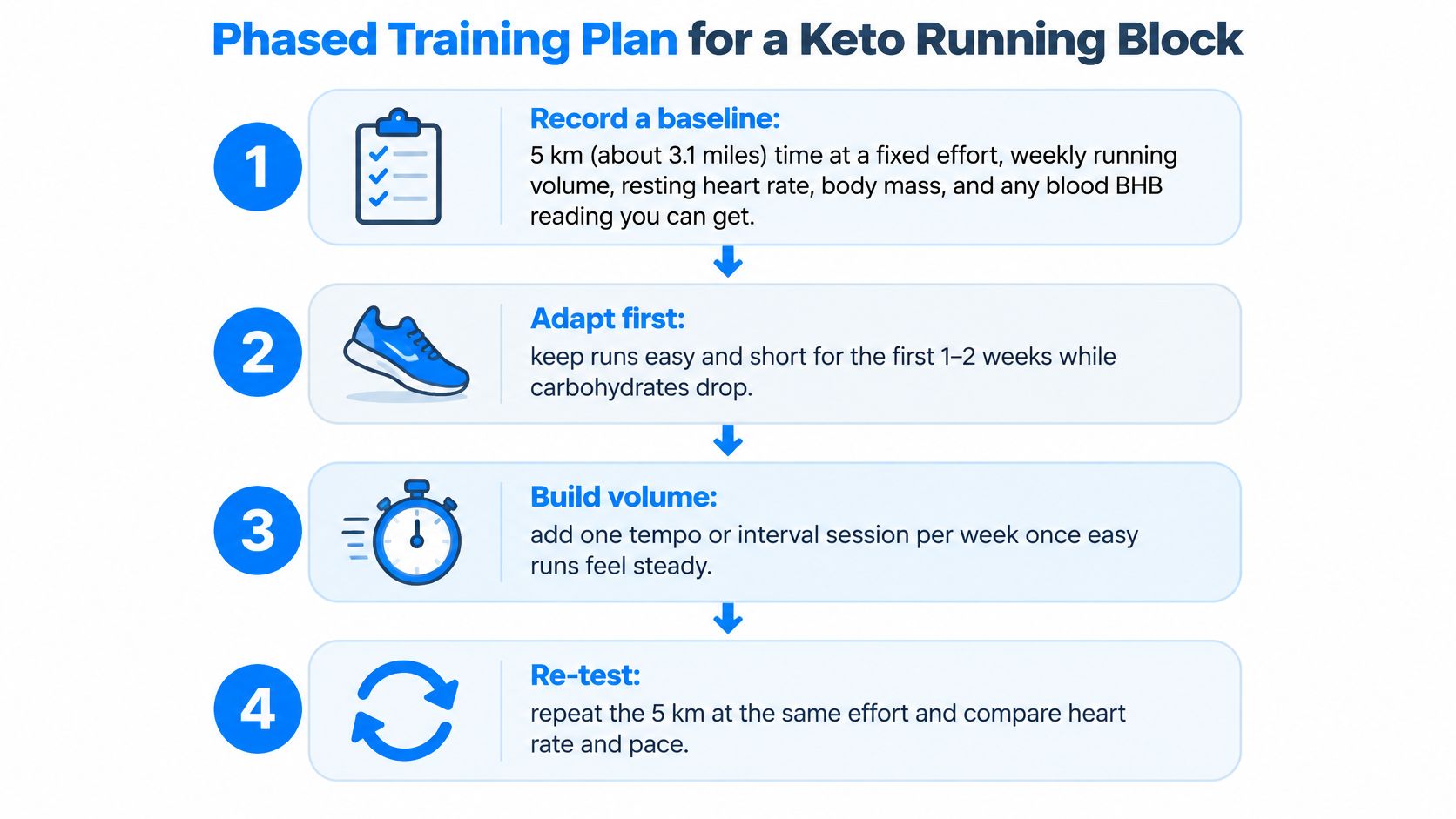
Phased Training Plan for a Keto Running Block
Run this as a four week test, not as an identity. The reviews summarized in the Journal of the International Society of Sports Nutrition describe athlete diets near 4 to 7% of energy from carbohydrate, with 3 to 4 weeks allowed for adaptation and efficiency maintained below approximately 60% of VO₂max but impaired above approximately 70% of VO₂max. That intensity line should shape your calendar from day one.
The process flow below shows the sequence at a glance.
The Four Week Procedure
- Record a baseline before day one. Log a 5 km time at fixed effort, weekly volume, resting heart rate, body mass and any blood BHB reading you can obtain, because you can't judge change without a starting point.
- Keep weeks 1 to 4 easy and long. Stay below about 60 to 70% of VO₂max and hold volume near your normal load rather than building it, because you're testing diet tolerance, not stacking two stressors.
- Leave quality work out of this window. Skip intervals, hill repeats and race pace work, because early poor sessions tell you more about adaptation than about fitness.
- Repeat the baseline at the end of week four. Compare pace at a matched heart rate under matched conditions, because matched effort is the only fair comparison.
- Add one controlled tempo session only if pace and recovery held. Stop it if pace falls or heart rate drifts upward at the same pace, because drift is your early warning.
- Place carbohydrate around quality work. Schedule a planned carbohydrate portion in the 24 to 48 hours before a key session, log whether pace and heart rate hold, and retest the same session after two weeks.
- Write and rehearse the race plan. Practice your carbohydrate plan in a long run before race day, because an untested fueling plan is a guess.
If pace still falls after step six, move carbohydrate earlier, to the previous evening's meal, before you cut quality volume. That order matters. You're testing timing before you surrender the session. The video below walks through how to structure the block in practice.
Three errors ruin most blocks. You judge progress by weight loss, you add intensity too early, or you race a fueling plan you never rehearsed. Each step above blocks one of those errors.
Fueling, Electrolytes and Recovery on Keto
Start with a caveat most electrolyte advice skips. A 2025 scoping review reports that aerobic performance may normalize after roughly four weeks of adaptation, and that commonly repeated advice to drink liberally to counter keto related natriuresis and kaliuresis lacks experimental evidence. A generic drink more rule can leave one runner short and overload another.
Estimate Your Own Losses
Weigh yourself before and after a one hour run in your usual kit. Treat each kilogram lost as about one litre of fluid, then note heat, pace and session length, because those variables change the number next time. Repeat the test in warm weather and in cool weather so you have two working ranges.
For sodium, use that sweat estimate to frame a conversation with a dietitian or clinician rather than copying a fixed dose from a label. The keto electrolytes drink guide explains what to look for on a label. One option in that category is the Tecton EDGE™ Performance Shot + Electrolytes, which combines liposomal R3HBG™ ketone with sodium, potassium and magnesium for active days. Whatever you choose, match it to your measured loss, not to a slogan.
Fueling Anchors That Matter More Than Ratios
Total energy intake matters more than macronutrient ratios alone. If you under eat, you'll misread an energy deficit as a keto failure. Protein around 1.6 to 2.0 g per kg of body mass supports training adaptation, and low carbohydrate vegetables and seeds supply fibre and micronutrients that a narrow menu can miss. For broader context on energy balance during fat loss phases, the fat-burning guidance from Navilo Health is a useful companion read. Time larger meals away from long runs so gastrointestinal comfort doesn't confound your test, track sleep and soreness daily, and if your plan includes carbohydrate after hard sessions, keep that timing consistent so recovery data stays comparable.
Monitoring Performance and Diagnosing Problems
Use a three part decision rule before you declare keto a success or a failure. First, compare matched sessions at the same pace and heart rate target. Second, compare a high intensity benchmark such as a 5 to 10 km time trial or repeated intervals. Third, track recovery and gastrointestinal tolerance for at least four weeks.
Resting ketone readings, body mass and easy run comfort are weak evidence on their own. A high BHB number confirms exposure, not performance. A lighter scale reading can hide an energy deficit, and comfortable easy miles can coexist with deteriorating intervals. You need the hard benchmark because that's where carbohydrate limitation shows up first.
Running Symptoms on Keto, Likely Causes and Fixes
| Signal | Likely cause | First check | Fix |
|---|---|---|---|
| Intervals or tempo slow while easy runs hold | Carbohydrate limited high intensity work | Matched pace comparison against a pre keto session | Keep quality sessions off keto or add carbohydrate before them |
| Dizziness when standing | Fluid or sodium deficit, or adaptation effect | Standing versus seated heart rate and body mass | Adjust fluid and sodium; seek medical review if persistent |
| Cramps late in long runs | Sodium loss exceeding intake | Sweat rate estimate from pre and post run weight | Individualized sodium before and during runs |
| Fatigue persisting after week four | Energy or carbohydrate intake too low | Weekly intake log and body mass trend | Increase total energy intake and reduce restriction |
| Rapid body mass loss | Energy deficit beyond training needs | Weekly mass trend under the same conditions | Add food energy before adding more training |
Each check is something you can do at home. A standing heart rate check takes a minute, a sweat rate calculation needs a scale, and an intake log needs a week of honesty. Run the check before you change three variables at once, or you'll never know which change helped.
Change one variable, retest the same session, then decide. Guessing in bulk produces data you can't use.
Some signals aren't self adjustment problems. Seek medical attention for fainting, chest pain or persistent confusion, and get professional advice promptly if symptoms occur while you're taking glucose lowering or diuretic medication. Don't try to outlast those.
Ketone Supplements in a Running Plan
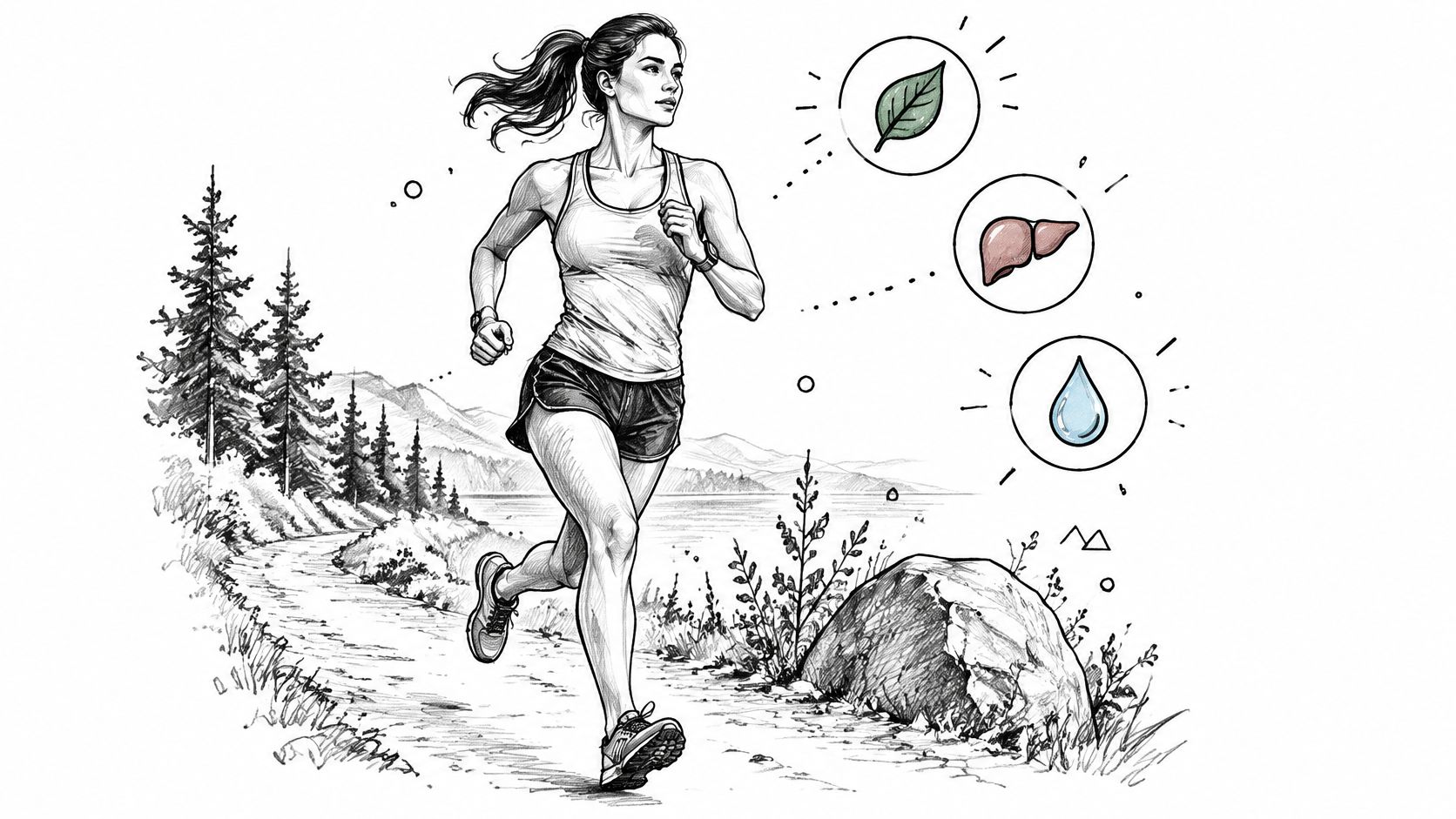
Supplement marketing blends three routes. Nutritional ketosis comes from diet, endogenous production is your liver making ketones, and exogenous supplementation delivers BHB orally so tissues can take it up and oxidize it in mitochondria for ATP. The image below shows the systems runners are trying to support when they use any of these routes.
A pharmacokinetic study summarized in the ketone ester literature reported BHB rising from approximately 0.2 mmol/L before ingestion to 4.1 mmol/L at 120 minutes, with peaks across controlled human studies of approximately 3.3 to 6.7 mmol/L depending on dose. Treat that rise as transient availability. The background on whether exogenous ketones work separates a higher BHB reading from pace, because the number that matters is still your matched-session result.
Ketone Delivery Forms Compared
| Form | What it supplies | Practical check | Evidence note |
|---|---|---|---|
| Ketone salts | BHB bound to a mineral | Confirm the mineral load fits your sodium plan | Check sodium and mineral content on the label |
| Ketone esters | Higher BHB yield per dose | Test tolerance in training before any quality session | Peak BHB 3.3 to 6.7 mmol/L depending on dose |
| Precursors (1,3-butanediol, MCT) | Substrate converted to BHB in the body | Expect individual response and confirm with the same easy session | Conversion varies between users |
| Liposomal encapsulation | Delivery approach for BHB or ester | Compare label details rather than assuming absorption from format | Performance evidence still limited |
Check the isomer before anything else. D-BHB is the form your body produces and uses; L-BHB is a different input for a running plan. Tecton's R3HBG is described as a tri-ester of three D-BHB molecules on a glycerol backbone. Whatever the product, read the label for isomer, grams per serving, sodium and mineral content, and third party testing. Use supplements selectively: a hard session timed away from carbohydrate, a fasting window, or a long easy run where you want ketones available while keeping the day's diet unchanged. Judge the experiment by pace at matched heart rate and gut tolerance across repeated easy sessions. A higher BHB value shows availability; your stopwatch decides whether it helped.
Your First Week on a Keto Running Block
Pick one run to learn from: the easy aerobic session you already repeat on a familiar route. Keep it truly easy, keep total energy intake steady, and leave intervals, tempo work and racing in the carbohydrate camp until this run shows what keto does to your normal pace.
Make the verdict goal-based. Greater fat oxidation can support long aerobic work, while fast running still leans on carbohydrate, so the question is narrower than “does keto work”: can this session hold pace at a matched heart rate with ordinary recovery and a settled gut?
If it holds, repeat the same session once more before adding intensity or extending duration. If it fades, move carbohydrate next to quality work and keep keto for runs it suits, because forcing an interval session to validate the diet only confuses the signal.
Medical flags come before experiments: diabetes, pregnancy, a history of disordered eating, or medication that lowers glucose or blood pressure. A supplement can stay optional; read isomer, grams per serving, sodium and third party testing, and let the run outrank the meter.
If you want ketone availability without tying every run to strict carbohydrate restriction, Tecton Ketones™ offers liposomal R3HBG™ shots built around bioidentical D-BHB for training, fasting windows and everyday energy support. Treat it as an option within the same test, measured by the run rather than the meter.


