


Approximately 10% of adults following ketogenic diets reported brain fog or reduced cognitive performance in a 2026 evidence table drawing on a scoping review of 89 studies. That estimate deserves context: the research is limited, and it doesn't mean everyone entering ketosis should expect impaired thinking.
Ketosis brain fog is a description of symptoms, not a standardized medical diagnosis. If your thinking feels slower after cutting carbohydrates, the useful question isn't just whether you're producing ketones. It's whether you're getting enough fluid, sodium, food, and sleep, and whether symptoms suggest something that needs medical review.
A supplement shouldn't be your first diagnostic test. Start by separating the dietary transition from the ordinary problems that can accompany it.
Brain Fog Timeline in the First Weeks
Brain fog can occur during the first weeks of carbohydrate restriction, but there's no established universal adaptation timeline. Some people notice trouble concentrating; others don't. The available literature also doesn't establish that symptoms reliably disappear if someone stays on the diet, according to a review of nutritional approaches and cognitive outcomes.
Timing is useful for organizing observations, not diagnosing the cause. The following windows are a practical tracking framework rather than validated clinical stages. In particular, the “peak” and “adaptation” labels shouldn't be read as a promise about when symptoms will start or resolve.
Typical brain fog timeline on carbohydrate restriction
| Phase | Typical timing | What people report | Likely driver |
|---|---|---|---|
| Early restriction | Days 1–3 | Headache, fatigue, mild fog | Glycogen and water loss |
| Peak window | Days 3–7 | Fog, irritability, cravings | Sodium and fluid loss during the fuel shift |
| Adaptation | Weeks 2–4 | Symptoms may ease, although improvement isn't guaranteed | Higher BHB use and more consistent electrolyte intake |
| Persistent | Week 4 onward | Fog that stays or worsens | Confounders or a medical cause; reassess |
Use the table to ask better questions. Did symptoms begin when you changed your meals, stopped drinking coffee, or started exercising without replacing fluids? Did they improve after eating, or worsen after a poor night's sleep?
For broader dietary context, the ketogenic diet timeline can help you distinguish changes in eating patterns from changes in how you feel.
Tracking habit: Record your day of carbohydrate restriction, a morning clarity rating, and your fluid and salt intake. Consistent observations are more informative than trying to remember whether yesterday felt better.
You don't need to wait for a particular week to ask for help. Sudden, severe, or worsening symptoms shouldn't be assigned to “adaptation,” even if they occur immediately after starting keto.
Why the Brain Feels Foggy During the Switch
On a restricted-carbohydrate day, the brain can draw on both glucose and ketones. Glucose remains in use as the liver makes more ketones, so this shift is gradual rather than an instant switch. The illustration shows fuel availability; it doesn't predict mental performance.
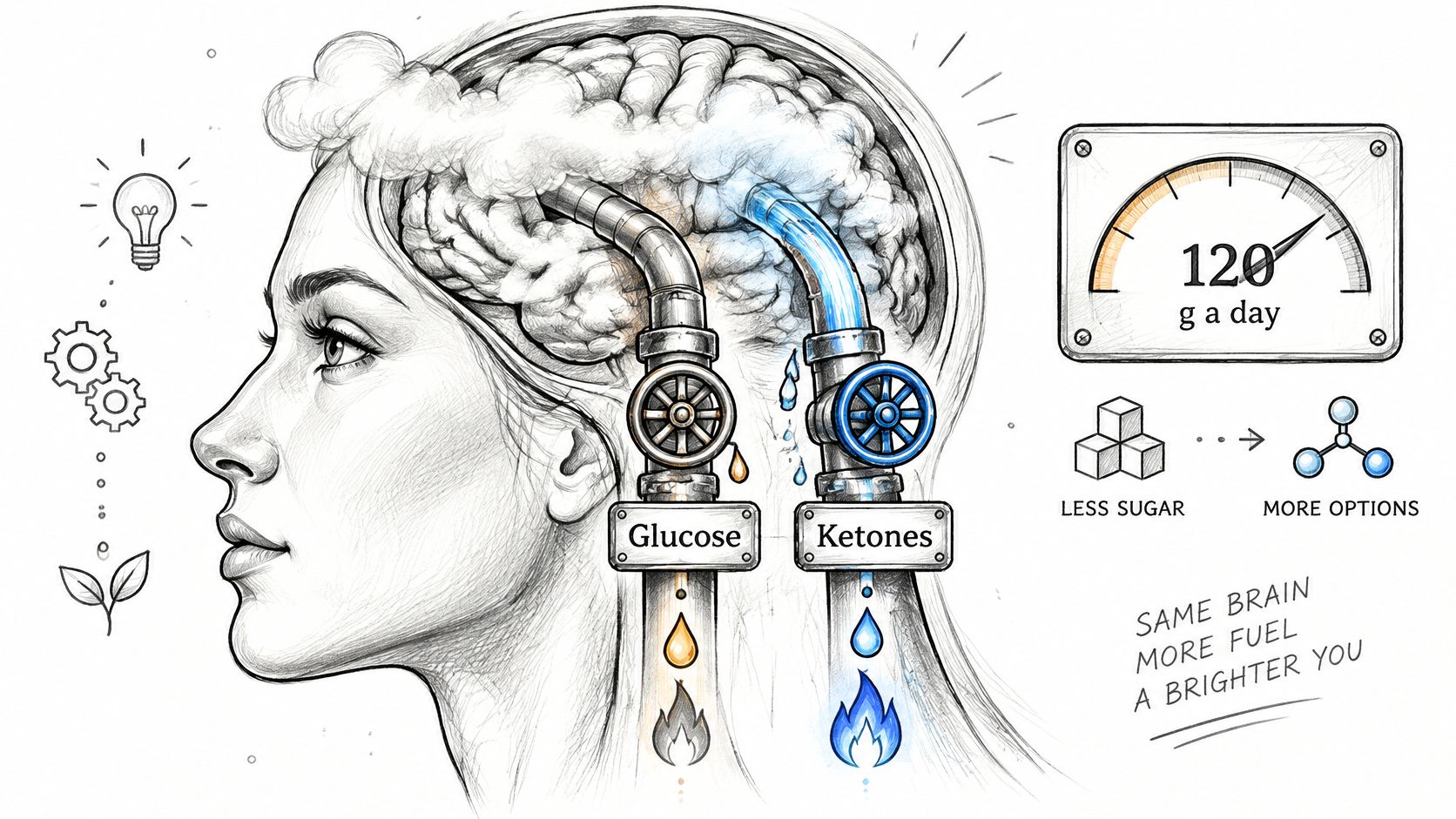
How ketones become usable energy
During carbohydrate restriction, the liver increases endogenous ketone production, meaning production inside the body. Beta-hydroxybutyrate, usually shortened to BHB, and acetoacetate circulate in the blood and cross the blood–brain barrier through transport proteins called monocarboxylate transporters.
Inside cells, ketones enter pathways that produce acetyl-CoA, which feeds the citric acid cycle. Mitochondria use oxidation to support production of ATP, the usable energy currency cells need to work. Glucose reaches this shared energy machinery through a different upstream pathway.
The brain can use both fuels. Metabolic flexibility is the ability to adjust fuel use as availability and demand change.
A controlled PET study of 10 healthy adults examined brain metabolism after four days on a very-high-fat ketogenic diet with a 4.5:1 fat-to-protein-plus-carbohydrate ratio. Plasma ketones increased eightfold and glucose fell by 24%; brain acetoacetate metabolism rose sixfold while cerebral glucose metabolism fell by 20%. The study measured changes in fuel use, not whether participants' concentration improved or brain fog resolved.
Why fuel availability doesn't explain everything
A separate review of cerebral ketone metabolism describes healthy adults receiving intravenous BHB whose cerebral glucose consumption fell by approximately 14% while oxygen consumption remained unchanged. This helps explain why lower glucose use alone doesn't establish that the brain lacks energy.
Early symptoms may arise during an adaptation mismatch. Fuel availability is changing at the same time as fluid and sodium intake, sleep, or eating habits may be unsettled. This is one possible explanation; persistent or severe symptoms need assessment rather than an assumption that adaptation is the cause.
BHB also has cellular-signaling roles under investigation. Proposed effects on endothelial function, meaning how blood-vessel lining cells work, have not been established as an explanation for improved everyday cognition.
For a visual explanation of the transition, this accompanying video provides additional context.
Common Confounders That Look Like Keto Fog
Ordinary, potentially correctable problems deserve attention before you blame ketones. Research hasn't established what proportion of ketosis brain fog each confounder explains, so claiming that one cause accounts for most cases would go beyond the evidence.
The practical distinction is between being in ketosis and everything else that changed when you started eating differently. Skipping breakfast, removing caffeinated drinks, training harder, and sleeping poorly can overlap with carbohydrate restriction.
Confounders that mimic or amplify ketosis brain fog
| Confounder | Mechanism | Typical signal | First check |
|---|---|---|---|
| Sodium and fluid loss | Falling insulin increases renal sodium and water excretion | Headache, dizziness, fog on standing | Daily fluid and sodium intake, urine colour |
| Insufficient calories | Large unplanned energy deficit | Fatigue and poor concentration by afternoon | Total intake against estimated needs |
| Sleep loss | Reduced recovery and attention lapses | Slow reaction time, morning fog | Sleep duration across seven nights |
| Abrupt carbohydrate cut with glucose-lowering medication | Glucose falls below target | Shakiness, sweating, sudden confusion | Fingerstick glucose and medication review |
| Caffeine withdrawal | Adenosine rebound after stopping intake | Headache and drowsiness 12–24 hours after the last dose | Timing of the last caffeinated drink |
| Illness or medication effects | Diuretics, antihypertensives, and infections can alter fluid or glucose balance | New drowsiness, fever, dizziness | Clinician review of current prescriptions |
These patterns are clues, not diagnostic rules. Fog that worsens when you stand up warrants attention to fluid balance and blood pressure. Afternoon difficulty concentrating calls for a look at meals and sleep rather than an automatic increase in ketone intake.
Headache after a missed coffee suggests a different question from sudden confusion with sweating or shakiness. The latter needs prompt assessment for a glucose problem, particularly if you use glucose-lowering medication.
Correct the likely problem before judging the diet
The relationship between keto and electrolyte imbalance is especially relevant when dizziness accompanies poor concentration. However, drinking more water without considering sodium, medication, and medical history isn't a complete plan.
If symptoms are mild and no warning signs are present, address the most plausible contributor consistently before changing several other variables. Avoid making a supplement, a major caffeine change, and a new fasting routine part of the same experiment.
A useful improvement is one you can connect to a specific change. If everything changes at once, you won't know what helped.
What the Evidence Says and Which Ketone Source Fits
The cognitive evidence is encouraging but mixed, with results depending on who was studied and what investigators measured. A change in blood BHB is evidence of exposure, not proof of clearer thinking.
In a randomized six-week study involving 23 adults with mild cognitive impairment, a ketogenic diet improved verbal memory relative to a high-carbohydrate diet, and improvement was associated with ketosis. That population and intervention aren't equivalent to a healthy adult taking a supplement for dietary-transition symptoms.
The supplied evidence also includes a 2025 systematic review and meta-analysis covering 29 studies and 1,347 participants reporting a modest average cognitive effect from exogenous ketones, with a standardized mean difference of 0.26 and a 95% confidence interval of 0.11–0.40. A modest average effect isn't a guarantee of noticeable benefit for an individual.
Ketone sources compared by mechanism, speed and limits
| Ketone source | How BHB rises | Speed | Main limitation |
|---|---|---|---|
| Nutritional ketosis | Carbohydrate restriction increases liver ketone output | Days to weeks, with individual variation | Requires sustained dietary change |
| Endogenous production | The body makes BHB during fasting or very low intake | Hours to days, depending on context | It's a physiological process, not a product |
| Ketone salts | BHB is supplied with sodium, potassium, calcium, or magnesium | Product-dependent | Mineral load can constrain use |
| Ketone esters, including R3HBG | Digestion releases ketone components, depending on ester structure | Rapid exposure is possible; formulation matters | Tolerance and exposure differ across products |
| Precursors, such as 1,3-butanediol or MCT | Metabolism indirectly increases ketone production | More variable | Indirect exposure and gastrointestinal tolerance |
Nutritional ketosis is one route to endogenous production, not a separate kind of ketone molecule. Exogenous supplementation means consuming a ketone source from outside the body.
Read formulation claims carefully
D-BHB is the form the body naturally produces and uses in its energy pathways. Don't assume that an L-isomer has identical metabolic handling, or interpret “bioidentical” as proof of superior cognitive results.
Liposomal delivery means encapsulating ingredients in lipid vesicles, with the intention of supporting delivery or absorption. Direct human comparisons are needed before claiming that one liposomal product outperforms other formats.
Tecton EDGE™ Performance Shot + Electrolytes combines liposomal R3HBG™ ketone with sodium, potassium, and magnesium for active-use routines. Its formulation description doesn't establish that it resolves brain fog.
An adjunct may fit someone who has addressed basic contributors and wants a defined performance trial. People using glucose-lowering or blood-pressure medication, or living with kidney, liver, or other metabolic conditions, should first consult a clinician. When asking whether exogenous ketones work, specify the outcome: which source fits your goal, medical context, and tolerance?
Clinical Signs That Need Medical Attention
Sudden confusion, slurred speech, facial droop, or one-sided weakness requires emergency services. Don't wait to see whether food, electrolytes, or ketones improve it. A recent dietary change doesn't make an emergency less urgent.
The safety distinction is between mild, stable symptoms you can discuss with a clinician and symptoms that make self-management inappropriate. Nutritional ketosis and ketoacidosis aren't interchangeable, and a home ketone reading can't establish which situation you're in.
Warning signs and the action each one calls for
| Symptom or sign | Possible meaning | Action |
|---|---|---|
| Sudden confusion, slurred speech, one-sided weakness | Stroke or another emergency | Call emergency services now |
| Nausea, vomiting, abdominal pain, fruity breath, rapid breathing | Possible ketoacidosis, including with SGLT2 inhibitors | Seek urgent same-day care; use emergency care for severe symptoms |
| Fog persisting beyond four weeks or worsening | Confounder or another medical cause | Book a clinician appointment |
| Dizziness on standing, very low urine output | Dehydration or electrolyte imbalance | Obtain same-day medical advice |
| New cognitive change in older adults or people with known neurological conditions | Requires formal assessment | Schedule evaluation; don't self-treat with supplements |
Medication changes the safety boundary
People with type 1 diabetes or insulin-treated diabetes need particular caution around symptoms compatible with ketoacidosis. SGLT2 inhibitors can be associated with ketoacidosis even when glucose isn't markedly high, so a reassuring glucose reading doesn't rule out danger.
Shakiness, sweating, and confusion with glucose below 70 mg/dL, or 3.9 mmol/L, require treatment according to an established clinician-directed hypoglycemia plan. If the person can't safely swallow, loses consciousness, or needs help managing the episode, seek emergency assistance.
For older adults and people with Parkinson's disease, dementia, epilepsy, or another neurological condition, a new cognitive change deserves assessment rather than an assumption that the diet explains it. Don't use a supplement trial to delay that review.
Safety boundary: A higher BHB reading doesn't prove that your symptoms are harmless. Symptoms, glucose, medication, hydration, and clinical history matter together.
You also don't need to wait until the persistent-symptom window to contact your clinician. Worsening function, difficulty managing ordinary tasks, or an unexplained change from your usual thinking is enough reason to ask for advice.
Why This Matters for Daily Performance
A useful check of ketosis-related fog looks beyond ketone readings to how well you handle everyday tasks. Sodium loss, poor sleep, or too few calories can also affect performance, so consider these ordinary causes before blaming ketones or trying a supplement.
- Steadier energy: At your usual work time, record whether you finish a familiar task without an unexpected slump. Note whether you ate beforehand, since missed meals can also affect energy.
- Cognitive endurance: At the same time each day, complete a 20-minute attention or reaction-time task and record both your score and errors. Feeling alert does not always mean your performance is accurate.
- Workout performance: Compare similar sessions, recording the work completed and perceived effort while keeping meals, hydration, and training load similar. Brain-metabolism findings alone do not establish better exercise endurance or glucose sparing.
- Metabolic efficiency: Assess whether you can maintain your usual thinking and activity across different conditions, rather than using a higher BHB reading as proof of improved fuel use.
After an exogenous ketone dose, circulating BHB may rise before you notice a meaningful performance change. There is no established timetable requiring mental clarity to improve within minutes, days, or weeks.
A familiar task completed faster with more mistakes may not represent progress. Likewise, an easier workout after better sleep cannot automatically be credited to a ketone product.
Choose the outcome before testing a change. Keep the surrounding routine reasonably consistent, and account for sleep, food, and sodium before attributing a difference to ketosis.
Confirm the Cause and Adjust in Order
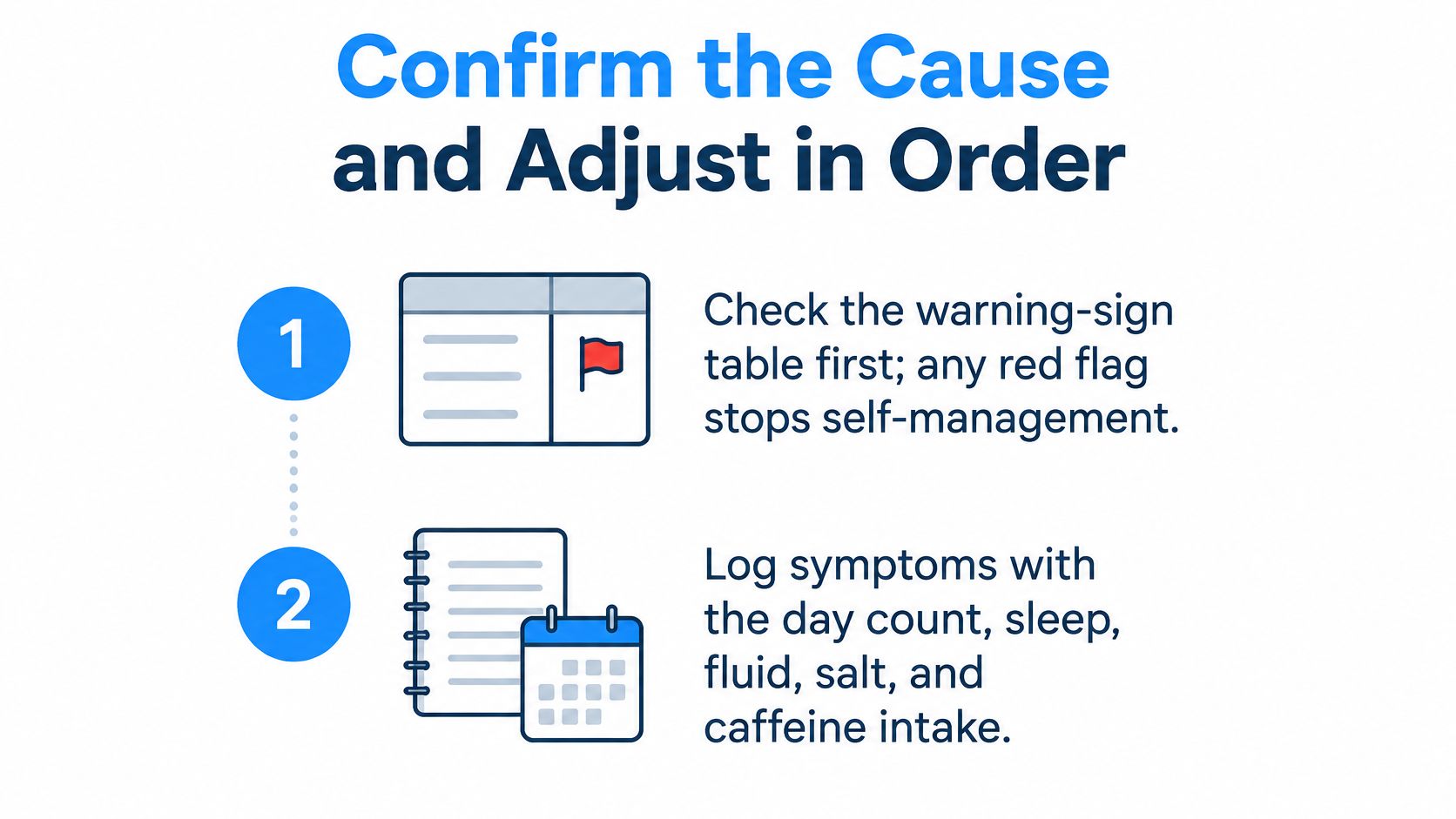
Work through these steps in order, stopping at any red flag. Start by deciding whether self-management is appropriate, then change and track one relevant factor at a time. The aim is to find an ordinary, correctable cause before attributing fog to ketosis or adding a supplement.
Use this visual reminder to guide observation and self-management.
Application Framework
- Check the warning signs described above. If any apply, pause self-management and seek the level of care indicated in the clinical guidance.
- Make a symptom log you can compare. Each day, note when fog starts and ends, how long it has been since you changed carbohydrate intake, meals, sleep, fluids, sodium, caffeine, and medication changes. Rate morning clarity on the same scale each time. For example, record “morning clarity: 4/10” alongside the day's routine, then compare similar days rather than relying on memory.
- Review fluids and sodium together. Sodium loss can resemble a problem with ketosis, but a fixed salt or water target may not suit your health or medications. Seek individualized advice if you have hypertension, kidney disease, swelling, fluid restrictions, or take medication affecting blood pressure or electrolytes. Include foods such as leafy greens, avocado, nuts, and seeds before considering high-dose potassium or magnesium supplements.
- Check food intake and sleep. Compare what you eat with your usual intake and activity, especially if restriction has been substantial. A registered dietitian can help assess whether your meals are adequate. Protect a consistent opportunity for sleep before concluding that an alternative fuel is missing.
- Use your existing medication plan. If medication may affect your diet or symptoms, follow the review guidance above and consult your clinician before changing treatment.
- Measure only when the result will guide a decision. If appropriate, record fingerstick glucose and capillary BHB alongside symptoms, hydration, and blood pressure. Ask your clinician which readings matter and what to do if they fall outside your individual targets.
- Make carbohydrate changes tolerable. Reducing intake gradually may make it easier to see which changes coincide with symptoms. No universally validated taper prevents brain fog, so pause or reconsider a schedule if symptoms worsen.
-
Consider an adjunct after the basics are stable. A human pharmacokinetic PET study found that a single oral ketone ester dose of 395 mg/kg changed brain fuel use within one to two hours, reducing whole-brain glucose metabolism by 17%. This study describes a research dose and a measured metabolic change; it does not establish a self-dosing amount or prove that ketone esters treat brain fog.
Tecton Ketones™ offers R3HBG, a D-BHB tri-ester, in liposomal single-serve shots. Follow the label directions, and stop and seek clinician advice if gastrointestinal discomfort or other concerning symptoms occur.
- Decide whether to continue, adjust, or stop. Compare attention, accuracy, reaction time, gastrointestinal tolerance, relevant glucose readings, and your symptom log with baseline. A higher BHB reading alone is not a reason to continue. If symptoms persist or the cause remains unclear, bring your record to your clinician.
A useful decision rule is to change one correctable factor, then check whether the same symptom measure improves while other conditions stay reasonably similar. Identify what changed, correct what you can, and expect a meaningful outcome before continuing any optional adjunct. You can make a safer choice without deciding that ketosis itself is good or bad.


