


Popular sports-nutrition advice often treats fast-acting carbohydrates as mandatory before every workout. That's too broad for athletes who eat low-carb, but the opposite claim is just as misleading: a pre-workout doesn't become performance-enhancing because it contains ketones.
A useful way to assess keto friendly pre workouts is to separate what a formula delivers from what human performance research supports. Ketone exposure, caffeine, and electrolytes are different inputs, with different purposes and evidence behind them. The right choice depends on the training demand, the dose, and how well you tolerate the product.
| Input | What it delivers | What to assess |
|---|---|---|
| Exogenous ketones | A source of circulating beta-hydroxybutyrate (BHB) | Form, disclosed dose, tolerance, and evidence for the intended use |
| Caffeine | A stimulant that can support acute exercise performance | Milligrams per serving, body-mass-adjusted dose, timing, and side effects |
| Electrolytes | Minerals such as sodium, potassium, and magnesium | Amount per serving and fit with your diet, sweat losses, and hydration needs |
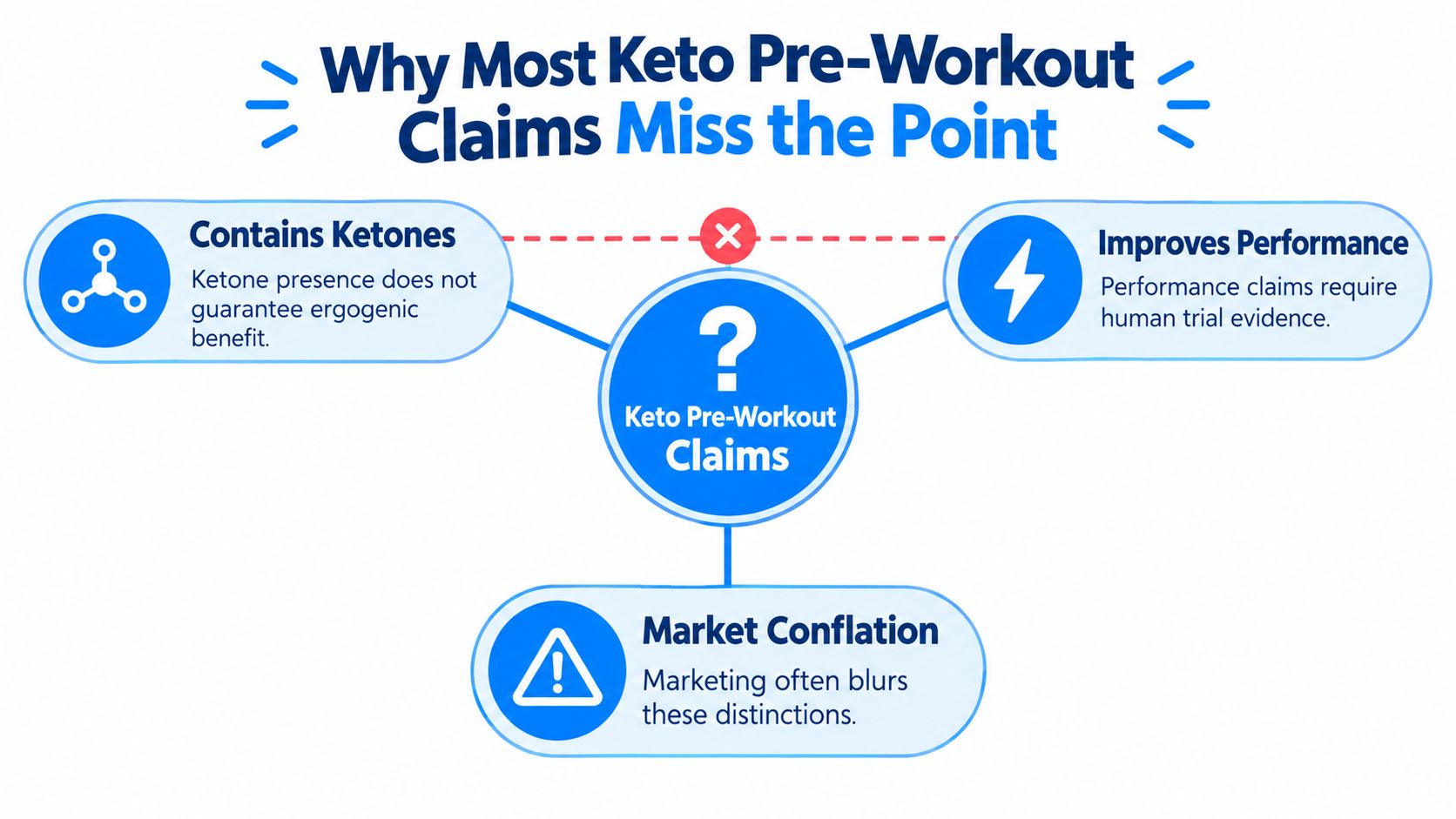
Why Most Keto Pre-Workout Claims Miss the Point
A product that contains ketones may raise circulating BHB. That's a metabolic effect, not proof that the product makes you faster, stronger, or able to exercise longer. A systematic review and meta-analysis of acute exogenous ketone studies concluded that ketone ingestion did not significantly improve endurance-exercise performance, even though ketone availability can change measurably (systematic review of acute exogenous ketones).
The distinction matters because pre-workout marketing often collapses two questions into one: What reaches the bloodstream? And what outcome has been demonstrated in controlled human exercise research? A label can answer the first question with an ingredient list. It can't answer the second without relevant trials.
Two inputs, two evidence bars
Think of a keto-friendly pre-workout as two separate inputs: a potential metabolic fuel and, if included, a stimulant. Ketones should be judged on the form and dose delivered, tolerability, and whether the outcome claimed has been tested. Caffeine should be judged against its own evidence for alertness and exercise performance, as well as the dose and timing.
This approach also leaves room for products that don't use either ingredient. Some athletes do better with water, a suitable electrolyte source, or a meal timed to their training. For a broader look at non-supplement choices, this guide to natural pre workout options offers useful context.
Practical rule: Treat “contains ketones” as an ingredient statement, not a performance result.
The Physiology a Keto Pre-Workout Is Built On
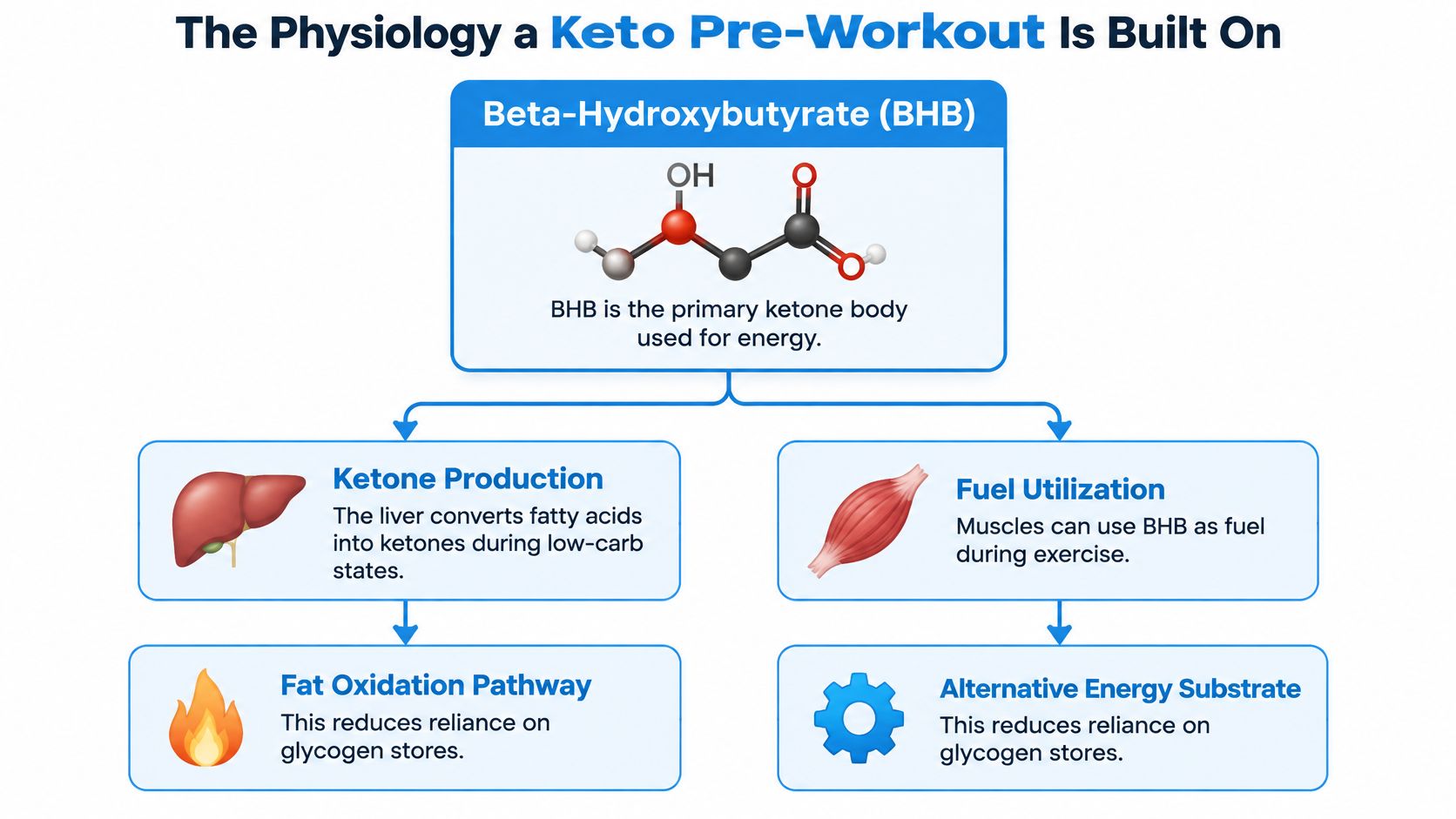
Beta-hydroxybutyrate, or BHB, is a ketone body that can serve as an energy substrate. After entering tissues, it can be converted into acetoacetate and then into acetyl-CoA. Mitochondria use acetyl-CoA in the tricarboxylic-acid cycle, supporting the production of ATP, the cell's usable energy currency. Glucose follows a different route: it is processed through glycolysis, producing molecules that can also feed mitochondrial energy production.
The body's use of glucose and ketones is not an either-or switch. Metabolic flexibility means being able to use different fuels as availability and demand change. Exercise intensity, duration, diet, training status, and the person's current metabolic state all affect which fuels contribute.
Three routes to circulating ketones
These terms describe distinct processes:
- Nutritional ketosis is a diet-induced state, commonly associated with sustained carbohydrate restriction or fasting.
- Endogenous ketone production is the body's own production of ketones, primarily by the liver. It can occur during low-carbohydrate availability and other conditions, including overnight fasting.
- Exogenous ketone supplementation supplies ketones or ketone precursors from outside the body. It can raise circulating BHB without first relying on diet-induced ketosis.
The brain can use ketones as fuel. In a controlled human study, intravenous BHB reduced cerebral glucose consumption by approximately 14% while cerebral oxygen consumption remained unchanged (human brain-metabolism study). A separate isotope-tracing study measured BHB use in human brain metabolism during acute hyperketonemia, demonstrating that ketone carbon can contribute to mitochondrial energy production (human isotope-tracing study). These findings establish fuel use, not improved concentration, cognition, or athletic performance.
Inside a Keto Friendly Pre-Workout Formula
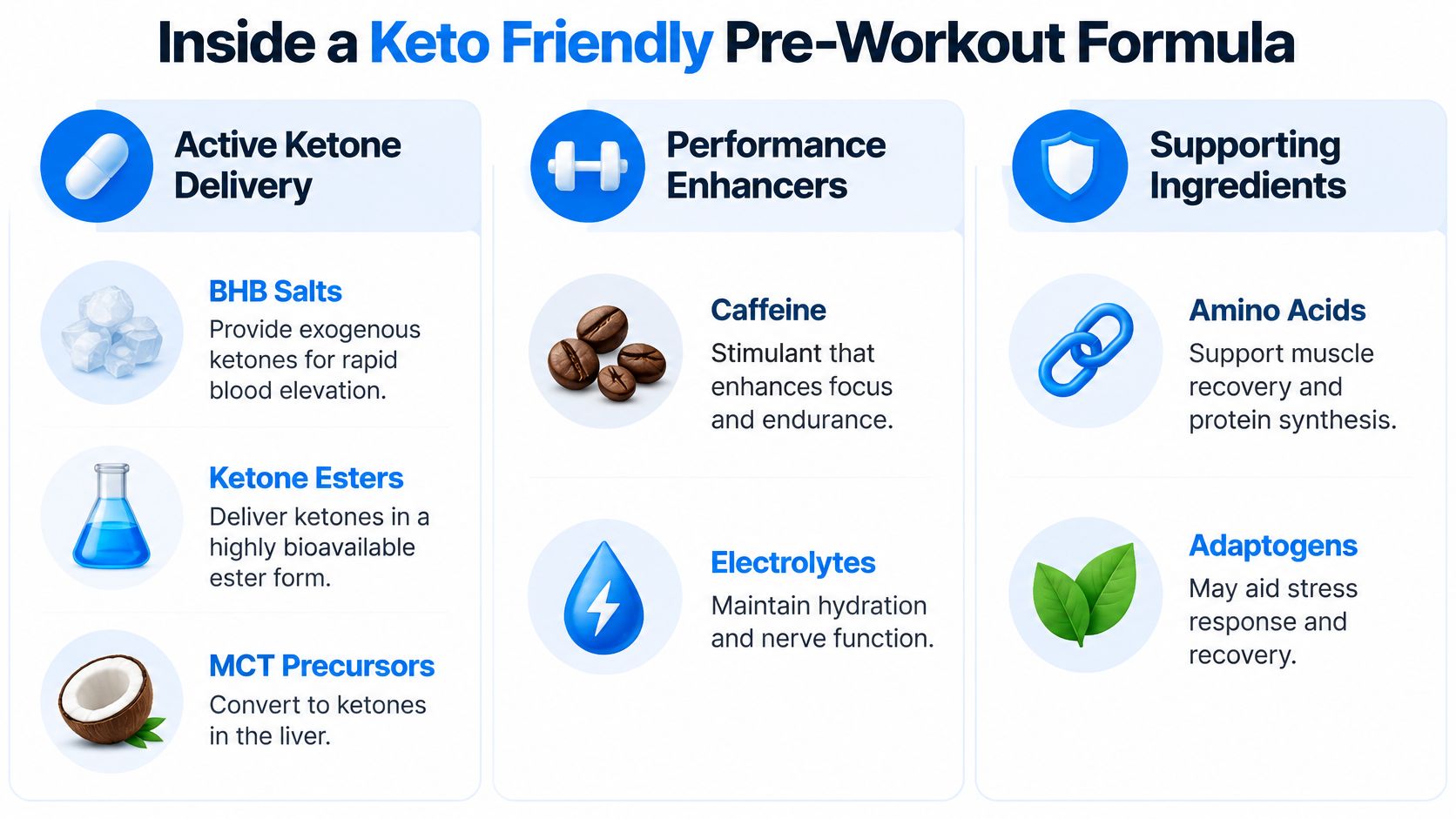
A formula can combine ingredients with different jobs, so read the label by function rather than by the product's overall promise. Active ketone delivery is one category; stimulants, hydration ingredients, and other supporting compounds are separate categories.
Identify what each ingredient is meant to do
Ketones and precursors include BHB salts, ketone esters, and precursors such as medium-chain triglycerides (MCTs). They don't all deliver ketones in the same way or on the same timeline. A label that names the form and discloses the active amount gives you more useful information than a generic “ketone energy” claim.
Caffeine is a separate performance input. Assess the amount per serving and, when comparing it with research, the dose relative to body mass. A formula that combines ketones and caffeine shouldn't be treated as if evidence for one ingredient automatically validates the other. Tecton's article on ketosis and caffeine offers additional context on considering them separately.
Electrolytes, including sodium, potassium, and magnesium, contribute to hydration and normal nerve and muscle function. Their relevance varies with diet, sweat losses, and the demands of a session. Check the actual amounts rather than assuming the word “electrolytes” means a meaningful serving.
Other formulas include amino acids or ingredients marketed for focus, such as L-theanine, alpha-GPC, lion's mane, or 5-HTP. These additions should be evaluated individually; a list of ingredients isn't proof of an effect in the finished product.
For an example of how ketone delivery and electrolytes can sit alongside one another, Tecton EDGE™ Performance Shot + Electrolytes is described as a liposomal R3HBG ketone shot with sodium, potassium, and magnesium, designed for use during training or physically demanding days. It's a caffeine-free option, so any stimulant effect would need to come from elsewhere. If caffeine alternatives are also relevant to your routine, Optimal Native's focus pouch guide provides another format to consider.
Ketone Salts, Esters, Precursors, and Liposomal BHB Compared
“Exogenous ketones” describes a family of formats, not a single standardized ingredient. Salts bind BHB to minerals; esters link ketones or precursors to an alcohol backbone; MCTs require hepatic metabolism before they contribute to ketone availability. Liposomal delivery describes a delivery approach, not a performance outcome in itself.
| Format | Chemical form | Blood-BHB response | Mineral/alcohol load | Tolerability | Evidence strength |
|---|---|---|---|---|---|
| Ketone salts | BHB bound to minerals such as sodium, potassium, calcium, or magnesium | Can raise circulating BHB; the response depends on the product and dose | Mineral load comes with the BHB | Mineral quantity and gastrointestinal tolerance can constrain the dose | Acute ketone research doesn't establish a universal performance benefit |
| Ketone esters | Ketone body or precursor linked to an alcohol backbone | Can produce substantial BHB elevations | Doesn't carry the same mineral burden as salts | Taste and gastrointestinal tolerance may be limiting | Human exercise results are mixed, with no universal benefit established |
| MCT precursors | Medium-chain triglycerides processed by the liver | Ketone availability rises after metabolism | Not BHB bound to a mineral or supplied as an ester | Tolerance varies by person and product | Evidence for a precursor shouldn't be treated as evidence for every finished formula |
| Liposomal or bioidentical D-BHB | BHB in a liposomal delivery system; composition depends on the product | Intended to deliver BHB, but the response is product-specific | Not inherently mineral-bound; check the actual formulation | Assess the complete ingredient list and personal tolerance | Delivery technology alone doesn't demonstrate an ergogenic effect |
What a blood-ketone rise can and can't tell you
A controlled study summarized in a review found circulating D-BHB near 3 mmol/L within 30–60 minutes after athletes consumed approximately 573 mg/kg of ketone ester. In another study, a dose of 330 mg/kg raised BHB without improving performance during incremental cycling to exhaustion; mild ketoacidosis was also observed. Those results show why dose, formulation, and tolerability matter, and why a higher blood-BHB reading isn't interchangeable with a better workout (review of ketone supplementation and exercise).
Human metabolic research has shown that ingested D-BHB can be taken up and oxidized by extrahepatic tissues, including the brain, heart, skeletal muscle, and kidney (review of ketone metabolism). That supports the physiological relevance of ketones as fuel. It doesn't establish that all forms produce the same exposure or that a given formula improves performance.
A product described as bioidentical or liposomal still needs transparent information about its composition and delivered dose. For example, Tecton's GLP-1 Shot is described as containing liposomal R3HBG ketone, 5-HTP, and prebiotic fiber for routines involving appetite patterns, fasting windows, or energy dips. That positioning isn't evidence of a workout-performance effect.
What the Human Evidence Actually Shows for Performance
Caffeine and ketones should be judged by different evidence standards. Caffeine has stronger and more consistent evidence for acute exercise performance. Exogenous ketones can alter fuel availability, but controlled exercise studies haven't shown a consistent performance advantage.
A systematic review and meta-analysis found that caffeine at 3–6 mg/kg improved mean power output by approximately 3.03% and reduced time-trial completion time by approximately 2.22% versus placebo across endurance protocols. A separate review reported that 3–9 mg/kg increased running time to exhaustion by an average of 16.97%, with substantial variation between studies, and improved time-trial performance by about 0.71%. Lower doses of 0.9–2 mg/kg have also been associated with small improvements in strength, muscular endurance, and movement velocity (review and meta-analysis of caffeine in sport).
Those figures describe research findings, not guaranteed results for an individual or a specific commercial formula. Caffeine can also cause unwanted effects, and taking it late may interfere with sleep. For a product containing caffeine, calculate the serving's dose relative to body mass, consider your sensitivity, and pay attention to timing.
Ketone exposure isn't an ergogenic result
In the systematic review of acute exogenous ketone ingestion discussed earlier, the pooled analysis did not find a significant improvement in endurance-exercise performance. A broader review also described mixed outcomes across exercise studies, including null and negative results. That means it's not scientifically defensible to claim that ketone inclusion alone guarantees more power, faster times, or longer endurance.
The distinction is important for low-carb athletes. Ketones may be relevant as an alternative fuel, but the benefit of a given product depends on the format, dose, exercise, and individual response. For more context specific to longer events, see this discussion of ketones for endurance athletes.
A formula can deliver measurable ketones without delivering a measurable performance improvement.
When a Keto Pre-Workout Actually Makes Sense
The most defensible use of a keto-friendly pre-workout is the one that matches a real training need. The label shouldn't decide that need for you.
- Heavy resistance work: If alertness or perceived effort is the priority, caffeine has a stronger acute performance evidence base than ketones. A ketone ingredient may still fit a low-carb routine, but don't assume it replaces a tested training or nutrition strategy.
- High-intensity intervals: Consider caffeine only if you tolerate it and the timing works with sleep. Ketones are a secondary option, not a proven shortcut to higher output.
- Short races: Current evidence doesn't justify assuming that ketone pre-loading will improve race performance. Use familiar fueling and avoid experimenting with a new product on event day.
- Long endurance sessions: Hydration, electrolyte planning, and pacing remain practical priorities. A ketone product may change fuel availability, but that change shouldn't be mistaken for a guaranteed faster time.
- Fasted or low-carbohydrate training: Exogenous BHB may be of interest when you want circulating ketones without waiting for diet-induced production. Whether you feel or perform differently is individual, so test it under ordinary training conditions.
The same formula can feel different depending on when you train, what you've eaten, and how much caffeine you've already had. Gastrointestinal tolerance is especially difficult to predict from a label. Start with a product you can evaluate without other new supplements or changes to your usual training routine.
How to Read a Keto Friendly Pre-Workout Label
A practical label check begins with what the product delivers. If a formula hides its active amounts inside a blend, it's harder to compare with research or assess your personal tolerance.
Use this checklist before choosing a product:
- Ketone form and dose: Identify whether the product uses salts, esters, a precursor, or another form. Look for a disclosed amount of active BHB, not just a ketone-related marketing term.
- Caffeine per serving: Check the stated amount. Compare it with your own body mass and account for other caffeine sources that day.
- Electrolytes: Look for the named minerals and their amounts. “Electrolyte blend” alone doesn't tell you what the serving provides.
- Other ingredients: Review sweeteners, dyes, and compounds you personally avoid. Check the full formula, not just the headline ingredient.
- Tolerability and timing: Consider whether the format agrees with your stomach and whether its stimulant content suits the time of day.
Be cautious with terms such as “metabolic boost,” “clean energy,” or “endurance fuel” when the label doesn't define the ingredient, amount, or intended mechanism. If hydration is part of your routine, this guide to keto electrolytes can help you assess that part of the formula separately.
Why This Matters and How to Apply It This Week
Steadier energy is a possible personal experience, not a guaranteed result of a ketone supplement. Cognitive endurance has a physiological basis because the brain can use ketones, but fuel use alone doesn't prove improved focus. Workout performance depends on the exercise demand and the input used; caffeine has stronger acute performance evidence than exogenous ketones. Metabolic efficiency is best understood as the ability to use available fuels, not as a promise that a supplement will make every session more effective.
Application Framework
- Identify the session's main demand, such as strength, intervals, or endurance.
- Choose the input with the strongest evidence for that demand.
- Check the dose, timing, and ingredients against your body mass and tolerance.
- Test the product in training before relying on it for an important session.
A useful keto-friendly pre-workout isn't defined by its label alone. It's matched to your training, transparently dosed, and evaluated against the right evidence.
Tecton Ketones™ offers liposomal R3HBG ketone products in formats that pair ketone delivery with electrolytes or caffeine, depending on the intended routine. Explore Tecton Ketones™ to compare the available options and decide whether one fits your training needs.


