


The most popular advice about ketones is to take them in the morning or before training. That makes sense when the goal is immediate fuel, but it doesn't answer a different question: what happens when exogenous ketones are taken before bed, during the body's longest resting and fasting period?
The answer isn't a simple promise of deeper sleep. Nighttime ketone use changes the fuel available to the brain and other tissues, and the effect depends on the formulation, dose, timing, training load, and individual tolerance. Current human research offers encouraging signals, especially for sleep efficiency after strenuous exercise, but the evidence remains too limited to treat bedtime ketones as a universal sleep solution.
The Emerging Practice Of Nighttime Ketone Supplementation
Exogenous ketones before bed sit at the intersection of sports nutrition, sleep science, and metabolic physiology. Unlike nutritional ketosis, which develops after dietary carbohydrate restriction, supplementation raises circulating ketones directly. The body receives beta-hydroxybutyrate, or BHB, without waiting for the liver to produce the same quantity from stored fat.
That distinction matters at night. A pre-workout serving is usually intended to support output during movement. A bedtime serving is used during a period when the body is quiet, external food intake has stopped, and the brain continues to demand energy. The proposed objective shifts from performance in the next hour to maintaining an alternative fuel supply during overnight recovery.
Why the timing is different
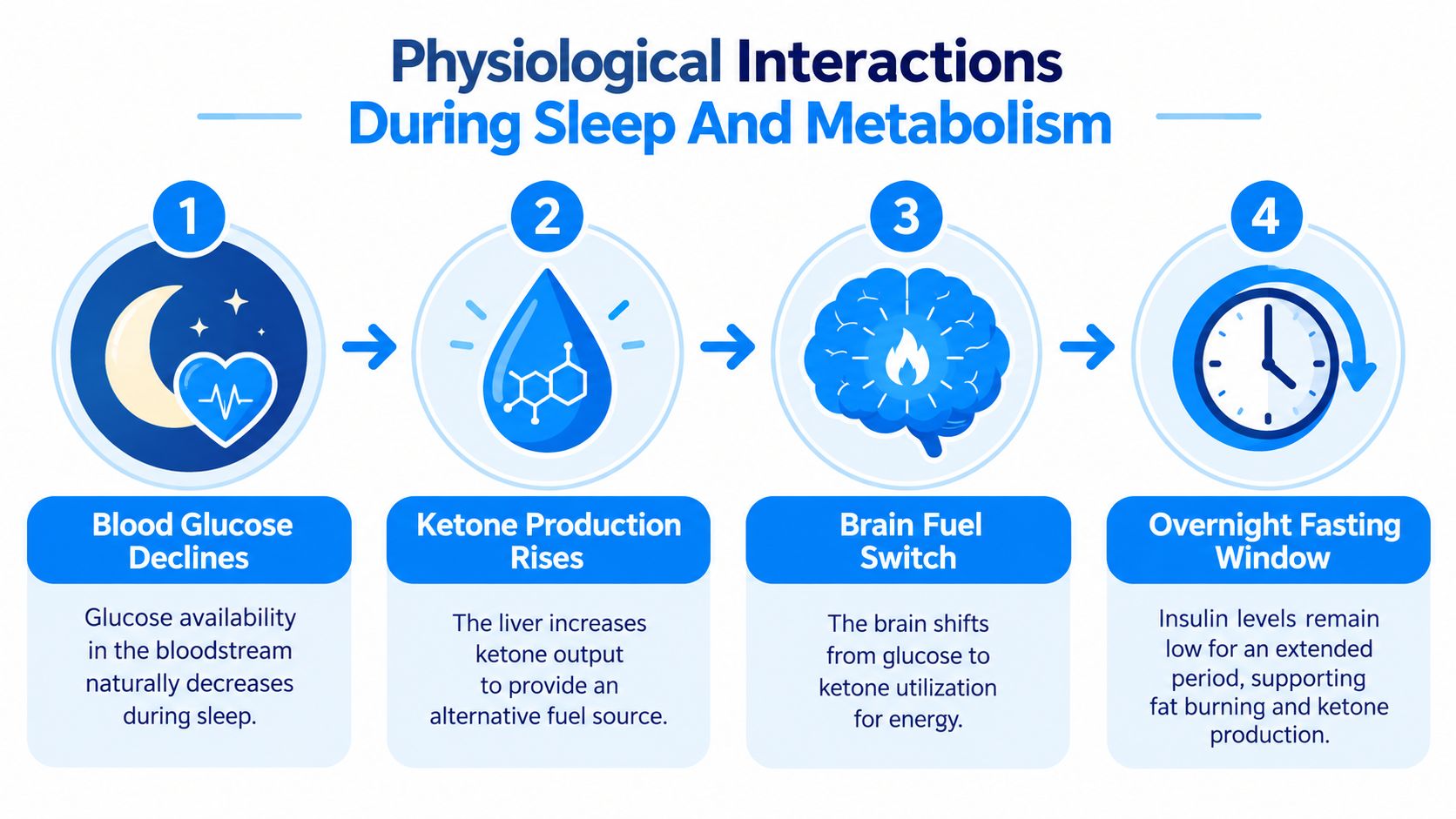
During a normal overnight fast, insulin is generally lower than after a meal, and the body gradually increases its reliance on stored fuels. Endogenous ketone production is the liver's response to that energy context. Exogenous supplementation bypasses part of that process by supplying BHB from outside the body.
That doesn't mean a supplement recreates every feature of a ketogenic diet. Nutritional ketosis involves a broader dietary pattern, changes in fatty-acid availability, and adaptation over time. An exogenous ketone serving is better understood as a temporary fuel intervention.
As of 2024 to 2025, this idea had moved beyond a niche recovery practice into a formal clinical research question. Registered studies include 20 participants and test ketone ingestion 30 minutes before bedtime in people with obstructive sleep apnea and in healthy volunteers, according to the ClinicalTrials.gov sleep study record. The research is examining sleep disruption, symptoms, overnight BHB exposure, tolerability, and objective sleep staging.
Physiological Interactions During Sleep And Metabolism
Sleep creates a distinctive metabolic setting. Food is absent, movement is minimal, and the nervous system still needs a continuous supply of ATP, the molecule cells use to power work. ATP production occurs largely inside mitochondria, where cells break down available fuels and transfer their chemical energy into usable cellular energy.
Glucose and ketones enter this system through different routes. Glucose is processed through glycolysis and then the citric acid cycle. BHB is converted into acetoacetate and then into acetyl-CoA, which can enter the citric acid cycle directly. The mitochondria then use electron transport and oxidative phosphorylation to produce ATP.
BHB is therefore not a stimulant and not a sedative. It's a transportable fuel molecule and a signaling metabolite. It can influence the balance of fuels circulating in the blood while also participating in cellular signaling pathways related to energy availability. Those effects don't guarantee better sleep, but they explain why nighttime dosing deserves a more precise discussion than the phrase “ketones help you sleep.”
What changes in the bloodstream
A systematic review and meta-analysis of 43 trials with 586 participants found that acute exogenous ketone ingestion increased blood BHB by a mean of 1.73 mM, with a 95% confidence interval of 1.26 to 2.21 mM, and decreased blood glucose by a mean of 0.54 mM, with a 95% confidence interval of negative 0.68 to negative 0.40 mM, as reported in Advances in Nutrition. This is evidence of a measurable glucose-ketone shift, not evidence that every person will sleep better.
The brain can use ketones as an alternative fuel, while skeletal muscle, cardiac muscle, and other tissues can also oxidize them. The practical concept is metabolic flexibility, the ability to use more than one fuel source as availability changes. During a fasting window, exogenous BHB may temporarily increase fuel availability without requiring the liver to produce all of it.
For a product designed primarily around training and movement, the Tecton EDGE™ Performance Shot + Electrolytes combines liposomal R3HBG ketone with sodium, potassium, and magnesium. Its stated use is clean, steady energy during training, movement, or physically demanding days, so bedtime use should be considered separately from its primary performance context.
For a deeper explanation of how nighttime fuel availability may relate to sleep staging, see this discussion of sleep architecture and ketone metabolism.
Clinical Evidence On Sleep Quality And Architecture
The strongest bedtime evidence currently comes from a controlled athletic study, not from broad claims about the general population. In a 2023 randomized crossover study of 10 well-trained cyclists, participants took 25 g of a ketone monoester immediately after exercise and again 30 minutes before sleep. Compared with placebo, sleep efficiency improved by 3%, while the ketone intervention counteracted an exercise-related decline in REM sleep and an increase in wakefulness after sleep onset, according to the peer-reviewed study in Medicine & Science in Sports & Exercise.
The design is important because the athletes completed both a morning endurance session and an evening high-intensity interval session that ended one hour before bed. Researchers used polysomnography, which measures objective sleep signals rather than relying only on a morning questionnaire.
What the study does and doesn't show
The result supports a specific interpretation: bedtime ketone dosing may help preserve aspects of sleep architecture when strenuous exercise has disturbed them. It doesn't establish that ketone monoester improves sleep for everyone, that a smaller serving produces the same result, or that a different formulation will behave identically.
The participant group was small and consisted of trained cyclists. That limits how confidently the findings can be applied to sedentary adults, people with irregular sleep, or individuals who haven't adapted to low-carbohydrate eating. The study also examined a carefully controlled exercise context, not ordinary bedtime use across a long period.
The most responsible reading is therefore conditional:
- Objective sleep signal: Sleep efficiency improved versus placebo in the specific athletic protocol.
- Architecture signal: The intervention counteracted exercise-related changes in REM sleep and wakefulness after sleep onset.
- Generalization limit: The findings don't prove a universal sedative or sleep-promoting effect.
- Practical implication: The strategy may be most relevant after demanding training, especially when late exercise tends to leave the athlete alert or restless.
A bedtime ketone is not a substitute for a stable sleep schedule, a suitable bedroom environment, or medical evaluation of persistent sleep problems. It may support a metabolic context associated with recovery, but it can't correct every cause of poor sleep.
Formulation, Timing, And Dosage Considerations
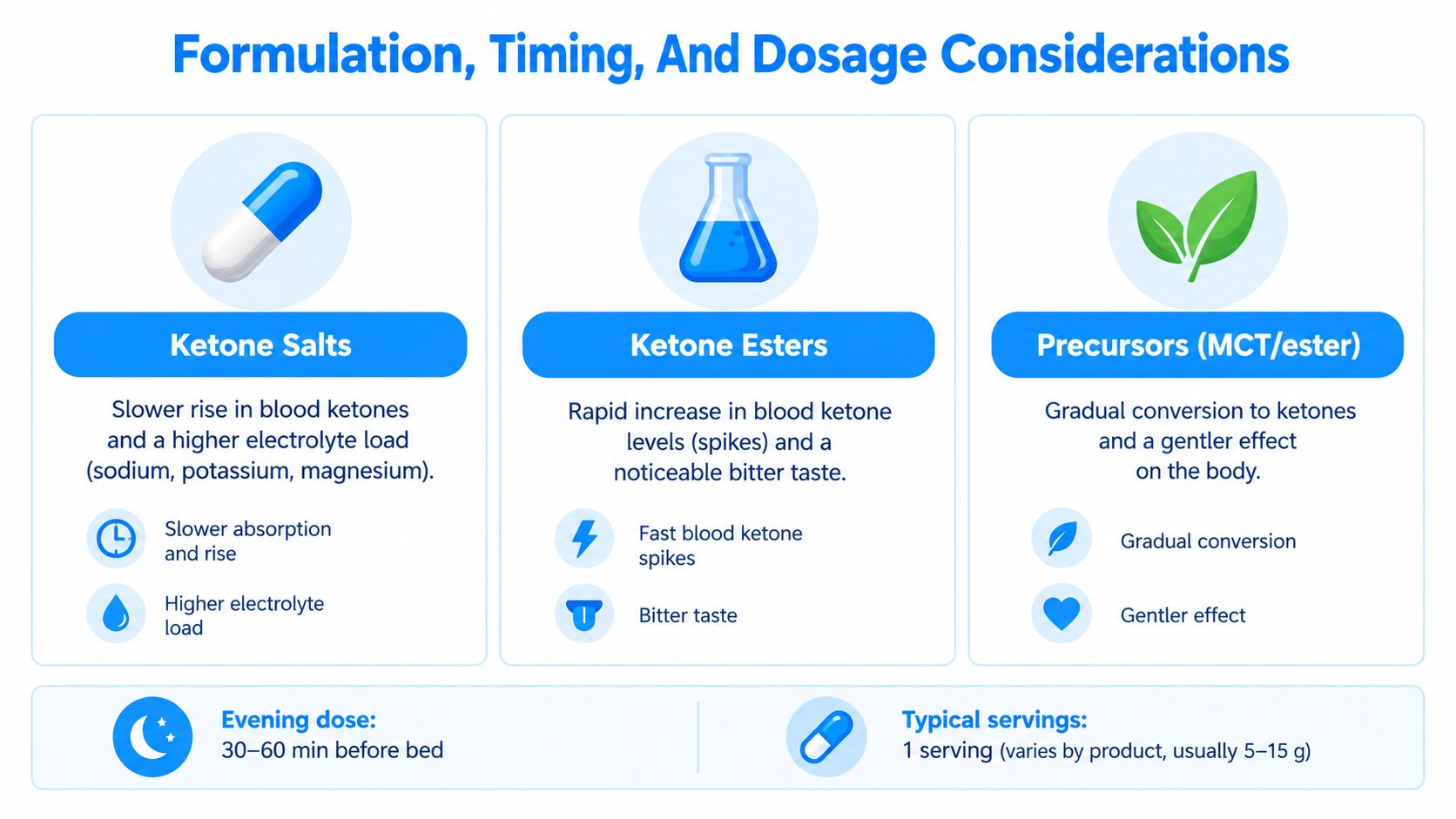
Formulation determines the shape of the BHB curve. In a randomized four-arm crossover study of 15 healthy volunteers, both ketone ester and ketone salt drinks raised blood D-beta-hydroxybutyrate. The ester reached a higher peak of 2.8 mM, compared with 1.0 mM for the salt, and concentrations returned to baseline within 3 to 4 hours, according to research published in Frontiers in Physiology.
That difference matters before bed. A rapid, high peak may be useful in a performance setting, but a strong taste or gastrointestinal response can undermine sleep. Salts may provide a slower rise while also adding an electrolyte load. Precursors such as MCT-related compounds depend on conversion and may feel less direct.
A practical selection framework
- Ketone salts: Often provide a more gradual BHB response, but the mineral content and serving size deserve attention.
- Ketone esters: Can produce a sharper blood ketone rise and may have a bitter taste. The controlled sleep study used a monoester, so its results shouldn't automatically be assigned to salts or precursors.
- Precursors: Convert into ketones through metabolism and may offer a gentler experience, although the resulting BHB exposure can be less direct.
Timing should be treated as an experiment, not a universal prescription. The available sleep research has used dosing 30 minutes before bed in one athletic protocol and one hour before bedtime in a separate healthy-adult trial. Anyone testing a new product should begin with the label serving, avoid stacking multiple ketone products, and assess gastrointestinal tolerance before moving the dose closer to sleep.
A calm, repeatable evening routine matters too. A resource such as the SouthShore Fine Linens bedtime guide can help address the environmental and behavioral factors that supplementation can't replace. For broader timing considerations outside the sleep window, review when to take ketones.
Cognitive And Neuroprotective Potential At Night
The brain is metabolically demanding, even while the body is motionless. Ketones offer it another substrate for mitochondrial ATP production, which is why researchers study BHB as more than an exercise fuel. The relevant concept isn't that ketones make the brain “stronger” overnight. It's that the brain can adjust its fuel mix when ketone availability rises.
Human neuroimaging provides direct evidence that this transition can occur quickly. A pilot study found that a single 395 mg/kg ketone ester dose increased blood BHB, lowered blood glucose, tripled cingulate BHB levels, and “rapidly shifted brain glucose to ketone metabolism” in volunteers, as reported in the neuroimaging research available through PMC.
From fuel substitution to next-day function
This fuel switch may be relevant when cognitive demand continues through a fasting period. If the brain can draw more heavily on ketones, glucose use can decrease while overall energy production remains supported. That is a mechanism for fuel substitution, not proof that a bedtime serving improves memory consolidation, prevents cognitive decline, or treats brain fog.
The distinction between energy utilization and clinical outcome protects the reader from overinterpretation. A measurable rise in brain BHB shows access to an alternative fuel. It doesn't establish that every person will wake with clearer thinking, nor does it justify disease-related claims.
For performance-minded adults, the reasonable structure-function expectations are narrower:
- Cognitive endurance: A different fuel may support continued brain energy availability during an overnight fast.
- Steadier energy: Reduced dependence on a single circulating fuel can be useful for people who tolerate ketones well.
- Metabolic efficiency: BHB oxidation gives mitochondria another route to acetyl-CoA and ATP.
- Cellular signaling: BHB also acts as a metabolic signal, although the downstream effect of bedtime supplementation varies by context.
Nighttime use is therefore best viewed as a metabolic experiment with cognitive relevance, not as a guaranteed nootropic or sleep medicine.
Who Should And Should Not Use Ketones Before Bed
The best candidate is someone with a clear reason to test the strategy. That might include a well-trained endurance athlete whose demanding evening sessions disturb sleep, or an adult who wants to study whether a measured ketone dose fits a fasting-oriented routine. The evidence doesn't support treating exogenous ketones before bed as necessary for healthy sleep.
A randomized, placebo-controlled trial in healthy adults gave 1.5 g or 2.9 g of d-beta-hydroxybutyric acid daily for 14 days, with intake one hour before bedtime. Compared with placebo, the lower dose improved sleep initiation and maintenance subscales, while the higher dose improved refreshing-on-rising, according to the study in Bioscience, Biotechnology, and Biochemistry. The dose-sensitive pattern suggests a subjective sleep-quality effect rather than simple sedation.
Situations requiring caution
- Sensitive digestion: Nausea, cramping, or loose stools can make a bedtime product counterproductive.
- Unclear metabolic response: People who notice unusual symptoms after carbohydrate restriction or fasting shouldn't assume ketones will feel predictable.
- Medication or health considerations: Anyone managing a metabolic condition, using glucose-affecting medication, pregnant, or under clinical care should ask a qualified clinician before experimenting.
- Poor sleep with an unknown cause: Supplementation shouldn't delay assessment of persistent or severe sleep disruption.
Keep the experiment simple. Track bedtime, sleep onset, awakenings, morning alertness, exercise load, and digestive comfort. Protect personal information when using wellness or self-care tools, and review guidance such as how Luno protects your data before sharing sensitive information online. For a focused discussion of tolerability, consult exogenous ketone side effects.
Conclusion And Practical Takeaways
Exogenous ketones before bed are neither a miracle sleep aid nor an idea without evidence. Human research has measured improvements in sleep efficiency and preservation of sleep architecture after strenuous exercise, while other work has reported dose-sensitive changes in subjective sleep quality. The studies are still limited by small samples, specific populations, and different formulations.
The physiology is coherent. BHB gives mitochondria an alternative substrate for ATP production, shifts the circulating glucose-ketone balance, and can reach the brain rapidly. But a plausible mechanism isn't the same as a guaranteed outcome. A ketone ester, ketone salt, and precursor won't necessarily create the same overnight experience.
Application Framework
- Define the reason: Test bedtime ketones for a specific purpose, such as recovery after demanding evening training, rather than taking them automatically.
- Choose one formulation: Don't compare multiple products on the same night. Formulation changes the speed and height of the BHB response.
- Start conservatively: Use the labeled serving and allow enough nights to assess tolerance. Stop if digestive discomfort or restlessness appears.
- Protect sleep fundamentals: Keep the room, schedule, light exposure, and evening routine consistent so the supplement isn't being tested against a constantly changing background.
- Measure what matters: Record sleep onset, awakenings, morning restoration, training demands, and next-day cognitive endurance.
- Review the result: Continue only if the observed benefit is repeatable and the product doesn't create new problems.
For most readers, the practical takeaway is simple. Bedtime ketones may be worth a structured trial when the goal is metabolic support during an overnight fast, especially after strenuous exercise, but they shouldn't replace sound sleep habits, balanced nutrition, or clinical care.
Tecton Ketones™ offers bioidentical R3HBG ketone nutrition in liposomal formulations designed to provide direct BHB fuel without requiring a strict ketogenic diet. Visit Tecton Ketones™ to review the available options and decide whether a measured ketone routine fits your nighttime or performance goals.


