


Can you work out twice a day without doubling fatigue along with your training stimulus? The answer is yes, but only when the second session has a clear purpose and your recovery system can support it.
Twice-daily training is not automatically better than one well-designed workout. It can help distribute training stress, preserve technique quality, separate strength from cardio, or make demanding endurance work more manageable. It can also become a fast route to declining performance when both sessions are hard and nutrition, sleep, or rest fall behind.
What Twice-Daily Training Actually Delivers
Can two workouts in one day improve training, or just leave you with more fatigue? The answer depends on what the second session is meant to accomplish and whether your body can recover between efforts.
More frequent training does not automatically produce more muscle growth, endurance, or fitness. A 2007 study of national-level male weightlifters found no additional overall benefit from training more often each day, although the twice-daily group improved some measures of isometric knee-extension strength and neuromuscular activation (Healthline's review of twice-daily training).
The useful question is, “What problem does a second session solve?”
A morning strength workout followed by evening technique practice can give each effort more attention. A long endurance session can become two manageable blocks. A runner can separate easy aerobic work from mobility, while a field-sport athlete can place technical practice away from heavy conditioning. These arrangements work because they improve better distribution of stress, not because frequency has a magical effect.
Fuel availability adds another layer. If the first workout has drawn down glycogen, the second session may feel harder even when the schedule looks reasonable. Meals, fluids, and adequate carbohydrate can help restore usable fuel. Exogenous ketones can also provide an alternative circulating fuel pathway when glycogen is depleted, though they do not make every two-a-day plan more productive.

One day, two different jobs
A productive double usually assigns each session a distinct role:
- Primary session: Heavy strength work, intervals, a long run, or the most technically demanding training.
- Secondary session: Mobility, technique, easy aerobic work, accessories, or controlled conditioning.
- Recovery window: Food, fluids, rest, and enough time for the nervous system and muscles to regain capacity.
The U.S. Physical Activity Guidelines recommend at least 150 minutes of moderate-intensity aerobic activity weekly, or 75 to 150 minutes of vigorous activity, plus at least two weekly strength-training sessions (GoodRx's evidence overview). A 2023 review of a large-scale cohort found that meeting the minimums was associated with up to a 21% lower risk of early death, while exercising at two to four times the minimum was associated with up to a 31% lower risk. Those figures describe total activity, not a special benefit of two-a-day workouts.
Practical rule: Use a second session to improve the quality or distribution of weekly training, not to chase volume for its own sake.
For many recreational exercisers, one well-structured workout followed by adequate recovery is enough.
Understanding the Metabolic Physiology
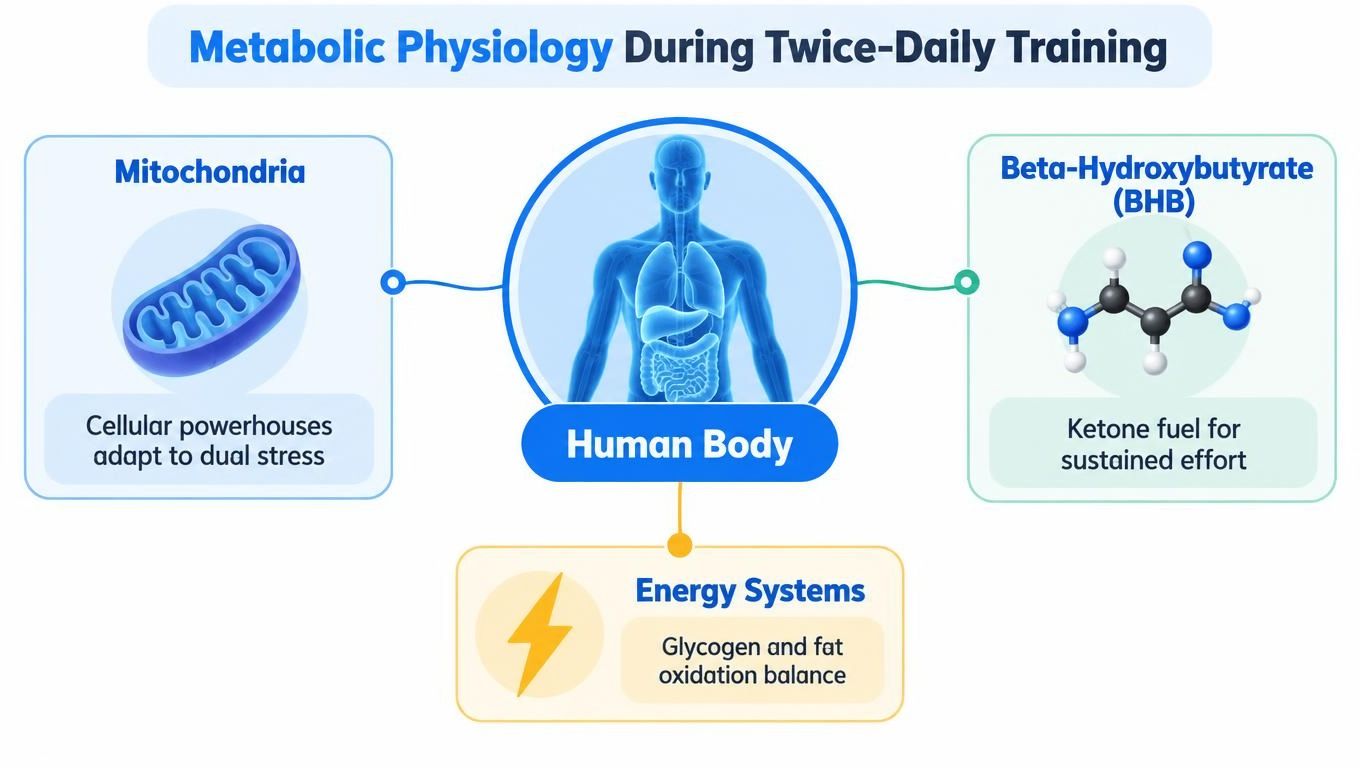
During exercise, your muscles need ATP, the immediate energy currency that powers contraction. Mitochondria make much of that ATP by processing fuel supplied from glucose, fatty acids, and ketones. A useful analogy is a flexible power plant: glucose can provide rapid energy for demanding work, while fat and ketones can contribute to sustained energy production when the exercise intensity and fuel conditions allow it.
The first session of a training day often uses muscle glycogen, the stored form of glucose. As glycogen availability falls, the body increases its reliance on fat oxidation and other fuels. That doesn't mean the body abruptly switches from glucose to ketones like a light switch. It adjusts the mix according to exercise intensity, recent meals, training status, and the availability of circulating fuels.
Beta-hydroxybutyrate, or BHB, is one of the main ketone bodies. The liver produces BHB endogenously from fatty acids during conditions such as fasting or carbohydrate restriction. The bloodstream then transports BHB to tissues that can use it. Inside cells, BHB is converted into compounds that enter the mitochondrial energy pathway and support ATP production.
Glucose and ketones reach ATP through different entry points, but both ultimately depend on healthy mitochondrial machinery. Ketones aren't a replacement for glucose during every type of exercise. High-intensity efforts still rely heavily on carbohydrate metabolism because rapid force production demands rapid energy delivery. During lower-intensity work or periods when glycogen is less available, ketones can provide an alternative substrate.
Three forms of ketosis
These terms describe different physiological situations:
- Nutritional ketosis: Ketone production rises because a person follows a diet that restricts carbohydrate availability.
- Endogenous ketone production: The liver makes ketones from stored or circulating fat.
- Exogenous ketone supplementation: A person consumes ketones or a ketone precursor, allowing BHB to enter circulation without waiting for the liver to produce it.
That distinction matters for two-a-days. A second session may occur while glycogen is partially reduced, but reduced glycogen doesn't guarantee high endogenous ketone production. Exogenous ketones provide a separate route for circulating BHB, though they don't erase the need for carbohydrate, protein, fluids, or sleep.
A controlled 2019 Journal of Applied Physiology study found that twice-daily training improved mitochondrial efficiency but not mitochondrial biogenesis compared with once-daily training. The groups showed similar overall anthropometric, cardiorespiratory, and metabolic adaptations, while the twice-daily group reported lower perceived exertion during constant-load exercise (the study's full report). A separate high-intensity interval study reported greater expression of markers connected with mitochondrial and fat-oxidation processes, including PGC-1α, after repeated daily exercise with short recovery (the peer-reviewed HIIT study).
For readers exploring the broader relationship between glucose, fat, and ketone use, this overview of the body's energetic systems provides useful context. In practical terms, a product such as Tecton EDGE™ Performance Shot + Electrolytes is designed to provide liposomal R3HBG™ ketone and sodium, potassium, and magnesium for active people seeking steady energy during training or physically demanding days.
Who Should Consider Two-a-Day Training
The best candidate for twice-daily training isn't just the person with the most motivation. It's the person whose goals require more carefully distributed work and whose recovery capacity matches the workload.
Endurance athletes
Endurance athletes often have the clearest reason to split training. They may need aerobic volume, technique practice, strength work, and mobility without forcing every demand into one long session. Separating an easy aerobic session from strength training can protect the quality of both.
A runner might use a short morning technique session and an easy evening run. A cyclist might place steady riding in the morning and mobility or strength work later. The second session should still have a purpose. Adding distance without a plan can increase fatigue faster than it improves fitness.
A performance study comparing once-daily training with twice-every-second-day endurance training found similar performance in a one-hour time trial after a 60-minute steady-state ride, despite differences in selected adaptation markers (the Journal of Applied Physiology research). The lesson is important: a favorable metabolic signal doesn't guarantee superior performance.
High-intensity trainers
People who perform repeated sprint work, hard intervals, heavy lifting, or demanding functional conditioning need more caution. Two intense sessions can create a large combined stress on muscle tissue, connective tissue, the nervous system, and energy availability.
A safer pairing is usually hard work first and low-impact work second. For example:
- Morning: Heavy lower-body strength.
- Evening: Easy cycling, mobility, or technical drills.
- Avoid: Maximal lifting followed by another maximal lifting session without a clear performance reason.
If the second workout consistently feels like survival rather than purposeful practice, the schedule is probably too aggressive.
Beginners and general fitness participants
Beginners usually don't need two sessions because they can make meaningful progress from a much smaller training dose. Early adaptation comes from consistency, skill acquisition, and learning to recover. Adding another workout before those habits are stable can hide poor exercise selection, insufficient food, or inadequate sleep.
A beginner who wants more movement may choose a walk, gentle mobility routine, or recreational activity later in the day. That isn't the same as adding a second demanding workout, and it may provide the extra activity without creating the same recovery burden.
A useful decision test is simple:
- Do you have a defined reason for the second session?
- Can you fuel and hydrate between sessions?
- Can you maintain sleep and normal daily function?
- Can you reduce or remove the second session when performance worsens?
If the answer to several of these questions is no, one daily workout is the more intelligent choice.
Structuring Sessions and Managing Recovery
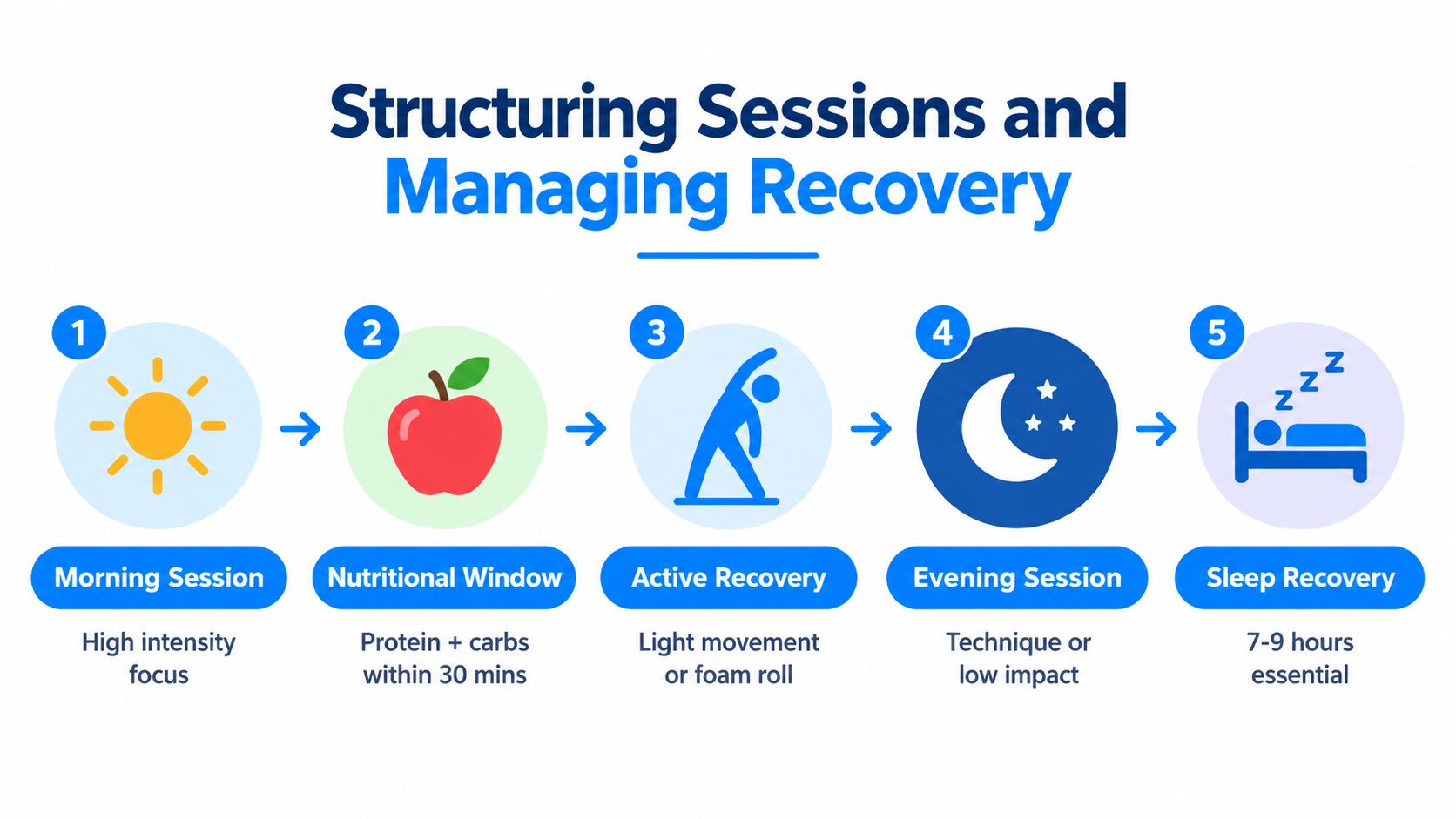
Could the second workout be useful without competing with the first? Set up the day by assigning each session a clear purpose. Place the highest-priority work when energy, concentration, and coordination are strongest. If strength is the goal, lift before easy cardio. If technical quality matters, practise the skill while fresh. Use the later session for work that remains effective under moderate fatigue.
Spacing determines how much of the first session your body can support again. Leave several hours between workouts, with a longer interval giving glycogen restoration, fluid replacement, and nervous-system recovery more time. A short gap can leave the second session under-fuelled, particularly when it includes sprints, heavy lifting, or other high-intensity work. The second workout should feel like a planned extension of the day, not an attempt to repeat peak performance immediately.
Build the recovery window deliberately
The interval between sessions is part of the program. The first workout creates demand, while the recovery window determines whether the next session can produce a useful training signal.
Prioritize these resources:
- Carbohydrate: Restores some muscle glycogen and supports another demanding effort.
- Protein: Provides amino acids for tissue repair and remodeling.
- Fluids and electrolytes: Replace sweat losses and support muscle and nerve function.
- Low-intensity movement: Gentle walking or mobility may reduce stiffness, provided it does not become another hard workout.
- Sleep: Supports adaptation, mood, motor control, and the ability to train again.
Use the recovery strategies with SleepHabits as a reminder to establish adequate sleep, food, and hydration before considering supplements. A supplement cannot correct a schedule that repeatedly demands more than the body can restore.
Exogenous ketones can serve as an optional fuel strategy within this plan. A circulating BHB source may provide an alternative substrate during a later low-intensity session, especially when glycogen availability is reduced. It supplies only part of the energy needed for exercise and does not replace carbohydrate when rapid, high-intensity output is the goal. Fuel selection should match the session, rather than treating ketones as a general recovery solution.
A practical pairing could look like this:
- Morning: Hard intervals or heavy strength.
- Midday: A meal, fluids, and quiet recovery.
- Evening: Technique, mobility, accessory work, or easy aerobic training.
For the post-session process, review these post-workout recovery tips. The aim is a second workout that adds a specific benefit without reducing the quality of tomorrow's training.
Recognizing Overtraining Warning Signs
How can you tell whether a second workout is building capacity or draining it? Training fatigue is expected, but persistent fatigue paired with declining performance, motivation, or movement quality signals that the workload may exceed recovery. Twice-daily training increases exposure to that mismatch, so objective trends matter more than enthusiasm on any single day.

A structured plan can work when sleep, calories, and session intensity match the athlete's ability to recover. Hard doubles performed 6 to 7 days per week, however, may regress within 3 to 4 weeks when recovery is inadequate, according to evidence summarized in fitness reporting (the fatigue and recovery analysis). This does not predict the response of every athlete. It shows how quickly an unsustainable schedule can become visible.
Measure the trend, not one bad workout
One poor session is not enough to identify overtraining. Compare repeated sessions, then check whether physical and behavioral changes are appearing in daily life.
- Performance decline: A drop of more than 5% in repeated-session performance is a reason to reduce frequency or insert a deload. Use overtraining prevention strategies to define that response before fatigue distorts judgment.
- Persistent soreness: Soreness lasting well beyond two days suggests that tissue recovery is falling behind training stress.
- Resting heart rate: A raised resting heart rate across several mornings can indicate that current workload exceeds recovery capacity.
- Behavioral changes: Irritability, poor concentration, disrupted sleep, or unusual reluctance to train strengthen the warning pattern.
- Movement quality: Slower technique, unstable positions, and repeated compensations matter even when every prescribed set is completed.
The goal is not to diagnose overtraining syndrome from a checklist. It is to recognize when the second session costs more than it contributes. A later workout can also feel unusually difficult when glycogen is low. Alternative fuel strategies, including exogenous ketones, may support energy availability for suitable lower-intensity work, but they cannot correct inadequate recovery or replace carbohydrate for rapid, high-intensity output.
If pain is sharp, persistent, or worsening, stop the aggravating activity and seek appropriate clinical assessment. When food contributes to the problem, this guide to post-workout eating can help review daily energy and recovery basics.
A missed second workout is a small adjustment. Prolonged injury or declining performance can interrupt training for much longer.
The following video reinforces the difference between productive training stress and inadequate recovery:
Sample Schedules and Program Templates
A useful double schedule separates stressors rather than repeating the same stress twice. The following templates are examples, not universal prescriptions. Adjust exercise selection, duration, and intensity to your training history and current recovery.
Endurance emphasis
Morning: Technique drills or a focused quality session.
Evening: Easy aerobic work at a conversational pace.
This model works when the athlete needs more aerobic practice but doesn't want every session to become intense. The later workout should support volume and movement quality, not compete with the primary session.
Strength emphasis
Morning: The main compound lifts or the muscle group that matters most.
Evening: Accessories, mobility, trunk work, or a separate low-impact aerobic session.
Splitting a long strength workout can preserve concentration and technical precision. It also lets you place smaller exercises in a separate session instead of performing them after heavy fatigue has degraded form.
Hybrid emphasis
Morning: Strength training.
Evening: Easy cycling, rowing, walking, or sport-specific technique.
This arrangement is often easier to manage than pairing two demanding conditioning sessions. Keep the second session controlled enough that it doesn't interfere with the next day's priority.
A weekly decision model
Don't make every day a double. Place two-a-days on selected training days and retain single-session or rest days so the weekly load has room to settle. The exact pattern depends on the athlete, but a common principle is to avoid stacking hard sessions across every available day.
Record:
- The purpose and intensity of each session.
- How you performed in the second workout.
- Food and fluid intake between sessions.
- Sleep quality and morning readiness.
- Any soreness or pain that changes movement.
Runners who need a more individualized progression can use a personalized running training plan, especially when doubles are being added to an endurance-focused program. A schedule should adapt to the athlete's response, not force the athlete to defend the schedule.
Application Framework for Optimal Results
Use this framework before adding a second daily workout.
First, define the purpose. Choose one reason: separating strength and cardio, improving technique, distributing endurance volume, or preserving quality on a long training day.
Second, make the sessions unequal. Schedule the highest-priority or hardest work first. Keep the second session shorter, easier, or more technical unless the program gives it another defined role.
Third, protect the recovery window. Leave at least 6 hours between sessions, and use a longer gap when possible. Carbohydrates and protein support refueling, while fluids help restore what training removes. The interval is recovery time, not hidden training time.
Fourth, match fuel to the work. Nutritional ketosis, natural ketone production, and exogenous ketone supplementation are different strategies. An exogenous BHB product can provide circulating fuel when glycogen is reduced, offering an alternate energy pathway during a second session. It cannot replace adequate calories or the carbohydrate often needed for high-intensity work.
Finally, monitor trends against your own baseline. Record repeated-session output, soreness, resting heart rate, sleep, and motivation during a normal training week before adding doubles. If these measures worsen, reduce frequency and apply the deload rules from the overtraining section above, including the recovery guidance.
Two-a-days work when they make training more precise. They fail when the second session adds fatigue without a clear purpose.
Tecton Ketones™ offers bioidentical exogenous ketone nutrition built around R3HBG, including options designed for steady energy during demanding training without requiring a strict ketogenic diet. To assess direct BHB fuel, visit Tecton Ketones™ and compare the available formulas with your performance and recovery goals.


