


Brain energy supplements provide the brain with an additional fuel substrate to support energy metabolism. Most formulations in this category aim to increase circulating beta-hydroxybutyrate (BHB), a ketone body that tissues can oxidize for energy, without requiring adherence to a strict ketogenic diet.
How Brain Energy Supplements Support Brain Fuel
Glucose serves as the brain's primary day-to-day fuel, while ketones function as an alternative reserve substrate. Metabolic flexibility describes the capacity to shift between these fuels as demand changes, for example during extended cognitive work, exercise, fasting, or lower carbohydrate intake.
When people refer to "ketones," they may be describing three distinct physiological contexts:
- Nutritional ketosis results from very-low-carbohydrate, higher-fat intake that shifts hepatic metabolism toward ketone production.
- Endogenous ketone production is the liver's own generation of ketones, typically during fasting or carbohydrate restriction.
- Exogenous ketone supplementation provides ketone molecules from an external source, increasing fuel availability without changing dietary pattern.
This distinction is clinically important. A supplement does not reproduce a ketogenic diet. It supplies a defined fuel substrate while habitual meals remain unchanged.
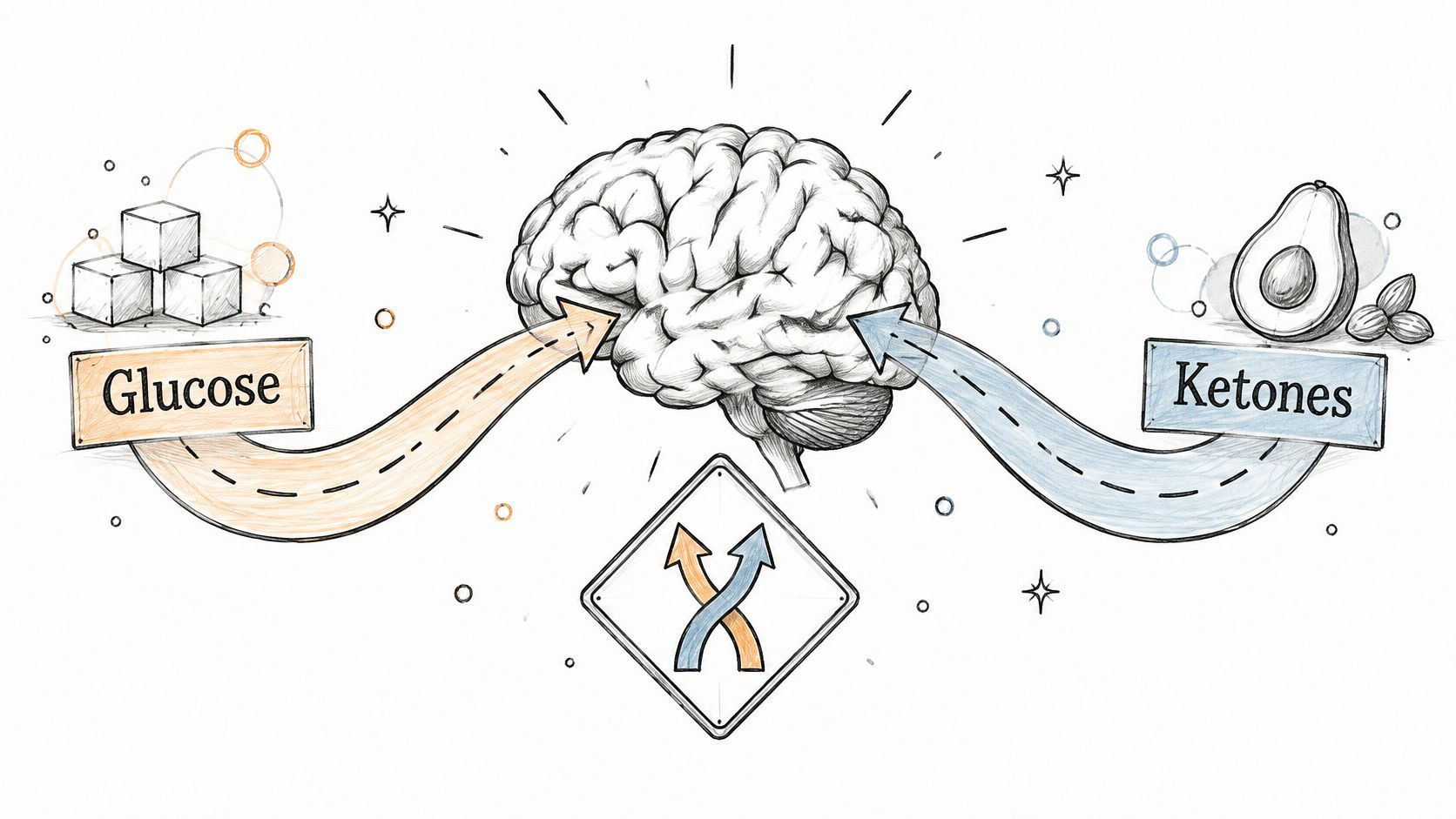
Three Ways Ketones Become Available
Each pathway can increase usable ketone fuel, but the physiological effort and accompanying metabolic changes differ.
| Route | What Creates Ketones | What the Person Must Do | Fuel Delivered |
|---|---|---|---|
| Nutritional ketosis | Low-carbohydrate, high-fat eating shifts metabolism | Maintain a restrictive dietary pattern | Endogenous ketones and broader dietary changes |
| Endogenous production | The liver produces ketones during fasting or carbohydrate restriction | Limit carbohydrate or avoid food for a period | The body’s own ketone fuel |
| Exogenous supplementation | A supplement supplies ketone molecules | Consume the product | Directly available ketone fuel |
In short, the first two pathways require the body to generate ketones. The third provides the substrate directly.
Once BHB is circulating, it can enter brain energy pathways and support mitochondrial ATP production. It does not replace glucose, and availability alone does not determine cognitive or physical output. It provides an additional substrate option when glucose timing or supply is limited.
Ketones also operate within broader cellular energetics. This overview of how energy supplements are intended to function, including NMN and CoQ10 roles, is summarized in CoQ10 and NAD+ pathways explained. Supporting energy chemistry is distinct from demonstrating improved cognition.
The Tecton Ketones Approach
Tecton Ketones is formulated around R3HBG, a tri-ester composed of a glycerol backbone carrying three D-BHB molecules. Following digestion, it releases bioidentical D-BHB, the same stereoisomer predominantly produced by the human liver.
The formulation is designed for routine use without R-1,3-butanediol, artificial dyes, sweeteners, and BPA packaging. Liposomal delivery is used to support absorption and serving-to-serving consistency. Because the system is not based on ketone salts, it avoids the substantial mineral load associated with salt-based products.
Ketones are an alternative fuel, not a substitute for sleep, balanced nutrition, or clinical care.
The relevant clinical question is whether additional fuel availability aligns with an individual's demand. Some adults use it before sustained focus, others around endurance exercise or during fasting windows. When used as directed with measured expectations, it can fit within those defined contexts.
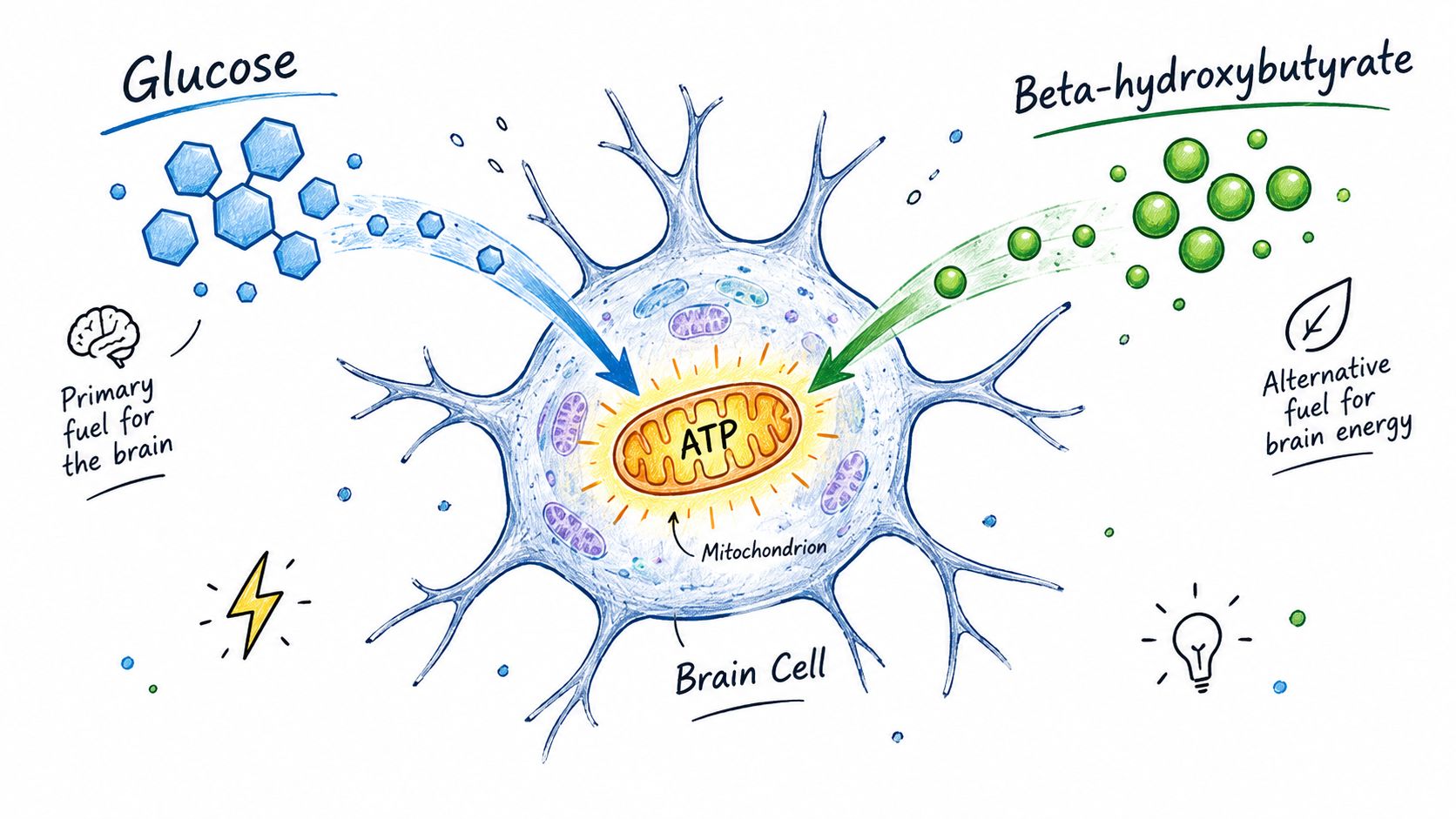
The brain remains metabolically active continuously. Even during sleep, neurons consume adenosine triphosphate, or ATP, to support signaling, maintenance, and repair. Glucose is the familiar daily substrate, while beta-hydroxybutyrate, or BHB, is another substrate brain cells can oxidize when ketones are present.
Both pathways converge on mitochondrial ATP production, which sustains cellular communication and maintenance.
Ketones are an alternate fuel. They are not a switch that increases brain capacity on demand.
Following Glucose Into Brain Cells
After carbohydrate digestion, glucose enters the circulation and crosses into brain tissue via regulated transporters. Within the cell, it undergoes stepwise breakdown, and downstream products enter mitochondria for ATP generation.
This pathway is efficient and closely linked to meal timing and blood glucose stability. For context on stable glucose and daytime function, including how it may reduce night waking with stable glucose, fuel supply and sleep physiology are closely related.
How BHB Feeds the Same Energy Demand
During fasting or carbohydrate restriction, the liver produces ketone bodies, including BHB. BHB circulates in blood, crosses the blood-brain barrier, and enters brain cells through monocarboxylate transporters. Enzymatic steps then convert it into intermediates that mitochondria can use for ATP.
Glucose remains essential. The relative contribution shifts with substrate availability. That is the physiological basis for metabolic flexibility, and why brain energy supplements aim to provide ketone fuel directly rather than requiring dietary ketone production.
https://tectonketones.com/blogs/news/brain-energy-metabolism
Why Fuel Availability Matters During Demand
Extended focus, intense training, and fasting can reveal whether output depends on stable substrate supply or short-term stimulation.
- Long work blocks that require sustained attention for hours
- Hard training where brain and skeletal muscle draw on available energy
- Fasting windows when exogenous glucose intake is temporarily absent
Human research is also examining BHB in relation to endothelial function and cellular signaling. These mechanistic observations are reported in peer-reviewed literature indexed in PubMed, but they are not established clinical outcomes.
Historical Clinical Context from Epilepsy Research
Ketogenic diets were developed in the 1920s to reproduce selected metabolic features of fasting, including increased ketone availability for the brain. A Cochrane review analyzed 13 randomized trials with 932 participants, including 711 children and 221 adults.
Across four pediatric studies, seizure freedom was approximately three times more likely than with usual care, relative risk 3.16. At least 50% seizure reduction was approximately six times more likely, relative risk 5.80, and one study reported 38% achieving over 50% reduction at three months versus 6% with usual care.
These dietary findings do not demonstrate that a commercial supplement treats epilepsy, and therapeutic ketogenic diets require medical supervision. Read the full research about ketogenic diets for epilepsy.
With brain energy supplements, begin with the ingredient panel rather than the front-label ketone figure. The relevant variables are molecular identity, accompanying compounds, and whether conversion is still required for usability.
Comparing Ketone Salts, Esters, and Precursors
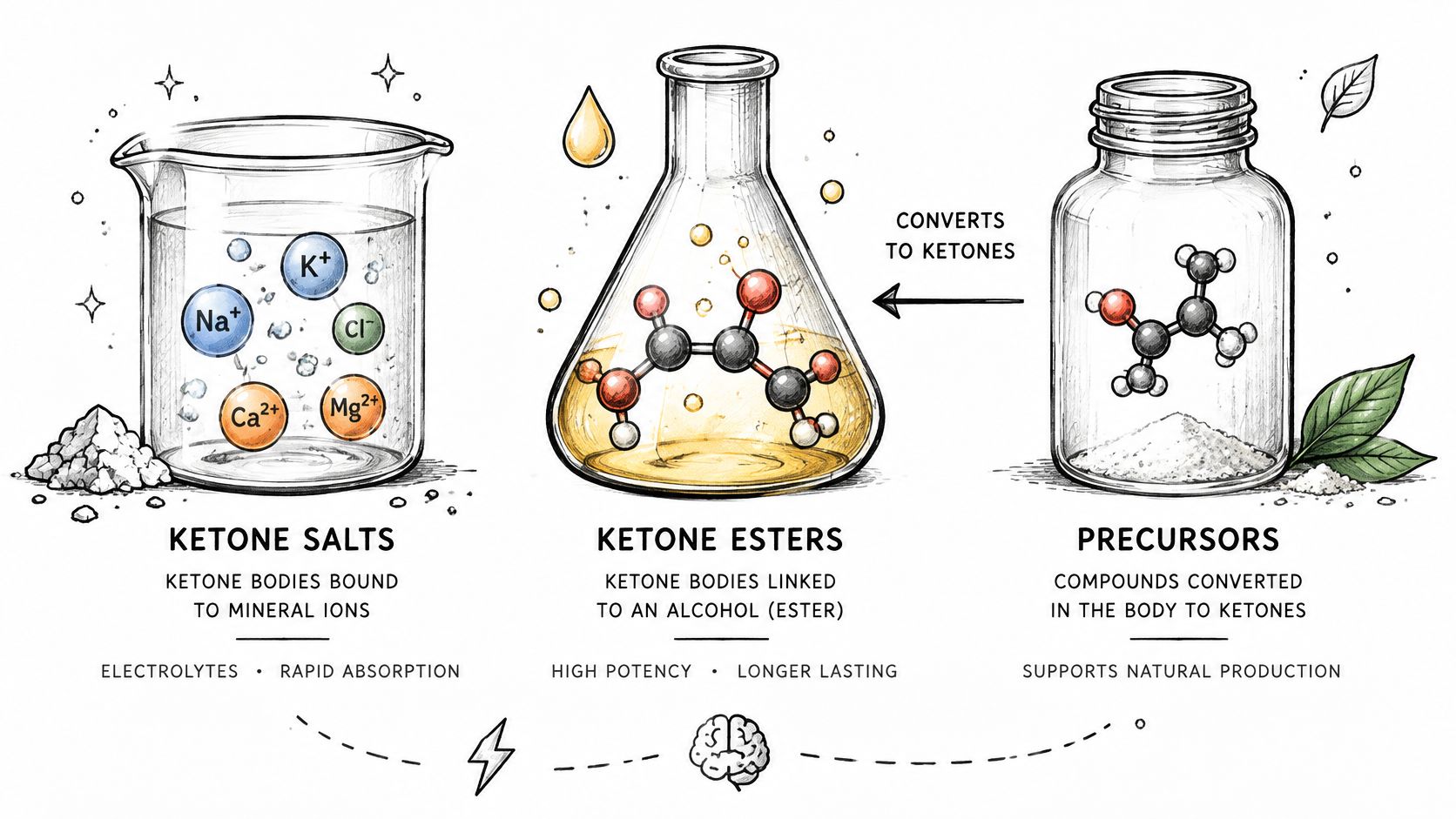
Product labels often group distinct chemistries together. Evaluation should separate structure, mineral load, isomer composition, and delivery method.
How Common Ketone Formats Differ
| Format | What It Supplies | Common Limitation | Tecton Position |
|---|---|---|---|
| Ketone salts | BHB paired with minerals | Mineral load; variable isomers | Outside its delivery format |
| Ketone esters | Ketones held in ester bonds | Different esters behave differently | R3HBG is an ester |
| Precursors | Compounds converted into ketones | Requires metabolic conversion | Excludes R-1,3-butanediol |
| Tecton R3HBG | Three D-BHB molecules on glycerol | Product-specific evidence matters | Liposomal formulation |
The comparison is therefore less about total grams declared and more about what reaches circulation as usable D-BHB after digestion.
Ketone salts bind BHB to sodium, potassium, calcium, or magnesium. Those minerals contribute to daily intake, which can limit repeated use for individuals monitoring electrolytes or minerals.
Ketone esters are hydrolyzed during digestion to release their components. Precursors follow a longer pathway because hepatic conversion is required first, which is closer to supplying starting material than finished fuel.
Equal grams on a label don't necessarily mean equal amounts of immediately usable D-BHB.
Read the Isomer and Delivery Details
D-BHB is the principal BHB stereoisomer produced by the liver and readily oxidized by tissues. Its mirror image, L-BHB, follows different handling, so it should not be equated with immediate fuel, although current evidence does not justify describing it as inactive.
When comparing products, label specificity matters more than front-panel claims:
- Isomer disclosure indicates whether listed BHB is D-BHB or a mixed preparation.
- Mineral amounts show the electrolyte burden per salt-based serving.
- Serving composition distinguishes delivered ketones from precursor compounds.
Tecton describes R3HBG as a tri-ester linking three D-BHB molecules to one glycerol backbone. Digestion cleaves those bonds to release bioidentical D-BHB without use of R-1,3-butanediol.
Its liposomal delivery uses lipid-based carriers intended to support absorption and consistency. That formulation rationale requires direct comparative human data before any conclusion about superior absorption or cognition.
Tecton also reports avoidance of BPA packaging, artificial dyes, and sweeteners. That may affect daily acceptability, but it is separate from demonstrating that alternatives are unsafe.
Practical Takeaway
Human ketone-ester studies support the concept that ingestion can alter energy metabolism in heart and skeletal muscle. They do not confirm identical effects for every ester and do not establish improved cognition, consistent with Harvard's caution about brain supplements.
A New Dietary Ingredient notification addresses expected safety under labeled conditions. It is distinct from FDA approval for efficacy or disease treatment.
- Check D-BHB content and accompanying minerals.
- Review ingredients and labeled directions.
- Compare Tecton's formulation with your daily tolerance needs before choosing.
The central question with brain energy supplements is not whether ketones can enter an energy pathway. They can. The question is whether additional fuel addresses a defined need, without confusing a plausible mechanism with a guaranteed result.
Why This Matters
- Steadier energy reflects fewer dips when meals are delayed or work extends. Ketones provide another substrate rather than stimulation, but availability does not prove that any single serving will sustain an afternoon.
- Cognitive endurance is the ability to remain engaged through demanding mental work. Locked Cognition pairs ketone fuel with nootropic ingredients for that context. Intended function remains distinct from demonstrated effect, a distinction emphasized in Harvard's discussion of brain supplement evidence.
Think of ketones as another fuel delivery, not a signal that forces the brain to perform.
For example, completing a long report depends on substrate supply, but also on sleep, meal regularity, limited interruptions, and rest breaks.
Match the Formula to the Demand
- Workout performance involves different energetic demands. Tecton's Performance + Electrolytes combines ketone fuel with hydration support for endurance contexts, while Performance + Caffeine adds caffeine for higher-intensity sessions where alertness is relevant. These describe product positioning, not proven training benefit.
- Metabolic efficiency, used precisely, means access to another usable fuel during exercise or recovery without full dietary ketosis. It does not mean improved mitochondrial function or fat loss. For fasting individuals: ketone fuel provides energy, so use is not equivalent to a calorie-free fast.
- Appetite awareness and metabolic balance are the intended context for Tecton's GLP-1 product, alongside support for normal blood glucose regulation. The name should not be interpreted as a drug effect, proven glucose management, or weight-loss promise.
Practical Takeaway
- Select one defined task to evaluate, such as a long work session or familiar workout.
- Follow label directions and avoid introducing multiple new supplements simultaneously.
- Track observed energy, concentration, output, and tolerability, rather than assuming efficacy.
Then compare Tecton's formulations with the selected task, and discuss use with a clinician if taking medication or managing a health condition.

The most appropriate candidates for brain energy supplements are adults with a specific, repeatable demand, such as endurance exercise or prolonged desk work. A defined task makes it easier to separate useful support from expectation.
A need for energy does not automatically indicate a need for ketones. Persistent fatigue, new memory concerns, or reduced exercise tolerance warrant clinical evaluation before supplement use.
More available fuel is a physiological change, not a guarantee of mood, memory, or performance improvement.
For an initial trial, choose an ordinary day rather than competition, examination, or major presentation. Follow labeled serving instructions and keep meals, sleep, and other supplements stable.
- Endurance athletes may test a serving around a familiar training session, while maintaining planned carbohydrate and fluid intake.
- Professionals and students may try one serving before a scheduled reading or writing block.
- Low-carb eaters may seek ketone availability without further carbohydrate restriction. During fasting, ketones still provide energy, so this is not a calorie-free approach.
Match the Formula to the Task
Clinicians and coaches can use Tecton's product lineup as a selection framework, while distinguishing positioning from demonstrated outcomes.
| Situation | Formula to Consider |
|---|---|
| Endurance and hydration planning | Performance + Electrolytes |
| Intensity and focus | Performance + Caffeine |
| Sustained mental work | Locked Cognition |
| Appetite cues and metabolic balance | GLP-1 |
A runner might evaluate the electrolyte option before a routine training session, following label directions. An office worker might try Locked Cognition before a standard morning focus block, rather than combining several unfamiliar products.
No universal timing window is established for every ketone formulation. Do not assume onset, dose, or duration data from another product applies to R3HBG.
The GLP-1 product name does not establish drug-like effects, weight loss, or improved glycemic control. Treat appetite perception as an observation, not an expected outcome.
Older adults should maintain the same boundary. Supporting fuel availability during demand is not equivalent to preventing or treating Parkinson's disease, Alzheimer's disease, dementia, or epilepsy; Harvard's supplement guidance reinforces caution around cognitive claims.
Practical Takeaway
- Choose one setting, such as a routine workout or morning study session.
- Use only the labeled serving, reviewing caffeine and other ingredients before combining products.
- Record your response, including concentration, perceived effort, gastrointestinal comfort, and sleep.
The reasonable physiological expectation is added, potentially measurable ketone fuel availability, without guaranteed change in output. Responses vary, so discuss suitability with a clinician, then compare Tecton's formulations with the actual task.
Selecting a brain energy supplement works best with a defined objective, a stable routine, and honest observation of tolerability and response.
A Practical Application Framework
Consider initial uses as an observation period rather than a performance test. Change one variable at a time, otherwise results cannot be attributed to the supplement versus sleep, meals, caffeine, or training load.
- Name the job. Determine whether the goal is endurance and hydration, high-intensity focus, cognitive stamina, or appetite awareness and metabolic balance. Define one concrete target, such as completing a standard afternoon work block.
- Match one shot. Based on that goal, review Performance + Electrolytes, Performance + Caffeine, Locked Cognition, or GLP-1. These are positioning categories, not promised outcomes. Avoid adding extra stimulants by default.
- Keep the setting consistent. Follow label directions during comparable training sessions, work periods, or fasting windows. Ketone shots provide energy, so they are not equivalent to a calorie-free fast.
- Record practical signals. Note energy steadiness, time on task, workout output, fluid intake, thirst, gastrointestinal comfort, and subsequent sleep. Compare similar days rather than a single productive session.
The useful question is whether the product fits comfortably into routine, rather than whether an immediate surge is felt.
Check Safety Before Adding a Routine
Before beginning, review the full ingredient panel and medication list with a clinician if any of the following apply:
- You're under medical care, taking prescription medicines, or managing a condition affecting nutrition or metabolism.
- You're on a prescribed ketogenic diet, where any supplement should fit within the existing clinical plan.
- You're pregnant, breastfeeding, or considering supplementation for someone under eighteen.
- You've noticed persistent fatigue, new cognitive symptoms, or unexplained changes in exercise tolerance.
This checklist does not identify proven contraindications. It indicates that suitability should be assessed individually, consistent with Harvard's advice to review brain supplements with a clinician.
Make Daily Use Deliberate
Tecton's stated formulation omits R-1,3-butanediol, artificial dyes, and sweeteners, and uses BPA-free packaging. Those choices may suit preference, but they do not establish universal tolerability or replace individualized review.
For preparation, review Tecton's guide to using exogenous ketones. Subscription, savings, flexible delivery, and free U.S. shipping over $50 are access details, not reasons to increase intake.
Select one suitable formula, follow its label, and review notes before reordering. The practical standard remains: Fuel Without Compromise.
Selecting a brain energy supplement requires distinguishing fuel delivery from dietary change and from medical treatment. These questions can help maintain realistic expectations.
FAQ
Do Brain Energy Supplements Replace a Ketogenic Diet?
They do not. Exogenous ketones provide ketone fuel without requiring dietary ketosis, but they do not reproduce all metabolic effects of carbohydrate restriction.
A ketogenic diet alters overall intake and induces hepatic ketone production. When prescribed medically, it requires clinical supervision, as reflected in ketogenic-diet evidence reviewed by Cochrane.
Taking ketones and following a ketogenic diet are different interventions, not interchangeable approaches.
Are Ketone Salts and Ketone Esters the Same?
No. Chemical structure and co-components differ meaningfully.
- Salts bind BHB to minerals, making sodium, potassium, calcium, or magnesium intake relevant.
- Esters use ester bonds that are hydrolyzed during digestion to release components.
- Isomers matter because D-BHB is the endogenously predominant form, while L-BHB is handled differently.
Tecton describes R3HBG as a glycerol-based tri-ester that releases bioidentical D-BHB. The stated liposomal delivery is intended to support absorption and consistency, although design alone does not demonstrate improved cognition.
Set Expectations Before Your First Serving
What Should I Expect From a Ketone Shot?
Expect additional fuel availability, not a defined sensation. Some adults report steadier energy during focus or training; others observe no change. Improved thinking is not assured.
For a useful initial evaluation:
- Follow the label for the selected product.
- Keep meals, sleep, and training consistent.
- Track concentration, gastrointestinal comfort, and sleep afterward.
Consider caffeine or electrolytes only if the selected formula contains them. Review Tecton's ketone supplement safety guide before combining products.
Can These Products Treat Epilepsy, Dementia, or Another Brain Disease?
No, and they should not be presented that way. Ketogenic-diet research does not establish that a commercial ketone supplement treats epilepsy, dementia, or traumatic brain injury.
Medical conditions or new cognitive symptoms require clinician evaluation, a position supported by Harvard's guidance on brain supplements.
Compare Tecton Ketones™ formulations, read the full ingredient label, and select one option only after reviewing suitability and directions.


