


5–10 g of partially hydrolyzed guar gum (PHGG) daily is the range most closely supported by human research for bowel-function and microbiome outcomes, while trials have also examined doses as low as 3 g/day. But is every PHGG product interchangeable, or does the way its molecular structure is processed determine what happens in your gut?
Partially hydrolyzed guar gum is a low-viscosity soluble fiber made from guar gum through controlled enzymatic hydrolysis. That processing reduces the size of the original galactomannan chains, changing PHGG from a thickening gum into a fiber that can dissolve easily while still reaching the colon for bacterial fermentation. The distinction matters because PHGG isn't “guar gum in powder form.” Its smaller molecular footprint affects mixability, viscosity, fermentation, and potentially its physiological effects.
This guide follows the evidence from established digestive uses to newer findings involving glucose regulation, cognition, and product-specific fermentation. It also separates human findings from preliminary research and preclinical signals, because “good for gut health” isn't a universal conclusion that applies equally to every person or every condition.
What Partially Hydrolyzed Guar Gum Actually Is
What does “partially hydrolyzed” mean on a supplement label, and why should you care?
Guar gum comes from guar beans and contains long chains of carbohydrate molecules called galactomannans. Those chains can bind water and create substantial thickness. Enzymatic hydrolysis cuts some of the long chains into shorter fragments. The result remains a soluble fiber, but it behaves very differently from intact guar gum.
A useful analogy is cooked spaghetti. A long, tangled strand takes up space and creates structure. Cut that strand into shorter pieces, and it occupies less space and moves more easily through a liquid. PHGG uses the same general structural idea. The original fiber backbone remains, but its reduced chain length produces a much lighter physical footprint.
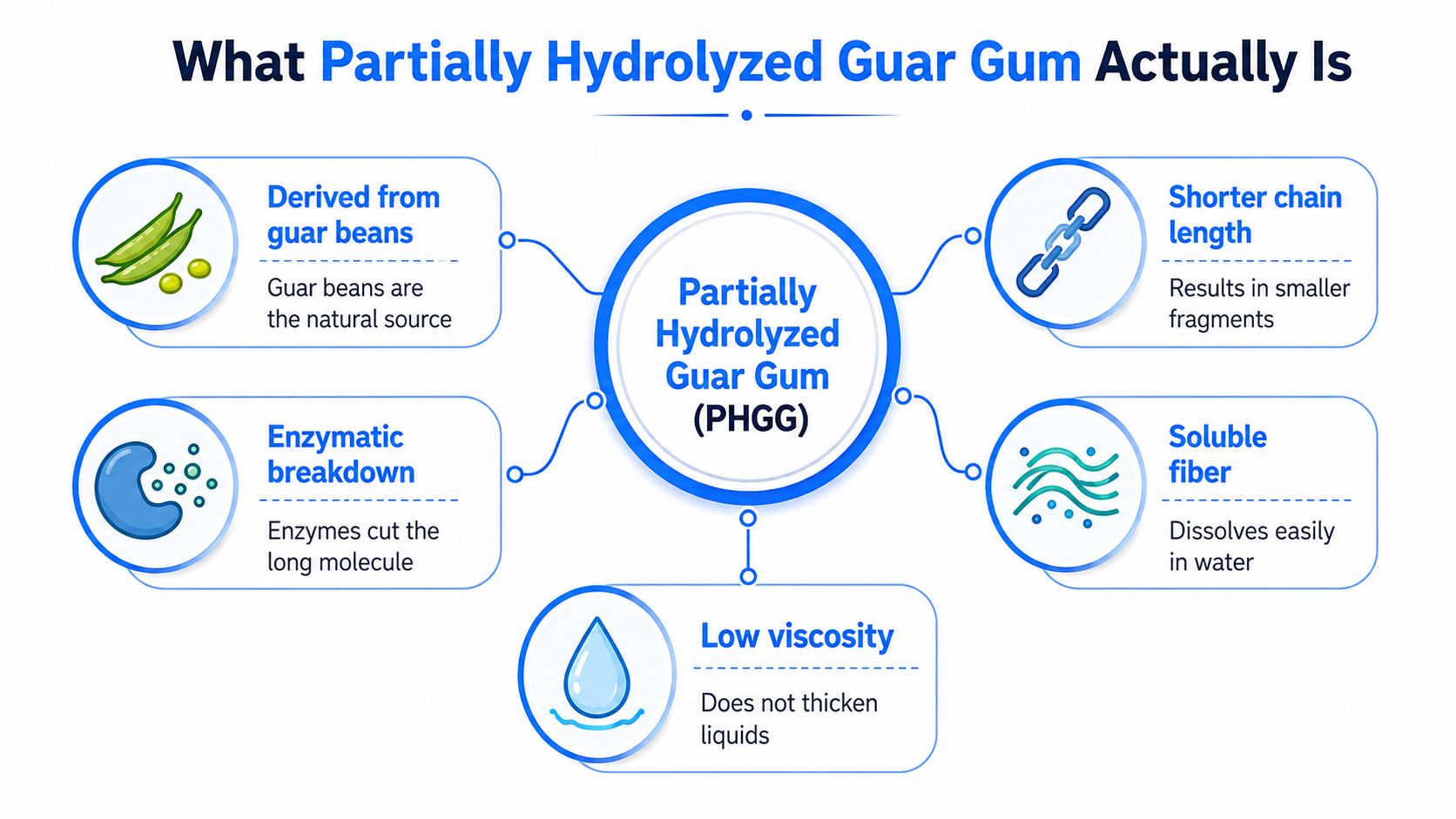
The difference between guar gum and PHGG
Intact guar gum is valued for thickening and gel-forming behavior. That can be useful in food formulation, but it may make a drink difficult to mix or unpleasantly dense.
PHGG is designed to provide fermentable soluble fiber with much less thickening. It can be stirred into water, coffee, smoothies, or soft food without creating the texture associated with native guar gum. This is one reason it appears in dietary supplements, oral nutrition products, and clinical nutrition formulas.
The physiological question is separate from the texture question. A fiber doesn't need to form a thick gel to interact with the gut. PHGG passes through the upper digestive tract and can serve as a substrate for colonic bacteria, where fermentation helps explain its effects on stool consistency and the gut microbiome. A broader overview of how prebiotic ingredients fit into supplement routines is available in this prebiotic fiber supplement guide.
By the end of the label, look for the words “partially hydrolyzed guar gum” or “PHGG.” Those terms distinguish the low-viscosity processed fiber from whole guar gum. The practical questions are then straightforward: what does it do, how should you introduce it, and does the evidence support uses beyond bowel function?
How PHGG Is Made and Why Viscosity Matters
What changes when guar gum is processed into PHGG? The answer lies in the length of its carbohydrate chains, which determines how thick the ingredient becomes in water.
PHGG starts with the endosperm of the guar bean, where galactomannan-rich gum is concentrated. Manufacturers use controlled enzymatic hydrolysis to cleave some of the long chains, then purify and dry the material into a powder. The result retains soluble-fiber properties while producing far less thickening than intact guar gum.
That processing difference is easy to see in a glass. One technical comparison reports approximately 10 mPa·s for PHGG in a 5% aqueous solution, compared with 2,000–3,000 mPa·s for a 1% guar gum solution. Because the solutions use different concentrations, these figures are not a direct consumer-serving comparison. They still show why PHGG and native guar gum behave so differently in liquid.
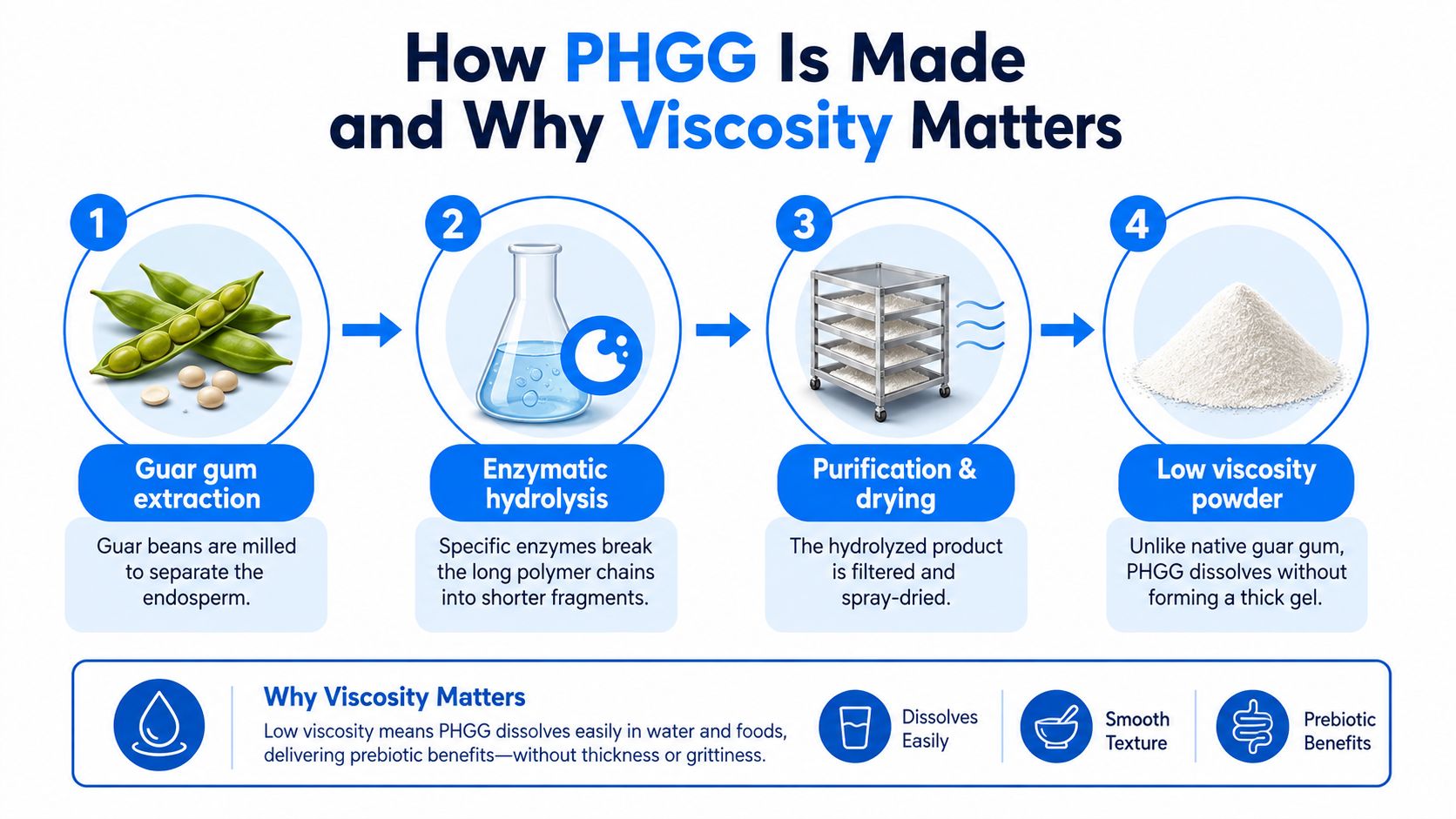
Lower viscosity changes the formulation
Lower viscosity makes PHGG easier to use in several ways:
- Mixability: It disperses more readily in beverages and soft foods.
- Texture: It avoids the strong gel associated with intact guar gum.
- Delivery: Formulators can add fermentable fiber to drinks, meals, and oral nutrition products without making them excessively thick.
- Dose practicality: People can consume studied amounts without a large serving of gel-forming material.
Viscosity describes texture, not the full biological effect. In a human glycemic study, 5 g of PHGG taken with 30 g of sucrose lowered 60-minute blood glucose compared with sucrose alone. The result suggests that PHGG may affect post-meal physiology through more than a physical thickening effect. The finding is relevant to the broader evidence picture, while its implications for everyday products still depend on dose, formulation, and study context.
For gluten-free baking applications, these gluten free baking tips offer context on ingredient behavior in baked foods. Separately, Tecton EDGE™ Performance Shot + Electrolytes is a ketone and electrolyte product, not a PHGG supplement, so the categories should remain distinct.
One unresolved manufacturing question is molecular-weight distribution. Products can share the PHGG name while differing in chain length, viscosity, and fermentation behavior. Those differences may help explain why two products with similar front-label wording do not always produce the same experience.
Evidence-Based Health Benefits of PHGG
Could a fiber improve stool consistency without acting like a conventional laxative? The clearest human evidence for PHGG concerns bowel function, stool form, selected IBS symptoms, and microbiome changes. In a randomized, double-blind trial involving 44 healthy adults, three months of PHGG normalized stool form and increased Bifidobacterium abundance, while stool frequency remained unchanged. That pattern matters: the effect was linked to consistency and microbial composition, not just more frequent bowel movements. Human microbiome and bowel-function trial
IBS findings are also clinically relevant, although they do not establish a permanent solution. A 12-week randomized, placebo-controlled study using 6 g/day reported significant improvements in bloating and gas compared with placebo, with no significant side effects in that trial. Another study tested 5 g/day or 10 g/day for 12 weeks and found improvements in gastrointestinal symptoms, quality of life, and psychological distress. The improvements were strongest during the first month and smaller by the six-month follow-up. IBS trial evidence
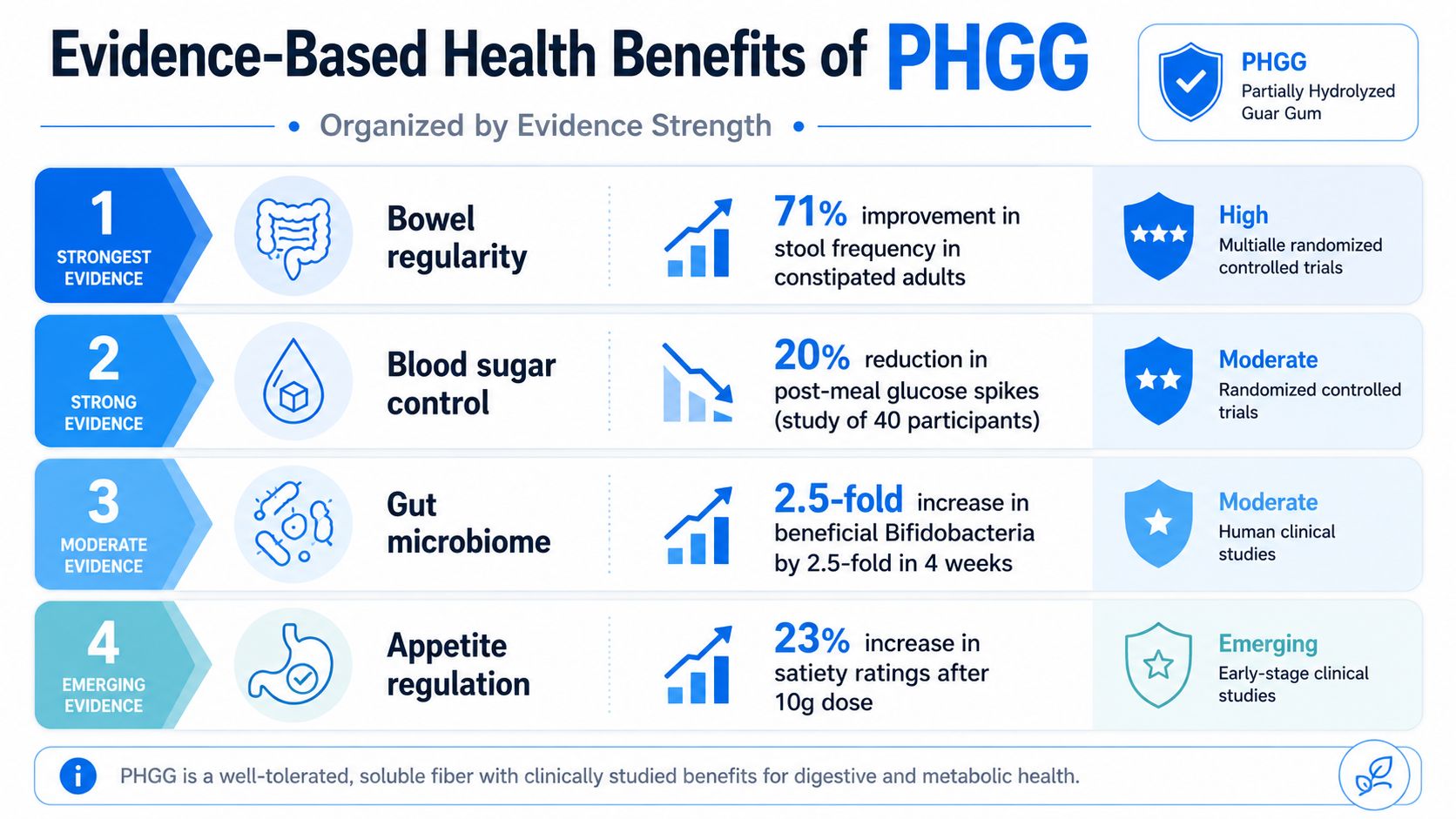
What the fermentation evidence means
PHGG reaches the colon, where bacteria ferment it and produce short-chain fatty acids. A controlled human microbiota study found increased short-chain fatty acid production and beneficial bacteria. Under the tested conditions, low-molecular-weight PHGG also retained prebiotic activity similar to higher-molecular-weight forms. This finding supports fermentation as part of PHGG's action, while product differences and real-world dosing still require separate evaluation.
Glycemic findings are narrower. In the sucrose study described earlier, 5 g of PHGG taken with 30 g of sucrose lowered 60-minute blood glucose compared with sucrose alone. That result describes one meal condition, not a universal effect across diets, meals, or metabolic conditions. A 2025 pilot in South Korea reported improved glycemic control within a multi-component PHGG program, but a structured program cannot establish a single dose for independent use. Recent clinical context
Cognitive and sleep outcomes remain early signals. A 2024 trial in healthy elderly subjects found that 5 g/day for 12 weeks improved visual memory, sleep quality, and vitality. A 2025 human study involving patients with a history of cognitive decline found PHGG was well tolerated and improved bowel function without adverse events. These results justify further study, not claims that PHGG directly improves cognition or sleep in the general population. Review and clinical evidence
Psyllium provides a useful comparison because it is more associated with stool bulk and gel formation. VitzAi.com insights on psyllium offers background on that alternative. For fermentable fibers and body-composition goals, see this discussion of prebiotics and weight loss.
Evidence boundary: PHGG has its clearest support for bowel-function normalization, microbiome changes, and IBS-related bloating. Cognitive and glycemic findings are promising, but they do not justify disease claims or universal promises.
How PHGG Compares to Other Soluble Fibers
PHGG occupies a middle position among soluble fibers. It ferments, but its low viscosity makes it easier to use than thickening fibers. It can be gentler than highly fermentable inulin or FOS for some people, but it doesn't provide the same bulk-forming action as psyllium.
| Fiber | Viscosity | Tolerability | Prebiotic Strength | Evidence Depth |
|---|---|---|---|---|
| PHGG | Low viscosity and easy to mix | Often well tolerated, though gas or bloating can occur | Meaningful fermentable activity | Human trials support bowel, IBS, and microbiome outcomes |
| Inulin and FOS | Usually low to moderate viscosity | Can produce gas in sensitive individuals | Dense, strongly fermentable substrate | Human evidence exists, but individual tolerance varies |
| Psyllium | Forms a more substantial gel | Often useful when introduced with adequate fluid | Fermentable activity is more limited than inulin or PHGG | Extensive human use for stool bulk and regularity |
| Acacia fiber | Low viscosity | Often considered gentle | Fermentable, with gradual bacterial use | Human evidence is present but less central to the PHGG literature |
| Whole guar gum | High viscosity and thickening | Texture and gastrointestinal tolerance can limit use | Fermentable, but delivery is less convenient | Older clinical history, with formulation limitations |
The distinction between fermentation and bulk prevents a common mistake. Psyllium works partly by holding water and increasing stool bulk. PHGG is better understood as a low-viscosity fermentable substrate that can influence stool form and bacterial activity without forming a heavy gel.
Inulin and FOS may provide a stronger fermentative stimulus, but that isn't automatically better. A more intense substrate can create more gas for people whose gut bacteria respond poorly to rapid fermentation. PHGG may suit someone who wants microbiome support without the texture of psyllium or the more noticeable fermentation associated with certain prebiotics.
Acacia fiber can be a reasonable alternative when the priority is a mild, easily mixed soluble fiber. Whole guar gum is more relevant when a manufacturer needs thickening or stabilization. For most individual buyers, the choice should reflect the desired outcome, tolerance, fluid intake, and the product's actual molecular and dosing information rather than the word “fiber” alone.
Dosing, Timing, and How to Use PHGG
Human trials have examined PHGG from 3 g/day to 10 g/day, with bowel and IBS research commonly centered in the 5–10 g/day range. A sensible general-use approach is to begin at 3–5 g/day, then increase gradually over one to two weeks if tolerance is good. People using it specifically for IBS-related bloating or bowel-function support may discuss the higher studied range with a clinician.
A practical introduction
- Start low: Use a modest serving first. Rapid escalation can make any fermentable fiber feel worse before it feels better.
- Match timing to purpose: Take PHGG with or just before a meal when exploring post-meal glycemic support. For general fiber use, consistency matters more than a precise clock time.
- Choose a familiar vehicle: Stir the powder into water, coffee, a smoothie, yogurt, or soft food. Its low viscosity makes it more flexible than intact guar gum.
- Monitor the response: Track stool form, bloating, gas, and abdominal comfort rather than judging success by frequency alone.
- Avoid stacking aggressively: Combining PHGG with several other fermentable fibers can raise the total fermentative load quickly.
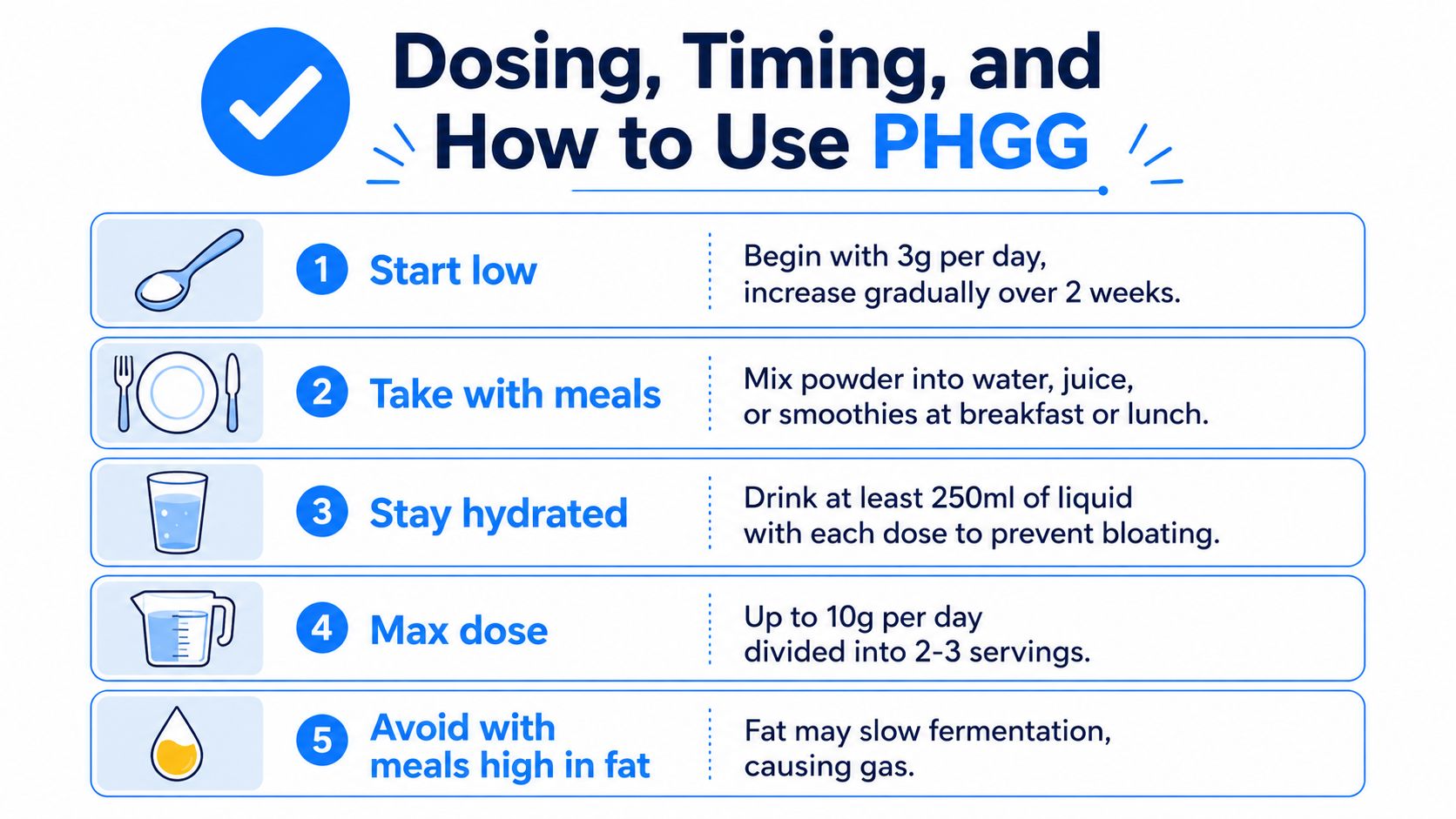
Mild gas or bloating can occur early, especially when the dose rises faster than the person's current tolerance. The studied IBS trial using 6 g/day for 12 weeks reported no significant side effects, but a favorable trial result doesn't eliminate individual variation. People with severe gastrointestinal symptoms, active inflammatory disease, or medically prescribed fluid or fiber restrictions should get clinical guidance before adding PHGG.
Adequate fluid is a sensible practice with fiber supplements, particularly when PHGG is combined with other products that affect stool water or bulk. Anyone taking medications, managing a diagnosed gastrointestinal condition, or following a restricted diet should ask a pharmacist or clinician about timing and suitability rather than assuming a dietary fiber is automatically appropriate. Additional gut-focused context is available in this guide to supporting gut health.
Where the Evidence Is Still Mixed or Uncertain
Could PHGG help one part of gut function while raising questions in another? The strongest human evidence concerns bowel function, stool form, microbiome changes, and IBS-related bloating. Findings outside those uses remain less certain.
The main caution comes from a 2025 mouse study using an AOM/DSS colitis model. Animals given PHGG developed worse colitis and more colon tumorigenesis, with effects that increased alongside dose. This is preclinical evidence, so it does not show that humans experience the same outcome. It does, however, give people with active inflammatory bowel disease or other significant colonic vulnerabilities a reason to seek medical oversight before self-prescribing PHGG.
Why product differences may matter
PHGG is often treated as one uniform ingredient, yet its molecular weight can change its physicochemical properties and its fermentation behavior in laboratory models. Two products listing the same daily dose may therefore interact with the gut differently. The unresolved question is not only how much PHGG a product contains, but also which molecular profile it provides. Molecular-weight and fermentation research
A dose-range study using 3 g and 6 g per day shifted gut microbiota differently, including increased Verrucomicrobia at day 14. That result helps explain why dose matters, but it does not identify the best dose for each person. Short-term microbiome changes, especially in laboratory or limited-duration research, cannot by themselves establish lasting clinical benefit.
The same standard applies to newer cognitive and glycemic findings. They broaden the research questions, while PHGG remains better established for digestive applications than for metabolic or cognitive outcomes. Preclinical and emerging human evidence Active inflammatory disease warrants particular caution.
Choosing a PHGG Product and Putting It Into Practice
A useful selection process starts with the label, not the marketing language.
- Confirm the ingredient. Look for “partially hydrolyzed guar gum” or “PHGG,” not whole guar gum.
- Check the serving dose. Compare the product's instructions with the human research range of 3–10 g/day.
- Look for technical transparency. Molecular-weight information, viscosity specifications, or fermentation data can help explain why products differ.
- Review quality controls. Prefer transparent ingredient lists and, where available, third-party testing. This third-party verification guide explains why independent quality checks matter.
PHGG is most likely to fit adults seeking a gentle soluble fiber, people with IBS-related bloating under appropriate guidance, or those interested in microbiome support without a thick gel. Approach it cautiously if you have active inflammatory bowel disease, severe gas sensitivity, or a clinician-directed fluid or fiber restriction. Introduce it gradually and judge the response over four to twelve weeks, while recognizing that study outcomes vary by dose, duration, and population.
Application Framework: Choose a clearly labeled PHGG product, begin with a low serving, keep the dose consistent, and record stool form and gastrointestinal comfort. If symptoms worsen or you have a diagnosed intestinal condition, stop self-experimenting and speak with a qualified clinician.
Tecton Ketones™ offers bioidentical exogenous ketone nutrition built around liposomal R3HBG™ for direct BHB delivery, with formulas designed for performance, cognition, and metabolic routines rather than fiber supplementation. Visit Tecton Ketones™ to explore a science-led ketone option that can complement, but not replace, a well-designed nutrition and gut-health plan.


