


Exogenous ketones reliably raise blood D-β-hydroxybutyrate (BHB) above about 3.5 mmol/L and can lower blood glucose by more than 1 mmol/L in controlled human studies, yet they don't reliably improve endurance or power, and cognitive effects stay modest and depend on context.
If a higher ketone reading meant a faster athlete, time trials would already have closed the question. They haven't. Most ketone content treats one blood number as proof of work capacity, sharper thinking, and better metabolic health at once. Those are separate outcomes, and the trials don't score them the same way. A useful reading splits fuel delivery, metabolic change, and real-world output, then assigns each its own confidence.
Table of Contents
- Do Ketone Supplements Work? The Short Answer by Goal
- Three Ways the Body Gets Ketones
- Why Higher Blood Ketones Do Not Guarantee Faster Athletes
- What the Studies Show
- Ketone Salts, Esters and Precursors Compared
- Why This Matters
- Who May Benefit and What to Expect Physiologically
- Safety, Side Effects and Who Should Check First
- Application Framework for Choosing by Goal
Do Ketone Supplements Work? The Short Answer by Goal
Do ketone supplements work? The answer depends on the outcome. Blood chemistry changes reliably in controlled studies; evidence for better endurance performance is weak, while cognitive findings are limited to specific settings.
| Outcome | What the studies show | Confidence |
|---|---|---|
| Blood BHB | Rises above about 3.5 mmol/L after ketone ester intake, according to the University of Bath recovery trial | High |
| Blood glucose | Falls by more than 1 mmol/L versus an isocaloric placebo in the University of Bath recovery trial | High |
| Endurance time to exhaustion | No gain: 52 vs 54 minutes, ketone vs placebo, in the University of Bath recovery trial | Low |
| Time-trial power | About 1.5% lower after a 50 g ester dose in trained cyclists | Moderate |
| Working memory | Improved in both metabolic groups, 10 with and 10 without metabolic syndrome | Modest, condition-dependent |
| Executive function | Faster Stroop and switching responses after 31 days in runners | Modest, small trial |
| Appetite | Reduced only in people without metabolic syndrome | Low |
Confidence describes how repeatable a finding appears, not what an individual should expect. Blood responses have been observed across controlled ester studies. Performance and cognitive findings are less consistent or limited to particular groups and tasks.
The endurance result illustrates why a blood response and a performance result need separate evaluation. In a randomized crossover study of 13 endurance-trained men, ketone ester intake increased carbohydrate storage after exercise to about 220 ± 26 g, versus 206 ± 26 g with placebo. Yet time to exhaustion was 52 ± 28 minutes versus 54 ± 33 minutes, with p = 0.87, according to the University of Bath recovery trial. A change in fuel use or storage does not, by itself, establish an improvement in exercise capacity.
Practical rule: Judge a product first by the size, timing, and duration of the BHB rise, then by the outcome you care about. A measurable blood response without a change in time or power is a metabolic effect, not evidence of a race benefit.
Use the application framework to connect a specific goal with a format and a logged trial.
Three Ways the Body Gets Ketones
Ketones can come from dietary change, ordinary production in the body, or a supplement. These routes differ in how ketones enter circulation and what they can tell you about metabolism.
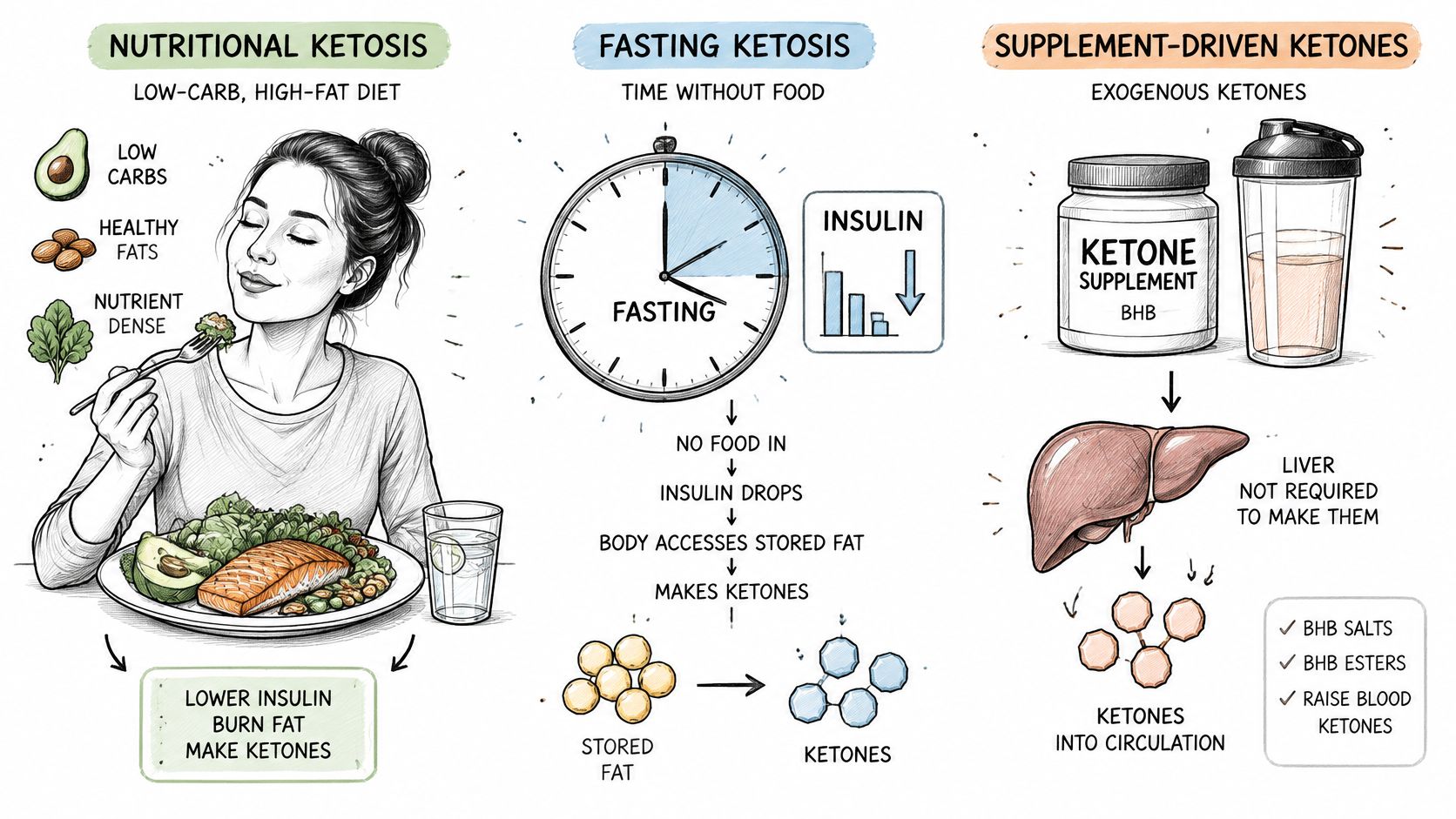
Nutritional ketosis follows carbohydrate restriction or fasting. As insulin falls, the liver makes BHB from fatty acids. This shift develops over time and depends on dietary conditions.
Endogenous production is the body's ongoing output. Sleep, fasting, and prolonged exercise can raise ketones through this pathway. Hormones and fat availability affect the rate.
Exogenous supplementation supplies BHB that is already formed. R3HBG raises blood ketones directly, independent of what has been eaten, and works alongside a normal diet. It has no loading phase, and you do not need to be in ketosis for it to work.
From blood BHB to ATP
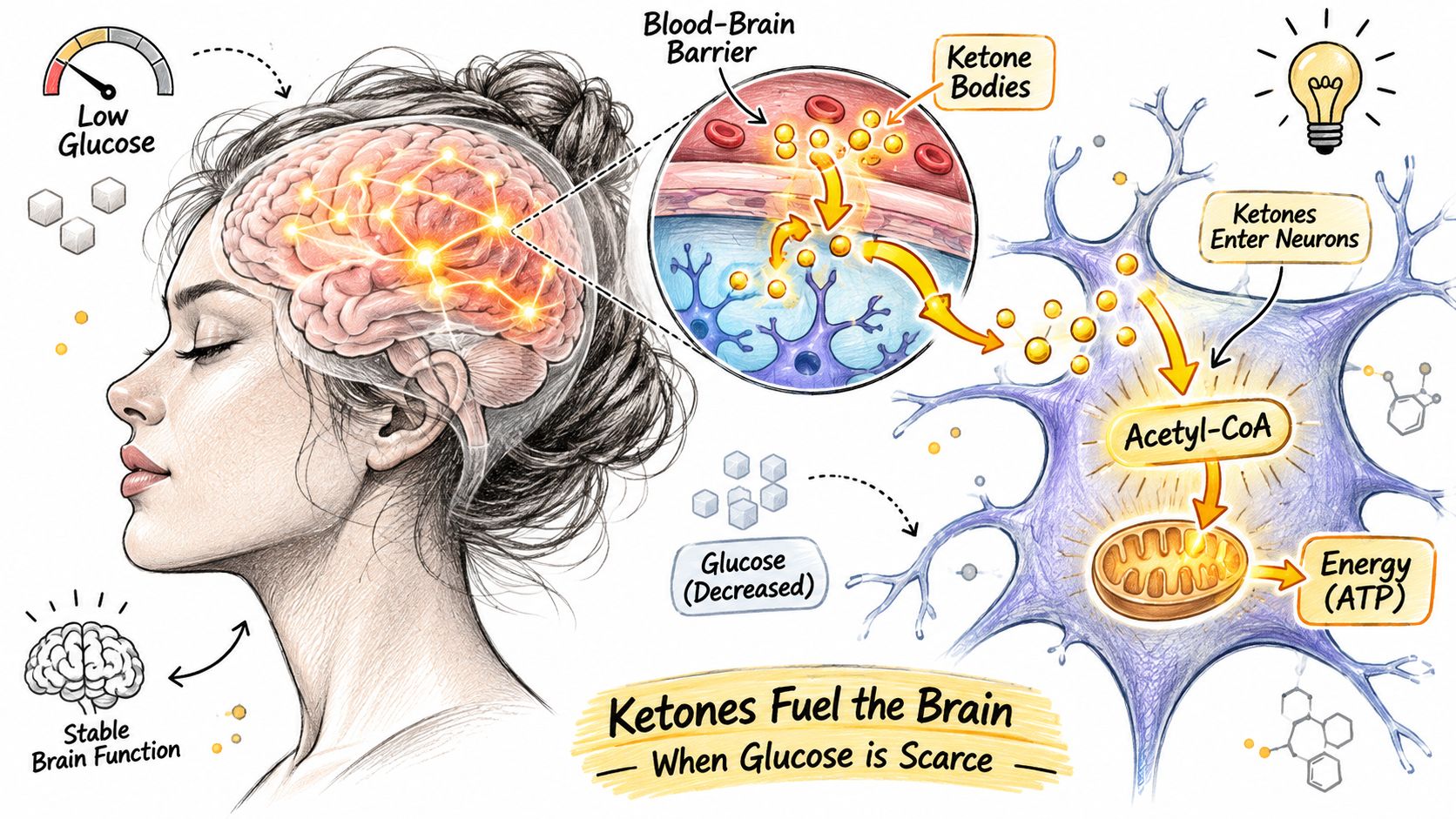
Muscle, heart, and brain can take up BHB from the blood. Cells convert it to acetyl-CoA, which enters the citric acid cycle in mitochondria and contributes to ATP production. Glucose follows a different initial route through glycolysis before its breakdown products enter mitochondrial metabolism.
Metabolic flexibility describes the ability to use different fuels as their availability and demand change. A supplement supplies a fuel tissues can oxidize while glucose remains available; it does not, by itself, demonstrate improved flexibility or performance.
Blood BHB indicates that ketones have reached circulation. It does not show whether an athlete has become faster or whether the body has shifted to a meaningfully different fuel pattern during exercise. Those are separate outcomes to assess.
BHB also acts as a signalling molecule. Preclinical research has examined its effects on class I histone deacetylases and the HCA2 receptor, pathways proposed to affect inflammatory and vascular signalling. Evidence for direct effects on human endothelial function remains limited and largely mechanistic.
For a comparison with fats that the liver must convert into ketones, see this guide to MCT powder. MCTs and ready-made BHB differ in how they deliver ketones to the body.
Why Higher Blood Ketones Do Not Guarantee Faster Athletes
Blood BHB is a measure of exposure. Whether that rise changes fuel use or race performance requires separate evidence.
A 2026 systematic review of 26 studies found that exogenous ketones consistently increased circulating beta-hydroxybutyrate and altered glucose, lactate, and acid–base measures. Evidence for endurance performance remained low-certainty and highly heterogeneous. Most acute studies reported null or negative performance outcomes; more consistent benefits appeared in limited chronic-adaptation protocols rather than in the hours after a single dose.
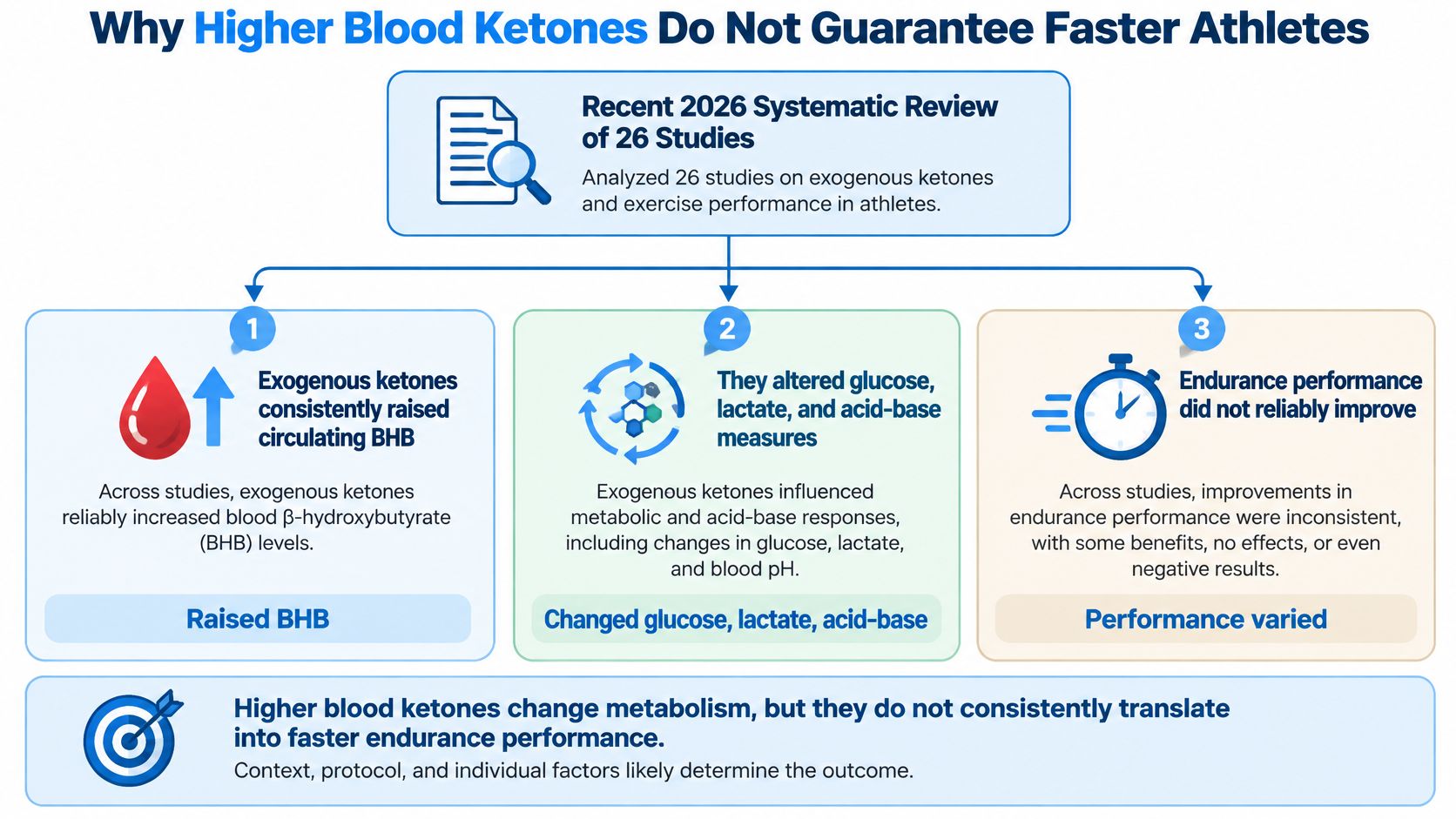
An earlier systematic review of 10 human studies screened 161 articles and included trials with 112 participants, 109 of them men. Across 16 performance outcomes, divided evenly between lower-body power and endurance, results were mixed. The studies tested both ketone esters and salts or precursors. Taken together, the findings separate three questions: whether BHB rises, whether metabolic measures change, and whether performance improves.
Why a hard effort can get worse
High-intensity work depends on rapid glycolytic ATP production and the body's handling of acid. Ketones do not replace that system. In a randomized, double-blind crossover study of 14 well-trained male cyclists, a 50-gram ketone-ester dose raised blood D-BHB to about 3–4 mmol/L during a 30-minute time trial and a later sprint. Mean time-trial power fell by about 1.5% versus control. Bicarbonate alone did not produce that drop, so greater ketone availability did not translate into higher output in this test.
Assess claims at three levels:
- Fuel delivery: Did blood BHB rise, and for how long?
- Metabolic effects: Did glucose, lactate, or carbohydrate retention change?
- Performance outcome: Did time, power, or work capacity improve?
The answer may differ with sport duration and intensity, carbohydrate availability, training status, dose timing, and gastrointestinal tolerance. Sustained energy, recovery, and maximal power are distinct outcomes, so a late-session fuel strategy should be judged against the demands of the session. For more on the evidence in long sessions, see this guide to ketones for endurance athletes.
A blood result alone establishes exposure. Evidence of a metabolic change, and then a performance effect, must be assessed independently.
What the Studies Show
Ketone bodies can cross the blood–brain barrier and provide fuel for the brain. Whether raising blood ketones changes cognitive performance is a separate question, and the human evidence remains limited.
Where a cognitive signal shows up
A randomized, placebo-controlled crossover study of 10 participants with metabolic syndrome and 10 matched participants without it found that ketone ester ingestion improved working-memory indices and reduced blood glucose in both groups, as reported in a 2025 human crossover study. Appetite fell only among participants without metabolic syndrome.
A separate randomized, placebo-controlled crossover study in 20 people with type 2 diabetes or insulin resistance found no improvement in cognition or plasma BDNF after acute and short-term exogenous BHB supplementation. The two studies suggest that cognitive responses may vary by population and outcome measured.
In a 31-day randomized trial of 18 recreational runners, 30 grams of ketone monoester taken three times daily did not improve 5-kilometer time-trial performance. Responses were faster on the Stroop incongruent task (p = 0.015) and switching task (p = 0.038). The signal is modest and limited to executive-function tasks in a small sample.
To assess a cognitive effect, distinguish a scored task from subjective alertness. Track the task, dose, time between intake and testing, glucose change, and any adverse effects such as nausea or cramps. Those measures help separate a change in blood chemistry from a change in performance.
The video below explains how researchers distinguish brain-fuel measurements from scores on cognitive tasks.
These findings do not establish ketone supplements as a treatment for cognitive decline, Parkinson's disease, Alzheimer's disease, dementia, or epilepsy. Claims about mental performance should remain limited to the specific tasks and populations studied.
Ketone Salts, Esters and Precursors Compared
Format decides the mineral load, how fast blood BHB rises, and whether any change in fuel use shows up as more work. Those are separate outcomes. A meter reading does not settle the performance question.
| Format | Example | Key trade-off | Evidence note |
|---|---|---|---|
| Ketone salts | BHB bound to sodium, potassium, calcium or magnesium | Mineral load | About 16 W (about 7%) lower time-trial power than control in a controlled ketone-salt study |
| Ketone esters | Monoesters and diesters | Fast blood rise; taste and gut tolerance vary | Larger, faster D-BHB rise than salts is the usual blood finding; race output still has to be tested on its own |
| Bioidentical tri-ester | R3HBG, as described by Tecton | Brand-specific formulation; check independent data | Tecton states direct D-BHB delivery; that is a blood-chemistry claim, not a performance result |
| Precursors | R-1,3-butanediol, MCT oil | Slower, indirect conversion to BHB; gut-dependent | Conversion, not direct BHB delivery |
What each format does
Salts pair BHB with sodium, potassium, calcium, or magnesium. In that controlled trial, supplementation raised circulating BHB and lowered the respiratory-exchange ratio in steady exercise below and around ventilatory threshold, which indicates greater fat oxidation. Average time-trial power was still lower than control. Blood ketones moved, and fuel mix moved with them. Work output did not improve. Confidence is reasonable for the chemistry in that protocol, and the performance direction is worse, not better. The mineral load also matters if you already take sodium or potassium from food and sports drinks.
Esters bond BHB to an alcohol-based carrier. They tend to produce a larger, faster blood rise than salts, so the blood-BHB claim is the stronger one. Taste and gastrointestinal tolerance differ by product. A dose that looks strong on a ketone meter can still be a dose you will not repeat, and a high reading is not evidence that power or speed improved.
Precursors such as R-1,3-butanediol and MCT oil are not BHB yet. The body has to convert them. That step is slower and more dependent on gut tolerance. A precursor label can look like a ketone product while the blood rise lags a true ester. The supported claim is indirect conversion, not direct delivery.
Bioidentical on a label usually means D-BHB, the isomer the body produces, rather than L-BHB. Liposomal means the ingredient sits inside lipid vesicles. Brands present that as an absorption aid. Independent head-to-head trials of liposomal versus non-liposomal ketones are still thin, so treat the word as a delivery description, not a performance result.
Tecton describes R3HBG as a tri-ester that delivers D-BHB. Tecton states that its R3HBG formulation raises blood ketones directly, independent of what has been eaten, and works alongside a normal diet. That is a brand claim about delivery, not a published race result. Check it the same way you would check any ester: published human data for the outcome you want, not the blood curve alone. One option in that line is the Performance Shot + Electrolytes, a ketone shot. Tecton EDGE is formulated without added sugar or artificial stimulants.
Label checklist
- Format: salt, ester, tri-ester, or precursor.
- Grams per serving: BHB or precursor, not just "ketone blend."
- Isomer: D-BHB, L-BHB, or unspecified.
- Liposomal or not: stated, or absent.
- Minerals, caffeine, and sweeteners: per serving, not per "proprietary blend."
Why This Matters
Biochemistry only helps if you can name what should change in a normal week, and what shouldn't.
- Steadier energy: Ketones are a second fuel beside glucose, and controlled intake can lower blood glucose. A meter change doesn't prove the afternoon feels smoother. Keep a simple energy log for two weeks and compare days with and without the serving.
- Cognitive endurance: The clearest human signal is on demanding executive tasks during prolonged effort, and the trials are small. Expect a possible edge on conflict or switching tasks, not a new baseline IQ.
- Workout performance: Fuel availability and post-exercise carbohydrate retention are the supported findings. Consistent gains in speed or power are not. On hard intervals, output can dip even while BHB is high.
- Metabolic efficiency: Altered glucose handling and a shift toward fat oxidation in steady work are measurable markers. They are not proof of better long-term health.
The true benefit of a ketone supplement is a flexible, measurable fuel option, not a guaranteed upgrade to performance or health.
Who May Benefit and What to Expect Physiologically
Who has a reason to run a trial, and which readout should move: blood BHB, metabolism, or the session itself?
The useful group is narrower than the marketing. Endurance athletes who want a second fuel on long training days, people eating fewer carbohydrates without a strict ketogenic plan, people using fasting windows, and professionals doing long blocks of demanding mental work can each run a tracked trial. A first-dose personal record is the wrong experiment.
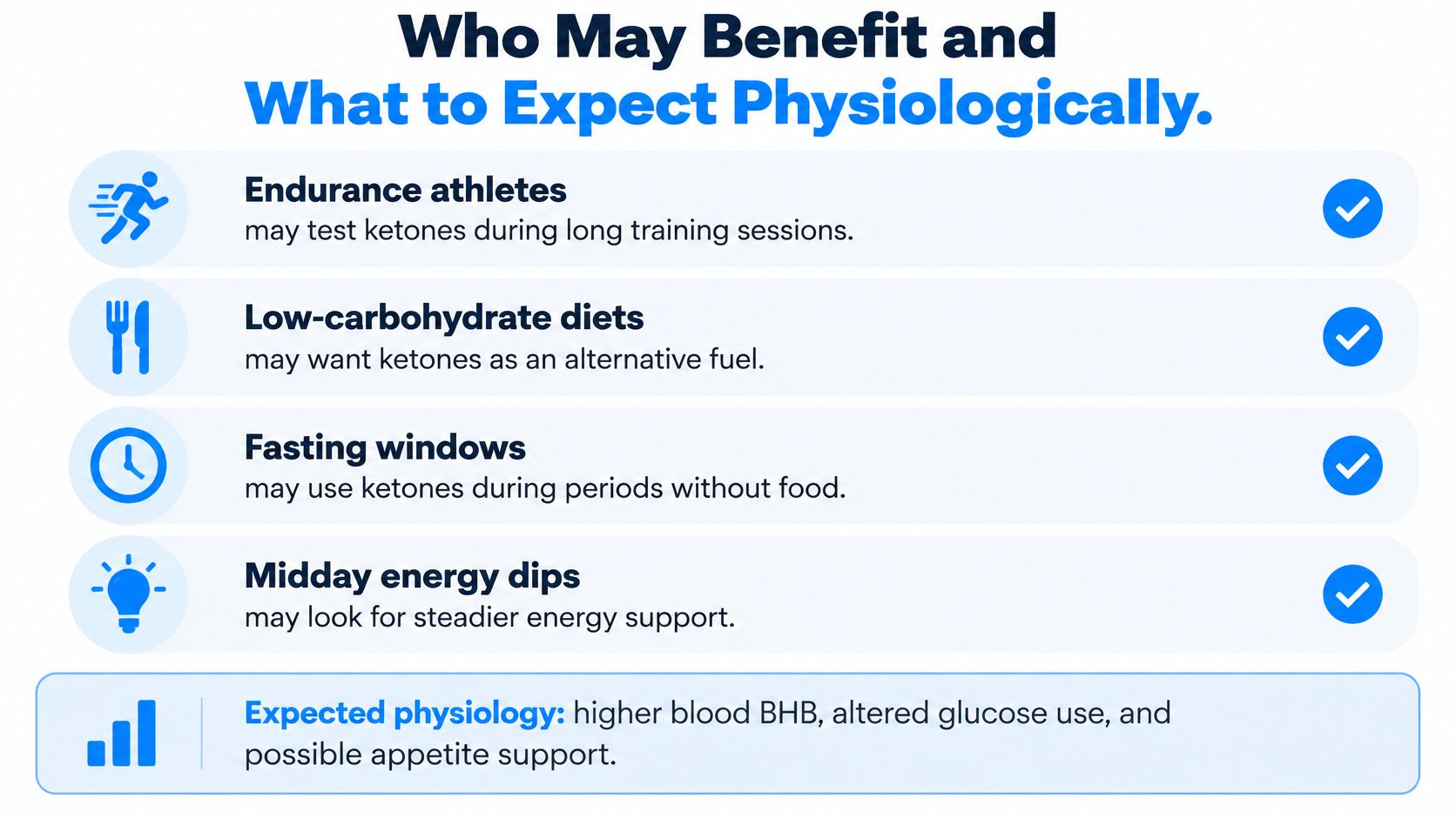
Raising blood BHB is the high-confidence outcome. After a serving it rises, peaks, and then falls as tissues clear it. A modest drop in blood glucose is a metabolic marker with middling confidence: measurable, not proof the afternoon felt easier. Pace and focus sit at the bottom. They belong in the log, not in how motivated the first session felt.
- Test in training. Never take the first serving on race day or on a formal test.
- Keep the diet normal. Change one variable so the log means something.
- Measure, don't guess. Track blood BHB with a meter alongside glucose, plus session time and a rating of effort or focus.
If you train in the heat, pair that log with fluid loss. You can calculate your sweat rate so sodium and fluid aren't drifting while you judge the ketone.
Gastrointestinal discomfort shows up in some people and varies by formula. Judge a defined trial of several weeks, not one workout.
Four shots each carry 10g of R3HBG: EDGE Caffeine (ketones with natural caffeine), EDGE Electrolytes, Locked Cognition (a ketone nootropic shot), and the GLP-1 Activator (a metabolic support ketone shot). Take them on different days rather than stacking servings, so the log still has one variable.
Safety, Side Effects and Who Should Check First
The common complaints are gastrointestinal: nausea, cramping, or diarrhoea, most often at high doses or with ester formats. Salt-based products add sodium or potassium, which matters on a sodium-restricted diet. Some blends add caffeine or other stimulants, and those bring their own effects on heart rate, sleep, and jitteriness. Ketones plus glucose-lowering medication can push blood glucose down further, so hypoglycaemia is a real risk, not a theoretical one.
Stop and seek medical care if symptoms are severe or persistent. Long-term human safety data for exogenous ketones are limited, and rare serious events aren't well characterised. A fuller plain-language list of what users report sits in this overview of exogenous ketone side effects.
Speak with a clinician before use if you are:
- Pregnant or breastfeeding.
- Living with diabetes or taking glucose-lowering medication.
- Living with kidney or liver disease.
- Living with an electrolyte disorder or taking diuretics.
- Under the age of majority.
Ketone supplements aren't a treatment for any disease. This list starts a conversation with a physician. It doesn't replace one. If the goal is thinking stamina rather than a supplement, cognitive strategies from Orange Neurosciences cover sleep, task design, and training habits that don't depend on a ketone curve.
Application Framework for Choosing by Goal
Pick with a sequence, not a slogan.
- Name one goal: endurance feel, training output, focus, or metabolic support. One goal keeps the log interpretable.
- Match the format: an ester or a tri-ester if you want a larger blood rise, salts only if the mineral load is acceptable, precursors only if your gut tolerates the conversion step.
- Apply the label checklist: grams, D or L isomer, liposomal or not, minerals, caffeine, and sweeteners.
- Confirm human evidence for that goal: a blood BHB rise isn't evidence that power, a 5K, or appetite will move.
- Run a defined trial: training days only, meter plus glucose, rated effort or a real cognitive task, several weeks.
- Review with a clinician if you have a health condition or take medication. If the goal is training recovery rather than a ketone effect, building an evidence-based recovery plan still starts with sleep, carbs, protein, and load management.
Tecton's R3HBG tri-ester gets the same six steps as any other product. The label and the published data decide, not the brand name. Tecton Ketones products may be dietary supplements, and statements on the site have not been evaluated by the FDA. They aren't intended to diagnose, treat, cure, or prevent any disease. The next measurable step is the first logged trial session, with the meter and the stopwatch both written down.
Tecton Ketones™ builds exogenous ketone shots around R3HBG so you can raise blood ketones on a normal diet and then judge the result with a meter, a session log, and a single named goal. That is the same standard this evidence asks for: fuel delivery first, performance claims only when a trial shows them. Visit Tecton Ketones™ to compare formulas and set up that first logged trial.


