


The popular advice to take a fixed number of grams of ketones misses the most important detail: grams of what? A ketone salt, a ketone ester, and a ketone precursor aren't interchangeable. Neither are grams of active ingredient and grams of delivered D-beta-hydroxybutyrate.
A useful beta hydroxybutyrate dosage starts with the molecule, then accounts for body size, timing, blood response, and tolerability. The practical goal isn't the highest meter reading. It's a reproducible, well-tolerated exposure that fits the activity you're trying to support.
Table of Contents
- Typical Dose Ranges by Product Form
- How to Convert a Serving into Grams of D-BHB
- How to Titrate Your Dose Without Overshooting
- Timing Around Exercise, Fasting and Focused Work
- Reading Blood Ketone Levels Against Your Dose
- Safety Limits, Side Effects and When to See a Clinician
- Build Your Dosing Routine and Confirm the Next Step
Typical Dose Ranges by Product Form
There's no universally established BHB dose. Larger servings generally produce greater and longer-lasting circulating ketone exposure, but the delivery molecule changes the response, as described in the human ketone-monoester pharmacokinetic study.
That distinction matters before comparing labels. A drink's total ingredient weight can include components other than BHB, and different ingredients require different metabolic processing.
Research servings and blood BHB response by product form
| Product form and serving | Blood BHB response | Context |
|---|---|---|
| Ketone-ester ingredient, 12.5 g | Reached at least 0.5 mmol/L, with a lower peak than 25 g | Randomized observational study in adults |
| Same ketone-ester ingredient, 25 g | Significantly higher peak BHB and total exposure than 12.5 g | Same study and formulation, larger serving |
| Ketone ester versus ketone salt, roughly 12 g and 24 g of delivered BHB | Ester peak 2.8 mmol/L versus salt peak 1.0 mmol/L | Controlled human ester–salt comparison |
| BHB plus MCT, 22.1 g versus 44.2 g | Peak 0.60 versus 0.73 mmol/L at 60 minutes | Higher dose sustained elevation longer in the dose-response evidence review |
| Ketone monoester, 25 mL, equivalent to 26.8 g, three times daily | Average peak 4.1 mmol/L | 28-day tolerability study in healthy adults, research setting only |
The first comparison involves a specific ketone-ester ingredient, not a reason to assume every monoester or other ester behaves identically. Product chemistry matters even within the ester category.
These are controlled-trial benchmarks, not consumer prescriptions. Participants, feeding conditions, delivery molecules, and monitoring differed across protocols, so the rows shouldn't be read as a single dose-escalation ladder.
The MCT comparison is particularly instructive: a substantially larger serving produced only a modestly higher peak. A bigger serving can change duration more than peak concentration, and a peak alone doesn't describe total exposure.
Practical rule: Match the dose number to the exact product form on the label, never to a gram target copied from another formulation.
How to Convert a Serving into Grams of D-BHB
A label's ingredient weight isn't automatically its D-BHB equivalent. D-BHB is the physiological stereoisomer used as ketone fuel, while racemic products contain both D- and L-forms; formulation differences complicate gram-for-gram comparisons, as discussed in the clinical review of exogenous ketone formulations.
Use this label-reading process before comparing products.
- Find the active ingredient weight. Separate the named ketone ingredient from total drink volume, flavorings, and other ingredients. Every Tecton bottle contains 10 g of R3HBG, a bioidentical ketone ingredient.
- Identify the molecule. Record whether you're buying an ester, a BHB salt, a precursor, or an MCT-containing formula. Our guide to exogenous ketone ingredients provides context for those distinctions.
- Look for an explicit D-BHB equivalent. An ester includes a non-BHB structural component, while a salt includes a mineral counter-ion. If the manufacturer doesn't state the equivalent, record it as unconfirmed rather than assuming all ingredient grams are D-BHB.
- Account for frequency. Multiply the confirmed D-BHB equivalent by the intended servings per day. Keep per-serving exposure separate from daily intake.
- Compare like with like. Match delivered BHB with delivered BHB, or ingredient weight with the identical research ingredient. Don't use a study's ester weight as a conversion factor for another molecule.
A worked label comparison
A 10 g R3HBG bottle and a 12.5 g research ester serving aren't directly comparable because both labels describe ketones. You need the D-BHB equivalent and product-specific absorption information before interpreting the difference.
Our Performance Shot + Electrolytes combines liposomal R3HBG with sodium, potassium, and magnesium. Liposomal delivery describes the formulation system, not a mathematical conversion from ingredient grams to circulating BHB.
Use this visual checklist when reading a label.
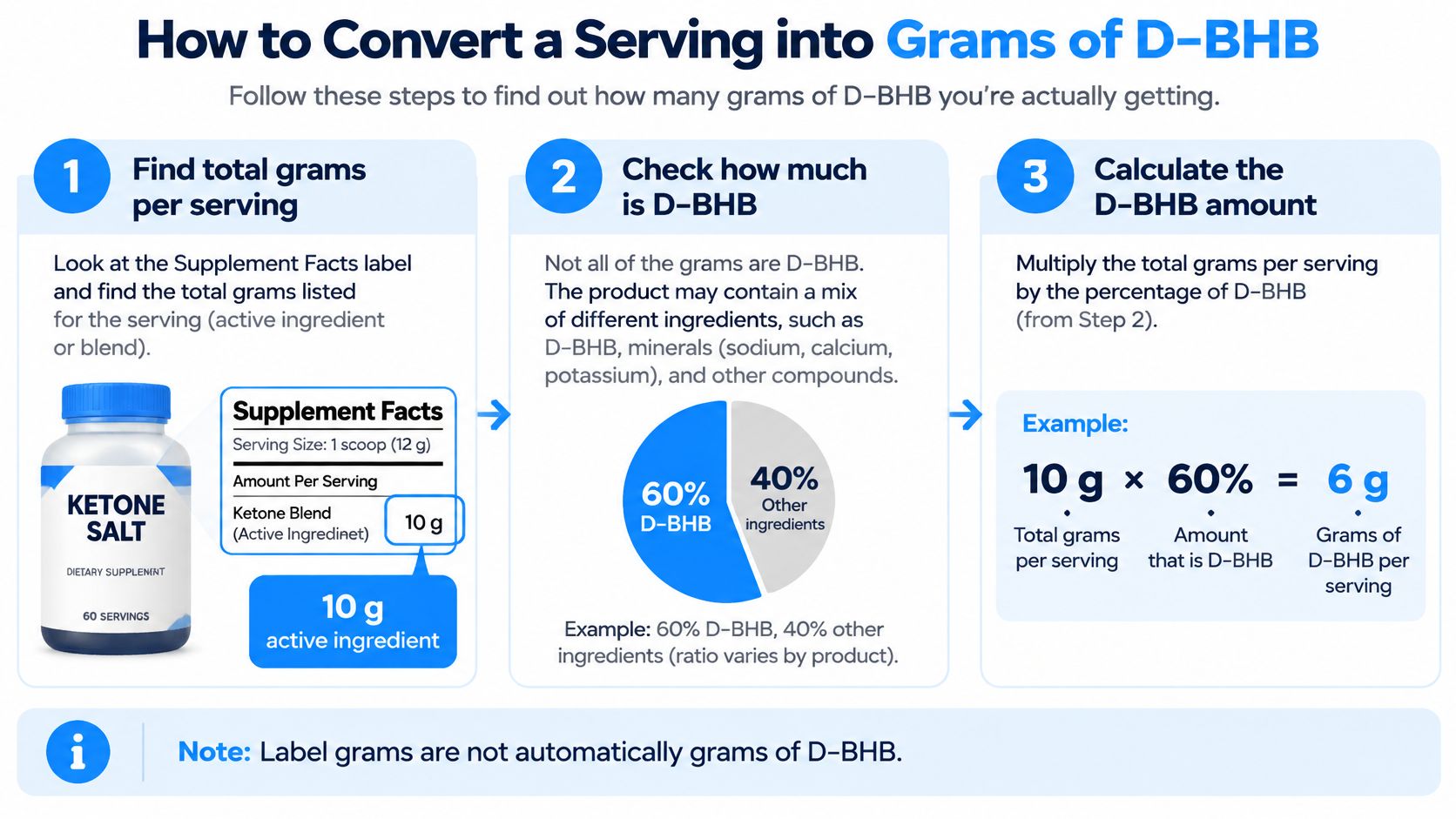
Before dosing, write down grams, molecule, and frequency.
How to Titrate Your Dose Without Overshooting
For a hypothetical adult weighing 70 kg, a study dose of 140 mg/kg converts to 9.8 g of the tested monoester. The controlled D-BHB-monoester pharmacokinetic study tested 140, 357, and 714 mg/kg, producing peak BHB concentrations of approximately 0.28, 1.00, and 3.30 mmol/L, respectively.
That calculation illustrates the research design. It doesn't establish a starting prescription for a different ester, a salt, or a finished commercial drink.
Keep a scale and notebook available when planning a weight-normalized comparison.
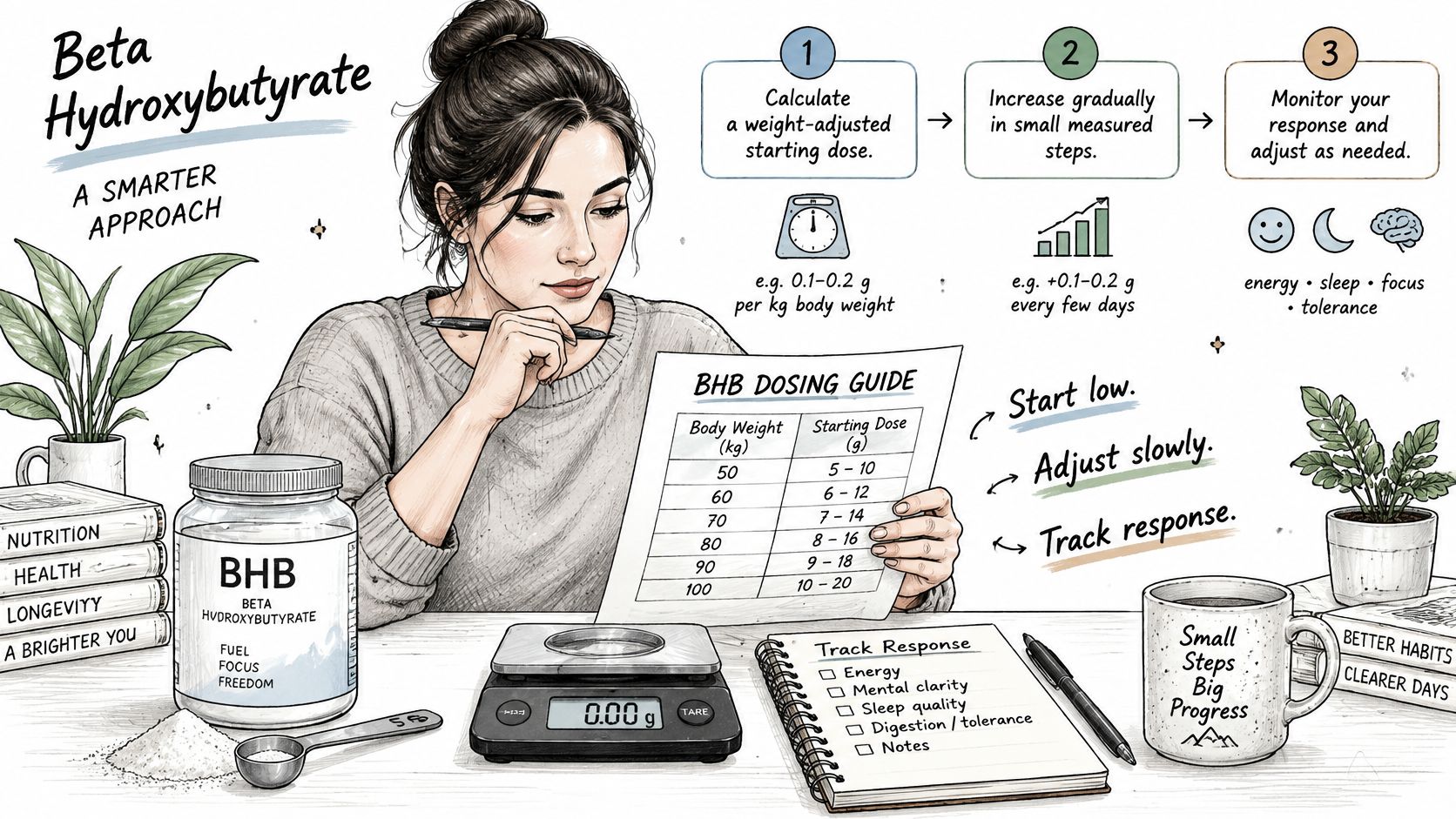
A conservative dose-finding sequence
- Establish an appropriate starting serving. Follow the specific product's label, not the largest research dose. Weight normalization is useful only when the molecule and dosing basis match.
- Observe tolerance before adding more. Record nausea, abdominal discomfort, bloating, bowel changes, headache, or appetite changes. Include whether you consumed the serving with food.
- Measure at a consistent interval. If you're using a blood ketone meter, a practical initial assessment window is approximately 30–60 minutes after dosing. Record elapsed time rather than relying on memory.
- Adjust on a separate occasion. Consider an increase only when the intended exposure wasn't achieved, tolerance was good, and the label permits it. Don't treat the study's higher-dose arms as mandatory steps.
- Avoid rapid redosing. Give the original serving time to act before concluding that it was insufficient. Otherwise, you can't distinguish delayed absorption from an inadequate amount.
For the same hypothetical adult, the higher study arms correspond to approximately 25 g and 50 g of that monoester. Those are mathematical translations of the protocol, not recommendations to consume those amounts.
The study was short and involved healthy participants. Its tolerability findings can't establish long-term safety or therapeutic dosing, and higher exposure isn't automatically more useful.
A video can supplement the written routine, but it shouldn't replace the label or your own symptom log.
Change one variable at a time: dose, food, or timing. Otherwise, you won't know which change altered your response.
Timing Around Exercise, Fasting and Focused Work
Our suggested use is one bottle taken 30–45 minutes before it's needed. Treat that as a scheduling starting point, not a guarantee that every person reaches peak BHB at the same moment.
The physiological rationale is straightforward. BHB is converted to acetoacetate and then acetyl-CoA inside mitochondria, feeding the tricarboxylic-acid cycle and oxidative phosphorylation to produce ATP; glucose must first undergo glycolysis and pyruvate conversion, as explained in the review of ketones and brain energy metabolism.
That review also describes a human intravenous-BHB PET experiment in which cerebral glucose consumption fell by approximately 14%, while cerebral oxygen consumption remained unchanged. This supports alternative brain-fuel utilization, not a claim that an oral shot improves cognition.
Timing and starting approach by use case
| Use case | When to take | Starting approach | Watch for |
|---|---|---|---|
| Before endurance training | 30–45 minutes before the session | Half serving on first use if consistent with the label, then the labeled serving if tolerated | Nausea, bloating, heartburn |
| Before a fasting window | 30–45 minutes before the fast begins | Labeled serving with a tolerance check | Stomach pain, nausea |
| Before focused mental work | 30–45 minutes before the session | Labeled serving, without stacking doses in the same window | Headache, reduced appetite |
| Repeated daily use | Consistent timing after tolerance is confirmed | Don't increase frequency until repeated-use tolerance is clear | Recurring gastrointestinal symptoms |
Test a training routine during an ordinary session rather than competition. Keep meal conditions consistent, because food and fasting state can alter the response; our ketone timing guide offers practical scheduling context.
If you're organizing fasting periods, Pretty Progress explains how to track intermittent fasting with widgets. Log supplement intake separately, since consuming exogenous fuel isn't equivalent to an unsupplemented fast.
Why This Matters
- Steadier energy: Evaluate whether energy feels more consistent during a defined task, not whether the meter peaks higher.
- Cognitive endurance: Alternative brain fuel provides a rationale to investigate sustained work, not proof of improved attention.
- Workout performance: Judge session quality and gastrointestinal comfort alongside your normal fueling strategy.
- Metabolic efficiency: Access to another fuel isn't evidence of improved metabolic flexibility, which concerns adapting fuel use to changing demands.
Endothelial function and cellular signaling are separate questions. A blood-ketone increase alone doesn't demonstrate improved vessel function or a beneficial signaling response.
Reading Blood Ketone Levels Against Your Dose
A blood BHB value of at least 0.5 mmol/L is commonly used as a research threshold for ketosis. After supplementation, however, it doesn't establish that your liver produced those ketones through fasting or carbohydrate restriction.
Endogenous production means your body makes ketones. Nutritional ketosis describes a diet-associated metabolic state, while exogenous ketosis follows ketone supplementation; a meter reading by itself can't identify the source.
Blood BHB ranges and what they mean
The following bands are biochemical reference points, not personalized performance targets.
| Blood BHB range | Interpretation | Practical note |
|---|---|---|
| Below 0.5 mmol/L | Below the commonly used research threshold for nutritional ketosis | Review serving identification and measurement timing before changing intake |
| 0.5 to 1.0 mmol/L | Ketones circulating; MCT-based approaches commonly produce modest elevations | Confirm tolerance before considering an increase |
| 1.0 to 3.0 mmol/L | Range commonly targeted in ketone-ester clinical reviews | Pair the reading with symptoms and task outcomes |
| Above 3.0 mmol/L | Higher exposure, not a performance score | Higher doses can create gastrointestinal limitations; a higher reading doesn't establish better cognition or performance |
These ranges summarize the formulation-dependent responses and commonly used exposure targets discussed in the clinical review of ketone dosing and tolerability. They aren't diagnostic boundaries or a guide for managing diabetes.
Use the visual as a reminder to interpret concentration alongside context.
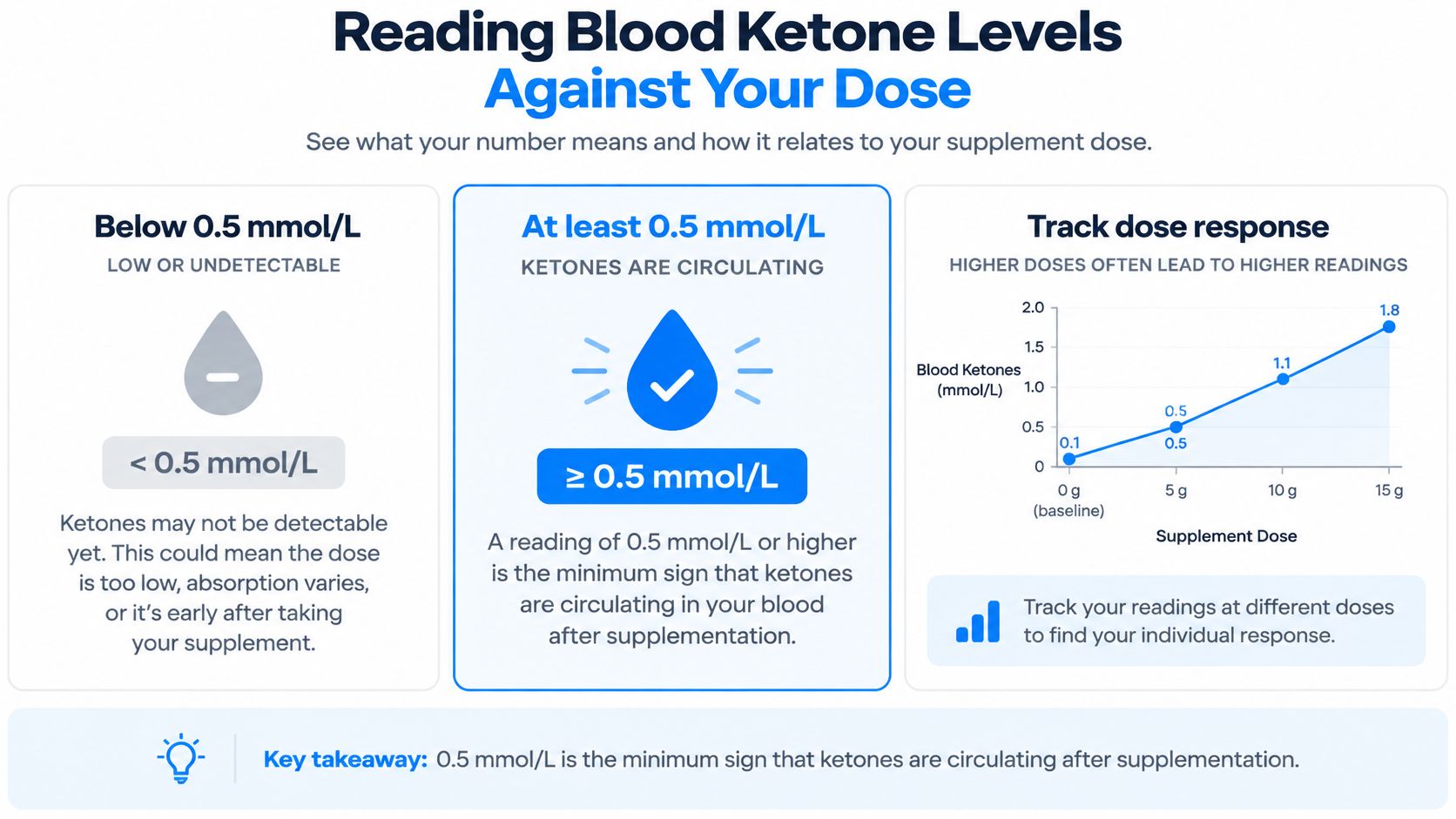
Make readings comparable
Use a blood BHB meter according to its instructions, with clean, dry hands and compatible strips. Keep the interval after ingestion consistent, and record food, exercise, serving size, and symptoms.
An unexpectedly low reading isn't an automatic reason to redose. An unexpectedly high reading isn't an achievement to reproduce.
Interpretation rule: Use the number to check exposure, then make the decision using tolerance, health context, and the intended task.
Safety Limits, Side Effects and When to See a Clinician
Adverse events with exogenous ketones are generally mild, but nausea, bloating, and diarrhea become more relevant with larger amounts and some MCT-containing formulations. That doesn't make discomfort something to push through, or establish a universal maximum safe dose.
Short-term safety findings are reassuring only within their actual scope. A randomized trial in healthy adults supported tolerability of up to 25 g daily of a specific ketone ester over 28 days, without clinically meaningful changes in vital signs or laboratory measurements.
That result isn't blanket clearance for every formulation, every consumer, or indefinite daily use.
Stop and reassess
- Reduce or pause the serving if nausea, bloating, or diarrhea appears.
- Consider food if nausea occurs, recognizing that this changes the conditions of your dosing test.
- Avoid product stacking so you can identify which ingredient or serving caused symptoms.
- Hold frequency steady until repeated-use tolerance is clear.
- Seek medical guidance for persistent, severe, or unexplained symptoms rather than trying to correct them with a different ketone dose.
Our guide to exogenous ketone side effects provides additional symptom-monitoring context.
When self-dosing isn't appropriate
The healthy-adult evidence doesn't establish safety during pregnancy, or for people with diabetes, kidney disease, or medication use. Discuss supplementation with a clinician before use if any of these apply.
Parkinson's disease, Alzheimer's disease, dementia, and epilepsy are outside what these consumer dosing benchmarks establish. Any use in those settings requires medical supervision, not an adaptation of an athletic or focused-work routine.
Tecton Ketones products may be dietary supplements, and statements on our site haven't been evaluated by the FDA. Supplement information isn't evidence of authorization to diagnose, treat, cure, or prevent disease.
Medications or chronic conditions mean clinician first. Bring the full ingredient label and intended schedule, not just the word ketones.
Build Your Dosing Routine and Confirm the Next Step
A useful routine is one you can document and repeat. Write down the product form, ingredient grams, confirmed D-BHB equivalent if available, and the reason you're using it.
Application Framework
- Choose the formulation deliberately. Match the molecule to relevant human evidence rather than comparing front-label gram totals.
- Set the serving and schedule. Use the label's starting guidance and reserve weight-adjusted calculations for comparable formulations.
- Record the response. Note gastrointestinal comfort, perceived energy, and the quality of the session or work period.
- Log blood BHB if useful. Keep measurement conditions consistent rather than collecting isolated readings.
- Change one factor at a time. Keep dose, meal conditions, and timing otherwise stable so the result remains interpretable.
R3HBG raises blood ketones directly, independent of what has been eaten, and works alongside a normal diet. That describes access to exogenous fuel, not a promise that meal conditions never affect the measured response.
Judge a bioidentical ketone option by its label, tolerability, and your own observations, not by brand claims. Choose continue, adjust, or stop based on the full record, with a clinician check when symptoms persist or medications or chronic conditions are involved.
Tecton Ketones™ offers bioidentical R3HBG ketone nutrition with clearly stated ingredient amounts and practical suggested-use guidance. Visit Tecton Ketones™ to review the formulations and labels, then use a documented serving, timing, and tolerance routine to assess whether one fits your needs.


